
LES-207 · Lesson 10 of 12 · 20 min
Qualification standards and training records
▶ Video coming soon A video version of this lesson is on the way.
Ferris brings a thick binder to the tenth class and sets it on the table with a thud. It holds the requalification records for every officer in Port Ardent for 2026. Each officer has a single page: the date, the firearm's serial number, the course of fire, the scores, the result of the judgment scenarios, the written test, any remedial training and the signatures of the officer and the instructor. 'Lawyers read this binder,' she tells the class. 'So do review boards, the Bureau of Criminal Investigation, the chief and, every so often, a judge. When something goes wrong, the first question is often: was this officer trained and qualified? This binder is how we answer it.'
This lesson explains how police officers qualify to carry firearms, what qualification involves in general terms, how it is recorded, what happens when an officer does not pass, and why critics and researchers have pushed services to make qualification more realistic. It describes the structure and purpose of qualification, not the details of any service's course of fire, which instructors teach on the range.
The legal requirement
In Ohio, peace officers complete firearms training as part of the basic training academy approved by the Ohio Peace Officer Training Commission. After that, section 109.801 of the Revised Code requires them to complete an approved firearms requalification program every year. An officer who does not complete it may not carry a firearm while on duty. The program must be approved by the commission's executive director and must follow rules adopted by the Attorney General. Many agencies, including Port Ardent, require more than the state minimum, for example a second qualification each year or separate qualification for low light and for patrol rifles.
Qualification is a minimum, not a goal. It confirms that an officer can handle a firearm safely, knows the law and policy and can shoot to a basic standard under set conditions. It does not prove that an officer will perform well in a real incident. Ferris describes it as the floor below which nobody is allowed to carry a firearm for the public.
What qualification involves
Requalification at Port Ardent has four parts, done over one day. The pattern is common across services, though the details vary.
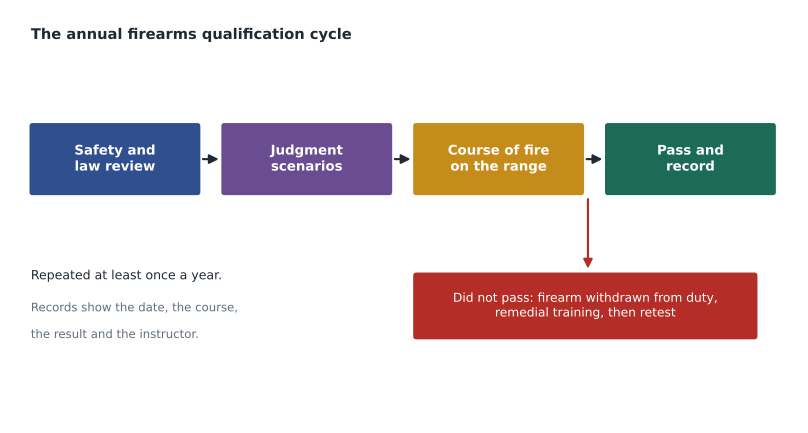
The first part is a review of the safety rules, the law of deadly force and the service's policies, followed by a written or oral test. Changes in the law, such as a new court decision, or in policy, such as a new rule about moving vehicles, are covered here. The second part is judgment training, using the range's simulator and live scenarios with role players, in which officers must decide whether to communicate, use another option or fire. Each scenario is debriefed, and an officer who makes a decision that would not have been justified repeats the training. The third part is the course of fire: a set series of shooting exercises on the range, at different distances and within time limits, scored against a minimum standard. The fourth part is the record: the instructor and the officer sign the page in the binder, and the service's training database is updated.
Officers who carry a patrol carbine or other long gun qualify separately on it, with its own course. Officers who use optics on their pistols qualify with them. Instructors also check each officer's equipment during qualification: the holster, magazines, ammunition and the firearm itself, which is inspected by an armorer if anything looks wrong.
| Part | Purpose | Typical record |
|---|---|---|
| Safety, law and policy review | Confirms the officer knows the rules and recent changes | Test result and date |
| Judgment scenarios | Tests decisions about whether and when to use a firearm | Scenarios completed, debrief notes, any repeats |
| Course of fire | Confirms safe handling and a minimum standard of accuracy | Scores for each stage, pass or fail |
| Equipment check | Confirms firearm, holster, magazines and ammunition are serviceable | Serial numbers and any items sent to the armorer |
| Remedial training, if needed | Fixes the problem before the officer carries again | What was done, by whom, and the retest result |
When an officer does not pass
Every year some officers do not pass on their first attempt. At Port Ardent, an officer who fails any part of requalification has their firearm withdrawn from duty that day and is assigned to duties that do not require one. The officer then completes remedial training with an instructor, who looks for the cause, which may be a skills problem, an equipment problem such as a poorly fitting grip, an eyesight change, an injury, or anxiety about shooting. The officer then retests. Ferris says that almost every officer who fails passes within a few weeks of remedial training, and that the few who cannot are referred for a fitness review.
Ferris says that failing is not shameful, but hiding a problem is. 'If you know you are struggling, come to the range before qualification,' she tells the class. 'Every instructor I have would rather spend an extra hour with you in November than withdraw your firearm in February.'
In 2026, Port Ardent requalified all 204 of its sworn officers between January 12 and March 27. One hundred and ninety-five passed every part on the first attempt. Nine needed remedial training, five for the course of fire, three for the written review and one for a judgment scenario. All nine passed their retests within thirty days. The fatigue scenario added after the clearing station incident was included for the first time, and Ferris recorded that two officers broke a safety rule during it, one by touching the trigger while holstering and one by unloading out of order. Both were corrected on the spot and repeated the scenario successfully.
| Measure | Result |
|---|---|
| Sworn officers requalified | 204 |
| Passed every part on the first attempt | 195 (about 95.6 in every 100) |
| Remedial: course of fire | 5 |
| Remedial: written review | 3 |
| Remedial: judgment scenario | 1 |
| Passed retest within thirty days | 9 of 9 |
| Safety rule broken in the fatigue scenario | 2, corrected on the spot |
The first-attempt rate is the number who passed divided by the number tested: 195 ÷ 204 is about 0.956, or 95.6 in every 100.
Ferris reads the remedial column before she reads the pass rate. A first-attempt rate in the mid-nineties tells the chief that the season went normally, but it says nothing about why the others struggled. If most remedial cases are for the course of fire, the range looks at coaching on fundamentals; if they cluster in the written review, the classroom material on law and policy needs work; and a single judgment failure is reviewed one to one, because it may reveal a decision-making problem that more shooting practice would not fix. She also compares the season with the last three, since one year's handful of failures can be chance, while the same weakness three years running is a pattern.
A summary like this is how a range master reports a season to the chief. The figures that matter most are not the first-attempt pass rate but the reasons for remedial training and how quickly officers returned to full duty. A rise in failures for one reason, such as the written review, suggests a training gap that the range should fix for everyone.
Making qualification realistic
For decades, many police qualification courses tested officers by having them stand still in good light and shoot at paper targets at known distances, often at the same time each year. Critics, including the authors of the 2008 RAND study of the New York City Police Department, pointed out that this tests a narrow skill under conditions very unlike real incidents, and that passing it does not show that an officer will make good decisions under stress. RAND recommended more scenario-based training, refusing to pass recruits until they demonstrated mastery, focusing requalification on proficiency rather than static scores and giving remedial training to officers with poor technique even when they passed.
Many services have since added judgment scenarios, low-light shooting, movement and stress to their qualification and training. There are limits. Realistic training takes time, instructors, ranges and money, and it must still be safe, which means that some realism will always be traded for control. Ferris says that her goal is for officers to leave the range having practiced not only hitting a target but deciding not to shoot. 'Half of my scenarios end with the right answer being to keep talking,' she says.
Why records matter
Training and qualification records are evidence. After a police shooting, investigators and prosecutors and review boards look at the officer's qualification history to see whether the officer was trained and current. In civil lawsuits, records can show whether a service met its obligation to train its officers. In City of Canton v. Harris (1989), the US Supreme Court held that a city can be liable under federal civil rights law for failing to train its officers when the failure amounts to deliberate indifference to the rights of the people the officers deal with. Agencies' training records are often central evidence in such cases, and in criminal cases prosecutors must disclose information that may help the defense.
Records also protect officers. An officer who was trained, qualified and current, and who acted consistently with that training, can point to the records as evidence of good faith and professionalism. Ferris says that she treats the binder with the same care as any evidence: entries are made at the time, in ink, signed and never altered without a dated note explaining the change. Records are kept for the period set by the agency's retention schedule and state records law, and longer if they relate to an incident under investigation.
At Kettle Creek Road, investigators requested Okeke's records within hours. They showed that he had requalified on February 3, 2026, passing every part on the first attempt, that his firearm had been inspected by the armorer in April, and that he had completed scenario training that included a person armed with a long gun at distance. The records did not decide anything about the shooting, but they established that Okeke was qualified and current, which allowed investigators to focus on his decisions on the night.
Who trains the trainers
Firearms instructors are themselves trained and certified. In Ohio, firearms instructors for peace officers must be certified through programs approved by the Ohio Peace Officer Training Commission and must keep their certification current. Instructors learn how to run a safe range, how to teach the fundamentals, how to diagnose and correct problems, how to design and debrief scenarios and how to keep accurate records. Ferris says that the most important skill an instructor learns is calm correction. 'Shouting at someone holding a loaded firearm is the worst thing you can do,' she says. 'A good instructor can stop an unsafe action with one quiet word.'
Instructors are also reviewed. At Port Ardent, Ferris observes each instructor running the line at least twice a year, and instructors review each other's scenario debriefs. Records of instructor training and observations are kept alongside the officers' qualification records, because a qualification is only as reliable as the person who signed it.
Desjardins points out that this chain of certification is what allows a court or oversight body to rely on a training record. When a record says that an officer passed, it means that a certified instructor, following an approved course, watched the officer do it and signed the page at the time.
Worked problem
Responding to a failed qualification
A twelve-year officer fails the course of fire for the first time in her career. Her scores have dropped steadily for three years, and she mentions that her eyes have been tired at night. What should the range master do?
Show solution
- Withdraw her firearm from duty that day, as policy requires, and explain why without blame.
- Look at her records for patterns, such as which stages she failed and how her scores have changed.
- Ask about equipment, health and vision, since an eyesight change is a common and fixable cause.
- Suggest an eye examination and consider whether an optic sight, if approved by the service, would help.
- Provide remedial training, retest and record every step.
Answer: The decline and her comment point to a likely vision change. The range master's job is to find and fix the cause, not just to retest, and to document everything so the record shows how the problem was resolved.
Common mistakes
MistakePassing qualification proves an officer will perform well in a real incident.
InsteadQualification is a minimum; it does not reproduce the stress and uncertainty of real incidents.
MistakeAn officer who fails qualification may carry a firearm until the retest.
InsteadThe firearm is withdrawn from duty until the officer passes.
MistakeQualification is only about shooting scores.
InsteadIt also covers safety, law, policy, judgment and equipment.
MistakeTraining records are internal paperwork.
InsteadThey are evidence in investigations, lawsuits and criminal cases, and they must be accurate and complete.
Summary and key terms
- Ohio's section 109.801 requires annual requalification; officers who do not complete it may not carry on duty.
- Qualification typically combines a safety and law review, judgment scenarios, a course of fire and an equipment check.
- Officers who fail have their firearms withdrawn until remedial training and a retest.
- Static qualification has been criticized; services increasingly add scenarios, stress and decisions not to shoot.
- Records are evidence for investigators, courts and the officer, and must be made carefully at the time.
- Qualification is the floor, not the goal.
- City of Canton v. Harris
- The 1989 case holding that cities can be liable for failure to train that amounts to deliberate indifference.
- Ohio Peace Officer Training Commission
- The body that approves basic training and firearms requalification programs in Ohio.
- Requalification
- The periodic process by which an officer shows they may continue to carry a firearm.
- Course of fire
- A set series of scored shooting exercises on the range.
- Remedial training
- Extra training to fix a problem found during qualification.
- Retention schedule
- The rules for how long records must be kept.
Practice problems
Work each problem on paper first, then reveal the answer to check.
What happens to an officer's firearm if they fail requalification?
Show answer
It is withdrawn from duty until they complete remedial training and pass a retest.
What were RAND's main criticisms of static qualification?
Show answer
It tests a narrow skill under unrealistic conditions and does not show how an officer will decide or perform under stress.
Why did investigators request Okeke's records?
Show answer
To establish whether he was trained, qualified and current.
Name the four parts of Port Ardent's requalification.
Show answer
Safety, law and policy review; judgment scenarios; course of fire; and the signed record, with an equipment check.
Lesson quiz · 5 questions
Score 60% or more to complete this lesson.
Create a free account to save your progress, take quizzes and earn a certificate.