
LES-207 · Lesson 3 of 12 · 20 min
Safe handling, clearing and proving a firearm safe
▶ Video coming soon A video version of this lesson is on the way.
The third class meets in the equipment room at the station, beside the clearing station where Brandon Pell's pistol fired in March 2025. Ferris has asked the students to look at it before they sit down. It is a steel cylinder about the height of a kitchen bin, angled toward the floor and filled with a dense material designed to capture a bullet. A laminated sign hangs above it. A small hole near the top of the lining, now patched, is the only sign of what happened. 'That hole is the most expensive training aid in this building,' Ferris says. 'It cost an officer his pride, a lot of paperwork and a few nights of sleep. It cost nobody their life, because the station was designed for the day someone would make a mistake.'
This lesson is about the moments when firearms are most often handled and least often used: loading and unloading at the start and end of a shift, handing a firearm to an armorer or another officer, securing a firearm found during a search, and cleaning. Most unintended discharges in police services happen during these routine moments, not in confrontations. The lesson describes the principles of safe handling and the general steps that public safety courses teach for proving a firearm safe. It does not teach anyone to operate a particular firearm. That happens on the range, with the service's own firearms and instructors.
Why routine handling is dangerous
Routine handling combines the conditions in which people make mistakes: repetition, distraction, fatigue and confidence. An officer who has unloaded a duty pistol two thousand times can do it without thinking, which is useful until the day something is different. The magazine is not seated properly, the officer is talking, a colleague is waiting, the shift has run long. Studies of errors in many fields find the same thing: experienced people make fewer mistakes overall, but the mistakes they do make often happen during tasks they have done so often that they have stopped paying attention.
That is why police services surround routine handling with rules that seem fussy to new recruits. Load and unload only at a designated clearing station. Do it one officer at a time. Do not talk while doing it. Point the muzzle into the clearing barrel throughout. Check the firearm by looking and by feeling, not just by remembering. Never hand a firearm to someone else without showing them it is unloaded and having them check it too. Each rule adds a small layer of protection.
Proving a firearm safe
Hunter education and firearms safety courses in the United States teach a similar check for making sure a firearm is unloaded: point it in a safe direction, remove all ammunition, look into the chamber, check the feeding path, and check that the barrel is clear. Some Canadian courses teach the same steps with the memory aid PROVE. Police training uses the same idea, adapted to the service's own firearms. The order matters. The muzzle goes in a safe direction first, so that if anything goes wrong during the check, nobody is hurt. The ammunition source is removed before the chamber is checked, so that the chamber cannot be refilled by accident. Then the shooter looks, and in many courses also feels, to confirm that nothing remains.
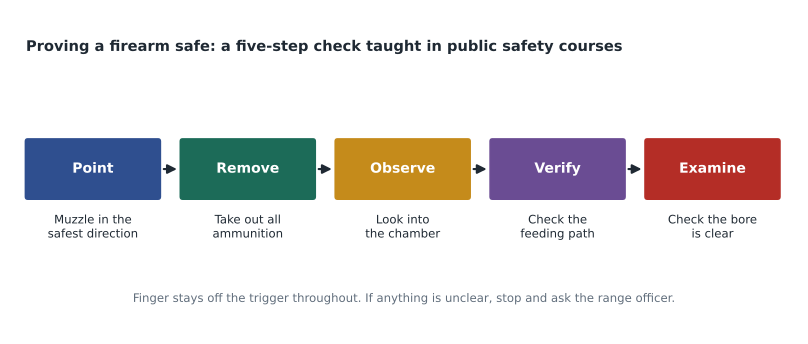
Two points about the check are emphasized in every course. First, the check is visual and physical. It is easy to glance at a chamber in poor light and see what you expect to see, so instructors ask officers to look carefully and, where the design allows, to confirm by touch. Second, the person receiving a firearm checks it again, even if they just watched it being checked. 'Two checks by two people is not an insult,' Ferris says. 'It is the system working.'
Ferris returns to the clearing station incident. Pell's mistake was in the order. He removed the magazine, which is the main ammunition source, but he had not yet cleared and checked the chamber, and his finger was inside the trigger guard while he was handling the pistol. In that moment, the firearm still held a round. 'He did a step from memory and skipped the part where you look,' she says. 'That is the most common pattern I see.'
Handing over a firearm
Police officers hand firearms to others more often than the public might think: to an armorer for inspection, to an evidence technician, to a range instructor, to a supervisor after a shooting. Every service sets out how this must be done. The general principles are the same everywhere. The firearm is made safe and proven unloaded before it is handed over, unless the circumstances make that unsafe or an evidence rule says otherwise. The muzzle stays in a safe direction during the transfer. Where the design allows, the action is left open so the receiver can see that it is empty. The person receiving it checks it again before doing anything else. The transfer is recorded when the firearm is changing custody, so that the service always knows who is responsible for it.
Agencies in Ohio, like those across the United States, keep inventory records of every firearm they issue, and many use sign-out logs or electronic tracking for long guns and spare firearms. These records matter. A service that cannot account for a firearm has a serious problem, and the first question in any firearms incident is whose weapon it was.
Firearms found or seized by police
Officers regularly come across firearms they did not issue: a handgun found during a search, a rifle surrendered by a family worried about a relative, a firearm left at the scene of a crime. These firearms are evidence, property or both, and they present special risks. Nobody knows how they have been stored, whether they are loaded, whether they have been modified or whether they work properly.
Services treat found firearms with extra caution. In general, the first officer secures the firearm where it is, keeps everyone away from the muzzle and does not handle it unless necessary to make the scene safe. Where possible, the firearm is photographed in place before it is touched, because its position and condition may be evidence. A trained officer or technician then makes it safe and proves it unloaded, documenting what was found. The firearm is packaged in a way that shows it is unloaded, such as with the action open and a cable tie through it, and it is labeled and logged. Some services require an officer with specific training, or a forensic firearms technician, to unload firearms of unfamiliar types. 'If you do not know how a firearm works,' Ferris says, 'the right thing is to leave it pointed somewhere safe, keep people away from it and call someone who does.'
| Situation | Main risk | General principle |
|---|---|---|
| Loading and unloading at shift change | Routine, distraction, fatigue | Clearing station only, one at a time, no talking, check by sight and touch |
| Handing a firearm to an armorer or instructor | Assuming the other person checked | Show it unloaded, action open if possible; receiver checks again; record the transfer |
| Firearm found during a search | Unknown condition, possible evidence | Secure in place, photograph, keep people clear, have a trained officer make it safe |
| Cleaning a duty firearm | Ammunition nearby, firearm thought unloaded | Prove unloaded, keep all ammunition out of the room, follow the armorer's procedure |
| Firearm surrendered by a family | Unknown storage, emotional situation | Take it at the scene with care, make safe, document and give a receipt |
What changed after the clearing station incident
Ferris led the review of the March 2025 incident. She interviewed Pell, the officer he was talking to and the sergeant on duty, and looked at the shift schedule. The review found that Pell had broken two safety rules, that he had reported the discharge immediately and honestly, and that the circumstances, a thirteen-hour shift ending after a fatal collision and a conversation at the clearing station, had made the mistake more likely.
The department required Pell to complete remedial firearms training with Ferris before he carried a firearm again, which took nine days. The professional standards unit found a policy violation, and Pell received a written reprimand. He has had no further incidents. Pell agreed to let the service use the incident, with his name, in training, and he spoke to the 2025 recruit class about it.
The service also changed its procedures. A sign above the clearing station now lists the steps in order. Only one officer may use the clearing station at a time, and the officer at the station does not talk to anyone until finished. Supervisors were reminded to watch for officers ending long shifts and to make sure they were not rushing. The range added a fatigue scenario to the annual requalification, in which officers unload and prove their firearms safe at the end of a long, distracting exercise. 'None of these changes is clever,' Ferris says. 'They just make it a little harder to do the dangerous thing without noticing.'
Jesse Morningstar asks whether Pell should have been punished more harshly. Desjardins says that the question goes to the heart of a safety culture. If the service had fired Pell, other officers might hide their own near misses. If it had done nothing, it would have sent the message that safety rules do not matter. A written reprimand, remedial training and a change to the system was, in the service's judgment, the balance between accountability and learning. 'Reasonable people could disagree about the exact sanction,' Desjardins says. 'What matters is that the service treated it as both a personal failure and a system failure, and fixed both.'
| Officer | Start (minute) | End (minute) | Proof check recorded | Finding |
|---|---|---|---|---|
| A. Kim | 0 | 2 | Yes | In order |
| R. Doucet | 3 | 5 | Yes | Station shared with S. Patel from minute 4 to 5 |
| S. Patel | 4 | 6 | No | No proof check recorded; overlapped with R. Doucet |
| M. Cruz | 8 | 10 | Yes | In order |
The supervisor's check is simple. First, read down the proof check column and flag any unloading without one. Second, compare each officer's start and end times with everyone else's: two uses overlap when each one starts before the other ends. Doucet used the station from minute 3 to 5 and Patel from minute 4 to 5 overlapped it, which breaks the one-officer rule, and Patel's missing proof check is the second flag.
The log is invented, but the idea is real. Some services use simple records like this, kept by supervisors or built into an equipment-room system, to make sure routine handling rules are followed and to spot patterns before they cause an incident.
Cleaning and maintenance
Cleaning a firearm is another routine moment when people are relaxed and attention drifts. Many unintended discharges outside police work happen while someone is cleaning a firearm they believed was unloaded. The general rules are simple: prove the firearm unloaded first, remove all ammunition from the room where the cleaning is done, follow the service's or manufacturer's procedure and keep the muzzle in a safe direction even while cleaning. Police services usually limit what officers may do themselves to routine cleaning and inspection; anything more is done by a certified armorer. Lesson 7 returns to maintenance.
Worked problem
Applying the principles at a scene
Officers executing a search warrant find a shotgun propped behind a bedroom door. The homeowner says it is not loaded. A new officer wants to pick it up and unload it to make the room safe. What should happen?
Show solution
- Treat the shotgun as loaded, whatever the homeowner says.
- Keep everyone away from the muzzle and do not handle it unless it presents an immediate risk.
- Photograph it in place, because its location and condition may be evidence.
- Have an officer trained on that type of firearm make it safe and prove it unloaded, documenting what was found.
- Package, label and log it so the record shows it was unloaded and who handled it.
Answer: The new officer should not handle an unfamiliar firearm. The scene is made safe by keeping people clear, and a trained officer makes the firearm safe after it has been documented.
Common mistakes
MistakeIf someone tells you a firearm is unloaded, you can rely on it.
InsteadTreat it as loaded and prove it unloaded yourself, even if you watched them check it.
MistakeRemoving the magazine makes a pistol unloaded.
InsteadA round can remain in the chamber; the chamber must be cleared and checked as well.
MistakeAny officer should unload any firearm found at a scene to make it safe.
InsteadUnfamiliar firearms should be secured in place and made safe by a trained officer after being documented.
MistakeThe clearing station is a formality.
InsteadIt exists for the day someone makes a mistake, and it turned the March 2025 discharge into a near miss.
Summary and key terms
- Most unintended discharges happen during routine handling, not confrontations.
- Repetition, distraction, fatigue and confidence make routine handling risky.
- Proving a firearm safe means pointing it safely, removing the ammunition source, then checking the chamber, feeding path and bore by sight and touch.
- Every handover is checked again by the receiver and recorded when custody changes.
- Found firearms are secured in place, documented, and made safe by trained officers.
- After the clearing station incident, the service combined individual accountability with system changes.
- Clearing station
- A designated place, with a clearing barrel, where firearms are loaded and unloaded.
- Proving safe
- Checking by sight and touch that a firearm contains no ammunition.
- Chamber
- The part of a firearm that holds the cartridge ready to fire.
- Feeding path
- The route by which ammunition moves from the magazine into the chamber.
- Bore
- The inside of the barrel.
- Armorer
- A person certified to inspect, maintain and repair a service's firearms.
Practice problems
Work each problem on paper first, then reveal the answer to check.
Why does the ammunition source come out before the chamber is checked?
Show answer
So the chamber cannot be refilled during the check.
What was the order mistake in the clearing station incident?
Show answer
The magazine was removed but the chamber had not been cleared and checked, and his finger was in the trigger guard.
Why should a found firearm be photographed before it is unloaded?
Show answer
Its position and condition may be evidence.
Name two system changes the service made after March 2025.
Show answer
A step-by-step sign, one officer at a time with no talking, supervisor attention to fatigue, and a fatigue scenario in requalification.
Lesson quiz · 5 questions
Score 60% or more to complete this lesson.
Create a free account to save your progress, take quizzes and earn a certificate.