
LES-207 · Lesson 5 of 12 · 20 min
Police firearms, holsters and equipment: an overview
▶ Video coming soon A video version of this lesson is on the way.
For the fifth class, Ferris brings a plastic crate to the classroom. Inside are a solid blue plastic pistol, the same size and shape as the service's duty pistol but unable to fire anything; a duty holster on a belt; an empty magazine with a red plastic block in it; a set of range glasses; a pair of electronic earmuffs; and a printed page from the service's firearms inventory. Instructors call the blue pistol a training replica. It is used in classrooms and in scenario training because it lets officers practice holding and moving with a firearm without any risk of a discharge. 'This is as close as you will get to a firearm in this course,' Ferris says, 'and even this one you will treat as loaded.' She hands it to Priya Sandhu, who checks its muzzle direction before she does anything else. Ferris nods.
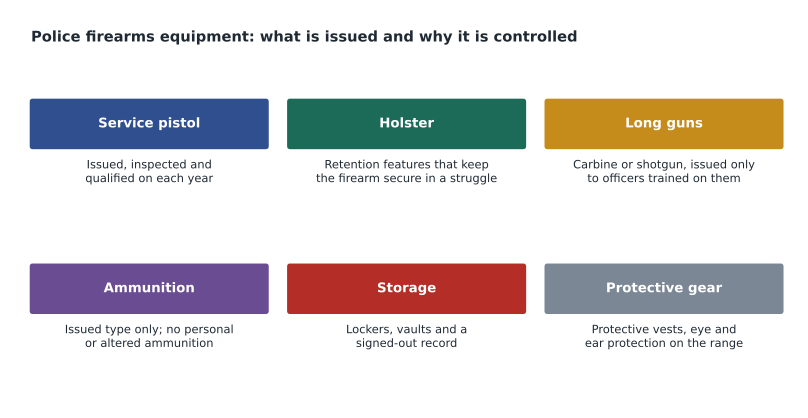
This lesson is an overview of the firearms and equipment that police services issue, what each is for and why each is tightly controlled. It does not describe how to operate any firearm or how to use it in a confrontation. Its purpose is to explain the choices services make and the rules that come with them, so that a new officer understands why the equipment is what it is and why personal preferences rarely count.
The service pistol
Almost every police officer in Canada and the United States who carries a firearm carries a semi-automatic pistol as the primary duty weapon. Services choose one model, or a small number of models, and issue it to every officer. Using a single model means that every officer is trained on the same controls, that instructors and armorers can support it efficiently and that spare parts and magazines are interchangeable. It also means that an officer who picks up a colleague's firearm in an emergency knows how it works.
In Ohio, as in most states, there is no statewide list of approved duty pistols; each agency chooses its duty firearm, often through a formal evaluation, and sets its own specifications in policy. Services typically evaluate reliability, safety features, how well the pistol fits a wide range of hand sizes, how easy it is to inspect and maintain and the support offered by the manufacturer. Many services have recently added small electronic sights, called optics, to their pistols, after research and field experience suggested they can help officers see their target and their sights more clearly under stress. Ferris says that the change took her range two years, because every officer had to be retrained and requalified.
The pistol belongs to the service. Its serial number is recorded against the officer who carries it, and it is inspected by an armorer on a regular schedule and whenever there is a problem. Officers are not allowed to modify it in any way, to change its parts, to fit accessories that have not been approved or to replace it with a personal firearm. 'If something is wrong with your firearm, you bring it to the armorer,' Ferris says. 'You do not fix it at your kitchen table.'
Long guns
Many services also issue long guns: patrol rifles, often called carbines, and in some services shotguns. A long gun is easier to shoot accurately at longer distances than a pistol, and it gives officers an option in rare situations where a person is armed with a rifle or is a long distance away. In the United States, patrol rifles became common in the decades after several incidents in which officers armed only with pistols were outmatched, including the 1997 North Hollywood bank robbery in Los Angeles. Today many agencies issue rifles to patrol officers or keep them in locked racks in patrol cars.
Long guns come with extra rules. Only officers who have completed the specific course for that firearm and who qualify on it each year may carry it. In patrol cars, long guns are stored in locked racks or cases, usually unloaded or in a defined condition set by policy, and they are signed out at the start of each shift. Services also set rules about when a long gun may be taken out of the car. Ferris says that the decision to deploy a long gun is reviewed as carefully as the decision to draw a pistol. 'A rifle is not a bigger pistol,' she says. 'It is more accurate and more powerful, and its bullets travel further. Rule 4, knowing what is beyond your target, becomes even more important.'
Holsters and retention
A police holster has two jobs that pull in opposite directions. It must let the officer draw the firearm when it is needed, and it must keep anyone else from taking it. Officers work close to people all day, often in struggles, and a firearm taken from an officer can be used against the officer or the public. Studies of officers killed in the line of duty in both countries include cases in which officers were shot with their own firearms after a struggle.
Duty holsters therefore have retention features, mechanisms that hold the firearm in place until the officer releases them in a particular way. Holsters are often described by retention levels, based on how many separate features must be released. Services choose holsters that balance retention and access, train officers on their holster until releasing it is automatic, and require the same model across the service. Officers are taught to protect their firearm in close contact and to keep the holster side of the body away from people when they can. The details are taught by instructors with the service's own holsters. 'Your holster is part of your firearm,' Ferris says. 'A worn or loose holster gets reported and replaced the same day.'
Holsters also play a role in safety. Many unintended discharges happen while an officer is putting a firearm back into the holster, when a finger, a piece of clothing or a strap gets into the trigger guard. That is why officers are taught to holster slowly and deliberately, with the finger straight along the frame, and to look at the holster if they need to. 'There is no prize for holstering fast,' Ferris says.
Ammunition
Officers carry only the ammunition their service issues. Services choose duty ammunition after testing, and one goal of that choice is to reduce the chance that a bullet will pass through a person or a wall and strike someone else, which supports the fourth safety rule. Personal, reloaded or altered ammunition is forbidden, both because it may not perform as tested and because it could malfunction. Training ammunition may be different from duty ammunition, and many services now use lead-free training ammunition to reduce exposure on the range.
Ammunition is counted like any other controlled item. Officers are issued a set number of rounds and magazines and must account for them. A lost magazine is reported. After any discharge outside training, the rounds remaining in each magazine are counted, because the count helps investigators establish how many shots were fired.
Protective and support equipment
Firearms equipment also includes the gear that protects officers and others. Soft body armor, usually worn under or over the uniform shirt, is designed to stop common handgun rounds and is certified to a recognized standard, such as the one set by the US National Institute of Justice, which many Canadian services also use. Armor has a service life and is replaced when it expires or is damaged. Range equipment includes impact-rated eye protection and hearing protection, and many services issue electronic earmuffs that block loud noise while letting officers hear commands. Weapon-mounted lights help officers identify what they are looking at in the dark, which supports the fourth rule, though policies limit when a weapon-mounted light may be used to search, because doing so points the firearm at whatever the light falls on.
Body-worn cameras are not firearms equipment, but they matter to firearms accountability. In many services, camera activation is required whenever an officer draws a firearm, and some services are testing holster sensors that start nearby cameras automatically when a firearm is drawn. The Kettle Creek Road incident, studied later in the course, shows why activation timing matters.
Carrying off duty
In the United States, many agencies allow, and some require, officers to carry a firearm off duty, and the federal Law Enforcement Officers Safety Act of 2004 allows qualified active and retired officers to carry a concealed firearm in most places across the country, subject to conditions such as annual qualification. Agency policy sets the rules about which firearm may be carried off duty, how it must be stored at home, and when off-duty officers should and should not take police action. Lesson 7 covers storage in more detail.
Inventory and accountability
Every firearm a service owns is listed in an inventory with its serial number, model, assigned officer or storage location and service history. Services audit the inventory regularly by physically checking each firearm against the list. Ferris shows the class the page she brought: an extract from the 2026 audit, with names removed, showing each firearm's serial number, the officer or locker it was assigned to, the date of its last armorer inspection and a column for the auditor's check.
| Serial | Recorded at | Found at | Action |
|---|---|---|---|
| PA-1043 | Locker 12 | Locker 12 | None |
| PA-1044 | Officer B | Officer B | None |
| PA-1051 | Repair shop | Not found | Report immediately |
| PA-1060 | Officer D | Locker 3 | Update the record and explain |
| CB-0207 | Car 6 rack | Car 6 rack | None |
Four of the five firearms are accounted for. The auditor works line by line: a serial number with no physical match is reported at once, and a firearm found somewhere other than its record shows still needs a written explanation, even though it is safe.
In the invented audit, one pistol recorded as being with the armorer was not physically found at the time of the check, and another was in a different place from the record. Both need explanation. In a real service, a firearm that cannot be found is treated as a serious incident until it is located, because a missing police firearm may be in the wrong hands.
Who decides what is issued
Equipment decisions are made by the service, not by individual officers, and they follow a process. A committee that usually includes the range master, armorers, front-line officers and a manager reviews a proposed change, such as a new pistol model, a new holster or the addition of optics. Officers test samples on the range, the service checks how the change would affect training, inspection and cost, and the decision is written into policy. Ferris says the process is slow on purpose. 'A change that looks small, like a new holster, changes how every officer draws and holsters,' she says. 'If we get it wrong, we have built a new habit of unsafe handling into the whole service.'
New equipment also brings new training. When Port Ardent added optics to its pistols, every officer completed a transition course on the range before carrying the new configuration on duty, and the requalification course was rewritten. Officers who had shot well with traditional sights for twenty years sometimes struggled at first, and instructors gave them extra range time. The same principle applies to every change: no officer carries new equipment on duty until they have been trained and have qualified with it.
Ferris adds that equipment problems are reported, not tolerated. A holster that has loosened, a magazine that sometimes fails to feed, a light whose switch is unreliable or body armor that no longer fits are all reported to the armorer or the equipment officer the same day. 'Officers are good at working around problems,' she says. 'On the range and on the street, a workaround is often the start of an incident.'
Worked problem
Choosing equipment
An officer asks the range master for permission to carry a personal pistol on duty because she finds it more comfortable and shoots it better than the service pistol. She has a valid state permit for it. What should the range master consider?
Show solution
- The service has chosen one model so that training, inspection, parts and support are consistent.
- A personal firearm has not been tested or approved by the service and is not covered by its armorer program.
- Holsters, magazines and ammunition would not match the service's equipment.
- If comfort is a real problem, the service may be able to offer a different grip size or fit within its approved options.
- Any change must follow policy, not a personal arrangement.
Answer: The answer under most policies is no, but the range master should take the comfort problem seriously and look at approved options, such as adjustable grips, that fit the officer better.
Common mistakes
MistakeOfficers may modify their duty pistol if the change is minor.
InsteadDuty firearms may not be modified; only the service's armorer may service or change them, within approved options.
MistakeA long gun is just a bigger pistol.
InsteadLong guns are more accurate and powerful and their bullets travel further; they require specific training and qualification.
MistakeHolstering quickly shows skill.
InsteadHolstering slowly and deliberately, with the finger straight, prevents unintended discharges.
MistakePersonal ammunition is fine if it is the right size.
InsteadOnly issued ammunition may be carried, because personal or altered ammunition has not been tested and may malfunction.
Summary and key terms
- Services issue one model of semi-automatic pistol so training, inspection and support are consistent.
- Long guns are issued only to officers trained and qualified on them, and are stored and deployed under strict rules.
- Duty holsters balance access with retention to prevent a firearm being taken in a struggle.
- Only issued ammunition is carried, and every round and magazine is accounted for.
- Body armor, eye and ear protection, lights and cameras are part of firearms safety and accountability.
- Many US agencies allow off-duty carry, and federal law allows qualified officers to carry concealed across most of the country.
- Law Enforcement Officers Safety Act
- The 2004 federal law allowing qualified officers to carry a concealed firearm across most of the country.
- Training replica
- An inert copy of a firearm used in classrooms and scenarios, which cannot fire.
- Retention holster
- A holster with features that hold the firearm until the officer releases them.
- Patrol carbine
- A rifle issued to patrol officers who are trained and qualified on it.
- Optic
- A small electronic sight mounted on a firearm.
- Firearms inventory
- The service's record of every firearm, its serial number, location and history.
Practice problems
Work each problem on paper first, then reveal the answer to check.
Why do services issue a single pistol model?
Show answer
So that training, inspection, parts and support are consistent and every officer knows how the firearm works.
What are the two jobs of a duty holster?
Show answer
To let the officer draw when needed and to stop anyone else taking the firearm.
Why are magazines counted after a discharge?
Show answer
The count helps establish how many shots were fired.
What happens if an audit cannot find a service firearm?
Show answer
It is treated as a serious incident until it is located.
Lesson quiz · 5 questions
Score 60% or more to complete this lesson.
Create a free account to save your progress, take quizzes and earn a certificate.