
LES-105 · Lesson 9 of 12 · 20 min
Bias, fairness and equal treatment
▶ Video coming soon A video version of this lesson is on the way.
Linh has been quiet in most discussions, but this class is the one she has been waiting for. She tells the group about her cousin Bao, who was stopped four times in a year while walking home from his job at a restaurant, always at night, never charged with anything. Each officer was polite enough. Each asked where he was going and checked his identification. Bao now takes a longer route home. Marco asks whether the officers might have had reasons, since the area has had break-ins. Linh says that is what everyone says, and that nobody ever told Bao what the reason was. Desjardins says that both of them have just described the central difficulty of this lesson: individual decisions can each seem reasonable while the pattern they form is unfair, and the people on the receiving end experience the pattern, not the individual reasons.
What bias is
Bias in policing means treating people differently, for the worse or the better, because of their membership in a group rather than their individual conduct. It can be explicit, meaning conscious attitudes and beliefs, or implicit, meaning automatic associations that influence perception and judgment without the person being aware of them. Explicit bias among officers is less common than it once was and is grounds for dismissal in most services, though it has not disappeared, as investigations of officers' private messages in several services have shown. Implicit bias is far more widespread because it affects nearly everyone. Research using reaction-time tests and simulation studies has found that people, including officers, more quickly associate certain groups with threat or crime, and that such associations can influence split-second decisions.
Implicit bias is not a moral failing in itself; it is a feature of how human minds learn from culture and experience. The ethical duty is to recognize that it exists and to counteract it. Training alone has limited effect: a large randomized study of implicit bias training in the New York City Police Department, published in 2020, found that officers' knowledge improved but there was no clear change in the racial patterns of their enforcement. Structural measures, such as clear policies about when stops are allowed, supervision, data review and slowing down decisions where possible, appear to matter more.
Racial profiling
Racial profiling is the use of race or ethnicity, rather than individual behavior, as a basis for suspicion. It violates the Equal Protection Clause and federal and state civil rights laws. Courts have made challenges difficult in some respects: in Whren v. United States (1996), the Supreme Court held that a traffic stop supported by probable cause of a violation is valid under the Fourth Amendment regardless of the officer's actual motive, which means pretext stops are generally lawful even if race influenced the choice of whom to stop. But in Floyd v. City of New York (2013), a federal court found that the New York Police Department's stop-and-frisk practices had been carried out in a racially discriminatory way and ordered reforms, including a federal monitor.
Stop-and-frisk practices in several American cities, in which officers stopped and patted down large numbers of pedestrians, were found to produce weapons or contraband in only a small share of stops and to fall heavily on Black and Hispanic residents. Many states, including Ohio, now encourage or require agencies to collect data on traffic stops, and many agencies have adopted bias-free policing policies that prohibit relying on race or ethnicity except as part of a specific suspect description.
Measuring fairness with data
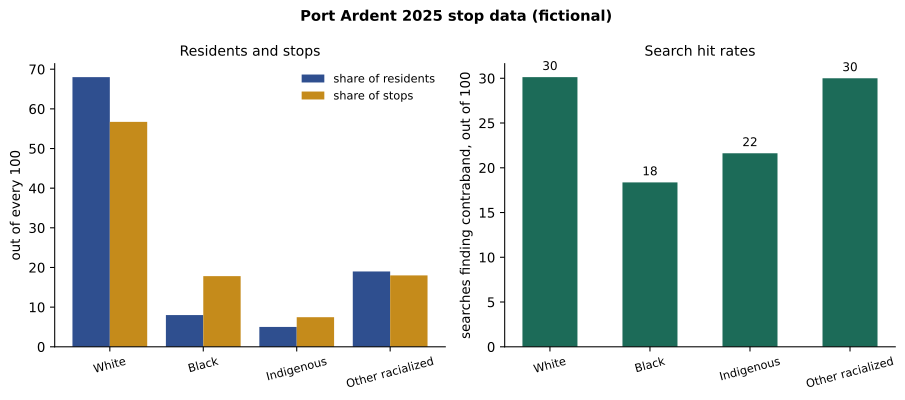
Because individual decisions are hard to judge, fairness is often assessed using patterns in data. The simplest approach compares each group's share of stops with its share of the population. Port Ardent's 2025 data, shown in the code below, use fictional figures for a city of 98,000. If a group makes up 8 out of every 100 residents but 18 out of every 100 stops, its stop rate is more than twice what its population share would predict. The ratio is called a disparity index. Population comparisons have a known weakness, called the benchmark problem: the population that lives in a city is not the same as the population that drives or walks in the places officers patrol. People who commute in, tourists and differences in driving patterns can all distort the comparison.
Researchers have developed better tests. The outcome test, also called the hit-rate test, compares how often searches of each group find contraband. If officers search one group with a lower threshold of suspicion, searches of that group will find contraband less often. The code calculates both measures. A group that is stopped and searched more often but found with contraband less often is a strong sign that officers are using a lower standard for that group. Another approach, the veil of darkness test developed by Jeffrey Grogger and Greg Ridgeway, compares stops made in daylight with stops made after dark, when officers are less able to see a driver's race before deciding to stop.
# Port Ardent 2025 (fictional): population share, stops, searches and searches finding contraband
groups = {
    "White":                 {"pop": 0.68, "stops": 3120, "searches": 156, "hits": 47},
    "Black":                 {"pop": 0.08, "stops": 980,  "searches": 98,  "hits": 18},
    "Indigenous":            {"pop": 0.05, "stops": 410,  "searches": 37,  "hits": 8},
    "Other racialized":      {"pop": 0.19, "stops": 990,  "searches": 50,  "hits": 15},
}
total_stops = sum(g["stops"] for g in groups.values())
print("group               pop  stop share  disparity  search rate  hit rate")
for name, g in groups.items():
    share = g["stops"] / total_stops
    disparity = share / g["pop"]
    search_rate = g["searches"] / g["stops"]
    hit_rate = g["hits"] / g["searches"]
print(f"{name:18s} {g['pop']:.2f} {share:10.2f} {disparity:9.2f} {search_rate:11.3f} {hit_rate:8.2f}")group pop stop share disparity search rate hit rate White 0.68 0.57 0.83 0.050 0.30 Black 0.08 0.18 2.23 0.100 0.18 Indigenous 0.05 0.07 1.49 0.090 0.22 Other racialized 0.19 0.18 0.95 0.051 0.30
The output shows that Black residents are stopped at about 2.2 times their population share, Indigenous residents at about 1.5 times, and both are searched at twice the rate of white residents after being stopped. Yet searches of Black and Indigenous people find contraband less often, about 18 and 22 times out of 100, compared with 30 for white drivers. That combination is what the outcome test looks for: it suggests officers are searching Black and Indigenous people on weaker grounds. The data cannot say why, and they cannot prove that any individual officer is biased. But they identify a pattern the service must explain and address, and they turn Linh's family's experience from an anecdote into evidence.
Beyond race
Bias affects many groups besides racialized communities. People with mental illness or developmental disabilities may be perceived as threatening because of unusual behavior, and they are overrepresented among people injured or killed in police encounters. People who are homeless are more visible to police and more likely to be stopped, ticketed and moved along for conduct that would be ignored in a private home. LGBTQ people, especially transgender people, have reported disrespectful treatment and a reluctance to report victimization. People who do not speak English fluently may be misunderstood or treated as uncooperative. Women reporting sexual violence have historically faced skepticism, which is why services now train officers in trauma-informed responses. Fair treatment means paying attention to all of these patterns.
Fairness inside the service
Bias is not only a matter of how police treat the public. It also shapes how services treat their own members, and the two are connected: a service that tolerates discrimination against its own officers is unlikely to treat the public fairly. American agencies have faced numerous lawsuits and federal investigations involving discrimination and harassment against women, racialized officers and LGBTQ officers, and studies have found that women remain a small minority of sworn officers and a smaller share of leaders. The 30x30 Initiative, launched in 2021, encourages agencies to raise women to 30 out of every 100 recruits by 2030.
Desjardins tells the class that the culture they join will test their ethics in small ways from the first week: jokes in the locker room, nicknames, comments about colleagues or the communities they police. Each one is a choice about what kind of workplace and what kind of service they want. Officers who object respectfully, or simply decline to laugh, shift the culture more than they realize. Officers who join in teach newer colleagues that bias is normal. Codes of conduct and human rights law prohibit harassment and discrimination in the workplace, and most services have processes for raising complaints outside the chain of command, but the everyday culture is set by ordinary officers.
What fair policing looks like in practice
Fairness in practice rests on a few habits and safeguards. Officers stop and question people based on specific, articulable conduct, not on general appearance or presence in an area, and they explain the reason for a stop. They use descriptions of suspects that include more than race, because a description that says only a young Black man justifies stopping hundreds of innocent people. They are aware of the situations where implicit bias is most likely to affect decisions: ambiguous behavior, time pressure, fatigue and high emotion. Services collect and publish stop data, review it for disparities as in the example above, and act on what they find. Many agencies publish traffic stop data, and some states require it by law. And services involve affected communities in reviewing policies and data, because people who experience the patterns often see what officers cannot.
Jesse adds that fair treatment also includes recognizing history. When officers enter his community, he says, they carry the memory of everything police have done there before, and a fair officer understands that the same words may land differently on someone whose grandparents were taken from their families with police help. Desjardins agrees and says that this is not about officers feeling guilty for the past. It is about understanding why trust has to be earned rather than assumed, and why the procedural justice skills from Lesson 1 matter even more in communities that have been treated unfairly.
Port Ardent has tried one practical measure that addresses Linh's complaint directly. Since 2025, officers who stop a pedestrian or driver and do not lay a charge or issue a ticket give the person a small card, sometimes called a stop receipt, with the officer's name and badge number, the reason for the stop in a few words, the incident number and information on how to give feedback or make a complaint. Officers were skeptical at first, worrying about paperwork and confrontation. After a year, the number of courtesy complaints arising from stops had fallen, and the community survey showed that people who received a card were more likely to say the stop was fair than people stopped before the program began. Desjardins says the card works for the reason procedural justice predicts: it gives people an explanation and a voice. It also has a quieter effect on officers. Writing the reason for a stop on a card that the person keeps makes an officer think about whether the reason is good enough to write down, which is the same discipline that honest notes impose. If Bao had received four cards, Linh points out, the family would at least know what reasons were given, and the service would know how often he was being stopped.
Worked problem
The suspect description
Dispatch broadcasts a robbery suspect description: a young Black man in a dark hoodie, last seen running toward the plaza. Ten minutes later, Malhotra sees a young Black man in a dark jacket walking calmly near the plaza, carrying grocery bags.
Show solution
- Assess the description: it is vague and fits many people. Race alone, with common clothing, is not enough to make every person matching it a suspect.
- Look for individual factors: the man is walking, not running; he carries groceries; his clothing is a jacket rather than a hoodie; the time and distance are possible but not compelling.
- Decide whether there are grounds to detain: without more, there are not reasonable grounds to detain him for investigation. Malhotra can speak to him as he would any member of the public, without detaining him, if he chooses.
- If he speaks to the man: explain why, be respectful, make clear the man is free to go, and end the encounter promptly if nothing connects him to the robbery.
- Request more information: ask dispatch for further details, such as height, build, other clothing or direction of travel, which may confirm or exclude the man.
Answer: Race and common clothing alone do not justify detention. Malhotra should look for specific connecting facts and seek a fuller description. If he does speak to the man, transparency and respect reduce the harm of a stop that may feel, to the man, like one more in a long series.
Common mistakes
MistakeBias only exists if an officer holds racist beliefs.
InsteadImplicit bias affects nearly everyone and can influence decisions without conscious intent; the duty is to counteract it with policies, supervision and data.
MistakeIf each stop is lawful, the pattern cannot be unfair.
InsteadIndividually lawful decisions can form discriminatory patterns, which is why services review aggregate data.
MistakePopulation comparisons prove profiling.
InsteadPopulation benchmarks have weaknesses; outcome tests and veil of darkness tests provide stronger evidence.
MistakeA suspect description with race is enough to stop anyone matching it.
InsteadVague descriptions require specific connecting facts; race and common clothing alone do not justify detention.
Summary and key terms
- Bias means treating people differently because of group membership rather than individual conduct; it can be explicit or implicit.
- Implicit bias training alone has shown limited effects; structural safeguards matter more.
- Racial profiling relies on stereotypes rather than individual suspicion and is unlawful as well as unethical.
- Whren, Floyd v. City of New York and stop data laws shape how profiling is addressed.
- Disparity indices, outcome (hit-rate) tests and veil of darkness tests help detect unfair patterns.
- Fair policing relies on specific grounds, explained stops, better suspect descriptions, data review and community involvement.
- Implicit bias
- Automatic associations about groups that influence perception and judgment without awareness.
- Racial profiling
- Relying on stereotypes about race or ethnicity, rather than individual suspicion, to single someone out.
- Disparity index
- A group's share of stops divided by its share of the population.
- Benchmark problem
- The difficulty of finding the right comparison population for stop data.
- Outcome test
- Comparing how often searches of different groups find contraband to detect different thresholds of suspicion.
- Veil of darkness test
- Comparing daylight and after-dark stops to see whether race influences who is stopped.
Practice problems
Work each problem on paper first, then reveal the answer to check.
Distinguish explicit from implicit bias.
Show answer
Explicit bias is conscious attitudes and beliefs; implicit bias is automatic associations that influence judgment without awareness.
In the code, what is the disparity index for Black residents, and what does it mean?
Show answer
About 2.2; Black residents are stopped at about 2.2 times what their population share would predict.
Why do lower hit rates for a group suggest bias?
Show answer
If searches of a group find contraband less often, officers may be searching that group on weaker grounds.
What should an officer do with a vague suspect description that includes race?
Show answer
Look for specific connecting facts, seek more details from dispatch, and not detain someone on race and common clothing alone.
Lesson quiz · 5 questions
Score 60% or more to complete this lesson.
Create a free account to save your progress, take quizzes and earn a certificate.