
LES-105 · Lesson 4 of 12 · 21 min
Codes of conduct, oaths and professional standards
▶ Video coming soon A video version of this lesson is on the way.
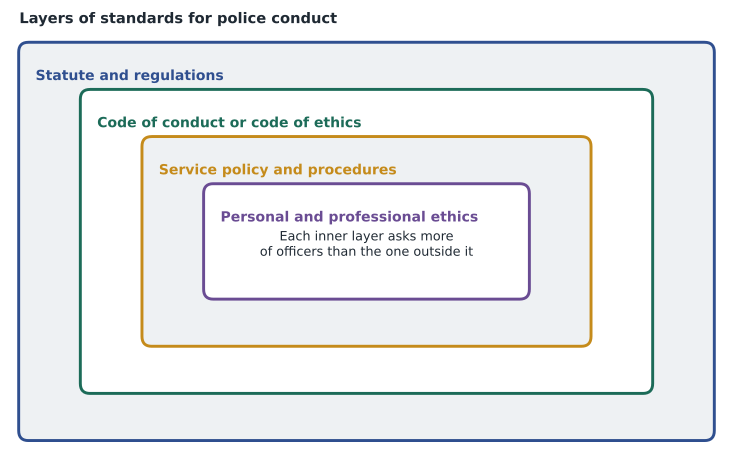
Every profession eventually writes down what it expects of its members. Physicians have had oaths since ancient Greece, lawyers have rules of professional conduct, and engineers wear an iron ring to remind them of their obligations. Police have codes too, and they come in several layers: a code of ethics adopted by the agency, state certification standards that apply to every officer, the department's own general orders and policies, and the oath each officer swears. Desjardins hands out copies of the Law Enforcement Code of Ethics and the Port Ardent general order on conduct and asks the class to read it twice: once for what it forbids and once for what it assumes about the kind of person an officer should be.
Why codes exist
Codes of conduct serve several purposes at once. They tell officers in advance what is expected, so that discipline is fair. They tell the public what it is entitled to expect, which supports trust and gives complainants a standard to point to. They express the profession's identity: what it means to be a police officer rather than simply someone with a uniform and a weapon. And they provide a common language for supervisors, oversight bodies and courts when conduct is reviewed. A code cannot anticipate every situation, so the best codes combine specific rules, such as a ban on accepting gifts above a certain value, with general principles, such as integrity and respect, that guide judgment where no rule applies.
Codes also protect officers. A clear rule about gratuities lets an officer decline a free meal without seeming rude: policy does not allow it. A clear rule about confidential information lets an officer refuse a friend's request to check a license plate. Desjardins says the most common use he saw of the code of conduct during his career was not discipline but cover: officers pointing to it when someone asked them for something improper.
Codes of ethics in American policing
In the United States there is no single national code. The most widely adopted statement is the Law Enforcement Code of Ethics of the International Association of Chiefs of Police, first adopted in 1957 and revised in 1991. It begins: As a law enforcement officer, my fundamental duty is to serve the community; to safeguard lives and property; to protect the innocent against deception, the weak against oppression or intimidation and the peaceful against violence or disorder; and to respect the constitutional rights of all to liberty, equality and justice. The IACP also publishes a shorter Oath of Honor. Agencies adopt these statements in their own policies, and state certification bodies such as the Ohio Peace Officer Training Commission set the standards officers must meet to be certified and to keep their certification.
Agencies also translate ethics into specific rules in their general orders: conduct unbecoming an officer, untruthfulness, neglect of duty, insubordination, misuse of authority, improper use of force, discrimination and harassment, and misuse of confidential information are common categories. Many agencies seek accreditation from the Commission on Accreditation for Law Enforcement Agencies, known as CALEA, which requires written directives on conduct and discipline. In Ohio, the Ohio Collaborative Community-Police Advisory Board has set statewide standards, such as on the use of force and on recruitment and hiring, and certifies agencies that adopt them.
What codes typically require
Although wording varies, police codes across the United States cover remarkably similar ground. Officers must obey the law and use their authority only for lawful purposes. They must treat people with courtesy and without discrimination. They must use force only when necessary and in proportion to the threat. They must be honest in their statements, notes, reports and testimony. They must protect confidential information and not use it for personal benefit. They must avoid conflicts of interest and decline gifts that could create an obligation. They must obey lawful orders and perform their duties diligently. And they must behave off duty in ways that do not discredit the service. The table summarizes these common categories with examples from Port Ardent files.
| Category | What it requires | Port Ardent example |
|---|---|---|
| Lawful use of authority | Powers used only for proper purposes | Arresting a man for causing a disturbance after he criticized an officer, without grounds |
| Respect and equality | Courtesy; no discrimination or harassment | Mocking a person with a mental illness during an apprehension |
| Honesty | Truthful notes, reports, statements and testimony | Backdating a notebook entry before a court appearance |
| Confidentiality | Information used only for police duties | Running a former partner's name through police databases |
| Conflict of interest | No personal benefit from the role | Steering tow calls to a relative's company |
| Diligence | Duties performed properly and promptly | Failing to follow up on a missing person report |
| Off-duty conduct | Behavior that does not discredit the service | Impaired driving while off duty |
On duty, off duty and online
Codes reach further than many recruits expect. Off-duty conduct matters when it reflects on an officer's fitness or on the service, which is why impaired driving, assault, harassment and dishonesty off duty can all lead to discipline and sometimes dismissal. Online conduct is an increasingly common source of complaints. Officers have been disciplined for social media posts that mocked victims, expressed contempt for groups they police, revealed confidential details of calls or posed with weapons in ways that frightened the public. Desjardins tells the class to assume that anything they post will eventually be read aloud in a disciplinary hearing or by a defense lawyer cross-examining them about bias. Freedom of expression applies to officers, but it is limited by duties of impartiality and confidentiality that come with the job.
Outside employment and business interests are also regulated. Most services require officers to get approval for secondary jobs and prohibit work that conflicts with policing, such as private investigation, debt collection or security work at bars the officer may have to police. Political activity is restricted in some jurisdictions so that officers are not seen to favor a party. These rules can feel intrusive, and officers sometimes resent them. The reasoning is that an officer is never entirely off duty in the public's eyes, and the authority of the uniform must not be lent to private causes.
From code to discipline
A code matters only if it is enforced fairly. When a complaint alleges a breach, it is assessed, investigated if warranted and, if the allegation is substantiated, dealt with through informal resolution, training, a reprimand, suspension, demotion or dismissal, depending on seriousness and the officer's record. Lesson 11 describes the process in detail. Here the important point is that the code connects ethics to consequences. Port Ardent's 2025 complaint figures, first seen in LES-101, show 64 complaints, of which 10 were sustained. The code below groups the allegations in those complaints by code category, which is the first thing internal affairs does when it prepares its annual report.
# Port Ardent 2025 complaints: allegations grouped by code-of-conduct category
from collections import Counter
allegations = [
    "courtesy", "courtesy", "authority", "force", "courtesy", "diligence", "force", "authority",
    "courtesy", "honesty", "diligence", "force", "courtesy", "confidentiality", "authority", "courtesy",
    "diligence", "force", "courtesy", "equality", "authority", "diligence", "courtesy", "force",
    "courtesy", "honesty", "authority", "diligence", "courtesy", "equality", "force", "courtesy",
]
substantiated = {"courtesy": 4, "diligence": 3, "honesty": 1, "confidentiality": 1, "force": 1}
counts = Counter(allegations)
print("category        alleged  substantiated  rate")
for cat, n in counts.most_common():
    s = substantiated.get(cat, 0)
    print(f"{cat:15s} {n:7d} {s:14d}  {s / n:.2f}")
print("total allegations:", sum(counts.values()))category alleged substantiated rate courtesy 11 4 0.36 force 6 1 0.17 authority 5 0 0.00 diligence 5 3 0.60 honesty 2 1 0.50 equality 2 0 0.00 confidentiality 1 1 1.00 total allegations: 32
Courtesy is by far the most common allegation, which matches research elsewhere: most complaints are about how people were spoken to and treated, not about force or corruption. The rate column also shows something worth discussing. Honesty and confidentiality allegations are rare, but when they are made they are sustained at a higher rate, partly because they often involve records that can be checked. Courtesy allegations are hard to prove without video, which is one reason body cameras have changed complaint outcomes in both directions: some complaints are confirmed and many are shown to be unfounded.
Orders, obedience and the limits of authority
Codes require officers to obey lawful orders, and insubordination is a disciplinary offense in every service. Police organizations are hierarchical for good reasons: emergencies require clear command, and officers must be able to rely on each other to follow a plan. But the duty is to obey lawful orders. An order to do something unlawful, such as to arrest someone without grounds, to use force that is not justified, to falsify a record or to ignore a crime committed by a friend of the service, is not binding, and following it is no defense to criminal charges or discipline. The principle that superior orders do not excuse wrongdoing was set out in international law after the Second World War and is reflected in police law and policy in the United States.
In practice the line is rarely so stark. More often an officer receives an order that is lawful but unwise, or one whose lawfulness is unclear. The usual professional approach is to raise the concern respectfully at the time if it is safe to do so, to comply with orders that are lawful even if disagreeable, to refuse orders that are clearly unlawful, and to document the exchange. Desjardins tells the class about a sergeant who once ordered him to move a group of young people out of a park simply because a resident had complained about their appearance. He asked what offense they were committing. The sergeant thought about it, admitted there was none, and changed the instruction to a friendly conversation about noise. Asking the question respectfully, he says, is how most unlawful orders are corrected before anyone has to refuse them.
Codes also guard against abuse in the other direction. Supervisors who use their rank to harass, bully or retaliate against subordinates breach the code themselves, and most services have policies and procedures that allow officers to raise workplace harassment outside the chain of command. Healthy obedience depends on supervisors who give lawful, explained orders and who treat disagreement as information rather than disloyalty.
Professional standards beyond the code
A code of conduct describes the floor. Professional standards describe what good practice looks like above it. Training standards, set by state certification commissions such as the Ohio Peace Officer Training Commission, require a basic program and, increasingly, continuing education. Accreditation bodies such as CALEA review whether agencies meet written standards. Professional bodies publish model policies on issues from vehicle pursuits to mental health calls. And individual officers hold themselves to standards that no document requires: preparing carefully for court, following up with a victim, explaining a decision to someone who disagreed with it. Desjardins calls this the difference between staying out of trouble and being good at the job.
Jesse asks whether codes written by governments and police leaders reflect the values of the communities being policed. Desjardins thinks the question is fair. Tribal police departments write their own codes, and the Sault Ste. Marie Tribe's department has added tribal values and a commitment to respect tribal culture to its general orders. Many services now consult community advisory committees when they revise conduct policies. Codes work best when the people who are policed can recognize their own expectations in them.
Worked problem
A favor for a friend
Marco's neighbor, knowing he is in police training and has friends on the Port Ardent service, asks him to find out whether a man who has been parking outside her house every night has a criminal record. She is frightened and says she just wants to know whether she is safe. Marco knows an officer who could run the name in a minute.
Show solution
- Recognize the issue: police databases may be used only for police duties. Running a name for a friend, however sympathetic, is a breach of confidentiality and can be a criminal offense in some circumstances.
- Identify the applicable rules: the department's general order on confidential information, the rules for access to state and federal criminal justice databases and privacy law.
- Consider the person affected: the neighbor is frightened, and her safety is a real concern, but the man parked outside also has privacy rights and may be entirely innocent.
- Identify lawful alternatives: she can call the police non-emergency line to report the vehicle, and officers can attend, speak to the man and run checks for a proper purpose.
- Act: Marco should explain that he cannot ask anyone to check, and help her make a report through the proper channel.
Answer: The neighbor's concern is real, but the only lawful way to address it is through a police call. Asking a friend to run the name would expose that officer to discipline and possibly prosecution, and would misuse a system the public trusts police to protect.
Common mistakes
MistakeCodes of conduct apply only on duty.
InsteadOff-duty and online conduct can breach the code when it reflects on the officer's fitness or discredits the service.
MistakeIf something is not specifically prohibited, it is allowed.
InsteadCodes combine specific rules with general principles such as integrity and respect, which apply where no rule does.
MistakeMost complaints are about force or corruption.
InsteadMost complaints concern courtesy and how people were treated; force and corruption allegations are fewer.
MistakeCodes exist only to discipline officers.
InsteadCodes also set public expectations, express professional identity and protect officers by giving them a clear reason to refuse improper requests.
Summary and key terms
- Police conduct is governed by layers of standards: law, codes of conduct or ethics, service policy and personal ethics.
- The IACP Law Enforcement Code of Ethics is the most widely adopted American statement, alongside agency general orders and state certification standards.
- Codes commonly cover lawful use of authority, respect, honesty, confidentiality, conflicts of interest, diligence and off-duty conduct.
- Off-duty, online and outside-employment conduct are regulated because officers carry the authority of the service with them.
- Courtesy is the most common complaint category; honesty allegations are rarer but often provable from records.
- Professional standards go beyond avoiding misconduct to describe good practice.
- Code of ethics
- A statement of the principles officers commit to, such as the IACP Law Enforcement Code of Ethics.
- General orders
- An agency's written directives governing conduct and procedures.
- Conduct unbecoming
- Behavior that reflects badly on the officer or the agency.
- Untruthfulness
- Making a false statement in an official capacity, usually grounds for serious discipline.
- Conflict of interest
- A situation in which personal interests could influence official duties.
- CALEA
- The Commission on Accreditation for Law Enforcement Agencies, which accredits agencies that meet its written standards.
Practice problems
Work each problem on paper first, then reveal the answer to check.
Give three purposes served by a police code of conduct.
Show answer
Telling officers what is expected, telling the public what to expect, and providing a common standard for discipline and review; codes also protect officers who refuse improper requests.
Why can off-duty conduct lead to discipline?
Show answer
Because an officer's off-duty behavior can show unfitness for the job or discredit the service, and the public sees officers as representatives of the police at all times.
In the Port Ardent complaint data, which category was most common?
Show answer
Courtesy.
A friend asks you to check whether someone has a criminal record. What should you do?
Show answer
Refuse to have anyone check, explain that police databases are only for police duties, and help the friend report concerns through the proper channel.
Lesson quiz · 5 questions
Score 60% or more to complete this lesson.
Create a free account to save your progress, take quizzes and earn a certificate.