
LES-105 · Lesson 5 of 12 · 20 min
Discretion: using judgment fairly and lawfully
▶ Video coming soon A video version of this lesson is on the way.
In LES-101 the class learned that police discretion is unavoidable: there are far more violations of law than any service could enforce, and officers must choose. This lesson looks at discretion as an ethical problem. Desjardins starts with numbers. In 2025, Port Ardent officers made 54,300 calls for service and observed many thousands of traffic violations, minor drug offenses, noise complaints and public disorder incidents that never became calls. Officers chose to act formally on a fraction of them. Each choice was a small exercise of state power, and taken together those choices decide who in the city experiences the law as a ticket, a warning, an arrest or nothing at all. Fair discretion means similar cases are handled similarly, for reasons the officer could state openly. Unfair discretion means the outcome depends on who the person is, how the officer is feeling or what the officer stands to gain.
Why discretion exists
Kenneth Culp Davis, whose 1969 book Discretionary Justice shaped the study of administrative power, argued that discretion is both necessary and dangerous. It is necessary because laws are written in general terms and cannot fit every situation, because resources are limited and because rigid enforcement would often be cruel or absurd. A strict policy of arresting every person found with a small amount of a prohibited drug would fill cells and courts without making anyone safer. A strict policy of ticketing every driver going slightly over the limit would consume patrol time better spent elsewhere. Discretion lets officers fit the response to the situation and the purpose of the law.
It is dangerous because it is largely invisible. When an officer decides not to act, there is usually no record. The person who receives a warning rarely complains, and the person who receives a ticket rarely knows that someone else in the same situation was let go. Davis argued that discretion should be confined, structured and checked: confined by clear limits, structured by policies and guidelines that say what factors matter, and checked by supervision and review. Much of modern police management, from charging policies to data collection on stops, can be understood as an effort to do what Davis recommended.
Legitimate and illegitimate factors
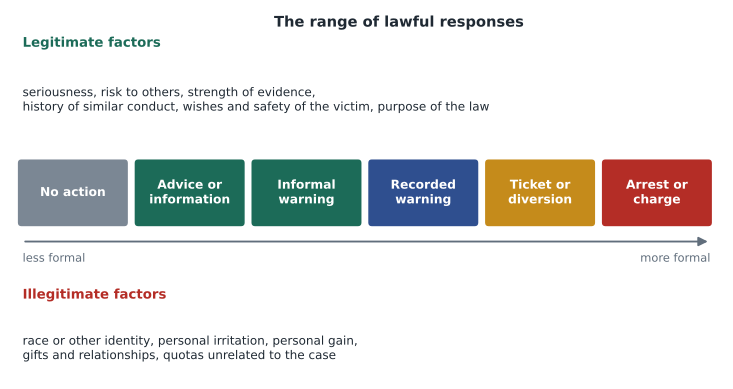
Not every factor that influences a decision is a fair one. Legitimate factors relate to the purpose of the law and the facts of the case: the seriousness of the conduct, the risk to others, the strength of the evidence, the person's history of similar conduct, the wishes and safety of the victim, the person's age and circumstances where the law recognizes them, and the likely effect of each response. Illegitimate factors include the person's race, ethnicity, religion, gender, sexual orientation, disability or social status; the officer's personal feelings about the person; personal gain, including favors or relationships; and organizational pressures such as quotas that have nothing to do with the case. The Equal Protection Clause and civil rights laws make some of these factors unlawful as well as unethical.
Some factors sit in a gray zone. Research since the 1960s, beginning with studies by Donald Black and Albert Reiss, has found that a person's demeanour, meaning how cooperative or hostile the person is, strongly predicts whether officers make an arrest. Is that fair? Partly. Hostility can signal risk or an ongoing offense, and cooperation can show that a warning will be enough. But demeanour is also shaped by fear, mental illness, intoxication, past experience with police and cultural differences in communication, and treating disrespect toward an officer as a reason for harsher treatment confuses the officer's ego with the public interest. Desjardins tells the class that being rude to a police officer is not an offense, and that officers who punish rudeness are using public power for private satisfaction.
How discretion is structured
Legislatures, courts and services have structured discretion in several ways. Some laws remove or limit it. Many states, including Ohio, have mandatory or preferred arrest laws for domestic violence, directing officers to arrest when there is probable cause, because victims are often under pressure not to cooperate. Other laws require officers to consider alternatives. Ohio law and many local programs encourage diversion for juveniles and for adults with mental illness or addiction, and many prosecutors' offices run diversion programs that officers can refer people to. Service policies add guidance on matters such as when to ticket, when to use discretion for minor drug possession and when a supervisor must approve a decision.
Structuring discretion involves trade-offs. Mandatory rules promote consistency and protect vulnerable people, but they can produce unjust results in unusual cases and can discourage some victims from calling. Research on mandatory arrest for domestic violence, starting with the Minneapolis experiment in the early 1980s and its replications, produced mixed results: arrest appeared to deter some offenders and increase violence by others. Flexible guidelines preserve judgment but rely heavily on the officer's fairness. Most services combine both, with firm rules where the risks of discretion are high and guidance elsewhere.
| Approach | Example | Strength | Risk |
|---|---|---|---|
| Mandatory rule | Mandatory or preferred arrest for domestic violence | Consistency; protects victims under pressure | Rigid in unusual cases |
| Required consideration | Juvenile and mental health diversion | Encourages proportionate responses | Depends on available programs |
| Policy guideline | Port Ardent guidance on minor traffic offenses | Flexible and explainable | Uneven application |
| Supervisor approval | Approval needed before certain charges or searches | Second look at high-stakes decisions | Delay; may be bypassed |
| Data review | Monitoring warning and ticket rates by officer | Reveals patterns individuals cannot see | Numbers need context |
Consistency: the test of fair discretion
Because individual decisions are hard to judge in isolation, fairness is often best assessed by comparing patterns. If two officers patrol similar areas and stop similar drivers for similar reasons, but one gives warnings in most cases and the other almost never does, at least one of them is applying discretion in a way that needs explaining. The difference might be legitimate: one may work a zone with more collisions. It might also reflect personal style, bias or pressure. Port Ardent's traffic unit started reviewing warning rates in 2024 after a complaint that drivers from one neighborhood were ticketed more often. The code below shows the kind of comparison the unit makes, using stops for the same offense, speeding between 15 and 30 over the limit, during daytime hours.
# Share of daytime stops ending in a warning for speeding 15 to 30 over, by officer (Port Ardent traffic unit, 2025)
from math import sqrt
stops = {"officer A": (118, 52), "officer B": (96, 41), "officer C": (130, 18), "officer D": (88, 39)}
total_stops = sum(n for n, w in stops.values())
total_warn = sum(w for n, w in stops.values())
p_all = total_warn / total_stops
print(f"unit warning rate {p_all:.2f}")
for name, (n, w) in stops.items():
    p = w / n
    se = sqrt(p_all * (1 - p_all) / n)
    z = (p - p_all) / se
    note = "  <- review" if abs(z) > 2.5 else ""
print(f"{name}: {w:3d} warnings in {n:3d} stops, rate {p:.2f}, z {z:+.1f}{note}")unit warning rate 0.35 officer A: 52 warnings in 118 stops, rate 0.44, z +2.1 officer B: 41 warnings in 96 stops, rate 0.43, z +1.6 officer C: 18 warnings in 130 stops, rate 0.14, z -5.0 <- review officer D: 39 warnings in 88 stops, rate 0.44, z +1.9
Officer C warns far less often than colleagues, and the gap is too large to be chance. That does not prove unfairness. The review that followed found that officer C mostly worked a school zone where the unit had agreed to enforce strictly after two children were struck the year before. Once stops in the school zone were separated out, officer C's rate was close to the unit average. The lesson, Desjardins says, is that data raise questions and supervisors answer them; patterns are the start of a conversation, not a verdict. Lesson 9 applies the same idea to differences between groups of people rather than officers.
Quotas, performance measures and pressure
Discretion can be distorted by the organization as well as by the individual. When officers are evaluated on the number of tickets, arrests or street checks they produce, discretion tilts toward formal action whether or not it serves the purpose of the law, and it tilts toward the people and places where formal action is easiest to generate. Several American states have passed laws banning ticket or arrest quotas, and many services in both countries have dropped explicit quotas in favor of broader performance measures. Informal pressure persists, however, in the form of supervisors who compare activity numbers at platoon briefings, as Malhotra's sergeant did in the Lesson 1 example. Desjardins argues that the ethical response is not to ignore performance but to measure the right things: response times, case outcomes, problems solved, complaints, community feedback and the quality of investigations, not raw counts of enforcement.
Officers who feel pressure to produce numbers face a real ethical choice. The decision model from Lesson 3 helps: the pressure is a reason that would not survive the publicity or reversibility tests. An officer can meet a legitimate expectation of activity by focusing enforcement where it matters most, such as collision-prone intersections, rather than by issuing marginal tickets to whoever is easiest to stop. And an officer who believes a numbers target is driving unfair enforcement can raise the concern with a supervisor, the association or, if necessary, internal affairs.
Discretion and the person in front of you
Discretion also has a personal side that numbers miss. Two drivers stopped for the same offense may be in very different situations: one late for a job interview, one fleeing an abusive partner, one impaired. Good discretion pays attention to such differences when they are relevant to the purpose of the law and the risk involved, while resisting differences that should not matter, such as which driver reminds the officer of a friend. Desjardins suggests a simple habit: before deciding, state the reason for the decision in one sentence that refers only to the facts and the purpose of the law. If the sentence would sound wrong read aloud to the person, to the next person stopped or to a supervisor, the reason probably is wrong. He adds that officers should record their reasons for significant discretionary decisions, such as a decision not to charge an assault, because the record protects both fairness and the officer.
Jesse points out that discretion also includes choosing not to use enforcement at all. In his community, he says, the officers people trust most are the ones who use the law last: they mediate disputes, connect people with elders or services and arrest only when they must. Desjardins agrees that the most important discretionary decision is often whether a situation needs the criminal law at all. Diversion to mental health services, crisis lines such as 988, launched in July 2022, community justice programs and restorative approaches are all exercises of discretion, and their availability shapes how fair discretion can be.
Worked problem
Two similar calls
On the same Saturday, Malhotra attends two shoplifting calls at the same pharmacy. In the first, a 19-year-old university student took cosmetics worth about forty dollars and was rude to the security guard. In the second, a 34-year-old woman who appears homeless took the same value of baby formula and apologized. The pharmacy manager wants both charged. Malhotra feels sympathy for the second woman and irritation with the student.
Show solution
- Identify the legitimate factors: value, evidence, prior record, the store's wishes, available alternatives such as a citation, diversion or referral, and any circumstances the law recognizes.
- Identify the illegitimate factors: Malhotra's irritation with the student's attitude and any assumptions based on appearance.
- Check records: the student has no record; the woman has one prior theft warning from two years ago.
- Apply the same criteria to both: both are first or near-first offenses of low value. Both are eligible for diversion; the woman may also be referred to social services, and the reason she took formula is relevant to which support is offered.
- Record reasons: note the criteria used for each decision so that a reviewer can see they were applied consistently.
Answer: Both cases fit a diversion referral, with a social services referral added for the woman because of an evident need. Charging the student because he was rude, or letting the woman go entirely only because of sympathy, would let the officer's feelings rather than consistent criteria decide. Consistency does not mean identical outcomes; it means the same criteria applied honestly.
Common mistakes
MistakeDiscretion means officers can do whatever they think is right.
InsteadDiscretion is the choice among lawful options, and it must be exercised for legitimate reasons, consistently, and within policies that structure it.
MistakeFull enforcement of every law would be the fairest policy.
InsteadFull enforcement is impossible with limited resources and would often be cruel or absurd; fairness comes from consistent, explainable choices.
MistakeA person's rudeness is a good reason for harsher treatment.
InsteadRudeness is not an offense. Demeanour may indicate risk, but punishing disrespect uses public power for personal satisfaction.
MistakeA difference in an officer's ticket rate proves bias.
InsteadPatterns raise questions that need context, such as assignment to a school zone; supervisors must look at the reasons before drawing conclusions.
Summary and key terms
- Discretion is necessary because laws are general, resources are limited and rigid enforcement would often be unjust.
- Discretion is dangerous because decisions not to act are largely invisible and hard to review.
- Davis argued discretion should be confined, structured and checked.
- Legitimate factors relate to seriousness, risk, evidence, history, victim wishes and the law's purpose; illegitimate factors include identity, personal feelings, gain and quotas.
- Mandatory rules, required considerations, guidelines, supervisor approval and data review all structure discretion, each with trade-offs.
- Consistency is the main test of fair discretion, and data can reveal patterns that supervisors must then explain.
- Discretion
- The freedom to choose among lawful responses, such as warning, citing, diverting or arresting.
- Structured discretion
- Discretion guided by policies or laws that specify which factors matter.
- Diversion
- Directing a person away from prosecution to a program such as counseling, treatment or community service.
- Mandatory arrest
- A law requiring arrest in certain cases, such as domestic violence, when probable cause exists.
- Demeanour
- A person's attitude and behavior toward the officer during an encounter.
- Selective enforcement
- Choosing which violations to act on, which must be based on legitimate factors.
Practice problems
Work each problem on paper first, then reveal the answer to check.
What did Davis mean by confining, structuring and checking discretion?
Show answer
Setting clear limits on it, guiding it with policies that identify relevant factors, and reviewing it through supervision and oversight.
List three legitimate and three illegitimate factors in a decision to charge.
Show answer
Legitimate: seriousness, strength of evidence, risk to others (also prior record, victim wishes). Illegitimate: race, personal feelings about the person, personal gain (also quotas).
Why might a mandatory charging or arrest policy for domestic violence be adopted despite reducing discretion?
Show answer
Because victims are often pressured to withdraw and discretion in these cases has historically led to under-enforcement and further harm.
In the code example, why was officer C's low warning rate not proof of unfairness?
Show answer
Most of the stops were in a school zone where the unit had agreed to strict enforcement; separating those stops brought the rate close to average.
Lesson quiz · 5 questions
Score 60% or more to complete this lesson.
Create a free account to save your progress, take quizzes and earn a certificate.