
LES-105 · Lesson 6 of 12 · 20 min
Noble cause corruption: when good ends tempt bad means
▶ Video coming soon A video version of this lesson is on the way.
Most people imagine police corruption as greed: an officer taking money to look the other way. Desjardins tells the class that in his experience the more common and more dangerous temptation came from the opposite direction, from officers who cared so much about outcomes that they bent the rules to get them. He describes a detective he worked with early in his career, a hardworking investigator who was certain that a man had committed a series of break-ins. When the evidence fell short, the detective's notes began to improve: details appeared that had not been there before, and an identification became firmer with each retelling. The man was convicted. Years later, the detective's credibility collapsed in another case, his old files were reviewed, and that conviction was overturned. Desjardins calls it the worst thing he ever saw a good officer do, and it was done for what the detective believed was a good reason.
What noble cause corruption is
The term noble cause corruption was popularized by Michael Caldero and John Crank in their book Police Ethics: The Corruption of Noble Cause, first published in 2000. They defined it as corruption committed in the name of good ends: violating the law or policy to achieve what the officer sees as justice. Examples include lying in reports or testimony to secure a conviction, planting or manipulating evidence, fabricating grounds for a search, coercing confessions, ignoring evidence that points away from a favored suspect, and using unnecessary force to punish a suspect the officer believes deserves it. Caldero and Crank argued that noble cause corruption is particularly hard to root out because it is driven by the same commitment to justice that draws many people to policing. The officers involved often see themselves not as corrupt but as dedicated.
Carl Klockars framed the same problem in a famous 1980 essay as the Dirty Harry problem, after the film character who tortures a kidnapper to find his victim. Klockars argued that police regularly face situations in which a morally good end seems to require a dirty means, and that there is no comfortable solution. His conclusion was not that dirty means are acceptable but that officers who use them must be punished even when the end was good, because a police force that rewards such methods will soon use them when the end is not good, or the suspect is not guilty.
Why good officers do it
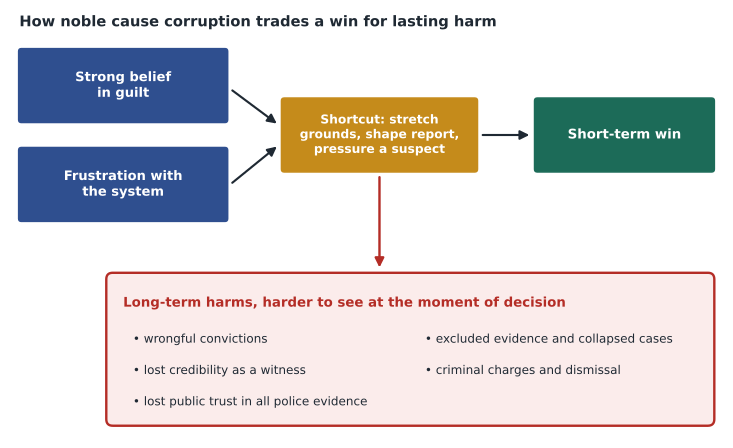
Several forces push officers toward noble cause corruption. The first is certainty. Experienced officers develop strong instincts about guilt, and instincts often feel like knowledge. The second is frustration with a system that seems to protect the guilty: evidence excluded on what officers see as technicalities, light sentences, repeat offenders released on bail. The third is the culture of results, which praises arrests and convictions and rarely asks how they were obtained. The fourth is moral identification with victims; officers who have sat with a sexual assault survivor or a grieving parent feel a duty to deliver justice that can override their duty to the process. And the fifth is the belief that the shortcut will never be discovered.
Each of these forces contains a mistake. Instinct is not evidence, and research on wrongful convictions shows how often confident investigators were wrong. Legal protections that seem like technicalities exist because the state has enormous power and has abused it. Results obtained by shortcuts are not justice but its imitation. Duty to victims includes a duty to convict the right person in a way that will stand up on appeal. And shortcuts are discovered more often than officers expect, through disclosure, video, cross-examination, phone records and the officers' own colleagues. When they are, the damage spreads far beyond the case.
Wrongful convictions: the clearest cost
The most serious consequence of noble cause corruption is the conviction of innocent people. The United States has recorded thousands of exonerations since 1989; the National Registry of Exonerations lists more than 3,500, and DNA evidence has cleared hundreds of people, many of them convicted of murder or rape. Official misconduct, including concealing evidence, coercing witnesses and false testimony by officers, is a contributing factor in a large share of exonerations. Cases such as the Central Park Five, five teenagers convicted in 1990 on the basis of coerced confessions and cleared in 2002 when the real attacker confessed and DNA matched him, show how pressure on suspects can produce false confessions that convince police, prosecutors and juries.
Tunnel vision deserves special attention because it is noble cause corruption's quieter cousin. It does not require any deliberate lie. Investigators focus on a suspect early, then interpret new evidence as confirming their theory and set aside evidence that does not fit. Each step feels reasonable. The result can be a case in which the true offender is never investigated. The confirmation bias described in Lesson 3 is the psychological engine of tunnel vision, and studies of exonerations repeatedly find investigators who stopped looking for alternatives once they had a suspect. The remedies are procedural: documenting alternative theories, assigning someone to challenge the main theory, recording interviews in full and disclosing all relevant evidence.
Interviewing is where the pull of noble cause is strongest, because a confession seems to settle everything. Research on false confessions shows that innocent people do confess, particularly young people, people with intellectual disabilities or mental illness and people who are exhausted, frightened or told that the evidence against them is overwhelming. American courts judge confessions by voluntariness under due process and by the Miranda rules, and many states now require electronic recording of custodial interviews in serious cases so that judges and juries can see how a confession was obtained. Many services have moved away from accusatory, confession-focused methods toward investigative interviewing models such as PEACE, developed in England in the early 1990s, which treat the interview as a search for accurate information rather than an effort to break the suspect. Desjardins says the change was resisted at first and is now regarded by most investigators he knows as simply better police work.
How much does certainty protect against error?
Officers sometimes argue that shortcuts are acceptable when they are very sure. The code below tests that argument. Suppose a service's investigators are right 95 times out of 100 when they feel certain of guilt, which is better than most research suggests. Suppose also that, across a year, they feel certain in 400 cases where the lawful evidence falls short, and that in each such case some officers are tempted to fill the gap. The code calculates how many innocent people would be convicted if every one of those cases were pushed through, and how the number changes with the accuracy of officers' certainty.
# If officers push through every "certain" case where lawful evidence falls short,
# how many innocent people are convicted?
cases = 400
for accuracy in (0.99, 0.95, 0.90, 0.80):
    innocent = round(cases * (1 - accuracy))
    print(f"certainty right {accuracy:.2f} of the time -> {innocent:3d} innocent people convicted per year")

# The real offender in each of those cases remains free to offend again
reoffend_rate = 0.30
innocent = round(cases * (1 - 0.95))
print(f"at 0.95 accuracy: {innocent} wrongful convictions, about {round(innocent * reoffend_rate)} real offenders likely to offend again")certainty right 0.99 of the time -> 4 innocent people convicted per year certainty right 0.95 of the time -> 20 innocent people convicted per year certainty right 0.90 of the time -> 40 innocent people convicted per year certainty right 0.80 of the time -> 80 innocent people convicted per year at 0.95 accuracy: 20 wrongful convictions, about 6 real offenders likely to offend again
Even at 99 out of 100, four innocent people a year would be convicted, and at a more realistic level of accuracy the number climbs to dozens. Each wrongful conviction also leaves a real offender free. The arithmetic shows why the legal system insists on proof rather than certainty, and why an officer's confidence, however sincere, cannot substitute for evidence. Marco says the numbers changed his mind; he had been sympathetic to the detective in Desjardins's story until he imagined being one of the innocent people in the output.
Other costs
Noble cause corruption damages cases even when the accused is guilty. Evidence obtained by violating rights is likely to be excluded, under the exclusionary rule. An officer found to have lied becomes a liability in every future case: under Brady v. Maryland (1963) and Giglio v. United States (1972), prosecutors must disclose evidence that could impeach a government witness, and many prosecutors' offices keep lists of officers whose credibility problems must be disclosed; an officer on such a list may be unable to testify, which ends most patrol and investigative careers. Lying under oath is perjury, fabricating evidence is a crime, and officers have been prosecuted and imprisoned for both. And each exposed case damages public trust in all police evidence.
Desjardins adds a cost that is rarely discussed: what noble cause corruption does to the officer. Officers who cross the line once usually find it easier the second time, and their sense of themselves shifts from someone who serves the law to someone who stands above it. Several of the officers he saw dismissed for dishonesty, he says, started with small, well-meant shortcuts and ended with lies that had nothing noble about them.
Resisting the temptation
Resisting noble cause corruption requires both individual and organizational measures. Individually, officers can learn to recognize the warning signs: certainty that outruns evidence, anger at a suspect, frustration with the courts, and the thought that no one will ever know. They can apply the frameworks from Lesson 2, especially the universal law test: would it be acceptable for every officer to do this whenever they felt certain? They can remind themselves that the system's job is to convict the guilty on reliable evidence, and that a case lost honestly is not a failure of justice in the way that a conviction obtained dishonestly is. Organizationally, services reduce the risk by rewarding careful investigation rather than raw outcomes, by recording interviews in full, by having supervisors review grounds for searches and arrests, by training on tunnel vision and by treating dishonesty as a firing offense regardless of motive.
| Red flag | What the officer may think | Professional response |
|---|---|---|
| Certainty without proof | I know he did it | Gather more evidence or accept the limits of the case |
| Frustration with courts | The judge will just let him go | Prepare a stronger lawful case; accept the court's role |
| Identification with victim | I owe her a conviction | The duty to the victim includes convicting the right person properly |
| Small adjustment | It is only a minor detail | Every detail in a report must be true |
| Secrecy | No one will ever know | Assume disclosure, video and cross-examination will reveal it |
Worked problem
Grounds for a search
Amara rides along with a plainclothes unit watching a house believed to be used for drug dealing. The officers see a man leave the house and get into a car. They have no specific grounds to believe he is carrying drugs. One officer suggests stopping him for a minor traffic violation and saying in the report that they smelled cannabis, because they are sure he is carrying something and they need a reason to search.
Show solution
- Recognize the issue: inventing an observation to justify a search is fabrication of grounds, a form of noble cause corruption, and it is criminal as well as unethical.
- Consider the law: a search based on invented grounds is unlawful, the evidence is likely to be excluded, and the officers could face charges for false reports, perjury or civil rights violations.
- Consider the alternatives: continue lawful surveillance, develop grounds through observation or informants, seek a warrant, or conduct a lawful traffic stop for the actual violation without searching.
- Apply the universal law test: if every officer invented smells when sure of guilt, no search justification would be believed.
- Act: Amara, as an observer, cannot direct the officers, but she should not participate, and the unit supervisor should be made aware of the suggestion.
Answer: The only acceptable options are lawful ones. A lawful traffic stop for the observed violation is permissible, but inventing a smell to justify a search is fabrication. The case also shows how casually noble cause corruption can be proposed: as a practical suggestion rather than a decision to do wrong.
Common mistakes
MistakeNoble cause corruption is less serious than taking bribes because the motive is good.
InsteadIt is often more harmful: it produces wrongful convictions, destroys officers' credibility and undermines trust in all police evidence.
MistakeIf an officer is very sure of guilt, small shortcuts are justified.
InsteadCertainty is often wrong, and even high accuracy produces innocent convictions when shortcuts are routine.
MistakeTunnel vision requires deliberate dishonesty.
InsteadTunnel vision usually arises from honest confirmation bias; the remedy is procedures that force consideration of alternatives.
MistakeExcluded evidence just means a guilty person goes free.
InsteadExclusion protects everyone's rights and the integrity of the justice system; shortcuts that lead to exclusion are the officer's responsibility.
Summary and key terms
- Noble cause corruption is breaking rules to achieve what the officer sees as justice.
- It includes fabricating grounds, shaping reports, false testimony, planting evidence, coercion and punitive force.
- Certainty, frustration, a culture of results, identification with victims and expected secrecy drive it.
- Its clearest cost is wrongful conviction, as shown by the many DNA exonerations and cases such as the Central Park Five.
- Tunnel vision, honest but narrow focus on one theory, is a closely related cause of wrongful convictions.
- Dishonest officers face exclusion of evidence, Brady and Giglio disclosure, criminal charges and the end of their usefulness as witnesses.
- Noble cause corruption
- Breaking laws or rules to achieve an outcome the officer believes is just.
- Dirty Harry problem
- Klockars's term for situations in which a good end seems to require a dirty means.
- Tunnel vision
- A single-minded focus on one theory that distorts how information is evaluated.
- Brady and Giglio material
- Evidence favorable to the defense, including information that could impeach a government witness, which prosecutors must disclose.
- Exclusionary rule
- The rule that evidence obtained in violation of constitutional rights generally cannot be used at trial.
- Wrongful conviction
- The conviction of a person who did not commit the crime.
Practice problems
Work each problem on paper first, then reveal the answer to check.
Define noble cause corruption and give two examples.
Show answer
Breaking laws or rules to achieve what the officer sees as justice; for example, fabricating grounds for a search and lying in testimony to secure a conviction.
Using the code, how many innocent people are convicted per year at 0.90 accuracy across 400 cases?
Show answer
40.
What did the Kaufman Commission identify as a major cause of wrongful convictions?
Show answer
Tunnel vision: an overly narrow focus on a particular theory that distorts the evaluation of information.
Give two organizational measures that reduce noble cause corruption.
Show answer
Rewarding careful investigation rather than raw outcomes, and recording interviews in full; also supervisor review of grounds and treating dishonesty as a firing offense.
Lesson quiz · 5 questions
Score 60% or more to complete this lesson.
Create a free account to save your progress, take quizzes and earn a certificate.