
LES-105 · Lesson 11 of 12 · 20 min
Accountability: complaints, discipline, oversight and the law
▶ Video coming soon A video version of this lesson is on the way.
A service can have an excellent code of conduct and well-trained officers and still lose public trust if people believe that misconduct, when it happens, will be ignored or covered up. Accountability is the set of systems that make officers and services answer for what they do. Desjardins invites Lieutenant Grace Achebe, who commands the Port Ardent Police Department's internal affairs unit, to explain how those systems work in practice. She begins by telling the class that most of her work is not catching bad officers. It is making sure that people who complain are heard, that officers who are accused are treated fairly, and that the service learns from what goes wrong. A good accountability system, she says, protects the public and good officers at the same time.
Layers of accountability
Police accountability comes from several directions at once. Internally, supervisors review officers' work and the internal affairs unit investigates complaints and allegations of misconduct. Externally, civilian review boards such as Port Ardent's Civilian Police Review Board review complaints, state agencies such as the Ohio Bureau of Criminal Investigation investigate shootings and deaths, and the Ohio Peace Officer Training Commission can revoke officers' certification. The courts hold officers accountable through criminal prosecution, civil lawsuits and the exclusion of improperly obtained evidence. Mayors and city councils hold chiefs accountable for how the service is run. And the public and the media hold everyone accountable through scrutiny, which body camera footage and bystander video have dramatically increased.
Each layer has strengths and weaknesses. Internal processes are fast and expert but can be seen as police investigating themselves. External bodies are more independent but may lack resources or powers. Courts are authoritative but slow, expensive and focused on legal liability rather than professional standards. Effective accountability uses the layers together.
How a complaint is handled in Port Ardent
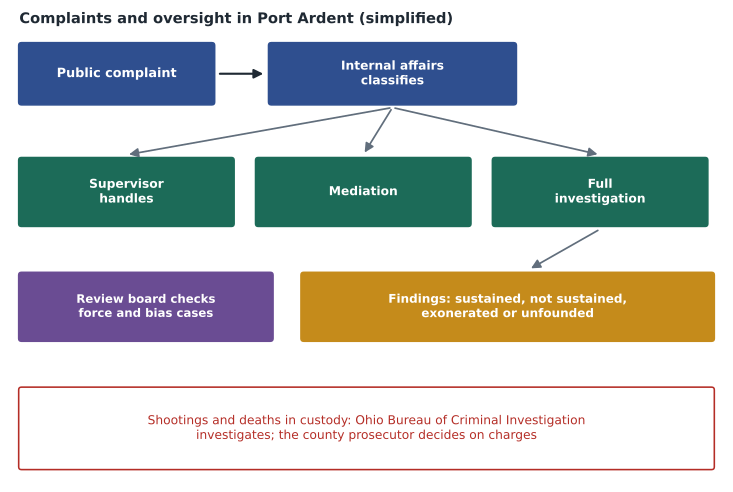
Port Ardent accepts complaints in person, by phone, by mail and online, including anonymous complaints. Internal affairs logs each complaint, classifies it and decides whether it can be handled by the officer's supervisor, through mediation with the complainant's agreement, or by a full investigation. Investigations end with findings for each allegation: sustained, not sustained, exonerated (the conduct occurred but was lawful and within policy) or unfounded (the conduct did not occur). Sustained findings go to the chief for discipline, which ranges from counseling and written reprimands to suspension, demotion and termination. Officers can appeal through the grievance and arbitration process in the collective bargaining agreement. Port Ardent's Civilian Police Review Board reviews investigations involving force or discrimination and can recommend different findings. Shootings and deaths in custody are investigated by the Ohio Bureau of Criminal Investigation, and the county prosecutor decides on criminal charges, often after presenting the case to a grand jury.
Fairness to officers
Accountability systems must be fair to officers as well as to complainants. Officers are entitled to know the allegations against them, to have representation, usually through their union, to respond, and to have decisions made on evidence by people without a conflict of interest. Investigations must be timely, because long delays harm complainants and officers alike: officers under investigation may be suspended or reassigned for months, and memories fade. Achebe tells the class that the large majority of complaints her unit handles end without a finding of misconduct, and that it matters to officers and to the public that those outcomes are reached fairly and explained. An officer cleared after a thorough, transparent investigation has his or her reputation protected in a way that an officer cleared by a superficial one never does.
Fairness also requires proportion. Discipline should match the seriousness of the misconduct, the officer's intent and record, and the harm caused, and similar misconduct should receive similar penalties. Research has found that inconsistent discipline, where well-connected officers receive lighter penalties or where penalties vary widely between supervisors, damages morale and strengthens the code of silence. In American agencies, arbitrators frequently reduce or overturn terminations; studies of large agencies have found that a significant share of officers fired for misconduct were reinstated through arbitration, which has led to calls for reform of arbitration processes and for published disciplinary matrices that set expected penalties.
Measuring the complaint system
Achebe shows the class how her unit tracks the system's performance. The code below uses Port Ardent's 2025 complaint figures to calculate how complaints were resolved and how long they took. Timeliness matters because a complaint that takes a year to resolve fails both the complainant and the officer, and because the collective agreement and state law set time limits that can bar discipline if an investigation runs too long.
# Port Ardent 2025 complaints: outcomes and days to close
from statistics import median
outcomes = {"screened out or withdrawn": 18, "informal resolution": 11,
            "investigated, no misconduct found": 25, "investigated, misconduct found": 10}
days = {
    "screened out or withdrawn": [6, 9, 12, 14, 15, 18, 20, 21, 22, 25, 28, 30, 31, 33, 35, 38, 40, 44],
    "informal resolution": [21, 28, 30, 34, 38, 41, 45, 49, 52, 58, 63],
    "investigated, no misconduct found": [62, 70, 75, 81, 84, 88, 90, 94, 97, 101, 104, 110, 112,
                                          118, 121, 126, 130, 137, 141, 150, 158, 166, 175, 190, 212],
    "investigated, misconduct found": [96, 118, 131, 144, 152, 160, 171, 188, 205, 241],
}
total = sum(outcomes.values())
for name, n in outcomes.items():
    d = days[name]
    assert len(d) == n
    over = sum(1 for x in d if x > 180)
print(f"{name:35s} {n:3d} ({n / total:.2f}) median {median(d):5.1f} days over 180 days: {over}")screened out or withdrawn 18 (0.28) median 23.5 days over 180 days: 0 informal resolution 11 (0.17) median 41.0 days over 180 days: 0 investigated, no misconduct found 25 (0.39) median 112.0 days over 180 days: 2 investigated, misconduct found 10 (0.16) median 156.0 days over 180 days: 3
Most complaints close within a few months, but five of the 35 investigated complaints took more than 180 days, including three of the ten that found misconduct. Achebe says those are the cases that worry her most, because delay in a serious case can mean that an officer who should be disciplined continues working without restriction, or that a complainant gives up on the process. Her unit has since added an investigator and set a target of closing investigations within 120 days.
Governance and transparency
Accountability for individual officers sits inside a larger question: who holds the service itself accountable for its priorities, policies and culture? In Port Ardent, the chief is appointed by the mayor with council approval and reports to the mayor, and the council's public safety committee holds hearings on the department's budget and policies. Elected officials are not supposed to interfere in individual investigations, but they are responsible for setting priorities and approving policies, such as rules on body cameras, vehicle pursuits and use of force. State law, collective bargaining agreements and certification standards set limits on what local leaders can change.
Transparency connects governance to the public. Services that publish data on complaints, use of force, stops and discipline, explain their policies in plain language and release body camera footage of serious incidents within a reasonable time give the public the means to judge them. Transparency has limits: privacy, the integrity of ongoing investigations and the rights of accused officers all justify withholding some information. Achebe says the test she applies is whether withholding information protects a legitimate interest or merely protects the service from embarrassment. Port Ardent now publishes an annual professional standards report with the kind of figures shown above, and she says the first year it did so, the number of people who told the community survey that complaints were taken seriously rose noticeably.
Legal accountability
Officers are subject to the same criminal law as everyone else, and in some respects to more. Officers who use excessive force can be charged with assault or worse; officers who lie can be charged with perjury or obstruction; officers who steal can be charged with theft and breach of trust. Federal law, 18 U.S.C. section 242, makes it a crime for anyone acting under color of law to willfully deprive a person of constitutional rights. Criminal prosecutions of officers are relatively rare and convictions rarer, partly because the law gives officers latitude in using force and partly because juries and judges are reluctant to second-guess split-second decisions. But they happen, and the possibility shapes conduct.
Civil liability is more common. People harmed by police misconduct can sue the officer and the service for damages. In the United States, claims are brought under 42 U.S.C. section 1983 against officers who violate constitutional rights. The doctrine of qualified immunity shields officers from liability unless they violated clearly established law, which has made many claims difficult and has been the subject of intense debate. Under Monell v. Department of Social Services (1978), cities can be liable when a policy or custom caused the violation. Large settlements often lead to policy changes, and the cost of repeated claims is one reason city governments press for reform. The Department of Justice can investigate agencies for a pattern or practice of unconstitutional conduct under 34 U.S.C. section 12601 and seek reforms, often through consent decrees, although the use of this power has varied greatly between administrations.
A last legal question concerns what happens to officers after they are dismissed. Researchers in the United States have documented the problem of wandering officers: officers fired or forced to resign from one agency for misconduct who are hired by another, often a smaller agency with fewer applicants. A study published in the Yale Law Journal in 2020 found that such officers were more likely than others to be fired again or to receive complaints. In the United States, the answer has been state decertification. Most states, including Ohio, can revoke an officer's certification, which prevents the person from working as an officer anywhere in the state; in Ohio the Peace Officer Training Commission revokes certification after convictions for felonies and certain other offenses. A national registry maintained by the International Association of Directors of Law Enforcement Standards and Training, and a federal accountability database created under a 2022 executive order, have aimed to stop officers moving across state lines; the federal database was shut down after that order was revoked in 2025, leaving the national index and state systems. Desjardins says the issue matters to every honest officer, because each wandering officer who commits misconduct again damages the reputation of the whole profession.
Accountability as learning
Achebe ends by arguing that accountability should not only be about blame. Some of the most valuable things her unit does are reviews that ask what the service can learn: why a policy was unclear, why training did not prepare officers for a situation, why supervisors missed warning signs. Aviation and medicine have shown that systems which treat errors only as individual failures tend to hide them, while systems that separate honest mistakes from misconduct and study both tend to improve. Policing is moving in this direction with sentinel event reviews, which examine serious failures, such as a wrongful arrest, by looking at every contributing factor rather than searching for a single person to blame. Discipline remains essential for misconduct. Learning is essential for everything else.
Worked problem
A complaint about a stop
A woman complains that a Port Ardent officer was rude and threatening during a traffic stop, refused to tell her why she was stopped and searched her car without consent. The officer's report says the stop was for an expired registration, that she was argumentative and that she consented to the search. Body camera footage exists.
Show solution
- Receive and classify: the complaint alleges discourtesy, failure to explain and an unlawful search. The search allegation is serious enough to require a full investigation rather than informal resolution.
- Gather evidence: obtain the body camera footage, the dispatch and plate query records, the officer's notes and report, and statements from the complainant and the officer.
- Compare accounts with the footage: the video shows the officer explaining the registration issue, which contradicts that part of the complaint, but it shows the officer saying I'm going to look in your car and the woman saying I guess, which is not clear consent.
- Make findings on each allegation: failure to explain, unfounded; discourtesy, not sustained because the tone is disputed and the footage is ambiguous; unlawful search, sustained, because the purported consent was not informed or voluntary.
- Decide on outcome and learning: discipline proportionate to a first finding, such as a reprimand and training on consent searches, and a reminder to the platoon about how consent must be obtained and recorded.
Answer: The complaint is partly sustained. The case shows how evidence, especially video, resolves some allegations and not others, and why findings are made allegation by allegation. It also shows the officer's report describing consent that the footage does not support, which is an honesty concern the investigation must note.
Common mistakes
MistakeAccountability means punishing officers.
InsteadAccountability includes fair investigation, clearing officers who did nothing wrong, proportionate discipline and organizational learning.
MistakeInternal investigations are worthless because police investigate themselves.
InsteadInternal units are expert and fast; external oversight adds independence. Effective systems combine both.
MistakeMost complaints result in findings of misconduct.
InsteadMost complaints are screened out, resolved informally or end without a misconduct finding; a minority are substantiated.
MistakeOfficers cannot be prosecuted for actions taken on duty.
InsteadOfficers are subject to the criminal law, including offenses specific to public officials, though prosecutions are relatively rare.
Summary and key terms
- Accountability comes from internal review, external oversight, courts, political governance and public scrutiny.
- Civilian review boards, state investigators such as the Ohio BCI and certification bodies such as OPOTC provide external oversight.
- Complaints are screened, resolved informally or investigated, with findings made allegation by allegation.
- Fair processes for officers, timely investigations and proportionate, consistent discipline support legitimacy and reduce the code of silence.
- Officers face criminal and civil liability, including 18 U.S.C. 242 prosecutions and section 1983 claims, limited by qualified immunity.
- Accountability should include organizational learning, such as sentinel event reviews.
- Internal affairs
- The unit that investigates complaints and allegations of misconduct within a police agency.
- Civilian review board
- A body of community members that reviews police complaints or investigations.
- Sustained
- A finding that the evidence supports the allegation of misconduct.
- Exonerated
- A finding that the conduct occurred but was lawful and within policy.
- Qualified immunity
- A doctrine shielding officers from civil liability unless they violated clearly established law.
- Sentinel event review
- A review of a serious failure that examines all contributing factors rather than seeking a single person to blame.
Practice problems
Work each problem on paper first, then reveal the answer to check.
Name three layers of police accountability.
Show answer
Internal review by supervisors and professional standards or internal affairs; external oversight bodies; the courts (also political governance and public scrutiny).
In the code example, how many complaints took more than 180 days, and why does that matter?
Show answer
Five, including three with misconduct findings; delay harms complainants and officers and can bar discipline under time limits.
Why should findings be made allegation by allegation?
Show answer
Because evidence may support some allegations and not others, as when video confirms an unlawful search but leaves tone disputed.
What is the purpose of a sentinel event review?
Show answer
To learn from a serious failure by examining all contributing factors, rather than only blaming an individual.
Lesson quiz · 5 questions
Score 60% or more to complete this lesson.
Create a free account to save your progress, take quizzes and earn a certificate.