
LES-101 · Lesson 3 of 12 · 19 min
Law enforcement in the United States: federal, state, local and tribal agencies
▶ Video coming soon A video version of this lesson is on the way.
Priya arrives at the third class with a question from her job search. She has seen postings for the FBI, the Ohio State Highway Patrol, the Lucas County Sheriff's Office, several city departments and a university police department, and the job titles, requirements and training all look different. Which one is the real police, she asks. Professor Desjardins laughs. All of them, he says, and that is the point of today's lesson. The United States has no single police force. Policing is divided among levels of government, shaped by history and constitutional law, and the result is a patchwork that new officers need to understand because they will work alongside many of these agencies throughout their careers.
Why policing is divided
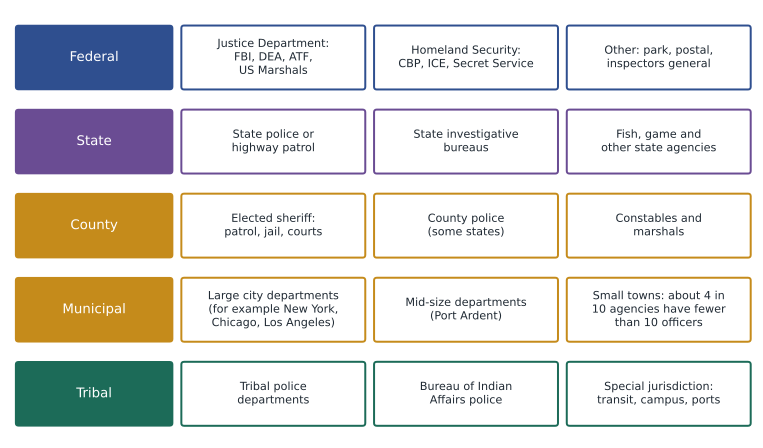
Under the Tenth Amendment, powers not given to the federal government are reserved to the states, and general police power belongs to the states. Each state delegates much of that power to counties, cities, towns and villages, which create their own departments. The federal government has police only for federal crimes, such as drug trafficking across state lines, terrorism, counterfeiting and crimes on federal land. The country has a long tradition of local control: residents expect their police to answer to locally elected officials rather than a distant capital. The result is several layers of agencies, each with its own jurisdiction, meaning the geographic area and types of offenses for which it is responsible.
Federal law enforcement
Federal law enforcement is spread across dozens of agencies. Within the Department of Justice, the Federal Bureau of Investigation investigates terrorism, espionage, cybercrime, public corruption, civil rights violations, organized crime and other federal crimes; the Drug Enforcement Administration enforces drug laws; the Bureau of Alcohol, Tobacco, Firearms and Explosives enforces firearms and explosives laws; and the US Marshals Service protects federal courts, hunts fugitives and transports federal prisoners. Within the Department of Homeland Security, Customs and Border Protection is the largest law enforcement agency in the country, alongside Immigration and Customs Enforcement and the Secret Service. Other agencies range from the Park Police to the inspectors general of federal departments.
Federal agents rarely do patrol work. They investigate and usually work closely with state and local agencies through joint task forces, in which local officers are deputized to work federal cases. Priya's interest in financial crime points toward agencies such as the FBI, the Secret Service, which investigates many financial crimes as well as protecting leaders, and the Internal Revenue Service's criminal investigation division.
State agencies
Every state except Hawaii has a primary state law enforcement agency. Some are state police with full powers across the state, such as the Michigan State Police; others are highway patrols focused on traffic and highway safety, such as the Ohio State Highway Patrol, although in practice many highway patrols also investigate crime and assist local agencies. States also have investigative bureaus, such as Ohio's Bureau of Criminal Investigation, which provides crime laboratory services and investigates officer-involved shootings at the request of local agencies, along with fish and game wardens, alcohol and gaming agents and others.
County and municipal agencies
In nearly every state, each county elects a sheriff. The sheriff's office runs the county jail, provides security for the courts and serves civil papers, and in many counties its deputies patrol areas outside city limits. Around Port Ardent, the Ardent County Sheriff's Office does all of these. A few states also have county police departments separate from the sheriff. Cities, towns, villages and townships create municipal police departments, which employ most officers in the country. The largest, the New York City Police Department, has more than 30,000 officers, while thousands of small towns have departments of fewer than ten. Port Ardent's department, with 204 sworn officers, is large by national standards.
Special jurisdiction agencies make up another layer: university and college police, transit police, airport and port police, school district police, and agencies that police parks, hospitals and housing authorities. Constables and marshals serve courts in some states. Many of these officers have full arrest powers within their jurisdiction. Linh notes that some of these jobs are civilian or limited-power roles that might suit people who want to work in public safety without full police duties.
Tribal law enforcement
Tribal nations are sovereign governments with their own police departments, courts and laws. Several hundred tribal agencies exist, from departments of a handful of officers to large agencies such as the Navajo Nation Police. The Bureau of Indian Affairs also provides police in some places. Jurisdiction on reservations is complicated: under Oliphant v. Suquamish Indian Tribe (1978), tribes generally lack criminal jurisdiction over non-Indians, although the Violence Against Women Act reauthorizations of 2013 and 2022 restored tribal jurisdiction over non-Indians for certain crimes such as domestic violence. Federal agencies handle major crimes under the Major Crimes Act, and in some states, under Public Law 280, the state has criminal jurisdiction instead. Tribal police often hold cross-deputization agreements with county and state agencies so that officers can act regardless of who is involved.
Jesse's tribe operates its own police department, which patrols tribal lands in several counties and works with county sheriffs and the state police under cross-deputization agreements. Jesse wants to work there because he believes police who know the language, families and history of a community can do things outsiders cannot. Professor Desjardins agrees, and adds that this course will return to the history behind Indigenous communities' wariness of police in lesson 4.
Cooperation across agencies
Because crime ignores boundaries, agencies constantly work together. Agencies share information through the FBI's National Crime Information Center (NCIC), which holds records of wanted persons, stolen property and more. Multi-agency task forces target drug trafficking, gangs and violent fugitives, and mutual aid agreements let departments lend each other officers for emergencies and major events. Fusion centers in each state collect and share intelligence across agencies. Cooperation is not automatic. Agencies compete for resources and credit, use different radio systems and records software, and sometimes disagree about who is responsible for a call near a boundary. Several major inquiries into mass casualty events have found that weak communication between agencies cost precious time.
# State and local law enforcement agencies by type, 2018 census (Bureau of Justice Statistics)
types = {
    "Local police": (11824, 465891),
    "Sheriffs' offices": (3051, 192380),
    "Primary state agencies": (49, 60451),
    "Special jurisdiction": (1753, 60833),
    "Constables and marshals": (647, 4221),
}
agencies = sum(a for a, o in types.values())
officers = sum(o for a, o in types.values())
for name, (a, o) in types.items():
    print(f"{name:24s} agencies {a:6,d} ({a / agencies:5.1%})  officers {o:7,d} ({o / officers:5.1%})  average {o / a:7.1f}")
print(f"total: {agencies:,d} agencies, {officers:,d} full-time sworn officers")Local police agencies 11,824 (68.3%) officers 465,891 (59.4%) average 39.4 Sheriffs' offices agencies 3,051 (17.6%) officers 192,380 (24.5%) average 63.1 Primary state agencies agencies 49 ( 0.3%) officers 60,451 ( 7.7%) average 1233.7 Special jurisdiction agencies 1,753 (10.1%) officers 60,833 ( 7.8%) average 34.7 Constables and marshals agencies 647 ( 3.7%) officers 4,221 ( 0.5%) average 6.5 total: 17,324 agencies, 783,776 full-time sworn officers
The output shows the scale of local control. Local police departments are two thirds of all agencies and employ well over half of all officers, but the average department is small, while the 49 primary state agencies average more than a thousand officers each. Sheriffs' offices employ about a quarter of officers, partly because many run jails. A national rate alone hides this variety: a rural sheriff and a big-city department face entirely different demands.
Jurisdiction in practice: a call near a boundary
Professor Desjardins illustrates jurisdiction with a story. Late one winter night, a driver on the highway just outside Port Ardent's city limits called 911 to report a car swerving between lanes. The call reached the Ardent County dispatch center, because the highway outside the city is patrolled by the sheriff and the state highway patrol. The car then took the exit into the city and stopped at a gas station, where Port Ardent officers arrived first. A state trooper arrived a few minutes later. The two agreed on the spot that the city officer would conduct the impaired driving investigation, because the driving that mattered most had continued into the city and the city officer had seen it, while the trooper took a statement from the caller. Nobody argued, because the agencies had worked together for years and had a written agreement on handovers. Professor Desjardins says that boundaries cause trouble when there is no such agreement, when radio systems cannot talk to each other or when two agencies each assume the other is handling a call.
Boundary questions also arise in investigations. A string of break-ins may cross several jurisdictions, a fraud may involve victims in many provinces or states, and an online threat may come from another country. In such cases, agencies decide who will lead, often the one with the most victims or the specialized unit, and others contribute officers and information. Priya recognizes this from her bank fraud work, where she sometimes sent the same evidence package to three different agencies before one agreed to take the case.
The 2018 census in numbers shows how fragmented American policing is. The five main types of agency in the code account for 17,324 agencies; the census total of 17,541 also includes a few hundred agencies of other kinds. Fragmentation has advantages: local control, officers who know their communities and agencies that answer to local voters. It also has costs: thousands of small agencies, each with its own policies, training, records system and hiring standards, many of which cannot afford specialized units, internal affairs investigators or modern data systems. Researchers and reform commissions have debated for decades whether small agencies should merge or share services, and some counties have created consolidated departments or shared dispatch centers. Professor Desjardins notes that an officer who leaves one small department can be hired by another a few miles away, which is why state decertification systems matter, as lesson 6 explains.
The United States also has many officers whose work overlaps with policing in less visible ways. Game wardens enforce wildlife laws across vast rural areas and often serve as the only law enforcement for miles. Code enforcement officers deal with noise, property and nuisance complaints that once went to police. Corrections officers, court bailiffs and probation officers supervise people at different stages of the justice system. Private security guards outnumber sworn officers in the United States and protect most shopping centers, offices and hospitals, and some cities now give them limited roles in public spaces. Linh notes that some of these careers might suit people who want to work in public safety without carrying full police powers, and Professor Desjardins agrees that the program prepares students for many of them.
Worked problem
Contracting with the sheriff
A village of 18,000 near Port Ardent pays its own department of 30 officers 6.9 million dollars a year. The Ardent County Sheriff offers to provide patrol under contract with the equivalent of 27 deputies for 5.4 million dollars a year. What is the cost per resident of each option, and what else should the village council consider?
Show solution
- Own department: 6,900,000 / 18,000 = 383 dollars per resident per year.
- Sheriff contract: 5,400,000 / 18,000 = 300 dollars per resident per year.
- The difference is 83 dollars per resident each year, or about 1.5 million dollars in total.
- Council should also weigh local control and accountability, response times, the specialized units each option provides, how costs might rise, and what residents want.
Answer: The sheriff contract is cheaper by about 83 dollars per resident each year. Keeping its own department gives the village more local control, which is why many communities pay the extra cost.
Common mistakes
MistakeThere is one national police force that does all police work.
InsteadPolicing is divided among federal, provincial or state, local and Indigenous agencies, each with its own jurisdiction.
MistakeFederal agents do the same work as city patrol officers.
InsteadFederal agents mostly investigate federal crimes and rarely patrol; local agencies handle most calls for service.
MistakeEvery community has the same level of policing.
InsteadRates of officers per resident vary widely with geography, population, crime and funding.
MistakeTribal police can arrest anyone for any crime on a reservation.
InsteadTribal criminal jurisdiction over non-Indians is limited, apart from specific crimes restored by the Violence Against Women Act.
Summary and key terms
- Policing is divided among levels of government because of constitutional rules and history.
- Federal agencies such as the FBI, DEA, ATF, US Marshals and CBP enforce federal law; states have state police or highway patrols and investigative bureaus.
- Elected sheriffs and municipal departments do most local policing; most agencies are small.
- Tribal police serve sovereign nations, but jurisdiction depends on who is involved, the crime and federal and state law.
- Agencies cooperate through shared databases, joint task forces and mutual aid, but cooperation is not automatic.
- Rates of officers per 100,000 residents vary widely and must be read alongside geography, crime and workload.
- Jurisdiction
- The area and types of offenses for which an agency has legal authority.
- Sheriff
- An elected county official who runs the jail, serves the courts and often patrols outside city limits.
- Tribal police
- A police department created by a sovereign tribal nation to police its lands.
- Special jurisdiction agency
- An agency that polices a particular setting, such as a campus, transit system or port.
- Mutual aid
- An agreement under which agencies lend each other officers and resources.
- NCIC
- The National Crime Information Center, a national database maintained by the FBI.
Practice problems
Work each problem on paper first, then reveal the answer to check.
Why is policing divided among several levels of government?
Show answer
General police power belongs to the states, which delegate much of it to local governments; federal agencies enforce only federal law.
Using the code output, which province has the highest rate of officers per 100,000, and why might the territories be higher still?
Show answer
This question applies to the Canadian data; for the US data, local police have the most agencies and officers, while state agencies have the largest average size.
Give one advantage and one disadvantage of a small community running its own police department.
Show answer
Advantage: local control and accountability. Disadvantage: higher cost per resident and fewer specialized units.
Name two ways agencies cooperate.
Show answer
Shared databases, joint task forces or integrated units, mutual aid agreements.
Lesson quiz · 5 questions
Score 60% or more to complete this lesson.
Create a free account to save your progress, take quizzes and earn a certificate.