
LES-101 · Lesson 11 of 12 · 19 min
Current issues and reforms in policing
▶ Video coming soon A video version of this lesson is on the way.
The penultimate class is a debate. Professor Desjardins divides the students into two teams and gives them a motion: that the City of Port Ardent should move a share of its police budget into a civilian crisis response service. Marco and Amara argue against, Linh and Jesse argue for, and Priya acts as the judge. The debate is lively, but what strikes Professor Desjardins is how often both teams reach for the same evidence and draw opposite conclusions. Afterward he tells them that this is what policing reform looks like in real life. There are few simple answers, many competing values and a body of research that is growing but still incomplete. This lesson surveys the main issues, what the evidence says and how to think about them clearly.
The context: crime, cost and confidence
Debates about reform take place against changing crime trends. Violent crime in the United States rose sharply in 2020 and 2021 and has fallen since. According to FBI data for 2025, released in August 2026 and based on reports from more than 17,000 agencies, murder fell 18.1% from 2024, to a rate of about 4.1 per 100,000, the lowest in roughly seventy years; violent crime fell 9.3% and property crime 12.4%. At the same time, the cost of policing keeps rising, driven by wages, technology and longer investigations, and many services report difficulty recruiting and keeping officers. Public confidence in police remains reasonably high overall but low in some communities, as lesson 9 showed. Reform debates are therefore about effectiveness, cost and legitimacy all at once.
Measuring crime is itself contested. A simple crime rate counts every incident equally, so a rise in minor thefts can swamp a fall in serious violence. The United States has no official severity-weighted index; the FBI reports counts and rates by offense type, and analysts sometimes build their own weighted measures, following the approach of Statistics Canada's Crime Severity Index. The code below builds a simple severity-weighted index for Port Ardent using illustrative weights, to show how the two measures can move differently.
# Crime rate versus a severity-weighted index for Port Ardent (illustrative weights)
crimes = {   # crime type: (weight, count 2024, count 2025)
    "homicide": (1800, 2, 1), "robbery": (120, 60, 48), "assault": (30, 520, 540),
    "break and enter": (60, 410, 360), "theft": (10, 2300, 2150), "mischief": (8, 1100, 1180),
    "fraud": (15, 640, 700), "impaired driving": (40, 180, 170),
}
pop = {2024: 97300, 2025: 98000}
for year, col in ((2024, 1), (2025, 2)):
    count = sum(v[col] for v in crimes.values())
    weighted = sum(v[0] * v[col] for v in crimes.values())
    print(f"{year}: {count:5d} incidents, rate {count / pop[year] * 1e5:7.1f} per 100,000; weighted per 100,000 {weighted / pop[year] * 1e5:9.0f}")
c24 = sum(v[1] for v in crimes.values()) / pop[2024]; c25 = sum(v[2] for v in crimes.values()) / pop[2025]
w24 = sum(v[0] * v[1] for v in crimes.values()) / pop[2024]; w25 = sum(v[0] * v[2] for v in crimes.values()) / pop[2025]
print(f"change in crime rate: {c25 / c24 - 1:+.1%}; change in severity index: {w25 / w24 - 1:+.1%}")2024: 5212 incidents, rate 5356.6 per 100,000; weighted per 100,000 102364 2025: 5149 incidents, rate 5254.1 per 100,000; weighted per 100,000 95510 change in crime rate: -1.9%; change in severity index: -6.7%
In this example the crime rate falls only slightly, because increases in mischief, fraud and assault nearly offset decreases in thefts and break-ins, but the severity index falls by much more, because there were fewer robberies, fewer break-ins and one fewer homicide, each carrying a heavy weight. A council member looking only at the crime rate would conclude that little had changed; one looking at the severity index would see real progress. Neither number tells the whole story, which is why good analysts report several.
Use of force and accountability
Use of force, especially deadly force, is the most visible issue in policing. Force is used in a small share of encounters, but each serious use of force can affect trust across a whole community. Reforms have focused on several areas. De-escalation training teaches officers to slow encounters down, create distance and time, and communicate, particularly with people in crisis; evaluations, such as a study of training in Louisville, have found reductions in use of force and injuries. Policies increasingly require officers to intervene when a colleague uses excessive force and to report it. After 2020, many states banned chokeholds and neck restraints except where deadly force is justified, required a duty to intervene, created or strengthened officer decertification and limited no-knock warrants. Ohio adopted a statewide use-of-force standard through the Ohio Collaborative.
Body-worn cameras spread rapidly in the 2010s. By 2016 nearly half of general-purpose agencies had acquired cameras, and many states now require or fund them. Early studies, such as one in Rialto, California, found large drops in complaints and use of force. Later and larger randomized trials, such as one with more than 2,000 officers in Washington, D.C., found little effect on either. Cameras do provide evidence, resolve many complaints quickly and give the public a view of police encounters, but they are expensive, raise privacy concerns and depend on policies about when they are switched on and when video is released. They are a tool for accountability, not a solution in themselves.
Who should respond? Alternatives to police
Lesson 8 showed that many calls involve mental health, homelessness and other social problems. A major reform movement asks whether some of these calls should go to someone other than an armed police officer. The best-known model is CAHOOTS in Eugene, Oregon, which since 1989 has sent medics and crisis workers to many mental health and welfare calls. In the United States, Denver's Support Team Assisted Response program, launched in 2020, sends a mental health clinician and a paramedic to suitable calls; a study found that reports of low-level crimes fell in the areas it served. The 988 crisis line, launched in July 2022, gives people another number to call, and many cities, including Port Ardent, run co-responder teams. These programs depend on careful call screening, on enough crisis workers to answer calls quickly and on reliable police backup when a call turns dangerous. They are not cheap, and they work best as part of a wider system of mental health care.
The 2020 calls to defund the police drew on these ideas, arguing that money should move from police to social services that prevent crime and crisis. Some cities cut police budgets in 2020 and 2021, then restored them as violent crime rose and staffing fell. The debate has since shifted to a more practical question: which calls are best handled by which responders? Marco, who argued against the motion in class, concedes that a crisis worker might handle some of Dev's calls better than Dev. Linh concedes that someone still has to answer the call at 3 a.m. when a person in crisis has a knife. Both, Professor Desjardins notes, are making the same argument for a system with more than one kind of responder.
Evidence-based policing
A quieter reform movement asks police to use research to decide what works. Lawrence Sherman coined the term evidence-based policing in 1998, arguing that police should test their strategies as medicine tests treatments. Decades of studies now point to several approaches with good evidence. Hot spots policing, which concentrates patrol and problem-solving on the small places where crime clusters, reduces crime in those places without simply displacing it. Focused deterrence, which identifies the small number of people driving gun violence, communicates clearly that violence will bring swift consequences and offers real help to those who want out, has reduced violence in many cities. Problem-oriented policing, which you met in lesson 9, has strong support across many problem types. Other popular practices, such as random patrol, rapid response to all calls and one-off bias training, have weaker evidence for their main goals.
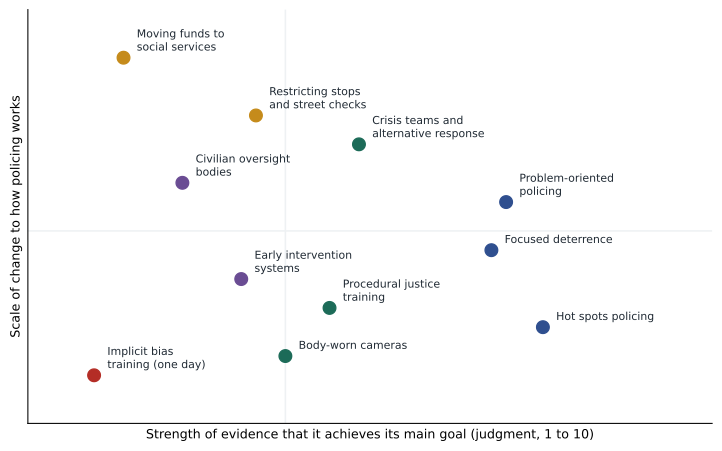
The figure maps common reform options by two dimensions: how strong the evidence is that they achieve their main goal, and how much they change the way policing works. Approaches in the lower right are well supported but leave the basic model intact; approaches in the upper left would change policing more but rest on weaker or more mixed evidence, often because they are newer or harder to test. The positions are judgments, and reasonable people place them differently. The figure is useful less for its exact placements than for the questions it raises: what is the goal, what is the evidence and what would it cost?
Technology, privacy and the future
New technology raises new questions. Automated license plate readers, drones, gunshot detection, facial recognition and software that predicts where crime will occur promise efficiency but raise concerns about privacy, accuracy and bias. Several American cities have banned or restricted police use of facial recognition after studies found higher error rates for some groups and after wrongful arrests based on false matches. Artificial intelligence tools that draft police reports from body-worn camera audio are spreading, raising questions about accuracy and accountability for what is written. The principle from lesson 1 applies: in a democracy, new police powers, including powers that come from technology, need legal authority, clear rules and independent oversight.
Reform through law and governance
American reform has come mostly from states and cities. Congress did not pass the George Floyd Justice in Policing Act after the House approved it in 2021. A 2022 executive order set standards for federal agencies and encouraged state and local reform, but it was revoked in January 2025, and the new administration directed agencies to strengthen support for law enforcement and to review federal consent decrees. In May 2025 the Justice Department moved to end the Minneapolis and Louisville consent decrees and closed several investigations. Reform in the coming years will depend largely on state legislatures, state attorneys general, city councils and police leaders themselves. Priya, judging the debate, observes that whatever happens in the capital, most of what changes policing happens in places like Port Ardent's council chamber, in its training room and in the patrol car.
Recruitment and staffing
Many reform proposals depend on having enough well-trained officers, and staffing has become a pressing issue in its own right. Services in both countries report fewer applicants, more early resignations and retirements, and long training pipelines that mean a vacancy can take a year or more to fill. Some services have responded with hiring bonuses, faster processing, recruitment from other careers and more flexible schedules. Others are reconsidering which tasks really need a sworn officer, which links staffing directly to the debate about alternative responders. Marco points out that the schedule he studied in lesson 5 is itself a recruitment issue, because many capable people with families never apply.
Worked problem
Costing a reform proposal
The city is considering expanding its co-response program from one team on weekday afternoons to three teams covering 14 hours a day, seven days a week. Each team adds a mental health worker (95,000 dollars a year including benefits) and dedicates one officer. If the expanded program handles 2,400 calls a year that now average 110 officer-minutes and two officers, and the teams take 70 minutes with one officer, how many patrol officer-hours are freed?
Show solution
- Current officer time for those calls: 2,400 × 110 minutes × 2 officers = 528,000 minutes = 8,800 hours.
- Time with co-response: 2,400 × 70 minutes × 1 officer = 168,000 minutes = 2,800 hours.
- Patrol hours freed: 8,800 − 2,800 = 6,000 hours a year, about 4% of the patrol hours available from lesson 8.
- Added cost: about 5 mental health workers to staff three teams across all shifts, or about 475,000 dollars a year, plus training and vehicles.
Answer: About 6,000 patrol hours a year are freed, at a cost of roughly half a million dollars, before counting benefits such as fewer emergency department waits, fewer arrests of people in crisis and possibly better outcomes for them. The proposal should include an evaluation plan so that council can judge whether it works.
Common mistakes
MistakeA falling crime rate always means the most serious crime is falling.
InsteadA count-based rate can hide changes in serious crime; a severity-weighted index gives another view.
MistakeBody-worn cameras reliably reduce use of force.
InsteadResults are mixed; large trials found little effect, though cameras help with evidence and complaints.
MistakeReform means either more police or fewer police.
InsteadMany reforms change which responders handle which calls and how police work, not just the number of officers.
MistakeIf a practice is popular, it must work.
InsteadSome popular practices have weak evidence; evidence-based policing tests strategies before spreading them.
Summary and key terms
- Reform debates combine questions of effectiveness, cost and legitimacy against a background of falling crime after the pandemic peak.
- Severity-weighted indexes and simple crime rates can move differently, so analysts report both.
- Use-of-force reforms include de-escalation, duty to intervene and data reporting; body-worn cameras help accountability but have mixed effects on force.
- Alternative responders and co-response teams aim to match mental health and social calls with appropriate responders.
- Evidence supports hot spots policing, focused deterrence and problem-oriented policing; other practices have weaker support.
- State and local action drives American reform, as federal oversight was sharply reduced in 2025.
- Crime Severity Index
- A measure that weights each offense by its seriousness, based on typical sentences.
- De-escalation
- Tactics that slow an encounter and reduce the need for force, such as distance, time and communication.
- Duty to intervene
- An officer's obligation to stop and report excessive force by another officer.
- Co-response
- A model in which an officer and a mental health worker respond together.
- Focused deterrence
- A strategy that targets the few people driving violence with clear consequences and offers of help.
- Evidence-based policing
- Using rigorous research to decide which police strategies to adopt.
Practice problems
Work each problem on paper first, then reveal the answer to check.
In the index code, why does the severity index fall more than the crime rate?
Show answer
Offenses with heavy weights (homicide, robbery, break and enter) fell, while lighter offenses rose.
Why did large trials of body-worn cameras find smaller effects than early studies?
Show answer
Possible reasons include different settings, control officers also changing behavior, and early studies being small.
Name two conditions for alternative crisis response programs to work.
Show answer
Careful call screening, enough crisis workers to respond quickly and reliable police backup.
What are the three questions to ask about any reform proposal?
Show answer
What is the goal, what is the evidence and what would it cost?
Lesson quiz · 5 questions
Score 60% or more to complete this lesson.
Create a free account to save your progress, take quizzes and earn a certificate.