
LES-101 · Lesson 1 of 12 · 21 min
Why study policing: the purpose of police in a democracy
▶ Video coming soon A video version of this lesson is on the way.
The first class of the criminal justice program at Maumee Valley Community College in Toledo, Ohio meets on a gray September morning in a classroom that used to be a computer lab. At the front stands Professor Ray Desjardins, a retired lieutenant who spent twenty-eight years with the Port Ardent Police Department, the lakeside city of 98,000 people about forty-five minutes up the highway. He worked patrol for eleven years, then investigations, then ran a night shift and finally a community response unit. He opens not with a law or a statistic but with a question: what are the police actually for? Most of the students expect the answer to be catching criminals. By the end of the term they will have a far more complicated answer, and this course is about how to get there.
Professor Desjardins asks five students to introduce themselves, because they will appear in examples throughout this course and the program. Amara Okafor, 19, grew up in Columbus in a Nigerian family and wants to work patrol and then become a detective in a major crimes unit. Jesse Morningstar, 22, is Anishinaabe; he grew up on the Sault Ste. Marie Tribe of Chippewa Indians reservation in Michigan and wants to join his tribe's police department. Priya Sandhu, 27, spent five years as a fraud analyst at a bank and wants to investigate financial crime, perhaps with the Ohio State Highway Patrol or a federal agency. Marco DiSanto, 31, served in the Army National Guard, has two young children and wants a patrol career that might lead to the canine unit, although he worries about shift work. Linh Tran, 20, is not sure she wants to carry a badge at all. She is interested in civilian roles such as crime analyst or emergency communicator, and she is honest that her older cousin's repeated stops by police have left her family wary.
| Student | Background | Career interest |
|---|---|---|
| Amara Okafor | Recent high school graduate, part-time retail job | Patrol, then major crimes detective |
| Jesse Morningstar | Anishinaabe, from a reservation in Michigan | Tribal police department |
| Priya Sandhu | Five years as a bank fraud analyst | Financial crime with state or federal agencies |
| Marco DiSanto | National Guard veteran, parent of two | Patrol, later canine or tactical unit |
| Linh Tran | Studying part-time while working evenings | Crime analyst or emergency communicator |
What are the police for?
The everyday answer is that police exist to fight crime. Yet when researchers began following officers on patrol in the 1960s and 1970s, they found that crime took up a modest share of the working day. Officers settled arguments between neighbors, directed traffic, found lost children, took people in crisis to hospital, dealt with drunk and disorderly people, checked on the elderly and answered a stream of calls that had nothing to do with crime at all. The sociologist Egon Bittner argued in 1970 that what unites this odd mix of tasks is not crime but the capacity to use force. People call the police, he suggested, when something is happening that ought not to be happening and about which someone had better do something now. The police are the one agency of government that can be sent to any such situation, at any hour, with the authority to impose a solution if necessary.
That insight leads directly to the central problem of policing in a democracy. A democratic state gives a small group of its citizens powers no one else has: to stop people, to search them, to take away their liberty and, in the last resort, to use force that can kill. The same state promises its citizens freedom of movement, privacy, equality before the law and protection from arbitrary power. Police work sits exactly at the point where those promises meet. When the police use their powers well, they protect freedom; when they use them badly, they threaten it. Every topic in this course, from the history of policing to oversight and reform, returns to this tension.
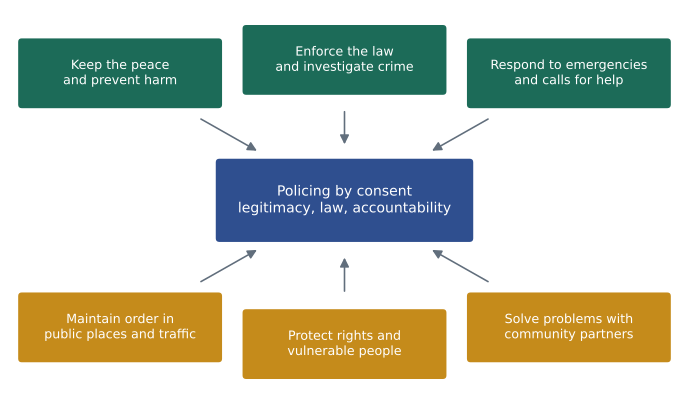
The functions of a police service
Most police services describe their work in a handful of functions. They keep the peace and prevent harm, which includes patrolling, being visible and stepping into disputes before they turn violent. They enforce the law and investigate crime, from taking a theft report to running a homicide investigation. They respond to emergencies and calls for help, often as the first public servant to arrive at a collision, a fire or a medical crisis. They maintain order in public places and on the roads. They protect rights and vulnerable people, including victims of family violence, children and people in crisis. Increasingly, they also work with partners such as schools, health agencies and social services to solve recurring problems rather than responding to the same address again and again.
In the United States there is no single national list. Each state sets the duties of its peace officers in its own statutes, and each city or county decides how its department is organized. Ohio law, for example, gives police officers in municipalities the duty to preserve the peace, protect persons and property and enforce the laws of the state and the ordinances of the city. The list matters because it frames how resources are spent and what the public can expect.
Policing in a democracy
What makes democratic policing different from policing in an authoritarian state? Scholars such as David Bayley have pointed to a few essential features. First, the police are subject to the rule of law: they must obey the same laws as everyone else, and their powers are set out in law rather than in the wishes of a ruler. Second, they are accountable, meaning that independent bodies, courts and the public can examine what they do and hold them to account. Third, they give top priority to serving individual citizens and private groups, rather than protecting a government from its own people. Fourth, they protect human rights, especially the rights of free speech, assembly and dissent that democracy requires. A police force that guards the regime and silences critics is not a democratic police force, however efficient it may be.
These principles are written into the legal systems of both Canada and the United States. The Bill of Rights in the United States Constitution protects people from unreasonable searches and seizures (Fourth Amendment), protects against compelled self-incrimination and guarantees due process (Fifth Amendment), and guarantees the right to counsel (Sixth Amendment). The Fourteenth Amendment applies these protections to state and local police, and in Mapp v. Ohio (1961), a case that began with a police search of a home in Cleveland, the Supreme Court held that evidence seized illegally must be excluded from state criminal trials. You will study these protections in detail in later courses; here the point is that the police in a democracy work inside a framework designed to limit them.
Legitimacy: why people cooperate with police
Police depend on the public more than most people realize. The great majority of crimes come to police attention because a victim or witness reports them, and most crimes are solved because someone provides information. Officers cannot be everywhere, and they cannot force a whole community to comply. They rely on people voluntarily obeying the law, calling for help, giving statements, testifying in court and accepting officers' directions in tense moments. This willingness depends on legitimacy: the belief that the police have the right to exercise authority and that people ought to defer to them.
Research by the psychologist Tom Tyler, beginning with his 1990 book Why People Obey the Law, found that people's views of police legitimacy depend less on whether police are effective at reducing crime, or whether an encounter ends in their favor, than on whether they were treated fairly. This idea is called procedural justice. Its four elements are voice (people get to tell their side), neutrality (decisions are made on facts and rules, not bias), respect (people are treated with dignity) and trustworthy motives (people believe the officer cares about their wellbeing). A driver who receives a ticket from a courteous officer who explains the reason may leave with more confidence in police than a driver who is let off by an officer who is rude and dismissive.
Legitimacy is not evenly distributed. Surveys in both countries consistently find that confidence in police is lower among young people, among Black and Indigenous residents, and among people who have had involuntary contact with police. Linh's family is an example. Her cousin's experience shapes how the whole family sees officers, and it will take more than one good encounter to change that view. This is why you will return to trust and community relationships in lesson 9 and in a full course later in the program.
How big is policing?
The United States has roughly 770,000 sworn officers, by recent estimates based on FBI data for 2024, working in about 18,000 state and local agencies plus federal agencies. The most recent full census by the Bureau of Justice Statistics, for 2018, counted 17,541 state and local agencies with about 241 full-time sworn officers for every 100,000 residents. Most agencies are small: about four in ten had fewer than ten full-time officers. These numbers tell you that policing is a large public service, but they also hide wide variation from place to place, which lesson 3 explores.
Port Ardent is a useful example because it is typical. Its police department has 204 sworn officers and 68 civilian employees, reports to the mayor and city council, and shares Ardent County with the elected sheriff, whose deputies patrol the townships and run the county jail. In 2025 it answered about 54,300 calls for service. Professor Desjardins has arranged for each student to complete a ride-along with a patrol officer there before the end of term, and the capstone in lesson 12 is a report on that shift.
How people become police officers
In Ohio, a person must complete a basic peace officer training academy approved by the Ohio Peace Officer Training Commission and pass the state certification exam before working as a peace officer. Some community colleges, including Maumee Valley, host academies; students can complete an associate degree, the academy or both. After hiring, new officers complete a field training program, riding with experienced field training officers, and serve a probation period, typically a year. Most departments require applicants to be at least 21 by the time they are sworn in. Every path includes physical testing, a background investigation, psychological assessment and interviews, because the public needs to trust that the people given police powers are fit to hold them.
Policing is also much more than sworn officers. Emergency communicators answer calls and dispatch units. Crime analysts study patterns and help commanders decide where to deploy resources. Forensic specialists, records clerks, victim services staff, court officers and information technology specialists all support the work. Linh's interest in analysis is not a step away from policing but a different route into it, and some of the most important decisions in a police service are informed by people who never wear a uniform.
How this course is organized
The next lessons build a picture of the system. Lesson 2 places police within the criminal justice system alongside the courts and corrections. Lesson 3 maps the many agencies that do police work, and lesson 4 traces how policing developed from the first modern police force in London in 1829 to today. Lessons 5 to 7 look inside police services: their structure, the way they are governed and overseen, and the laws, policies and discretion that guide individual officers. Lessons 8 to 10 turn to the work itself: patrol, community relationships and the toll the job takes on officers. Lesson 11 examines current debates about reform, and lesson 12 brings everything together in the ride-along report.
Worked problem
Officers per 100,000 residents in Port Ardent
Port Ardent has 98,000 residents and 204 sworn officers. The 2018 national figure was about 241 full-time sworn officers per 100,000 residents. How does Port Ardent compare, and how many more officers would it need to match that rate?
Show solution
- The rate per 100,000 is the number of officers divided by the population, multiplied by 100,000.
- 204 / 98,000 × 100,000 = 208.2 officers per 100,000 residents.
- To match 241 per 100,000, Port Ardent would need 241 × 98,000 / 100,000 = 236.2, or about 236 officers.
- Rates allow fair comparison between places of different sizes, but they say nothing about workload, geography or crime, which lesson 3 adds.
Answer: Port Ardent has 208.2 officers per 100,000 residents, below the 2018 national rate; it would need about 32 more officers to match it. Many mid-size cities sit below the national figure, which is pulled up by large cities.
Common mistakes
MistakeMost police work is about catching criminals.
InsteadCrime is an important part of the job, but most calls involve disorder, traffic, emergencies, people in crisis and requests for help.
MistakeLegitimacy depends mainly on whether police reduce crime.
InsteadResearch on procedural justice shows that people judge police mainly by how fairly they are treated.
MistakeA police force that keeps order efficiently is a democratic police force.
InsteadDemocratic policing also requires the rule of law, accountability and protection of rights, including the right to dissent.
MistakeOnly sworn officers do real police work.
InsteadCommunicators, analysts, forensic specialists and other civilians are essential to how a police service operates.
Summary and key terms
- Police are the one agency that can be sent to any situation in which something ought not to be happening, with the authority to use force if needed.
- Democratic policing rests on the rule of law, accountability, service to citizens and protection of rights.
- The Bill of Rights, state law and court decisions such as Mapp v. Ohio set the legal frame for police powers in this course.
- Legitimacy, the public's belief that police authority is rightful, depends heavily on procedural justice: voice, neutrality, respect and trustworthy motives.
- The United States has roughly 770,000 sworn officers in about 18,000 agencies, most of them small.
- Becoming an officer requires meeting legal standards, passing testing and background checks, and completing basic and field training.
- Legitimacy
- The belief that police have the rightful authority to act and that people ought to defer to them.
- Procedural justice
- Fair treatment in encounters, based on voice, neutrality, respect and trustworthy motives.
- Rule of law
- The principle that everyone, including the police, is bound by law and that powers come from law.
- Accountability
- The obligation of police to explain their actions to independent bodies, courts and the public and to face consequences.
- Sworn officer
- A person given police powers by law after taking an oath of office.
- Rate per 100,000
- A count divided by the population and multiplied by 100,000, allowing fair comparison between places.
Practice problems
Work each problem on paper first, then reveal the answer to check.
Give three examples of calls that a patrol officer might handle in a shift that are not about crime.
Show answer
Examples: a collision, a missing elderly person, a noise complaint, a person in mental health crisis, a lost child.
Why does procedural justice matter even when an officer must issue a ticket or make an arrest?
Show answer
Because people judge legitimacy mainly by fairness of treatment, a fair process can maintain trust even when the outcome is unwelcome.
A town of 12,000 has 22 officers. What is its rate per 100,000?
Show answer
22 / 12,000 × 100,000 = 183.3 officers per 100,000 residents.
Name two features that distinguish democratic policing from policing in an authoritarian state.
Show answer
Any two of: subject to the rule of law; accountable to independent bodies and the public; serves citizens rather than the regime; protects rights including dissent.
Lesson quiz · 5 questions
Score 60% or more to complete this lesson.
Create a free account to save your progress, take quizzes and earn a certificate.