
LES-101 · Lesson 3 of 12 · 20 min
Police services in Canada: federal, provincial, municipal and First Nations
▶ Video coming soon A video version of this lesson is on the way.
Priya arrives at the third class with a question from her job search. She has seen postings for the RCMP, the OPP, several city police services and a First Nations police service, and the job titles, pay and training all look different. Which one is the real police, she asks. Professor Desjardins laughs. All of them, he says, and that is the point of today's lesson. Canada has no single police force. Policing is divided among levels of government, shaped by history and constitutional law, and the result is a patchwork that new officers need to understand because they will work alongside many of these agencies throughout their careers.
Why policing is divided
Under the Constitution Act, 1867, Parliament has authority over criminal law and procedure, while the provinces are responsible for the administration of justice, which includes policing. Each province therefore decides how it will be policed, through a police act such as Ontario's Community Safety and Policing Act, 2019. Provinces can create their own police forces, require municipalities to provide policing, or contract with the federal government to have the RCMP do the job. The federal government also needs police for federal matters such as national security and organized crime, which is the RCMP's federal role. The result is several layers of agencies, each with its own jurisdiction, meaning the geographic area and types of offences for which it is responsible.
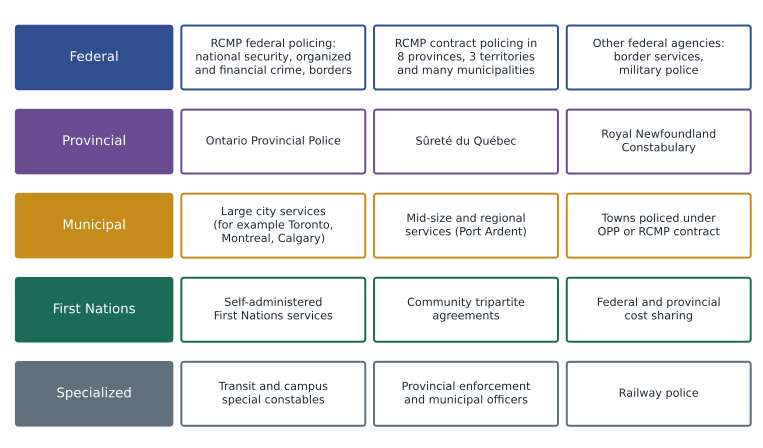
Federal policing: the RCMP
The Royal Canadian Mounted Police is governed by the Royal Canadian Mounted Police Act and led by a commissioner who reports to the Minister of Public Safety. It has two very different jobs. Its federal policing program investigates national security threats, serious and organized crime, money laundering, cybercrime and financial crime, protects dignitaries and works with international partners. Its contract policing program provides provincial or territorial policing in every province except Ontario and Quebec and in all three territories, and municipal policing under contract in more than 150 municipalities. In those areas, an RCMP officer in a patrol car is doing exactly the work a municipal officer does in Port Ardent.
Contract policing is under review. Provinces and municipalities complain about rising costs, vacant positions and limited local control, and Public Safety Canada completed an assessment of contract policing in 2024. The current police service agreements run until 2032, and some communities have chosen to leave: Surrey, British Columbia, replaced the RCMP with its own municipal police service, and other communities and provinces, including Alberta, have studied or begun building alternatives. Priya's interest in financial crime points toward federal policing, which recruits specialists such as forensic accountants as well as regular members.
Provincial police
Three provinces have their own provincial police. The Ontario Provincial Police polices rural areas and highways, provides policing under contract to hundreds of smaller Ontario municipalities that choose not to run their own service, patrols provincial highways and waterways and investigates major crimes across the province. The Sûreté du Québec plays a similar role in Quebec, and the Royal Newfoundland Constabulary polices St. John's and some other urban areas of Newfoundland and Labrador while the RCMP polices the rest. Around Port Ardent, the OPP detachment covers the surrounding townships, and its officers and the city service back each other up on serious calls.
Municipal police services
Most Canadians live in cities policed by municipal police services. The largest, such as the Toronto Police Service with more than five thousand officers, have hundreds of specialized units, from homicide to marine. Mid-size services such as Port Ardent's provide patrol, investigations, traffic and community programs, and call on the OPP or larger services for specialized help. Under Ontario's Community Safety and Policing Act, a municipality must provide adequate and effective policing in one of a few ways: by maintaining its own police service, sharing a service with other municipalities, or having the OPP provide it. Each municipal service is governed by a police service board, which lesson 6 examines.
Specialized police and enforcement officers fill the gaps. Special constables have limited police powers for particular settings, such as transit systems, university campuses and courthouses. Railway police employed by the national railways have police powers on and near railway property. Military police serve the Canadian Armed Forces. Border services officers, by-law officers and provincial conservation officers enforce particular laws but are not police services in the full sense. Linh notes that some of these jobs are civilian or limited-power roles that might suit people who want to work in public safety without full police duties.
First Nations policing
Since the federal First Nations Policing Policy of 1991, now the First Nations and Inuit Policing Program, the federal government and the provinces have shared the cost of police services for First Nations and Inuit communities, with the federal government paying 52% and the province or territory 48%. Communities can have a self-administered police service, run by a First Nation or group of First Nations with its own officers and police governing authority, or a community tripartite agreement under which dedicated RCMP or OPP officers serve the community. Ontario has the largest number of self-administered services, including the Nishnawbe-Aski Police Service, which serves dozens of First Nations across the far north, many reachable only by air or winter road. Inquests and reviews have repeatedly found these services underfunded and unable to offer the equipment, buildings and backup that other services take for granted. Ontario's 2019 act allows First Nations to opt into the provincial framework, and the federal government has promised legislation recognizing First Nations policing as an essential service.
Jesse's own community, Nimkii Bay First Nation, is served by the Nimkii Bay Anishinaabe Police Service, a self-administered service with fourteen officers that covers a reserve of about 2,400 people. Its officers do patrol, investigations, community programs and search and rescue, and they rely on the OPP for specialized units. Jesse wants to work there because he believes police who know the language, families and history of a community can do things outsiders cannot. Professor Desjardins agrees, and adds that this course will return to the history behind Indigenous communities' wariness of police in lesson 4.
Cooperation across agencies
Because crime ignores boundaries, agencies constantly work together. Integrated units combine officers from several services, such as joint forces operations against organized crime and integrated national security enforcement teams led by the RCMP. Police services share information through the Canadian Police Information Centre (CPIC), the national database of wanted persons, stolen property and criminal records that the RCMP maintains for all police. Mutual aid agreements let services lend each other officers for emergencies and major events. Cooperation is not automatic. Agencies compete for resources and credit, use different radio systems and records software, and sometimes disagree about who is responsible for a call near a boundary. Several major inquiries into mass casualty events have found that weak communication between agencies cost precious time.
# Police officers per 100,000 residents by province and territory, 2025 (Statistics Canada)
rates = {
    "Newfoundland and Labrador": 158, "Prince Edward Island": 141, "Nova Scotia": 174,
    "New Brunswick": 159, "Quebec": 195, "Ontario": 178, "Manitoba": 175,
    "Saskatchewan": 191, "Alberta": 162, "British Columbia": 161,
    "Yukon": 319, "Northwest Territories": 427, "Nunavut": 366,
}
national = 180
for place, r in sorted(rates.items(), key=lambda kv: -kv[1]):
    marker = "above" if r > national else "below"
    print(f"{place:26s} {r:4d}  {marker} national rate, {r / national:.2f} times")
provinces = [r for p, r in rates.items() if p not in ("Yukon", "Northwest Territories", "Nunavut")]
print(f"range among provinces: {min(provinces)} to {max(provinces)}")Northwest Territories 427 above national rate, 2.37 times Nunavut 366 above national rate, 2.03 times Yukon 319 above national rate, 1.77 times Quebec 195 above national rate, 1.08 times Saskatchewan 191 above national rate, 1.06 times Ontario 178 below national rate, 0.99 times Manitoba 175 below national rate, 0.97 times Nova Scotia 174 below national rate, 0.97 times Alberta 162 below national rate, 0.90 times British Columbia 161 below national rate, 0.89 times New Brunswick 159 below national rate, 0.88 times Newfoundland and Labrador 158 below national rate, 0.88 times Prince Edward Island 141 below national rate, 0.78 times range among provinces: 141 to 195
The output shows that the three territories have by far the highest rates, because small populations are spread across enormous areas, and every community needs officers within reach regardless of how few people live there. Among the provinces, Quebec and Saskatchewan have the highest rates and Prince Edward Island the lowest. A rate alone does not tell you whether a place is well policed: geography, crime levels, the number of calls and how officers are deployed all matter.
Jurisdiction in practice: a call near a boundary
Professor Desjardins illustrates jurisdiction with a story. Late one winter night, a driver on the highway just outside Port Ardent's city limits called 911 to report a car swerving between lanes. The call reached the OPP communications centre, because the highway is OPP territory. The car then took the exit into the city and stopped at a gas station, where Port Ardent officers arrived first. The OPP officer arrived a few minutes later. The two agreed on the spot that the city officer would conduct the impaired driving investigation, because the driving that mattered most had continued into the city and the city officer had seen it, while the OPP officer took a statement from the caller. Nobody argued, because the agencies had worked together for years and had a written agreement on handovers. Professor Desjardins says that boundaries cause trouble when there is no such agreement, when radio systems cannot talk to each other or when two agencies each assume the other is handling a call.
Boundary questions also arise in investigations. A string of break-ins may cross several jurisdictions, a fraud may involve victims in many provinces or states, and an online threat may come from another country. In such cases, agencies decide who will lead, often the one with the most victims or the specialized unit, and others contribute officers and information. Priya recognizes this from her bank fraud work, where she sometimes sent the same evidence package to three different agencies before one agreed to take the case.
Policing the North shows how geography shapes jurisdiction. In the territories and in the far north of Ontario and other provinces, many communities have no road access, a detachment may have only two or three officers, and backup can be hours away by air. Officers there do work that city officers never see, such as search and rescue on the land and ice, and they live in the communities they police. The high rates of officers per resident in the territories, which the code shows, reflect these realities rather than a surplus of police.
Canada also has police and enforcement officers whose work overlaps with policing in less visible ways. Conservation officers enforce fish and wildlife laws and carry firearms. Provincial highway safety inspectors enforce commercial vehicle rules. Municipal law enforcement officers enforce by-laws on noise, parking, property standards and animals, and in many cities they now take calls that once went to police. Corrections officers, sheriffs' officers in some provinces who handle court security and prisoner transport, and private security guards, who outnumber police in Canada, all contribute to public safety without being police officers in the full sense. Linh notes that some of these careers might suit people who want to work in public safety without carrying full police powers, and Professor Desjardins agrees that the program prepares students for many of them.
Worked problem
Choosing a model for a growing town
A town of 18,000 near Port Ardent is reviewing its OPP contract, which costs 5.4 million dollars a year for the equivalent of 27 officers and support. A consultant estimates that a town police service of 30 officers would cost 6.9 million dollars a year, plus 4 million dollars to set up. What is the cost per resident of each option, and what else should council consider?
Show solution
- OPP contract: 5,400,000 / 18,000 = 300 dollars per resident per year.
- Town service: 6,900,000 / 18,000 = 383 dollars per resident per year, plus 4,000,000 / 18,000 = 222 dollars per resident in setup costs.
- The difference is 83 dollars per resident each year, or about 1.5 million dollars in total.
- Council should also weigh local control and accountability, response times, the specialized units each option provides, how costs might rise, and what residents want.
Answer: The OPP contract is cheaper by about 83 dollars per resident each year, before setup costs. A town service would offer more local control, which is the main argument communities make for leaving contract policing.
Common mistakes
MistakeThere is one national police force that does all police work.
InsteadPolicing is divided among federal, provincial or state, local and Indigenous agencies, each with its own jurisdiction.
MistakeThe RCMP only does federal work.
InsteadThe RCMP also provides contract policing in eight provinces, three territories and many municipalities.
MistakeEvery community has the same level of policing.
InsteadRates of officers per resident vary widely with geography, population, crime and funding.
MistakeFirst Nations police services have the same resources as other services.
InsteadReviews have repeatedly found First Nations services underfunded compared with other services.
Summary and key terms
- Policing is divided among levels of government because of constitutional rules and history.
- The RCMP does federal policing and provides contract policing in most provinces and the territories; Ontario, Quebec and Newfoundland and Labrador have provincial police.
- Municipalities provide most urban policing, either through their own services or contracts.
- First Nations policing is cost-shared and delivered by self-administered services or tripartite agreements, which have long been underfunded.
- Agencies cooperate through shared databases, joint task forces and mutual aid, but cooperation is not automatic.
- Rates of officers per 100,000 residents vary widely and must be read alongside geography, crime and workload.
- Jurisdiction
- The area and types of offences for which an agency has legal authority.
- Contract policing
- An arrangement in which a province or municipality pays the RCMP or OPP to provide its policing.
- Self-administered service
- A First Nations police service run by a First Nation or group of First Nations with its own officers.
- Special constable
- An officer with limited police powers for a particular setting, such as transit or a campus.
- Mutual aid
- An agreement under which agencies lend each other officers and resources.
- CPIC
- The Canadian Police Information Centre, a national police database maintained by the RCMP.
Practice problems
Work each problem on paper first, then reveal the answer to check.
Why is policing divided among several levels of government?
Show answer
Criminal law is federal but the administration of justice, including policing, is provincial; provinces in turn require municipalities to provide policing.
Using the code output, which province has the highest rate of officers per 100,000, and why might the territories be higher still?
Show answer
Quebec, at 195; the territories have small populations spread over vast areas, so every community needs officers within reach.
Give one advantage and one disadvantage of a small community running its own police department.
Show answer
Advantage: local control and accountability. Disadvantage: higher cost per resident and fewer specialized units.
Name two ways agencies cooperate.
Show answer
Shared databases, joint task forces or integrated units, mutual aid agreements.
Lesson quiz · 5 questions
Score 60% or more to complete this lesson.
Create a free account to save your progress, take quizzes and earn a certificate.