
LES-101 · Lesson 2 of 12 · 19 min
The criminal justice system: police, courts and corrections
▶ Video coming soon A video version of this lesson is on the way.
In the second week, Professor Desjardins draws a long line across the whiteboard. At the left end he writes 'a window is smashed at 2 a.m.' and at the right end 'a person walks out of prison'. Between the two, he says, sits a chain of decisions made by dozens of people in several institutions, most of whom never meet each other. The police are the gatekeepers of this chain, but they control only the first links. Amara asks why so many cases she reads about in the news seem to end with charges dropped. By the end of the class she has her answer: the justice system is designed to filter cases at every stage, and understanding those filters is essential to understanding what police can and cannot achieve.
A system, or a set of separate agencies?
People speak of the criminal justice system, but its parts are independent by design. In the United States, each state has its own criminal code, police, prosecutors, courts and prisons, and the federal government has a separate system for federal crimes. Within a state, power is spread further: city police departments, county sheriffs, elected county prosecutors, county jails, state courts and state prisons all answer to different elected officials. Ohio alone has municipal courts, county courts, courts of common pleas and even mayor's courts in some villages and cities. Each agency has its own budget, its own leaders and its own priorities. Decisions in one part ripple through the others, but no single person is in charge of the whole.
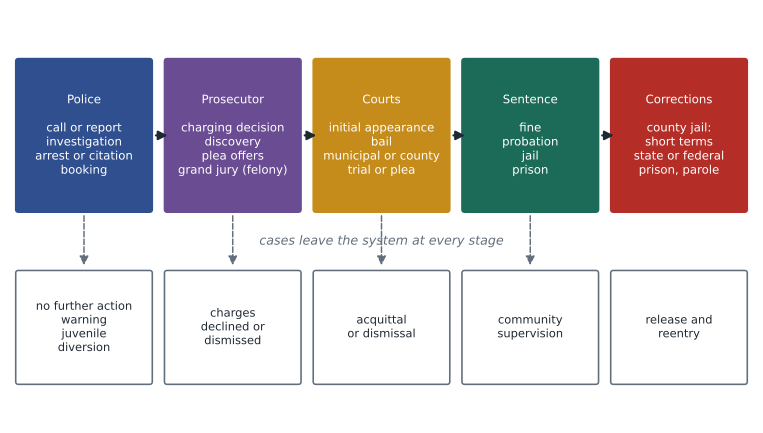
This separation is deliberate. Police investigate and charge or refer cases, but an independent prosecutor decides whether to proceed, an independent judge decides guilt and sentence, and correctional officials carry out the sentence. Each stage is a check on the one before it. A police officer may be convinced a suspect is guilty, but that belief must survive the scrutiny of a prosecutor, a defense attorney, a judge and sometimes a jury. Professor Desjardins tells the class that some of the hardest moments of his career were cases where he believed someone was guilty and the evidence did not meet the standard. 'That's the system working,' he says, 'even when it doesn't feel like it.'
Stage one: police
The process usually begins when someone calls the police, or when an officer sees something on patrol. Most crime never reaches the police at all. The National Crime Victimization Survey, run by the Bureau of Justice Statistics, regularly finds that fewer than half of violent victimizations and roughly a third of property victimizations are reported to police. Victims stay silent because the incident seemed minor, because they dealt with it another way, because they feared retaliation or because they did not believe the police could or would help. This gap between all crime and police-reported crime is sometimes called the dark figure of crime, and you will study it in the criminology course.
When a crime is reported, police record it, investigate and decide what to do. They may take no further action if there is no evidence or no offense. They may resolve it informally with a caution or a referral. For juveniles, most states encourage diversion to programs instead of formal processing, and juvenile courts handle young people separately from adults. If police have reasonable grounds to believe an offense was committed by a particular person, they can arrest or require the person to attend court. In most American jurisdictions, police make arrests and present the case, and the prosecutor decides which charges to file; serious felonies may also go before a grand jury. A case is said to be cleared or solved when police identify a suspect and have enough evidence to charge, even if the charge is later dropped.
Stage two: prosecution
The prosecutor is the most powerful decision-maker most people never think about. Prosecutors in the United States are usually elected county officials, such as the Lucas County Prosecutor in Toledo, and they have very wide discretion over which charges to file, whether to offer a plea agreement and whether to dismiss. Federal and state rules require them to disclose evidence favorable to the accused, a duty established in Brady v. Maryland (1963). Most criminal convictions in the United States result from guilty pleas rather than trials, typically as part of a plea agreement. A charge may be withdrawn, stayed or diverted to a program at this stage, which is why many cases that begin with an arrest never reach trial.
Stage three: the courts
After arrest, a person must be brought promptly before a judge or magistrate for an initial appearance, where the charges are read and bail or other release conditions are set. Many states, including Ohio, have reformed bail to rely less on cash; the Ohio Supreme Court changed its rules in 2020 to require courts to consider release with the least restrictive conditions. Misdemeanors are usually heard in municipal or county courts; felonies go to the court of common pleas in Ohio. The Sixth Amendment guarantees a speedy trial, and Ohio's speedy trial statute requires a felony trial within 270 days of arrest, with each day spent in jail counting as three. At trial the prosecution must prove guilt beyond a reasonable doubt, the accused is presumed innocent and does not have to testify, and evidence obtained in breach of constitutional rights may be excluded. These rules exist because a wrongful conviction is considered a far worse outcome than a wrongful acquittal.
The courts also decide sentence. Sentencing in Ohio follows statutory ranges for each degree of felony and misdemeanor, and judges must consider the purposes of protecting the public, punishing the offender and promoting rehabilitation using the minimum sanctions that accomplish those purposes. Federal courts use the United States Sentencing Guidelines, which have been advisory since 2005. Options range from a discharge or fine through probation and community supervision to custody.
Stage four: corrections
In the United States, county jails hold people awaiting trial and those serving short sentences, usually under a year, while state and federal prisons hold people serving longer sentences. Ohio's Department of Rehabilitation and Correction runs the state's prisons. Probation and parole supervise far more people than are incarcerated. The United States has one of the highest incarceration rates in the world, with close to two million people held in jails and prisons, and Black Americans are imprisoned at several times the rate of white Americans. Corrections is the stage police see least, but it affects them directly. People released without housing, treatment or support often come back into contact with police, and some of the most persistent calls in any city involve the same small group of people cycling through jail, hospital and the street.
Two models of criminal justice
The law professor Herbert Packer described two models that help explain debates about the system. The crime control model emphasizes efficiency: it sees the system as an assembly line that should quickly identify the guilty, process them and protect the public, trusting police and prosecutors to screen out the innocent early. The due process model emphasizes reliability and rights: it sees the system as an obstacle course, with every stage designed to test the evidence and protect the individual from the power of the state. Neither model describes a real system exactly. Real systems blend both, and arguments about bail, disclosure, delay, police powers and plea bargaining are often arguments about where to strike the balance between them.
Professor Desjardins asks the students where they stand. Marco leans toward crime control: he wants offenders off the street. Linh leans toward due process: she has seen what happens when people are treated as guilty before they are proven so. Priya points out that in her bank fraud work, careful evidence gathering was what made prosecutions succeed, so due process and effective crime control are not always opposites. That is a good point to end the discussion, Professor Desjardins says, because police officers who understand both models make better decisions than those who cling to one.
What the funnel means for police
The filtering at each stage creates what criminologists call the justice funnel. Starting from all crimes committed, only a share is reported, only some reported crimes are solved, only some solved cases lead to charges that proceed, only some charges end in conviction and only some convictions lead to custody. The numbers in the code below are illustrative, roughly the right order of magnitude for property and minor violent crime in both countries, and they make the point that police decisions at the start of the funnel shape everything that follows.
# An illustrative justice funnel: how 1,000 incidents shrink at each stage.
stages = [
    ("incidents that occur", 1.00),
    ("reported to police", 0.35),
    ("solved: suspect identified", 0.30),
    ("charge proceeds after review", 0.70),
    ("conviction or guilty plea", 0.65),
    ("custody sentence", 0.30),
]
count = 1000.0
for name, rate in stages:
    count *= rate
    print(f"{name:32s} {count:7.1f}")
print(f"share of incidents ending in custody: {count / 1000:.1%}")incidents that occur 1000.0 reported to police 350.0 solved: suspect identified 105.0 charge proceeds after review 73.5 conviction or guilty plea 47.8 custody sentence 14.3 share of incidents ending in custody: 1.4%
Only about six or seven incidents in a thousand end in custody under these assumptions. Small changes early in the funnel matter a great deal. If reporting rose from 35% to 45% because people trusted the police more, every later stage would grow by almost 30%. If poor investigation or a breach of rights caused more charges to collapse, all the work before that point would be wasted. This is why legitimacy, careful note-taking, respect for rights and good evidence handling are practical skills, not just ideals.
Victims in the justice system
For much of the twentieth century, victims were treated mainly as witnesses for the state. The prosecution was brought in the name of the people or the state, and victims had little say and little information. Since the 1980s, both countries have recognized victims' rights more formally. Most states have added victims' rights to their constitutions or statutes. Ohio voters approved Marsy's Law in 2017, which gives victims constitutional rights to information, notice of proceedings, to be present and heard at key stages, to privacy and to restitution. Port Ardent's department employs victim advocates who contact victims after serious crimes and help them through the court process. Police are usually the first official a victim meets, and how that first contact goes shapes whether the victim stays involved in a long and often frustrating process. Professor Desjardins tells the class that the most common complaint he heard from victims was not about the outcome of a case but about never being told what was happening.
Worked problem
Delay and the right to a timely trial
A person is arrested for a felony in Ohio and held in the county jail for 85 days before being released on bond, then waits a further 40 days at liberty. How many days count toward the 270-day limit?
Show solution
- Each day in jail counts as three, so 85 days in jail count as 255 days.
- The 40 days at liberty count once each, so the total is 255 + 40 = 295 days.
- The statutory limit is 270 days, so the count has passed it unless time was extended or tolled, for example by defense motions or continuances requested by the defense.
- If no tolling applies, the defense can move to discharge the accused for violation of the speedy trial statute.
Answer: The count is 295 days, over the 270-day limit unless time was tolled. Delays in police reports and lab results can cause cases to fail, so prompt, complete files matter.
Common mistakes
MistakePolice decide whether a person is guilty.
InsteadPolice investigate and charge or refer; prosecutors decide whether to proceed and courts decide guilt.
MistakeMost crimes are reported to police.
InsteadVictimization surveys show that most incidents are never reported.
MistakeA withdrawn or dismissed charge means the police got it wrong.
InsteadCharges end for many reasons, including evidence problems, diversion, the public interest or witnesses who do not appear.
MistakeDue process and crime control are always opposed.
InsteadCareful evidence gathering and respect for rights also make prosecutions succeed.
Summary and key terms
- The criminal justice system is made up of independent agencies: police, prosecutors, courts and corrections.
- Each stage checks the previous one, so cases leave the system at every point, producing a funnel.
- Most crime is never reported to police; reporting depends partly on public trust.
- Elected prosecutors decide on charges and plea agreements; bail reform, speedy trial rules and sentencing ranges shape what follows.
- Packer's crime control and due process models describe the tension between efficiency and protecting rights.
- Good police work at the start of the funnel, including evidence handling and respect for rights, determines whether cases succeed later.
- Criminal justice system
- The police, prosecutors, courts and correctional agencies that respond to crime.
- Dark figure of crime
- Crime that occurs but is never reported to or recorded by police.
- Cleared case
- A case in which police have identified a suspect and have grounds to charge.
- Diversion
- Directing a person away from formal prosecution to a program or other response.
- Crime control model
- A view of justice that stresses efficient processing of offenders to protect the public.
- Due process model
- A view of justice that stresses testing the evidence and protecting the rights of the accused.
Practice problems
Work each problem on paper first, then reveal the answer to check.
Why might a victim decide not to report a crime to police?
Show answer
Examples: they thought it was minor, dealt with it privately, feared retaliation or did not believe police would help.
In the funnel code, what share of incidents ends in custody if the reporting rate rises to 0.45?
Show answer
1000 × 0.45 × 0.30 × 0.70 × 0.65 × 0.30 = 18.4, so about 1.8%.
Which model of justice would favor quick guilty pleas, and which would favor full disclosure and testing of evidence?
Show answer
Crime control favors quick pleas; due process favors disclosure and testing of evidence.
Give one way police work affects the corrections stage.
Show answer
Examples: decisions about charges and diversion determine who enters corrections; police meet released people again when support fails.
Lesson quiz · 5 questions
Score 60% or more to complete this lesson.
Create a free account to save your progress, take quizzes and earn a certificate.