
IRW-120 · Lesson 6 of 12 · 27 min
Choker, basket and vertical hitches
▶ Video coming soon A video version of this lesson is on the way.
Later on the October 15 rigging night, Carla laid three slings of the same size side by side and rigged the same short beam three ways: hanging from one sling in a straight vertical hitch, choked around its middle, and cradled in a basket. "Same sling, three different capacities," she said, and pointed to the tag, which listed all three. "The tag is telling you that a sling is only as strong as the way you use it." A hitch is the way a sling is attached to a load. TRD-105 showed the three basic hitches; this lesson looks at how ironworkers use them on steel and how each one changes the sling's capacity.
The three basic hitches
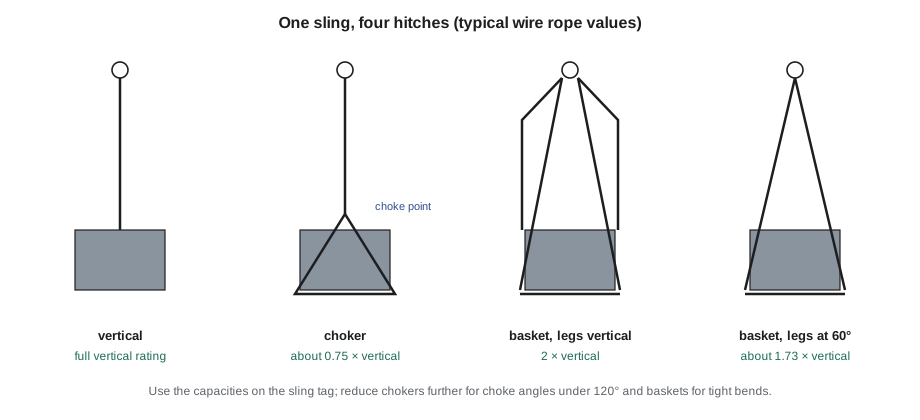
- A vertical hitch attaches the load to one end of the sling, through an eye, a shackle or a hook, with the sling hanging straight. It gives the sling's full rated capacity, called its vertical rated capacity, but it gives no control: a load on a single vertical leg can spin freely.
- A choker hitch passes the sling around the load and back through its own eye, or through a choker hook or shackle, so it tightens around the load as it takes the weight. It grips, which makes it the ironworker's everyday hitch for beams, columns lying flat and bundles. It reduces the sling's capacity, because the rope is bent sharply at the choke point.
- A basket hitch cradles the load with both ends of the sling on the hook. With both legs vertical, it carries twice the vertical rated capacity, if the load is held so it cannot roll out. When the legs spread, the capacity falls with the angle, exactly as for a two-leg bridle.
Choker hitches on steel
For a wire rope sling, a choker hitch is typically rated at about 75 in 100 of the vertical rating, as long as the angle of choke, the angle the sling makes where it passes through its own eye, is 120 degrees or more. The tag gives the maker's choker rating, and that is the figure to use. When the choke is pulled tighter, so that the angle of choke is smaller, the capacity falls further. A typical reduction applied to the choker rating is to about 87 in 100 for a choke angle of 90 to 119 degrees, about 74 in 100 for 60 to 89 degrees and about 62 in 100 for 30 to 59 degrees. Follow the maker's table for the sling being used.
A choke angle smaller than 120 degrees happens when the choke is forced down against the load, usually by a rigger hammering the eye or pulling on the sling before the crane takes the weight. Let the choke form naturally as the sling tightens. Never hammer a choker down.
Worked problem
A choker on a beam
A single-leg wire rope sling has a vertical rated capacity of 7,800 lb. What is its capacity in a choker hitch, using the typical 75 in 100? If the choke angle on a beam is about 100 degrees, what capacity should the rigger use?
Show solution
- Choker rating: 7,800 × 0.75 = 5,850 lb (the tag would show this, rounded).
- Choke angle of 90 to 119 degrees: about 87 in 100 of the choker rating.
- Reduced: 5,850 × 0.87 ≈ 5,090 lb.
Answer: About 5,090 lb, about two thirds of the sling's vertical rating. A beam of 808 lb is well inside it.
Chokers on steel need some care to grip and to protect the sling.
- Choke on the web or around the whole section, not on the edge of a flange where the sling bends sharply and can slide off.
- Put the choke on the side of the piece that will be up when it is set, so the sling pulls free easily once the piece is connected.
- Protect the sling at flange tips and sharp corners with softeners, rubber pads, split hose or corner protectors.
- Use a choker hook or a shackle at the choke point when the sling will be released by the connectors at height. A sliding choker hook lets the connectors unhook without lifting the choke over a flange.
- Do not choke one sling over another unless the hitch is designed for it, and do not let the eye of a choker bear on the load.
When a beam is picked with one choker, it hangs at an angle unless the choke is exactly at the CG and the beam is uniform. Connectors want beams level, so most beams on a steel job are picked with two chokers used as a two-leg bridle, or with a single choker placed carefully at the CG and tested.
Double chokers and double wraps
A double choker uses two slings, each choked around the load, with their eyes on the hook. It forms a two-leg bridle, and each leg's capacity is its choker rating reduced for the sling angle. It is the usual way to pick a long beam level and to control a load that might roll.
A double-wrap choker passes the sling around the load twice before choking it. The two wraps grip much better, which makes the double wrap the right choice for bundles of loose pieces, such as bracing angles, pipe, rebar or joist bridging, because a single choker can let pieces slide out of the middle of a bundle. A double-wrap basket does the same for a cradled bundle.
Worked problem
A double choker on a long beam
A 3,000 lb girder is picked with two chokers forming a two-leg bridle at 60 degrees. Each sling has a choker rating of 5,850 lb, and the chokes are formed naturally. Is each leg within its rating?
Show solution
- Vertical share of each leg: 3,000 ÷ 2 = 1,500 lb.
- Tension at 60 degrees: 1,500 × 1.155 ≈ 1,732 lb.
- 1,732 lb is well below the choker rating of 5,850 lb.
Answer: Each leg carries about 1,730 lb, less than a third of its choker rating.
Basket hitches
A basket hitch has the highest capacity of the three, but it is the one most often misused. It holds a load only by cradling it, so a load that can roll, slide or tip out of the basket is not safe in a single basket. Round loads such as pipe, and bundles that may shift, are better in double-wrap baskets or chokers. Flat loads with a CG well inside the basket and two baskets spaced apart, so the load cannot tip, are suitable.
With both legs vertical, the capacity is twice the vertical rating, but only if the bend around the load is large enough. Lesson 2 showed that wire rope loses strength when it bends around a small diameter; a basket hitch around a small pin or a sharp edge must be reduced. When the legs of a basket spread at an angle, the capacity is reduced by the sine of the angle, just as with a bridle.
Worked problem
A basket at an angle
A single sling with a vertical rated capacity of 7,800 lb is used in a basket hitch with both legs at 60 degrees, bending around a large, rounded load. What is the basket capacity?
Show solution
- Basket with vertical legs: 2 × 7,800 = 15,600 lb.
- At 60 degrees: 15,600 × sin 60° = 15,600 × 0.866 ≈ 13,510 lb.
Answer: About 13,500 lb, provided the load cannot roll out and the bend is not sharp.
Choosing a hitch for common ironwork picks
| Piece | Usual rigging | Why |
|---|---|---|
| Column | Shackle through the lifting hole or lug near the top, vertical hitch | The column must hang plumb to be stood on its anchor rods |
| Simple beam | Two chokers as a bridle, or one choker at the CG | The beam must arrive level, and the connectors must be able to unhook |
| Long, light beam or joist | Spreader bar with vertical drops, choked at the points the maker shows | Avoids squeezing and buckling the piece |
| Bundle of angles or bridging | Two double-wrap chokers | Grips loose pieces so they cannot slide out |
| Deck bundle | Two baskets or chokers at the maker's marked points, with spreader if long | Keeps the bundle flat and the sheets together |
| Bolt kegs and small parts | A rated material basket or skip box | Loose items must be contained |
| Truss | Engineered pick points, often with a spreader | Trusses are unstable sideways and must be picked as designed |
Small parts, bolts, tools and welding leads are never sent up loose, in a bucket with no lid or on top of a beam. They go up in rated baskets, boxes or bags made for lifting, closed so nothing can fall out. A bolt dropped from three stories is a lethal object.
Deck bundles
Metal deck bundles are long, flat and heavy, and they have large surfaces that catch the wind. Deck makers mark the bundles with the points where slings should go and the weight of the bundle. They are usually picked with two slings in baskets or chokers at the marked points, sometimes with a spreader bar for long bundles, and landed on the steel only where the erection drawings allow, across beams near their supports, never at mid-span of a single joist or beam. The banding on a deck bundle is for shipping and must not be used to lift the bundle.
Subpart R requires deck bundles to be landed on framing members with enough support that they can be unbanded without being dislodged, and requires decking to be secured against displacement at the end of a shift or when wind or other conditions call for it; bundles placed on joists must also follow the joist rules. Crossbeam does not cut the banding until the bundle is secured.
Releasing the rigging
A hitch must be released as safely as it was made. Connectors release beams at height only after the minimum connection is made (lesson 11), using a choker hook, a shackle or a sliding hook so the sling can be freed without climbing out along the beam. A choke that is trapped under a landed load is never pulled out by the crane. Land loads on blocking or dunnage so slings can be removed by hand, and keep hands clear when the crane lifts the empty slings.
Synthetic slings on finished steel
Galvanized, painted and stainless steel, and architecturally exposed steel that will be seen in the finished building, are often rigged with synthetic web slings or round slings, which do not mark the finish. They have the same hitches and the same kinds of capacity reductions as wire rope, from their own tags, but they need more care on steel. A synthetic sling has almost no resistance to a sharp edge: a flange tip under load can cut through a round sling's cover and its core in an instant. Every edge a synthetic sling touches gets a protector made for the purpose, and the sling is inspected before each use for cuts, burns, snags and exposed core yarns.
Chain slings sit at the other end of the scale. Grade 80 or Grade 100 alloy chain resists edges and heat, adjusts in length with grab hooks, and lasts for years. It is heavy and can mark finished surfaces, and its links can be damaged by being hammered or bent around tight corners. Chain chokers on steel are common for rough work such as handling scrap, unloading heavy plate and rigging dunnage.
Choosing the hitch with the connector in mind
Every hitch must eventually be released, usually by a connector at height with one hand free. Before rigging a piece, the hooker-on asks how the connector will get it off. A shackle pin that must be unscrewed above the head, a choke trapped between a beam and its seat, or a basket wrapped under a beam that will bear on its flange are all hitches that look fine on the ground and cause trouble at the top. The usual answers are sliding choker hooks, shackles placed where they can be reached from the steel, and chokes placed on the top flange side.
Worked problem
Checking a choker on a bundle
A bundle of 12 bracing angles weighs 1,200 lb. It is picked with two double-wrap chokers forming a two-leg bridle at 60 degrees. Each sling's choker rating is 3,300 lb. What is the tension in each leg, and is it within the rating?
Show solution
- Vertical share: 1,200 ÷ 2 = 600 lb.
- Tension: 600 × 1.155 = 693 lb.
- 693 lb is well below 3,300 lb.
Answer: About 693 lb per leg, well within the rating. For bundles, the grip of the hitch matters more than its capacity.
Common mistakes
MistakeUsing the vertical rating for a choker hitch.
InsteadUse the choker rating on the tag, reduced further if the choke angle is under 120 degrees.
MistakeHammering a choke down tight.
InsteadLet the choke form as the sling takes the weight.
MistakeLifting a bundle of loose angles with a single choker.
InsteadUse double-wrap chokers so pieces cannot slide out.
MistakeUsing a single basket for a load that can roll.
InsteadUse chokers, double wraps or two spaced baskets that prevent rolling.
MistakeLifting a deck bundle by its shipping bands.
InsteadUse slings at the maker's marked points.
MistakeSending bolts up loose on a beam.
InsteadUse a rated, closed basket or bag.
Summary and key terms
- A vertical hitch gives the full vertical rating but no control over spin.
- A choker hitch grips the load; for wire rope it is typically rated at about 75 in 100 of vertical, less if the choke angle is under 120 degrees.
- A basket hitch with vertical legs carries twice the vertical rating, reduced by the sine of the angle when legs spread and by the D/d ratio at tight bends.
- Double chokers lift long pieces level; double-wrap chokers grip bundles of loose pieces.
- Columns hang from lifting holes or lugs; long, light members and trusses need spreaders or engineered pick points.
- Loose parts go up only in rated, closed containers.
- Vertical hitch
- A hitch in which the load hangs from one end of a straight sling.
- Choker hitch
- A hitch in which the sling passes around the load and through its own eye, tightening as it lifts.
- Basket hitch
- A hitch in which the sling cradles the load with both ends on the hook.
- Angle of choke
- The angle formed where a choker passes through its own eye.
- Double-wrap choker
- A choker hitch in which the sling passes twice around the load for a better grip.
- Softener
- Padding between a sling and a sharp edge that protects the sling and the load.
Practice problems
Work each problem on paper first, then reveal the answer to check.
A sling's vertical rating is 4,400 lb. What is its typical choker rating?
Show answer
4,400 × 0.75 = 3,300 lb.
The same sling is choked at 70 degrees. Using the typical reduction, what capacity applies?
Show answer
3,300 × 0.74 = 2,442 lb.
What is its basket rating with vertical legs? With legs at 45 degrees?
Show answer
8,800 lb; 8,800 × 0.707 ≈ 6,222 lb.
Which hitch is best for a bundle of loose bridging angles?
Show answer
Double-wrap chokers.
Why is the choke placed on the side of a beam that will be up when set?
Show answer
So the connectors can release the sling easily after the connection.
Lesson quiz · 5 questions
Score 60% or more to complete this lesson.
Create a free account to save your progress, take quizzes and earn a certificate.