
IRW-120 · Lesson 11 of 12 · 23 min
Tag lines, landing loads and multiple-lift rigging
▶ Video coming soon A video version of this lesson is on the way.
The last rigging night, on November 12, was held on the Ashcroft site itself, the day before the deck and detailing crew finished. Carla took the apprentices up to the third floor, where they could see the whole frame and the crane's two setups below them. "Everything we have done so far gets a piece into the air," she said. "Tonight is about the last three meters: controlling it, landing it, and letting go of it." Most injuries in steel erection happen near the end of a lift, at the landing point, where the load, the steel and the connectors' hands all come together.
Tag lines
A tag line is a rope fixed to a load and held by a worker on the ground or the steel, to stop the load spinning and to guide it as it swings. It lets a worker control a load from a safe distance, outside the load's path and well away from underneath it.
OSHA's crane rule requires non-conductive tag lines when working near power lines, and ASME B30.5 calls for tag lines wherever rotation of the load could be hazardous. Crossbeam uses at least one tag line on every pick and two on long pieces, and keeps them on until the load is landed and stable.
- Use rope of a size that can be gripped and is strong enough to check the load, typically ½ to ⅝ in natural or synthetic fiber, dry and clean. Near power lines, use non-conductive rope and keep it dry.
- Tie the tag line to the load with a knot that will not slip and can be released, or use a tag line clip. Fix it to the piece, not to the rigging.
- Fix the tag line at the end of the piece, so it has the most leverage against rotation.
- Hold the tag line by hand. Never wrap it around a hand, wrist or body, and never tie it off to a fixed object while the load is moving. A load that swings out will drag a worker with it.
- Stand where you can let go: outside the load path, away from the edge of the steel, with a clear place to step back to.
- If the load starts to pull you, let go. The tag line is a guide, not a brake. A worker cannot hold a load of steel that the wind or the crane's swing wants to move.
Tag lines can be hazards too. A long tag line trailing from a piece can catch on steel or on a worker, and a tag line held by a worker on the steel at height can pull them off balance. At height, Crossbeam uses short tag lines or tag poles, and the connectors are tied off before they take hold of one.
Controlling the swing
A load starts to swing when the crane starts or stops a motion too quickly, when the wind pushes it, or when it is picked up off center. The operator controls most swing with smooth, slow motions. The tag line handlers check rotation and small swings early, before they grow. A load that swings more than a little is stopped and allowed to settle before it continues toward the steel; it is not grabbed by the connectors.
Connectors must not reach for a load until it is close, slow and under control. A beam swinging into the steel at walking speed has enough energy to break bones and push a connector off a column.
Landing loads
Landing a load means setting it down where it will stay. On the ground, loads are landed on blocking, dunnage or cribbing, so that the slings can be pulled out by hand and the piece does not sit on uneven ground. On the steel, a piece is landed in its connection: a beam on its seat or between its clip angles, a column on its anchor rods, a brace onto its gusset plates.
- Plan the landing point before the pick, with blocking or cribbing ready.
- Lower slowly in the last few feet, with the signal person calling small movements.
- Keep hands and feet out of the bite: never between the load and the blocking, the steel or another load.
- Never stand under a load or between a load and a fixed object while it is being landed.
- Check the load is stable on its landing before slacking the hook. A load that could roll, tip or slide is blocked, chocked or braced first.
- Slack off the rigging gradually, and watch the load as it takes its own weight.
Loads landed on the floor of a structure must not overload it. Bundles of deck or joists, pallets of bolts and stacks of beams are landed only where the erection plan allows, across beams near their supports, never at the middle of an unbraced beam or a single joist.
When the hook may let go
The most important rule in landing steel is that the hook stays on until the piece is connected well enough to stand on its own. A beam that is released before it is bolted can slide off its seat, roll, or be knocked off by the next piece.
Subpart R requires that, during the final placing of solid-web structural members, the load not be released from the hoisting line until the members are secured with at least two bolts per connection, of the same size and strength as shown in the erection documents, drawn up wrench-tight, or the equivalent the project structural engineer specifies. Columns must be anchored by at least four anchor rods, and the erection rules for joists and bracing apply before the hook is released from those pieces.
Pieces that need more, such as cantilevered beams, heavy girders, bracing that holds the frame plumb and trusses, are not released until the erection drawings' conditions are met: more bolts, temporary bracing, guys or welding. Lesson 12 shows a truss that stayed on the hook for nearly an hour after it was landed.
Multiple-lift rigging
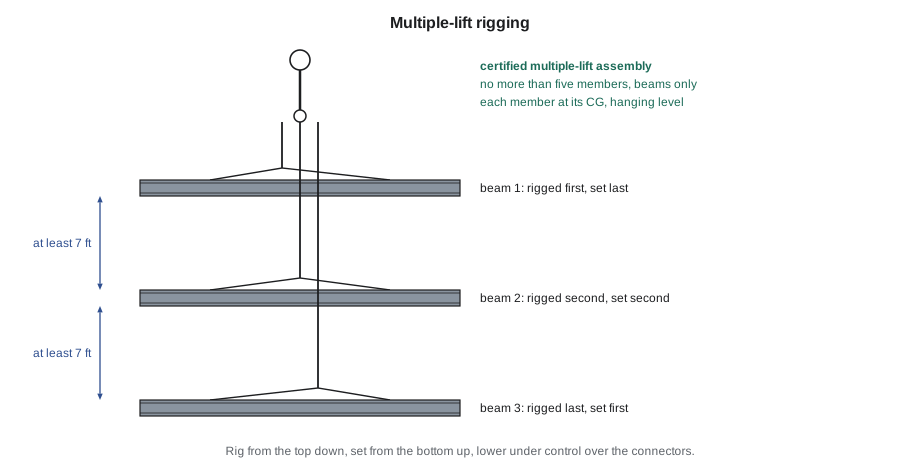
A multiple lift, which ironworkers call Christmas-treeing, hangs several beams one below another from the same hook, so the crane can carry them up in one trip and the connectors can set them one at a time. Done properly, it saves crane time without adding risk. Done badly, it puts several loads over the connectors at once and gives them more pieces to be caught between.
Subpart R allows multiple lifts only under strict conditions, and Crossbeam's procedure follows them exactly.
The conditions Crossbeam applies are these:
- Use a multiple-lift rigging assembly, a set of slings and hooks made for the purpose, certified by its maker or a qualified rigger with a rated capacity for the total load and for each attachment point, and a safety factor of 5 on every component.
- Lift no more than five members at once.
- Lift only beams and similar structural members, not columns, bundles, joists or deck.
- Train every worker involved in multiple-lift hazards and procedures before they take part.
- Keep the total load within the crane's chart and the assembly's rating, and each member within its attachment point's rating.
- Rig each member at its center of gravity so it hangs reasonably level.
- Rig from the top down, and hang the members at least 7 ft apart.
- Set the members from the bottom up.
- Use controlled load lowering whenever the load is over the connectors.
Worked problem
Checking a multiple lift
Carla planned a multiple lift of three floor beams, each a W12×26, 30 ft long, at 808 lb by the shipping list. The multiple-lift assembly weighs 100 lb and is certified for 4,400 lb total and 1,100 lb at each attachment point. The set radius is 60 ft with the 100 ft boom (SAMPLE chart, 20,600 lb; hook block 1,500 lb). Check the assembly and the crane. How far below the hook is the bottom beam, if the top beam hangs 4 ft below the hook?
Show solution
- Each attachment point: 808 lb, below 1,100 lb.
- Total on the assembly: 3 × 808 = 2,424 lb, below 4,400 lb.
- Crane load: 2,424 + 100 + 1,500 = 4,024 lb; 4,024 ÷ 20,600 ≈ 0.20, about 20 in 100.
- Bottom beam: 4 + 7 + 7 = 18 ft below the hook.
Answer: The lift is within the assembly and the crane, with a wide margin. The tree is about 18 ft long, so the crane needs that much extra hook height to fly the bottom beam over the steel already set; the lift plan checks the hook height at 60 ft in the range diagram.
Setting a multiple lift needs care at the top. The connectors set the bottom beam first, with the others hanging above them. Each beam is bolted and its choker hook released before the crane booms or hoists to bring the next beam to its place. The connectors stay clear of the beams still hanging, and the signal person watches every piece, not just the one being set. If the hanging beams start to swing or rotate, the operation stops until they settle.
Releasing the rigging
When the piece is connected and the hook may be released, the connector releases the choker hook or shackle, or the sliding choker, and signals the crane to take the slack out slowly. The sling is watched until it is clear of the steel, because a choker that snags as the hook rises can pull a piece off its seat or whip back at the connector. The empty hook and slings are sent back clear of the steel and of the workers below, and never swung over the shakeout area while people are there.
On the ground, slings are pulled from landed loads by hand once the load is on blocking; the crane is never used to drag a sling out from under a load. A pinched sling is freed by lifting the load again slightly and re-blocking it.
A final word on hands
Andy closed the last rigging night with one rule he had followed for 28 years: "If you would not put your head there, do not put your hand there." Between a load and the steel, between a sling and a load, between two pieces in a multiple lift, and between a landing beam and its seat are all places where the crane is stronger than anything a hand can do. Push and guide with the palm flat on the side of the piece, or with a tag line or a push pole, and keep fingers away from the edges that will meet.
Landing bundles on the steel
Bundles of deck, joists and bracing landed on the steel frame are loads on the structure as well as loads on the crane. The erection drawings and the deck or joist maker's instructions say where bundles may be landed: usually across two or more beams, close to their connections, never on a single joist or at the middle of an unbraced beam. A bundle landed in the wrong place can bend a beam, roll a joist or tip off the steel. Before the hook is slacked, the bundle is checked for level and bearing, and before the banding is cut, it is secured so it cannot shift.
Hooks off at the end of the day
At the end of each shift on Ashcroft, Carla walked the steel with the connectors: every piece connected to the minimum, nothing hanging from the hook, no loose pieces or bundles that wind could move, and the crane's hook empty and raised. A piece that could not be made safe was landed back on the ground. Steel left half-connected overnight is steel that can fall in an evening gust.
Worked problem
How long a tag line?
A tag line handler must stand at least 10 ft outside the edge of the load path, and the load will be at most 6 ft above the ground where they stand when it passes. About how long must the tag line be, at minimum, from the load to the handler's hands at about 3 ft above the ground?
Show solution
- Horizontal distance: 10 ft.
- Vertical distance: 6 − 3 = 3 ft.
- Line length: √(10² + 3²) = √109 ≈ 10.4 ft, plus slack to hold.
Answer: At least about 10.4 ft; in practice a tag line of 15 to 25 ft gives room to move while staying outside the path, without leaving a long tail to trip on.
Common mistakes
MistakeWrapping a tag line around a hand for a better grip.
InsteadHold it in the hands only, ready to let go.
MistakeTying a tag line off to a column to hold a load.
InsteadNever tie off a tag line while the load is moving.
MistakeReleasing a beam with one bolt in each end.
InsteadKeep the hook on until at least two bolts per connection are wrench-tight, or more if the drawings require.
MistakeChristmas-treeing a bundle of joists.
InsteadMultiple lifts are for beams and similar members only.
MistakeSetting the top beam of a multiple lift first.
InsteadSet the members from the bottom up.
MistakeDragging a sling out from under a load with the crane.
InsteadLand loads on blocking and pull slings by hand.
Summary and key terms
- Tag lines control rotation and swing from a safe distance; hold them by hand, never wrapped or tied off, and let go if the load pulls.
- Land loads slowly, on planned landing points and blocking, with hands and feet out of the bite.
- A beam stays on the hook until at least two bolts per connection are wrench-tight; columns need at least four anchor rods.
- Multiple lifts use a certified assembly, no more than five members, beams only, trained workers, members at their CG and at least 7 ft apart.
- Multiple lifts are rigged top down and set bottom up, with controlled lowering over the connectors.
- Rigging is released slowly and watched until clear; empty hooks go back clear of people.
- Tag line
- A rope fixed to a load to control its rotation and swing from a safe distance.
- Blocking
- Timber or other material placed under a landed load to support it and allow slings to be removed.
- Wrench-tight
- Tightened by a worker with an ordinary spud wrench, before final tightening.
- Multiple lift
- A lift of several members hung one below another from the same hook; also called Christmas-treeing.
- Multiple-lift rigging assembly
- A certified set of slings and hooks made to carry several members in one lift.
- Controlled load lowering
- Lowering a load with the hoist under power, not by free fall or brake alone.
Practice problems
Work each problem on paper first, then reveal the answer to check.
What kind of tag line is required near power lines?
Show answer
A non-conductive tag line.
How many members may a multiple lift carry?
Show answer
No more than five.
Three beams weigh 900 lb each and the assembly weighs 100 lb. What is the load below the hook?
Show answer
3 × 900 + 100 = 2,800 lb.
In what order are multiple-lift members set?
Show answer
From the bottom up.
What should a tag line handler do if the load starts to pull them?
Show answer
Let go.
Lesson quiz · 5 questions
Score 60% or more to complete this lesson.
Create a free account to save your progress, take quizzes and earn a certificate.