
IRW-120 · Lesson 5 of 12 · 28 min
Sling angles and load on the legs
▶ Video coming soon A video version of this lesson is on the way.
On October 15, Carla hung a 40 lb bucket of bolts from a spring scale on each leg of a short two-leg bridle, lifted it with a chain hoist and slowly pulled the two legs wider apart. When the legs hung straight down, each scale read about 20 lb. When they were spread to 45 degrees, each read about 28 lb. At 30 degrees, each read 40 lb, as much as the whole bucket. "Same bucket, same slings," she said. "The only thing that changed is the angle. That is the lesson." TRD-105 introduced sling angles; this lesson applies them to the loads ironworkers rig every day and to the forces that the angles put into the steel itself.
Why the angle matters
A sling can only pull along its own length. When two sling legs hang vertically, each pulls straight up and carries half the load. When the legs are spread, each leg pulls partly up and partly sideways. Only the upward part holds the load, so each leg must pull harder to provide the same lift. The sideways parts of the two legs cancel each other, but they still act: they squeeze the load between the pick points and pull the hook and the shackles sideways.
Sling angles in this course are measured from the horizontal, as most rated capacity charts and sling tags measure them. A leg hanging straight down is at 90 degrees; a leg lying almost flat is at a small angle.
The load angle factor
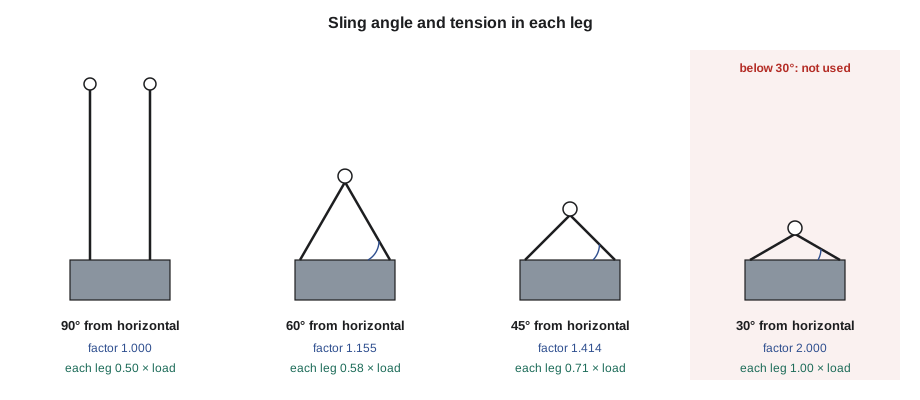
The tension in each leg of a symmetrical bridle is found by dividing the load by the number of legs carrying it, then dividing by the sine of the sling angle:
The number 1 ÷ sin θ is called the load angle factor. Riggers learn its main values by heart: 1.000 at 90 degrees, 1.035 at 75 degrees, 1.155 at 60 degrees, 1.414 at 45 degrees and 2.000 at 30 degrees. At 30 degrees each leg of a two-leg bridle carries the whole weight of the load. Below 30 degrees the tension climbs very quickly, small errors in the angle make large errors in the tension, and the horizontal pull on the load becomes large; most sling makers do not rate slings below 30 degrees, and Crossbeam does not rig below 45 degrees without the lift director's approval.
| Sling angle from horizontal | Load angle factor (1 ÷ sin θ) | Tension in each leg of a 2-leg bridle, as a fraction of the load |
|---|---|---|
| 90° | 1.000 | 0.50 |
| 75° | 1.035 | 0.52 |
| 60° | 1.155 | 0.58 |
| 45° | 1.414 | 0.71 |
| 30° | 2.000 | 1.00 |
Measuring the angle without a protractor
On the ground, a rigger cannot easily measure an angle, but can measure lengths. If L is the length of a sling leg from the hook to the pick point and H is the height of the hook above the pick points when the sling is tight, then sin θ = H ÷ L, and the load angle factor is simply L ÷ H.
Worked problem
A two-leg bridle on a beam
A W12 beam weighing 2,600 lb with its rigging is picked with a two-leg bridle. Each leg is 10 ft long, and when the slings are tight the hook is 8 ft above the pick points. What is the sling angle, and what is the tension in each leg?
Show solution
- sin θ = H ÷ L = 8 ÷ 10 = 0.8, so θ ≈ 53 degrees.
- Load angle factor = L ÷ H = 10 ÷ 8 = 1.25.
- Tension in each leg = (2,600 ÷ 2) × 1.25 = 1,625 lb.
Answer: About 53 degrees and 1,625 lb in each leg. Each leg needs a rated capacity of at least 1,625 lb in a vertical hitch, and each shackle at the beam must be rated for that load at the angle it is pulled.
Sling makers publish bridle charts that give the rated capacity of a two-leg, three-leg or four-leg bridle at 60, 45 and 30 degrees. These charts already include the angle factor. A rigger may use the chart or the calculation, but must not apply the angle twice by taking a capacity from the chart and then dividing by the factor again.
Three-leg and four-leg bridles
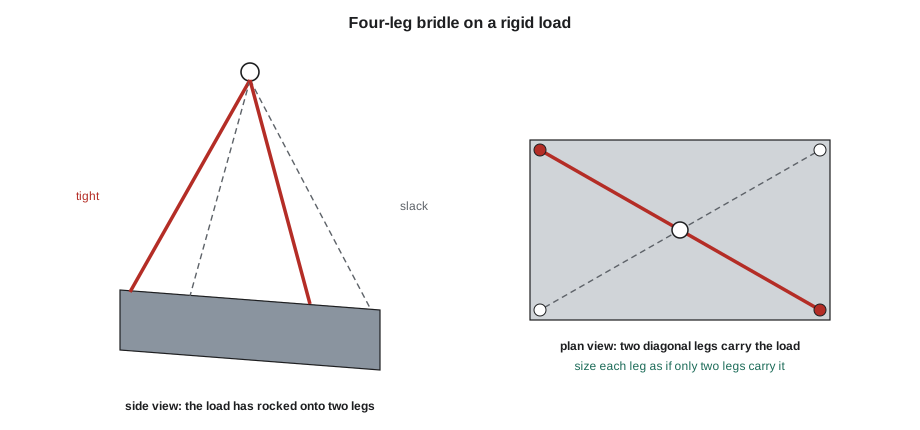
Four-leg bridles are common on loads that need to hang level in two directions: deck bundles, embed crates, stair landings, mechanical equipment and precast pieces. It seems natural to divide the load by four. On a rigid load, that is a mistake.
Unless every leg is exactly the right length, the pick points are exactly level and the load is perfectly flexible, a rigid load rocks onto two diagonally opposite legs, and those two carry almost all of the weight while the other two hang slack or nearly so. A single short leg, a sling that stretches less than the others or a CG that is off center is enough. For that reason, riggers size each leg of a three-leg or four-leg bridle on a rigid load as if only two legs carry the load, unless an engineered lift plan shows otherwise.
Worked problem
A four-leg bridle on an embed crate
A crate of embedded plates weighing 5,200 lb is lifted with a four-leg bridle, all legs at 60 degrees. What tension must each leg be rated for?
Show solution
- Assume two legs carry the load: 5,200 ÷ 2 = 2,600 lb each, vertically.
- Load angle factor at 60 degrees: 1.155.
- Tension: 2,600 × 1.155 ≈ 3,003 lb.
- If the load were shared by four legs: 1,300 × 1.155 ≈ 1,502 lb, half the safe figure.
Answer: Each leg must be rated for at least about 3,000 lb. Rigging the crate as if four legs share the load would leave two legs overloaded by about twice.
Unequal legs and off-center loads
When the CG is not midway between the pick points, the hook sits above the CG and the two legs are at different angles. The shorter, steeper leg near the CG carries more of the load vertically, as lesson 4 showed, and its tension depends on its own angle. Each leg is worked out separately: first its vertical share, then its tension.
Worked problem
An off-center pick
A canopy frame weighing 2,200 lb is picked from two points 13 ft apart. Its CG is 5 ft from point A and 8 ft from point B, and the hook is directly above the CG, 8 ft above the pick points. What is the tension in each leg?
Show solution
- Vertical shares: A = 2,200 × 8 ÷ 13 ≈ 1,354 lb; B = 2,200 × 5 ÷ 13 ≈ 846 lb.
- Leg A length: √(5² + 8²) ≈ 9.43 ft; its factor is 9.43 ÷ 8 ≈ 1.179 (about 58 degrees).
- Leg B length: √(8² + 8²) ≈ 11.31 ft; its factor is 11.31 ÷ 8 ≈ 1.414 (45 degrees).
- Tension A: 1,354 × 1.179 ≈ 1,597 lb. Tension B: 846 × 1.414 ≈ 1,196 lb.
Answer: About 1,597 lb in leg A and 1,196 lb in leg B. The two legs have different lengths; a rigger who used two equal slings would find the frame hanging tilted, with the CG pulled under the hook.
What the angle does to the steel
The sideways pull of spread slings does not disappear. It squeezes the load between the pick points with a force equal to the vertical share of each leg divided by the tangent of the sling angle. At 45 degrees, the horizontal pull at each pick point is as large as the vertical share; at 30 degrees it is about 1.7 times as large.
For a stiff beam, that squeeze is small compared with its strength. For a long, light member, it can buckle the piece in the air: a long, light beam or a bar joist bowing sideways, a bundle of angles crushing together, or a truss chord folding. It also pulls lifting lugs sideways, which they may not be designed for, and side loads shackles. That is why long members are picked with spreader bars that take the squeeze in the bar and leave the drops vertical (lesson 3), and why long-span trusses get an engineered rigging plan (lesson 12).
Worked problem
The squeeze on a load
A light 40 ft joist weighing 2,200 lb is picked with a two-leg bridle at 45 degrees, with the legs fixed near its ends. What horizontal force acts at each pick point?
Show solution
- Vertical share of each leg: 2,200 ÷ 2 = 1,100 lb.
- tan 45° = 1.
- Horizontal force: 1,100 ÷ 1 = 1,100 lb at each end, pushing the ends toward each other.
Answer: About 1,100 lb at each end, compressing the whole joist. A joist is designed to carry floor load in bending, not a squeeze along its length; the joist maker's handling instructions call for a spreader with vertical drops for long joists.
Headroom and sling length
Longer slings give steeper angles and lower tensions, but they need more headroom between the hook and the load. On a steel job, headroom can be limited by the crane's boom height at a long radius, by the steel already in place above the landing point, or by the need to fly a beam in under a beam above it. The rigger chooses slings long enough for a safe angle and short enough to fit. If both cannot be met, the answer is a spreader bar or a lifting beam, not a flatter angle.
A useful habit is to check the angle by eye after the slings come tight on the test lift. If the legs look flatter than a right-angled corner between them, they are below 45 degrees. If the angle between the two legs at the hook is more than 120 degrees, the legs are below 30 degrees and the lift stops.
Angles on everyday steel picks
Most beams at Ashcroft were picked with two chokers forming a bridle, and the chokers were placed about a quarter of the length in from each end, so the beam would not sag or swing up at the ends. With legs of 10 ft on a 30 ft beam, that put the choke points about 15 ft apart and the legs at roughly 60 degrees, which is why Carla's gang carried matched pairs of slings in a few standard lengths. A gang that has to choose between a sling that is too short and one that is too long will choose wrong sooner or later.
Columns are picked from a single point and hang vertically, so they have no sling angle to worry about. Bundles, crates and deck are picked with bridles whose angles depend on the size of the load; a wide crate on short slings is the most common way to end up below 45 degrees without noticing.
Worked problem
Choosing a sling length
Two choke points on a beam are 15 ft apart. What is the shortest sling length that keeps each leg of a two-leg bridle at 60 degrees or steeper?
Show solution
- Half the spacing: 15 ÷ 2 = 7.5 ft.
- At 60 degrees, cos 60° = half spacing ÷ leg length = 0.5.
- Leg length = 7.5 ÷ 0.5 = 15 ft.
Answer: At least 15 ft, measured from the hook to the choke point. A useful rule: for 60 degrees, each leg is as long as the distance between the pick points.
Angles and the hardware
Sling angles affect every piece of hardware in the bridle, not only the slings. The shackles at the pick points are pulled at the sling angle and must be rated for the leg tension, with any side-load reduction if they are pulled out of line. The master link or shackle at the hook carries the whole load. Lifting lugs designed for a vertical pull may not be designed for the sideways part of an angled pull. A rigger who has worked out the leg tension uses it to check each item along the leg, from the hook to the steel.
Common mistakes
MistakeDividing the load by four for a four-leg bridle on a rigid load.
InsteadAssume two legs carry the load unless an engineered plan shows otherwise.
MistakeUsing the bridle chart and then dividing by the angle factor again.
InsteadThe chart already includes the angle; apply it once.
MistakeRigging below 30 degrees to save headroom.
InsteadUse longer slings, a spreader bar or a lifting beam.
MistakeAssuming both legs carry the same load on an off-center piece.
InsteadWork out each leg's share and angle separately.
MistakeIgnoring the squeeze on long, light members.
InsteadUse a spreader with vertical drops for long joists, light beams and trusses.
MistakeMeasuring the angle from the vertical and using the horizontal factor.
InsteadMeasure from the horizontal, or use L ÷ H.
Summary and key terms
- Spreading sling legs increases the tension in each leg; only the vertical part holds the load.
- Tension = (W ÷ n) × (1 ÷ sin θ), with θ measured from the horizontal; the factor is 1.155 at 60°, 1.414 at 45° and 2.000 at 30°.
- In the field, the load angle factor is L ÷ H: sling length over the height of the hook above the pick points.
- Size the legs of three-leg and four-leg bridles on rigid loads as if only two legs carry the load.
- Off-center loads need each leg worked out separately.
- Spread slings squeeze the load; long, light members need spreaders with vertical drops.
- Sling angle
- The angle between a sling leg and the horizontal.
- Load angle factor
- The number 1 ÷ sin θ that multiplies a leg's vertical share to give its tension.
- Bridle
- Two or more sling legs joined at the hook to lift one load.
- Bridle chart
- A sling maker's table of rated capacities for multi-leg bridles at given angles.
- Included angle
- The angle between two sling legs at the hook.
- Headroom
- The vertical space available between the hook and the load.
Practice problems
Work each problem on paper first, then reveal the answer to check.
What is the tension in each leg of a two-leg bridle lifting 4,000 lb at 60 degrees?
Show answer
2,000 × 1.155 = 2,310 lb.
A leg is 12 ft long and the hook is 6 ft above the pick points. What is the sling angle?
Show answer
sin θ = 6 ÷ 12 = 0.5, so 30 degrees.
For a four-leg bridle on a rigid 6,000 lb load at 45 degrees, what should each leg be rated for?
Show answer
3,000 × 1.414 ≈ 4,242 lb.
What horizontal force does a two-leg bridle at 30 degrees put at each end of a 2,000 lb load?
Show answer
1,000 ÷ tan 30° ≈ 1,000 ÷ 0.5774 ≈ 1,732 lb.
If the included angle at the hook is more than 120 degrees, what is the sling angle?
Show answer
Less than 30 degrees; the lift stops.
Lesson quiz · 5 questions
Score 60% or more to complete this lesson.
Create a free account to save your progress, take quizzes and earn a certificate.