
IRW-120 · Lesson 4 of 12 · 30 min
Load weights and center of gravity
▶ Video coming soon A video version of this lesson is on the way.
"The first question for every pick is the same," Carla said at the October 8 rigging night. "What does it weigh? The second question is where does it balance. If you cannot answer both, you do not rig it." Steel is one of the easiest loads to weigh, because its shape and size are known exactly and its density does not change. Ironworkers still get weights wrong, usually by forgetting the connection material, the rigging or the hook block, or by trusting a guess. This lesson shows how to find the weight of steel pieces and where their center of gravity lies, building on the general methods in TRD-105.
Where weights come from
On a steel job, the most reliable weight for a piece is the one the fabricator calculated. Shop drawings and the fabricator's shipping lists give the weight of each piece mark, including its connection plates, clips and stiffeners. Erection drawings often list the heaviest pieces and their locations so the crane can be planned. Delivery tickets list the weight of each load and often of each bundle. When these are available, use them, and check them against a quick calculation of your own.
When a weight is not given, calculate it from the shape and size. A rigger's estimate should always err on the heavy side. If an estimate is not certain, treat the lift as if it were heavier and plan the crane and rigging for that weight.
Weights of structural shapes
US structural shapes are named by nominal depth and weight per foot. A W12×26 is a wide-flange shape about 12 in deep weighing 26 lb for every foot of length. An HSS 6×6×3/8 is a square hollow section 6 in across with a 3/8 in wall; its weight per foot is in the steel manual. Angles, channels and plates are listed the same way. Multiply the weight per foot by the length to get the weight of the member.
Plates and odd pieces are calculated from their volume. Steel weighs about 490 lb per cubic foot. A quick rule is that a square foot of 1 in plate weighs about 40.8 lb.
Worked problem
Weighing a beam and a plate
Beam B2-14 at Ashcroft is a W12×26, 30 ft long. A loose base plate in the same delivery is 4 ft × 2 ft × 1 in. What does each weigh?
Show solution
- Beam: 26 lb/ft × 30 ft = 780 lb.
- Plate area: 4 × 2 = 8 ft²; at 1 in thick, 40.8 lb/ft².
- Plate weight: 8 × 40.8 = 326.4 lb.
Answer: About 780 lb for the beam and 326 lb for the plate. The beam's shipping list gives 808 lb, because it includes the two shear tabs and the bolts bagged with it; use the larger figure.
Connection material adds weight that is easy to forget: end plates, shear tabs, clip angles, stiffeners, cap plates, base plates and the bolts sent with the piece. On simple beams it may add a few kilograms or pounds per piece; on moment-frame girders, columns with large base plates and braced-frame pieces with gusset plates it can add far more. Crossbeam's rule when the shop weight is not available is to calculate the member and add 10 in 100 for connections, then round up.
Bundles and deliveries
Much of what an ironworker rigs is not a single piece but a bundle: bar joists, bracing angles, deck sheets, grating, bolts in kegs, or a crate of embedded plates. Bundles are weighed by counting and multiplying, and then checking the tag. Deck bundles and joist bundles from the maker carry tags with their weights. A bundle may be rigged differently from a single piece (lesson 6), and its weight may be uneven if the pieces in it are different lengths or sizes.
Worked problem
A bundle of deck
A deck bundle at Ashcroft holds 30 sheets of 1½ in deck, each 30 ft long and 3 ft wide in cover, at a typical weight of 2.1 lb/ft². What does the bundle weigh, and what does the tag say?
Show solution
- Area of one sheet: 30 × 3 = 90 ft².
- Weight of one sheet: 90 × 2.1 = 189 lb.
- Bundle: 30 × 189 = 5,670 lb.
- The maker's tag reads 5,750 lb, including dunnage and banding.
Answer: About 5,670 lb calculated and 5,750 lb on the tag. Use the tag. The calculation is a check that the tag belongs to this bundle.
Center of gravity
The center of gravity (CG) is the point where the weight of a piece can be thought of as acting, the balance point. A load hangs so that its CG is directly below the hook. If the hook is not above the CG when the load leaves the ground, the load swings or tilts until the CG is below the hook. That swing is what knocks workers over, pinches hands and lets a load slide out of a choker.
For a uniform member such as a plain beam, the CG is at the middle of its length. For a piece with heavy parts at one end, such as a column with a base plate, a beam with a large end plate or a girder with a moment connection at one end, the CG moves toward the heavy end. For a piece with an odd shape, such as a stair stringer with landings, a canopy frame or a truss with an outrigger, the CG may not even be inside the steel.
Finding the CG by moments
The CG of a piece made of several parts is found by taking moments: multiply the weight of each part by its distance from a reference point, add the results, and divide by the total weight. The answer is the distance of the CG from the reference point.
Worked problem
The CG of a column with plates
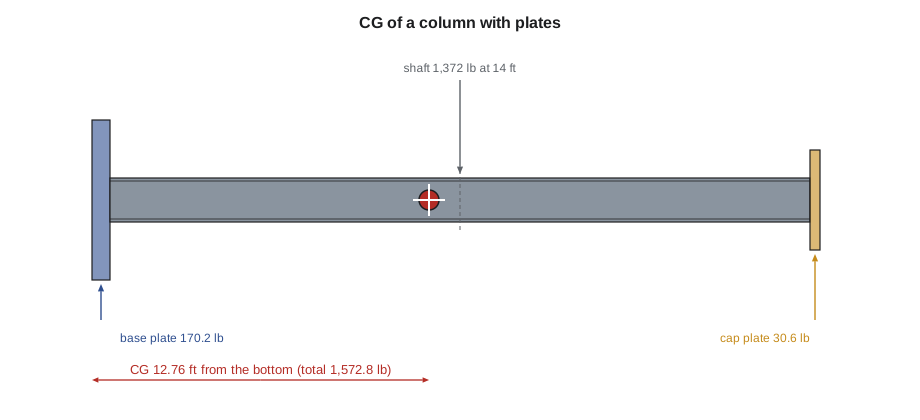
A first-tier Ashcroft column is a W10×49, 28 ft long, with a 20 × 20 × 1½ in base plate at the bottom and a 12 × 12 × ¾ in cap plate at the top. Where is its CG, measured from the bottom of the base plate? Ignore the small difference in length the plates make.
Show solution
- Shaft: 49 × 28 = 1,372 lb, acting at 28 ÷ 2 = 14 ft.
- Base plate: 20 × 20 × 1.5 = 600 in³ × 0.2836 lb/in³ = 170.2 lb, acting at about 0.06 ft.
- Cap plate: 12 × 12 × 0.75 = 108 in³ × 0.2836 = 30.6 lb, acting at about 27.97 ft.
- Total weight: 1,372 + 170.2 + 30.6 = 1,572.8 lb.
- Moments: 1,372 × 14 + 170.2 × 0.06 + 30.6 × 27.97 = 19,208 + 10.2 + 855.9 = 20,074.1 ft·lb.
- CG: 20,074.1 ÷ 1,572.8 ≈ 12.76 ft, about 12 ft 9 in, from the bottom.
Answer: About 1,573 lb, with the CG about 12 ft 9 in from the bottom, about 1 ft 3 in below the middle of the shaft. The column is picked from the lifting hole near the top, so it hangs plumb and the base plate swings out first: the tag line goes on the base.
Worked problem
A beam with a heavy end
Girder G3-2 is a W12×26, 30 ft long, with an 80 lb moment end plate at one end and only a light shear tab at the other. How far is its CG from the middle?
Show solution
- Beam: 780 lb at 15 ft from the heavy end.
- End plate: 80 lb at about 0 ft.
- Total: 780 + 80 = 860 lb.
- CG from the heavy end: (780 × 15 + 80 × 0) ÷ 860 = 11,700 ÷ 860 ≈ 13.60 ft.
- Offset from the middle: 15 − 13.60 = 1.40 ft, about 1 ft 5 in, toward the heavy end.
Answer: About 1 ft 5 in toward the heavy end. A choker or bridle centered on the beam would let it hang down at the end-plate end; the hooker-on moves the rigging about 1 ft 5 in toward that end so the girder hangs level for the connectors.
Sharing the load between two pick points
When a load is picked from two points, the two points carry different shares unless the CG is exactly midway between them. The point closer to the CG carries more. Taking moments about one pick point gives the share at the other:
where W is the weight, dA is the distance from the CG to point A and dB is the distance from the CG to point B.
Worked problem
Unequal shares
A stair stringer assembly weighing 2,600 lb is picked from two points 16 ft apart. Its CG is 6 ft from point A and 10 ft from point B. What does each point carry?
Show solution
- Point A: 2,600 × 10 ÷ 16 = 1,625 lb.
- Point B: 2,600 × 6 ÷ 16 = 975 lb.
- Check: 1,625 + 975 = 2,600 lb.
Answer: 1,625 lb at A, the point closer to the CG, and 975 lb at B. Each sling must be sized for its own share, increased for its angle (lesson 5).
Finding the CG in the field
Calculated CGs are good, but steel erectors also find them by trial. The hooker-on rigs the piece where the CG should be, the crane takes the weight and lifts it a few centimeters, and everyone watches. If one end stays down or the piece tilts, the crane lowers it, the rigging is moved toward the low end, and the test is repeated. This is the reason for the test lift on every pick: it shows whether the piece is balanced, the rigging is seated and the crane is level, before anyone is under or near the piece.
Some pieces are meant to hang at an angle: a sloping beam for a ramp, a raked column, a stair stringer set at the pitch of the stair. The connectors receive them more easily if they arrive at the right angle. The hooker-on rigs these with one leg shorter than the other, or with a chain hoist in one leg to adjust the angle, and the piece is tested and trimmed before it is flown.
Weights the crane sees
The crane does not lift only the piece. It lifts the piece, the slings, shackles and spreaders, the hook block, and on some cranes part of the load line and any jib or attachment. Lesson 9 shows how load charts deal with these. For the rigger, the rule is simple: tell the operator the total weight below the hook, and tell them exactly what is included. "About 400" is not a weight. "Three hundred sixty-eight on the shipping list plus twenty-five of rigging, three ninety-three below the hook" is.
Odd shapes and assemblies
Not every piece is a beam or a column. Stair stringers with landings, canopy frames, pre-assembled bracing panels, lintels with hangers and pieces of ornamental metal can have centers of gravity in awkward places, sometimes outside the steel altogether. For these, Crossbeam's rule is to sketch the piece, break it into simple parts, take moments in two directions (along the piece and across it), and mark the CG on the steel with soapstone before rigging. If the shop drawing gives a CG, check it the same way. A piece with a CG outside the steel needs rigging that reaches to points on both sides of it, and a test lift with extra care.
Worked problem
A CG in two directions
A canopy frame is made of a 20 ft main beam weighing 650 lb and a 6 ft outrigger weighing 130 lb welded at right angles to it at one end. Taking the end of the main beam at the outrigger as the origin, with x along the main beam and y along the outrigger, where is the CG?
Show solution
- Total weight: 650 + 130 = 780 lb.
- x: (650 × 10 + 130 × 0) ÷ 780 = 6,500 ÷ 780 ≈ 8.33 ft.
- y: (650 × 0 + 130 × 3) ÷ 780 = 390 ÷ 780 = 0.5 ft.
Answer: The CG is about 8 ft 4 in along the main beam and 6 in out toward the outrigger side, just off the beam. The rigging must be arranged so the hook ends up above that point.
Weights and CGs are written on the piece list for each day, so the hooker-on does not have to work them out under pressure. When a piece turns up that is not on the list, it waits until someone has done the arithmetic.
Common mistakes
MistakeGuessing a weight instead of finding it.
InsteadUse the shop weight, check it with a calculation, and round up.
MistakeForgetting connection plates and bagged bolts.
InsteadInclude all connection material; add a margin if the shop weight is not available.
MistakeRigging every beam at its middle.
InsteadFind the CG; pieces with heavy ends need the rigging moved toward that end.
MistakeSkipping the test lift because the piece is light.
InsteadTest every pick a few centimeters off the ground.
MistakeReporting only the piece weight to the operator.
InsteadReport the total below the hook and say what it includes.
MistakeAssuming a bundle's weight is even.
InsteadCheck the tag and how the pieces are stacked.
Summary and key terms
- Use the fabricator's piece weights and tags first; check them with a calculation and round up.
- US shapes are named by depth and weight per foot; multiply by length to get the weight.
- Steel weighs about 490 lb/ft³; plates are weighed from their volume.
- A load hangs with its CG below the hook; rig at the CG or the load will tilt and swing.
- Find the CG of a built-up piece by moments; heavy plates move it toward their end.
- With two pick points, the point closer to the CG carries the larger share.
- Center of gravity
- The point where the whole weight of a piece can be thought of as acting; its balance point.
- Piece mark
- The identifying mark on a steel member, matching the erection and shop drawings.
- Mass per meter
- The mass of a structural shape for each meter of length, part of its Canadian designation.
- Weight per foot
- The weight of a structural shape for each foot of length, part of its US designation.
- Moment
- A weight multiplied by its distance from a reference point.
- Test lift
- Lifting a load slightly, stopping and checking balance, rigging and crane before the full lift.
Practice problems
Work each problem on paper first, then reveal the answer to check.
What does a W14×30 beam 25 ft long weigh?
Show answer
30 × 25 = 750 lb.
What does a 3 ft × 2 ft × ½ in plate weigh?
Show answer
6 ft² × 40.8 × 0.5 = 122.4 lb.
A 2,000 lb load is picked from two points 12 ft apart with its CG 3 ft from point A. What does A carry?
Show answer
2,000 × 9 ÷ 12 = 1,500 lb.
Why is the tag line on a column fixed to the base?
Show answer
The base plate end swings out as the column stands up and must be controlled.
What should the rigger tell the operator?
Show answer
The total weight below the hook and what it includes.
Lesson quiz · 5 questions
Score 60% or more to complete this lesson.
Create a free account to save your progress, take quizzes and earn a certificate.