
INS-310 · Lesson 7 of 12 · 25 min
Ductwork insulation and wrap
▶ Video coming soon A video version of this lesson is on the way.
In the middle of September, Priya spent two weeks on Marcel Ouellet's duct crew at Mountview, insulating the supply ductwork on the third floor of the new addition before the ceilings closed. The main supply duct ran down the corridor from the shaft, about 36 in wide and 18 in deep, for about 120 ft, with branches to every room. On the first morning Marcel cut a piece of foil-faced duct wrap, wrapped it round the duct, and pulled it so tight that the blanket thinned to almost nothing at the corners. "That," he said, "is what the last crew did on the second floor. Hollis made us strip about a hundred and thirty feet of it." He cut a second piece to the length the maker's table gave, wrapped it loosely, and pressed the corners with his palm. "This is what he wants."
Ductwork carries heated, cooled or ventilated air around a building. Most commercial and institutional buildings have far more ductwork than pipe, and a large share of an insulation contractor's commercial work is duct insulation. This lesson covers why ducts are insulated, the materials used, how duct wrap and duct board are installed, and the rules that apply. Lesson 8 covers insulation inside ducts.
Why ducts are insulated
- Energy. Heated or cooled air loses or gains heat through the duct walls as it travels, especially where ducts run through unconditioned spaces such as attics, crawl spaces, shafts, outdoors or mechanical rooms. Energy codes require insulation on ducts in many locations.
- Condensation. Ducts carrying cool air, such as air-conditioning supply ducts, can be colder than the dew point of the surrounding air. Without insulation and a sealed vapor retarder, water condenses on them, drips on ceilings and grows mold. On cold ducts, the vapor retarder is as important as the insulation.
- Temperature control. Air arriving at the far end of a long duct should be close to the temperature it left the air handler at.
- Sound. External wrap reduces noise breaking out of a duct a little; internal liner (lesson 8) does much more.
- Fire. Some ducts, such as kitchen grease exhaust ducts and ducts passing through fire separations without dampers, need listed fire-resistive wraps or enclosures. These are special listed systems, installed exactly as their listing says by trained installers, and they are not ordinary thermal insulation.
Materials for ductwork
The main external duct insulation products are:
- Duct wrap, a flexible glass fiber or mineral wool blanket, usually faced with a foil-scrim-kraft (FSK) or other vapor retarder facing. In North America it is commonly made to ASTM C1290, the standard for flexible fibrous glass blanket used to insulate ducts externally. It is the usual choice for concealed ducts above ceilings and in shafts.
- Duct board, rigid or semi-rigid glass fiber or mineral wool board, usually faced with FSK or all-service jacket, made to ASTM C612 or the maker's own standard. It gives a firm, neat surface and is used on exposed ducts in mechanical rooms, plant rooms and anywhere the insulation can be bumped.
- Flexible elastomeric sheet, closed-cell rubber sheet bonded with adhesive, used on cold ducts and in some outdoor applications, because it is its own vapor retarder.
- Outdoor systems, such as board with a weatherproof metal jacket or a factory-applied weather-resistant membrane, for ducts on roofs.
Duct coverings must meet fire rules for flame spread and smoke development, because ducts run through ceilings and shafts where a fire could spread along them.
In Ohio, the mechanical code, following the International Mechanical Code and NFPA 90A, limits duct coverings, linings and their adhesives to a flame-spread index of 25 or less and a smoke-developed index of 50 or less, tested to ASTM E84 or UL 723, with a few stated exceptions. Products sold for duct use are labeled with these ratings; check the label or the data sheet.
Energy code requirements
How much insulation a duct needs depends on where it runs and on the energy code that applies. Ohio's commercial energy code is based on the 2021 International Energy Conservation Code, with ASHRAE 90.1-2019 as an alternative path; each has its own table of duct insulation levels by location: ducts outdoors, in unconditioned spaces, in indirectly conditioned spaces, and so on. Ducts inside the conditioned space they serve may need little or none. The engineer turns this into the specification's duct insulation schedule, which is what the insulator follows.
One detail in these codes matters on site: the R-value of duct wrap is judged at its installed thickness, not its labeled thickness. Makers publish installed R-values that assume the wrap is compressed by no more than about 25 in 100 of its thickness. A 2 in wrap is expected to end up about 1 1/2 in thick. Wrap that is pulled tight and crushed further no longer delivers the R-value the code and the schedule require, which is exactly why Hollis Brandt had the second-floor duct stripped.
Worked problem
What crushing does to duct wrap
A 2 in duct wrap has an installed R-value of about R-6 at its intended installed thickness of 1 1/2 in. Over-tightened, it is crushed to 1 in at the corners and flat faces. Roughly what R-value is left?
Show solution
- R-value is roughly proportional to thickness for the same material.
- R left ≈ 6 × 1 ÷ 1.5 = 4.
- That is about one third less than the schedule assumes. (Crushing also raises the density, which changes conductivity a little, so this is an estimate.)
Answer: About R-4, roughly a third less than specified.
The values in this example are typical published figures for one class of duct wrap; check the product actually used.
Before insulating a duct
Ducts are installed by the sheet metal contractor. Before the insulator starts, the ducts should be complete, supported, sealed and, where the specification calls for it, leak-tested. Insulating over leaking joints hides the leaks and, on cold ducts, lets humid air from the building be drawn into the insulation or cold air be blown into it. Check that hangers are in place and that there is room around the duct to wrap it; ducts jammed against beams or walls cannot be insulated properly, and those places should be raised with the general contractor before the work, not after. Accessories on the duct, such as access doors, dampers with their operators, sensors and test ports, must stay reachable; the insulation is cut around them and the edges sealed, and many specifications require a label at each access door.
Installing duct wrap
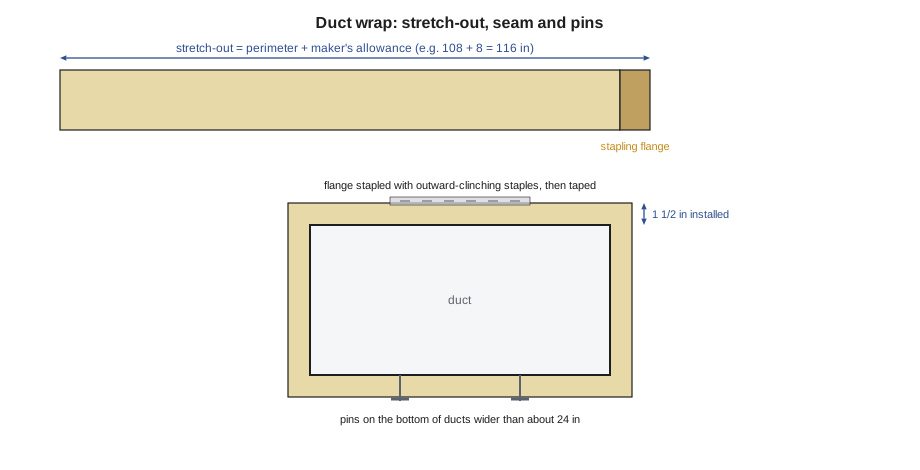
Duct wrap is cut to the stretch-out: the length needed to go round the duct at the intended installed thickness, plus an overlap. The maker's data sheet gives a table of stretch-out allowances for each thickness and duct shape, added to the duct's outside perimeter. For round ducts the allowance is roughly the extra girth from the installed thickness, 2 × π × the installed thickness, plus the overlap; for rectangular ducts it is smaller, because the wrap is pressed into the corners.
Worked problem
Cutting wrap for the Mountview supply main
The supply main is 36 × 18 in and 120 ft long. The wrap is 2 in nominal, in rolls 48 in wide and 100 ft long. The maker's table adds 8 in to the perimeter of a rectangular duct for this thickness, including a 2 in stapling overlap. How long is each cut piece, how many pieces cover the main, and how many rolls are needed?
Show solution
- Perimeter = 2 × (36 + 18) = 108 in.
- Stretch-out = 108 + 8 = 116 in per piece.
- Each piece covers the roll width, 4 ft of duct length. Pieces = 120 ÷ 4 = 30 pieces.
- Pieces per roll = 1,200 ÷ 116 = 10.3, so 10 full pieces per roll.
- Rolls = 30 ÷ 10 = 3 rolls, with offcuts from each roll for the branches.
Answer: Pieces 116 in long; 30 pieces from 3 rolls.
Then install it:
- Peel back the insulation from the facing along one edge of each piece to make a stapling flange of facing only, as wide as the overlap, typically about 2 in.
- Wrap the piece round the duct with the facing outward and the flange overlapping the other end of the piece. Do not pull it tight; let it lie at the intended thickness. Press it into the corners without crushing them.
- Fasten the flange with outward-clinching staples at about 6 in spacing, or as the specification says. Outward-clinching staples bend their legs outward in the facing so they do not reach the duct.
- Butt each piece tightly against the last, with the facing of one lapping the next or with the joint covered by tape.
- Tape every seam, staple line, tear and penetration with the pressure-sensitive tape the facing maker approves, rubbed down firmly. On cold ducts, the facing and tape together form the vapor retarder, and every staple must be covered so the vapor retarder is continuous.
- Hold the wrap up on the underside of wide ducts with mechanical fasteners, as below.
Holding wrap on wide ducts
On a narrow duct, the wrap's own grip and the stapled seam hold it. On a wide duct, the wrap on the underside sags away from the metal, opening an air gap and pulling the seams. Makers and common practice call for mechanical fasteners, such as cupped-head pins welded through the wrap or adhesive-applied pins with washers, on the bottom of ducts wider than about 24 in, at about 18 in centers, or as the specification states. The fastener must not crush the wrap more than the allowed compression. On cold ducts, every pin head or washer is covered with a patch of the vapor retarder tape.
Worked problem
Pins under the supply main
The 36 in wide main needs pins on its bottom face at about 18 in centers each way. Two rows run along the bottom, 18 in apart. How many pins does the 120 ft main need, and how many tape patches?
Show solution
- Pins per row = 120 × 12 ÷ 18 = 80.
- Two rows: 2 × 80 = 160 pins.
- The main carries cooled air in summer, so every pin head gets a tape patch: 160 patches.
Answer: 160 pins and 160 tape patches.
Installing duct board
Duct board on exposed ducts is cut to fit each face of the duct, with the board on two opposite faces running past the edges of the board on the other two, as lesson 1 describes for corners. It is held by pins and washers or by cupped-head pins on all faces at the specified spacing, and its joints and corners are sealed with facing tape or covered with corner angles. Board joints are butted tight. On cold ducts, the facing and taped joints are the vapor retarder and are sealed completely. Exposed board in mechanical rooms is often finished with a canvas or glass cloth and coating, or a PVC or metal jacket, as lesson 10 explains.
Outdoor ducts
Ducts on roofs carry the full weather load: sun, rain, snow, wind and the roofers walking past. The insulation must be protected by a weather-resistant jacket, usually metal or a factory-applied membrane, with its top seams lapped to shed water and every joint sealed. The top surface of a wide outdoor duct should slope or be crowned so water runs off rather than ponding on it. Supports, curbs and the duct's own seams all need flashing. Outdoor duct insulation that takes water is worse than none, because it holds the water against the duct, and in winter the water freezes.
The rest of Marcel's two weeks
The crew wrapped the third-floor main and branches over eight working days. Marcel had Priya check every piece she installed with a thickness gauge, a simple pin with marks pushed through the wrap at several places, and keep a list of locations where the duct was too close to a beam to wrap, which went to Gord Fennimore at Harcourt. Two of the five were moved by the sheet metal crew; the other three were insulated in place with flexible elastomeric sheet, which fitted the gap, with Hollis's agreement. When Hollis walked the floor at the end of the second week, he found two untaped staple lines and one access door covered by wrap, both fixed before the ceiling contractor started.
Common mistakes
MistakePulling duct wrap tight so it is crushed at the corners and faces.
InsteadCut it to the maker's stretch-out and let it lie at its installed thickness.
MistakeLeaving staples uncovered on a cold duct.
InsteadTape over every staple line so the vapor retarder is continuous.
MistakeSkipping pins under wide ducts.
InsteadFasten the bottom of ducts wider than about 24 in at the specified spacing.
MistakeInsulating over unsealed duct joints.
InsteadDucts should be sealed, and tested where specified, before insulation.
MistakeCovering access doors and damper operators.
InsteadCut around them, seal the edges and label them.
Summary and key terms
- Ducts are insulated for energy, condensation control, temperature and, with liner, sound; fire-resistive wraps are separate listed systems.
- Duct wrap (ASTM C1290) for concealed ducts, duct board for exposed ducts, elastomeric sheet for some cold ducts, weatherproof systems outdoors.
- Duct coverings must meet flame-spread 25 and smoke 50 limits.
- Energy codes set duct insulation by location; wrap R-value is judged at installed thickness, about 25 in 100 compression.
- Cut wrap to the maker's stretch-out, staple the flange, tape every seam and staple, and pin the bottom of wide ducts.
- Keep access doors, dampers and test ports reachable; protect outdoor duct insulation from water.
- Duct wrap
- Flexible blanket insulation wrapped around the outside of a duct.
- Duct board
- Rigid or semi-rigid board insulation fitted to the outside of a duct.
- FSK facing
- A foil-scrim-kraft facing that acts as a vapor retarder.
- Stretch-out
- The cut length of wrap needed to go round a duct at its installed thickness, plus the overlap.
- Stapling flange
- A strip of facing with the insulation peeled away, used to staple and tape the seam.
- Outward-clinching staple
- A staple whose legs bend outward in the facing so they do not reach the duct.
- Installed thickness
- The thickness of wrap after it is installed, allowing for compression.
- Flame-spread rating
- A measure of how quickly flame spreads across a material's surface in a standard test.
Practice problems
Work each problem on paper first, then reveal the answer to check.
A duct is 24 × 16 in. With an 8 in stretch-out allowance, how long is each piece?
Show answer
2 × (24 + 16) + 8 = 88 in.
How many 4 ft wide pieces cover an 82 ft duct?
Show answer
82 ÷ 4 = 20.5, so 21 pieces.
A wrap that is R-6 at 1 1/2 in is crushed to 1 1/4 in. Roughly what is left?
Show answer
6 × 1.25 ÷ 1.5 = 5.
A duct 30 in wide and 60 ft long needs two rows of bottom pins at 18 in. How many pins?
Show answer
2 × 720 ÷ 18 = 80.
Why must every staple be taped on a cold duct?
Show answer
Staples puncture the facing, which is the vapor retarder.
Lesson quiz · 5 questions
Score 60% or more to complete this lesson.
Create a free account to save your progress, take quizzes and earn a certificate.