
INS-310 · Lesson 3 of 12 · 24 min
Support rings, studs and clips
▶ Video coming soon A video version of this lesson is on the way.
On Thursday, September 24, Wendell took over one of Tomasz's evening sessions in the Coldstream shop. On the bench were a capacitor-discharge stud welder, a box of steel and stainless pins in several lengths, a bag of speed washers, a short length of angle iron bent into a ring segment, and a sheet of scrap plate clamped flat. "Tomorrow you will spend your time thinking about insulation," he told Priya and the two first-years beside her. "Tonight we think about what holds it up. Most equipment insulation that fails, fails because of what holds it, not because of the insulation." By the end of the evening the scrap plate had sixty pins on it, and Priya had learned to tell a good weld from a bad one by the sound.
Lesson 1 listed the ways insulation is held on large surfaces. This lesson covers the hardware: welded pins and studs, adhesive pins, speed washers and clips, support rings and angles, floating rings, and the rules about when you may weld to equipment and when you must not. It also covers fastener spacing, pin length and the safe use of a stud welder.
Pins and studs
A pin (also called an insulation hanger or weld pin) is a thin steel rod, usually about 12 to 10 gauge in diameter, fixed to the surface at one end and pointing outward. Insulation is pushed onto it, the pin passing through the board, and a speed washer or clip is pushed down the pin to hold the insulation. A stud is a heavier threaded rod, usually welded, used where bolts or nuts hold the insulation, its mesh or its jacket, and on very heavy or high-temperature systems. The words are used loosely on site; specifications usually say which they mean.
Pins are fixed in one of three ways:
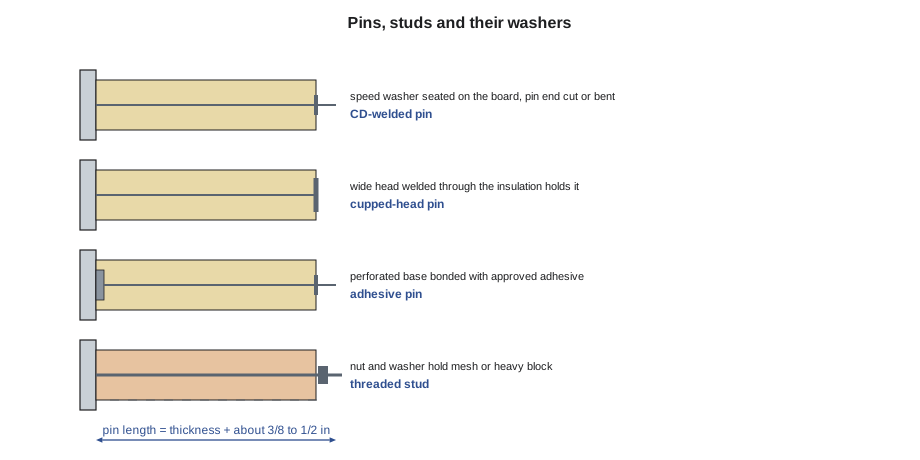
- Capacitor-discharge (CD) welding. A stud welder stores a charge in capacitors and releases it in a few milliseconds through the tip of the pin, which melts and fuses to the clean steel surface. CD welding is fast and puts little heat into the surface. It needs clean, bare steel or stainless; paint, rust, galvanizing and oil make poor welds. Pins come in plain steel, copper-coated steel and stainless steel, matched to the surface.
- Cupped-head pins welded through the insulation. On ductwork and some equipment, the insulation is laid on first and a pin with a wide cupped head is driven through it and welded in one action, so the head itself holds the insulation without a separate washer. This is common on duct wrap and board, and is covered in lesson 7.
- Adhesive-applied pins, sometimes called stick pins, have a perforated base that is bonded to the surface with an adhesive the pin maker approves. They are used where welding is not allowed or not practical: on painted or galvanized surfaces, on surfaces that must not be heated, and on some cold equipment. The adhesive must cure fully before the insulation goes on, and the surface must be clean and within the adhesive's temperature range.
Speed washers and clips
A speed washer is a thin metal disc, usually about 1 1/2 to 2 in across, with a spring-cut hole that grips the pin as it is pushed down and resists being pulled back off. Washers come in galvanized steel, aluminum and stainless steel; match the washer to the pin and the surface. Some washers have a cap that covers the cut end of the pin; on cold service the washer and pin end are sealed with vapor retarder mastic or a self-adhesive cap, because the pin conducts heat and moisture into the insulation.
Push the washer down until it seats firmly on the insulation without crushing it; on soft blanket, stop at the specified installed thickness. Then cut the pin off a few millimeters above the washer or bend its tip over, so nothing sharp sticks out to cut the jacket or the next worker. On two-layer work, the same pin can carry both layers if it is long enough, with a washer on the inner layer and a second washer on the outer layer; each layer is then held separately, as lesson 1 requires.
Other clips used on equipment include Z-clips and J-clips that hold board edges, jacket support clips (S-clips) that hang jacket on vertical surfaces, as INS-220 showed, and breather springs fitted to bands on hot vessels so the bands stay tight as the vessel grows and shrinks.
Pin length and spacing
A pin must be long enough to pass through the insulation with enough left over to fit the washer and trim. A common rule is insulation thickness plus about 3/8 to 1/2 in, rounded up to the next length that the supplier stocks. Pins that are too short leave the washer floating above a compressed board; pins that are far too long are a hazard until they are cut, and waste time.
Spacing is set by the specification or the insulation maker and depends on the surface's orientation, the weight and stiffness of the insulation, and whether the jacket adds support. Typical spacings, which you should check against the specification on every job, are:
| Surface | Typical pin spacing | Typical distance from edges |
|---|---|---|
| Vertical walls | 12 to 18 in | within about 3 in |
| Undersides and bottoms | 10 to 12 in (closer than walls) | within about 3 in |
| Tops | 18 in or as needed to stop movement | within about 3 in |
| Duct bottoms wider than about 24 in | about 18 in (lesson 7) | as the maker states |
Most specifications also ask for at least two pins in every piece of board, however small, so no piece can pivot on a single pin. Lay pins out on a grid with a chalk line rather than by eye; a grid lets the boards land with their joints between pins rather than on top of them.
Worked problem
Pins for the blancher tank
The blancher tank (lesson 1) has two long walls 10 × 4 ft, two end walls 5 × 4 ft and a bottom 10 × 5 ft. The specification calls for pins at a maximum of 12 in on walls and 10 in on the bottom, with the outer rows 3 in from every edge. The insulation is two layers of 1 1/2 in board. How many pins are needed, and what length?
Show solution
- Long wall, along the length: 120 − 2 × 3 = 114 in between outer pins; 114 ÷ 12 = 9.5, so 10 spaces and 11 pins.
- Long wall, up the height: 48 − 6 = 42 in; 42 ÷ 12 = 3.5, so 4 spaces and 5 rows. Pins per long wall = 11 × 5 = 55; two walls = 110.
- End wall: 60 − 6 = 54 in; 54 ÷ 12 = 4.5, so 5 spaces and 6 pins; × 5 rows = 30 per wall; two walls = 60.
- Bottom: 114 ÷ 10 = 11.4, so 12 spaces and 13 pins; 54 ÷ 10 = 5.4, so 6 spaces and 7 rows; 13 × 7 = 91.
- Total = 110 + 60 + 91 = 261 pins. Pin length = 3 + 1/2 = 3 1/2 in, so order 4 in pins, with 522 washers (two per pin).
Answer: 261 stainless pins 4 in long and 522 stainless washers.
Rounding the number of spaces up, never down, is what keeps the spacing at or below the maximum. Rounding down would stretch the spacing past what the specification allows.
When you may weld, and when you must not
Welding a pin is welding. On a sheet of scrap plate it is a skill; on a piece of equipment it can be a legal matter. Before you weld anything to equipment, you need to know what the equipment is and whether you are allowed to touch it with a welder.
Pressure vessels and boilers. In Ohio, boilers and many pressure vessels are regulated by the state's boiler program, which adopts the ASME Boiler and Pressure Vessel Code and the National Board Inspection Code. Welding anything to the pressure boundary of a code vessel, even a small insulation pin, can count as a repair or alteration that must be done by an organization holding the right National Board authorization, under an approved procedure, and may need inspection. Insulators do not weld to pressure vessels or boilers. Insulation clips and support rings on these vessels are welded by the fabricator before the vessel is tested, or the insulation is held by bands, clamp-on rings and floating rings instead.
- Piping under pressure. The same caution applies to pressure piping: do not weld to it. Use bands and clamp-on supports.
- Stainless steel vessels in food, pharmaceutical and chemical plants. Welding to stainless can spoil its corrosion resistance, discolor the inside face, and contaminate a sanitary surface. Many plants forbid welding on finished stainless vessels; where pins are allowed, they must be stainless and welded under the plant's procedure. Never let a carbon steel pin, brush or grinding disc touch stainless; the rust spots that follow are permanent.
- Lined, coated and painted equipment. Heat from welding can damage internal linings, glass or rubber, and external coatings. Lead paint, as INS-230 explained, must not be disturbed by welding or grinding without controls; that is why the January 2027 plan for Kellerton's engine room tank uses clamp-on rings and bands rather than welded pins.
- Ducts, casings, breeching and atmospheric equipment not under pressure can usually take welded pins, with the owner's or engineer's agreement. Thin galvanized duct may be burned through or have its zinc damaged, so adhesive pins or cupped-head through-welded pins with zinc touch-up are often used instead.
When in doubt, ask, and get the answer in writing. A pin welded where it should not be can put a vessel out of service until it is inspected and repaired.
Support rings and angles
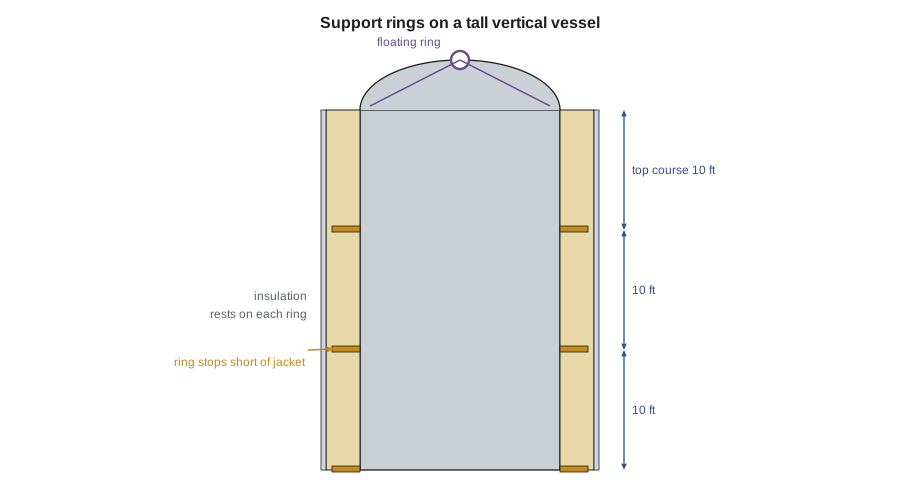
On a tall vertical vessel or stack, the weight of the insulation and jacket adds up. Without support, the lower courses are crushed, joints open at the top as the insulation creeps down, and the jacket buckles at the bottom. Support rings carry this weight in stages. A support ring is usually a flat bar or angle that projects from the shell by a little less than the insulation thickness, so it is buried in the insulation but stops short of the jacket. Each course of insulation rests on a ring, and each ring carries only the courses between it and the next ring up.
Rings are spaced at intervals set by the specification, commonly about 10 to 15 ft on vertical vessels, with a ring at or near the bottom of the shell. On pressure vessels, rings are welded to clips that the fabricator attached before testing; on equipment where welding is not allowed, clamp-on rings made of two or more bolted segments are tightened around the shell. Rings conduct heat, so on cold service they are fully covered and their edges are sealed, and on hot service their outer edge is kept back from the jacket so the jacket does not get a hot line.
On heads, a floating ring, a small loose ring at the center of the head, gives the bands from the tangent line something to pull against without welding to the head. On horizontal vessels, saddles take the place of rings as the points where the insulation has to be stopped, fitted and sealed.
Worked problem
Rings for a tall hot water tank
A vertical hot water storage tank has a shell 30 ft tall and 8 ft in diameter, insulated with 3 in of mineral wool board of about 6 lb/ft³. The specification asks for support rings at no more than 12 ft apart, with one at the bottom of the shell. How many rings are needed, and roughly what weight of insulation does each ring carry?
Show solution
- Spaces: 30 ÷ 12 = 2.5, so 3 spaces of 10 ft; rings at 0, 10 and 20 ft from the bottom: 3 rings. The top course from 20 to 30 ft rests on the third ring.
- Each ring carries 10 ft of insulation.
- Mean diameter of the insulation = 8 + 0.25 = 8.25 ft.
- Volume per section = π × 8.25 × 10 × 0.25 = 64.8 ft³; weight = 64.8 × 6 = 389 lb, plus the jacket.
Answer: Three rings, each carrying about 390 lb of insulation plus jacket.
Using a stud welder safely
A CD stud welder is simple to use but it is still electrical welding equipment, and on a plant site it is hot work. Before you start:
- Get the hot work permit the site requires. In a food plant or near combustible insulation, facings or adhesives, the permit may need a fire watch and a cleared area.
- Wear eye protection, gloves and long sleeves. The weld flashes and throws small sparks.
- Clean the surface to bare metal at each pin location, and clamp the ground cable close to the work on clean metal, never through a bearing, a flange gasket or a pipe that is not part of the work.
- Set the welder for the pin size and material, and test on scrap of the same material first. A good weld makes a sharp crack and leaves a small, even fillet; a poor weld fizzes or leaves the pin loose.
- Check welds by bending a sample pin about 30 degrees and back, or as the specification requires. Pins that snap off at the base were not fused.
- Never weld to anything under pressure or containing flammable material, and never weld where you have not been told you may.
At the shop session, Priya's first ten pins were wrong in three different ways: dirty plate, wrong setting, and a ground clamp on a painted bench leg. By the sixtieth pin, every one passed the bend test. On Monday morning at Kellerton she found out why Wendell had made her practice: the blancher tank was stainless, the plant's rule allowed stainless pins only, under its hot work permit, and every weld had to be right the first time because Lou Brisebois did not want a grinder anywhere near his tank.
Common mistakes
MistakeWelding pins to a pressure vessel or boiler because the shell looks like plain steel.
InsteadNever weld to pressure equipment; use fabricator-welded clips, bands, clamp-on rings or floating rings.
MistakeRounding the number of pin spaces down.
InsteadRound up, so the spacing stays at or below the maximum.
MistakeUsing carbon steel pins or tools on stainless equipment.
InsteadUse stainless pins and washers and keep carbon steel away from stainless surfaces.
MistakeLeaving pin ends sticking out above the washer.
InsteadCut or bend them over.
MistakeLeaving pins and washers bare on cold equipment.
InsteadSeal them with vapor retarder mastic or caps.
Summary and key terms
- Pins are CD-welded, through-welded with cupped heads, or adhesive-applied; studs carry heavier loads with nuts.
- Speed washers hold the insulation; cut or bend pin ends; seal them on cold service.
- Pin length is insulation thickness plus about 3/8 to 1/2 in; spacing follows the specification, closer on undersides.
- Do not weld to pressure vessels, boilers or pressure piping; on stainless, coated or lead-painted equipment, follow the owner's rules.
- Support rings carry vertical insulation in stages; clamp-on and floating rings avoid welding.
- Stud welding is hot work: permit, PPE, clean metal, good ground, test welds.
- Pin
- A thin rod fixed to a surface to hold insulation, also called an insulation hanger or weld pin.
- Stud
- A heavier threaded rod, usually welded, used with nuts.
- Capacitor-discharge welding
- Welding a pin in a few milliseconds with energy stored in capacitors.
- Speed washer
- A spring-cut washer that grips a pin and holds the insulation.
- Cupped-head pin
- A pin with a wide head that is driven through the insulation and welded, holding it without a washer.
- Support ring
- A ring on a vertical vessel or stack that carries the weight of the insulation above it.
- Clamp-on ring
- A bolted ring tightened around a vessel where welding is not allowed.
- Floating ring
- A loose ring at the center of a head that anchors bands.
Practice problems
Work each problem on paper first, then reveal the answer to check.
What pin length would you order for 2 1/2 in insulation?
Show answer
2 1/2 + 1/2 = 3 in, or the next stock length.
A wall is 8 ft long with outer pins 3 in from each end and a maximum spacing of 12 in. How many pins in each row?
Show answer
90 ÷ 12 = 7.5, so 8 spaces and 9 pins.
Why are support rings kept short of the jacket on hot vessels?
Show answer
So the ring does not carry heat to the jacket and make a hot line.
Name two ways of holding head insulation without welding to the head.
Show answer
Bands to a floating ring; clamp-on rings and lacing to a ring at the tangent line.
Why must you test a stud welder on scrap of the same material first?
Show answer
To set it correctly and check that welds pass the bend test before welding the work.
Lesson quiz · 5 questions
Score 60% or more to complete this lesson.
Create a free account to save your progress, take quizzes and earn a certificate.