
INS-220 · Lesson 9 of 12 · 23 min
Jacketing vessels and equipment heads
▶ Video coming soon A video version of this lesson is on the way.
During the Kellerton outage in the first week of November, while Marcel's crew refinished the old cement fittings on the condensate receiver's piping, Tomasz and Wendell Ashby, the journeyworker who runs most of Coldstream's equipment jacketing, jacketed the receiver itself. A second Coldstream crew had insulated the tank with mineral wool board on the Monday and Tuesday. Devon walked past it a dozen times that week on his way to the header. On Thursday he stopped to watch Wendell fit the last of sixteen curved gores on the head, each one lapped over the one below like the petals of a flower, with a round cap in the middle. "Water on a head goes down," Wendell said, without looking up. "So everything laps down."
Vessels and equipment are jacketed with the same rules as pipe, on a larger scale and with new shapes: big cylindrical shells, dished or flat heads, cones, nozzles, manways and nameplates. This lesson covers the jacket over vessels and equipment heads only. How vessels are insulated, with support rings, studs, clips and board insulation, is covered in INS-310; here the insulation is already on and inspected.
Vessel shells
A vessel shell is a large cylinder, and its jacket is laid out like pipe jacket: girth plus laps around, and coverage less laps along. The differences are scale and stiffness. Shells are usually jacketed with flat sheets or wide rolls, often 48 in wide, in a thicker gauge than pipe jacket, commonly 0.024 in or more, and often corrugated or stucco embossed to stiffen the large flat areas. ASTM C1729 calls for deep corrugated or box-rib profiles on large vertical vessels, and does not allow some corrugated profiles on horizontal cylinders, where they would hold water; check the specification and the standard before ordering.
On a large shell, one sheet does not reach around, so each ring of jacket is made of two or more sheets, each overlapping the next with a longitudinal lap. The rings overlap one another with circumferential laps. Both sets of laps follow the shingle rule. On a vertical vessel, each upper ring laps outside the ring below, and the vertical laps between sheets in a ring face away from the weather. On a horizontal vessel, the longitudinal laps go below the centerline with their edges pointing down, just as on pipe, and the circumferential laps between rings face away from the weather.
Shell jacket is held with bands around the vessel, often wider than pipe bands, at a spacing set by the specification. On hot vessels, which grow and shrink in diameter as they heat and cool, bands often include expansion springs so they stay tight without cutting the jacket as the vessel grows. On vertical vessels, jacket is also held by its own clips or screws at the laps, and the insulation is carried by support rings welded to the shell; INS-310 covers those.
Worked problem
Shell jacket for the Kellerton condensate receiver
The receiver is a horizontal tank with a shell 48 in in outside diameter and 96 in long between the head seams, insulated with 2 1/2 in mineral wool board, so the jacket diameter is 53 in. Wendell is using sheets 48 in × 96 in, laid with the long side around the shell, with laps of 3 in both ways. How many sheets per ring, and how many rings?
Show solution
- Girth = π × 53 = 166.5 in.
- Each sheet covers 96 − 3 = 93 in around the shell. Sheets per ring = 166.5 ÷ 93 = 1.79, so 2 sheets, with the second one cut down.
- Each ring covers 48 − 3 = 45 in along the shell. Rings = 96 ÷ 45 = 2.13, so 3 rings, with the last one cut narrow.
- Sheets = 3 rings × 2 sheets = 6 sheets for the shell.
Answer: Six sheets for the shell: three rings of two sheets each.
Wendell placed the narrow ring in the middle, not at an end, so both end rings would be full width where they met the heads. He set the longitudinal laps of all three rings at about 8 o'clock, below the centerline on the side away from the boiler house aisle, with their edges pointing down.
Heads
Vessel heads come in several shapes: flat, dished (torispherical), semi-elliptical (often called 2:1 heads because their depth is a quarter of their diameter), hemispherical and conical. All but flat heads are curved in two directions, so a flat sheet cannot simply be wrapped over them. Their jackets are built from segments.
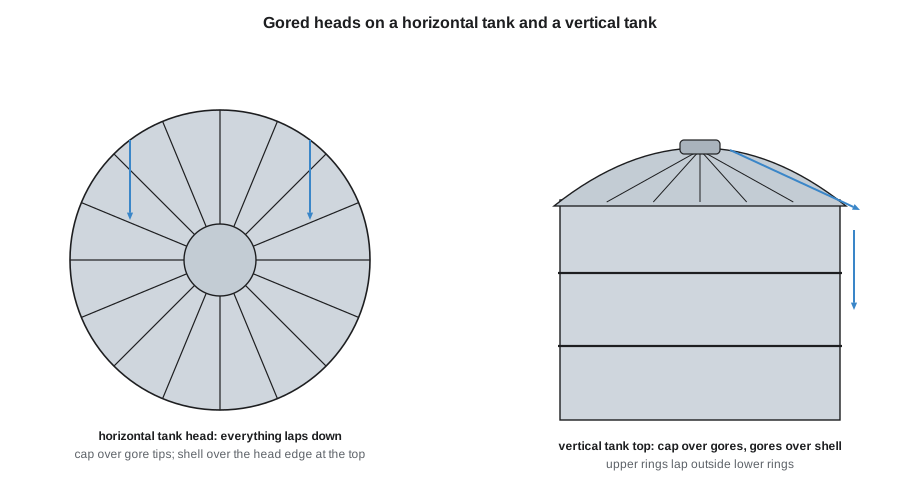
- Gored heads, or orange-peel heads: the head is divided into narrow, curved gores that run from the outer edge to a small cap at the center, like the sections of an orange peel. Each gore is cut to a pattern, formed to the curve and lapped over its neighbor. A round center cap covers the narrow ends of the gores.
- Pie-segment heads: on flat and shallow heads, the jacket is cut as flat wedges, like slices of pie, that overlap at their edges. This is quicker but only works where the head is nearly flat.
- Spun or pressed head covers: on some standard vessel sizes, factory-made one-piece or segmented aluminum head covers are available, made for the insulated head's diameter and shape.
The number of gores depends on the head diameter and how sharply it curves. More gores fit the curve better. Gore patterns can be calculated for each head shape, but in the field most jacketers measure the head instead: the girth at the edge of the head, and the curved length from the edge to the center measured over the insulation with a flexible tape. The gore is then laid out with a base width equal to the girth divided by the number of gores plus a lap, a length equal to the measured curved length less the center cap radius plus an edge lap, and a smooth taper to a narrow tip.
Worked problem
Gores for the receiver head
Each receiver head is a 2:1 semi-elliptical head. With insulation, the jacket diameter at the head edge is 53 in, and Wendell measured the curved length from the edge to the center over the insulation as 32 1/8 in. He used 16 gores, a 1 in lap on one side of each gore, a 2 in lap at the shell edge, and a center cap 12 in across. Find the gore base width and the gore length.
Show solution
- Girth at the edge = π × 53 = 166.5 in.
- Base width = 166.5 ÷ 16 + 1 = 10.41 + 1 = 11.41 in, call it 11 7/16 in.
- The center cap covers the last 12 ÷ 2 = 6 in of the curve, but the gores must run under its edge, so allow 2 in under the cap: gore length = 32.125 − 6 + 2 + 2 (shell edge lap) = 30.1 in, call it 30 1/8 in.
- Check the measured length: for a 2:1 head 53 in across, a quarter of the ellipse with half-axes 26.5 and 13.25 in works out to about 32.1 in, which matches the tape.
Answer: Sixteen gores 11 7/16 in wide at the base and 30 1/8 in long, tapering to a narrow tip under a 12 in center cap.
Lapping heads
The shingle rule decides the lapping on heads, and it depends on how the vessel sits.
- Horizontal vessel heads stand nearly upright. Water runs down their face. Upper gores lap over lower gores, and the shell jacket laps over the outer edge of the head jacket at the top, while at the bottom the head jacket edge laps over the shell. Many jacketers simplify this by putting a separate head band, a short ring of jacket, around the joint between shell and head, lapped to suit. The center cap laps over the gore tips.
- Vertical vessel top heads are like a roof. Water runs from the center outward and down over the edge. The center cap laps over the gores, the gores lap over the shell jacket at the edge, and the gore-to-gore laps face away from the weather. Outdoors, the top head is the most critical surface on the whole vessel: any lap that faces the wrong way, any low spot or any open seam will collect water.
- Vertical vessel bottom heads are protected from rain, but water running down the shell reaches them. The shell jacket laps over the bottom head jacket. On hot vessels, drain holes are often placed at the lowest point of the bottom head where the specification allows.
Nozzles, manways and nameplates
Vessels have openings in their jackets: nozzles for piping, manways and inspection openings, instrument connections, lifting lugs, supports and saddles. Each is a penetration, and each needs the treatment from lesson 4: a neat opening, a collar or a cone that sheds water, and sealant. On top heads, nozzles need rain hats or collars that lap over the head jacket. Nozzle insulation and jacket often stop at a flange with an end cap or a conical end cap, as lesson 8 showed.
Manways and inspection openings are opened at turnarounds. Their insulation and jacket are made as removable covers, with clips or quick-release fasteners, so they can be taken off and put back without damage. Nameplates and data plates on vessels must stay readable; pressure vessel inspectors need to see them. The jacket is cut to leave a framed window around the nameplate, or a small hinged or removable cover is made over it, with the frame sealed to the jacket.
Saddles and supports on horizontal vessels and the legs or skirts of vertical vessels are not insulated in the same way as the vessel. The jacket is fitted around them and sealed, or ends at them with an end cap. INS-310 covers how insulation is terminated at supports.
Working on and around vessels
Vessel jacketing is often at height: on top of tanks, on the upper rings of tall vessels and on platforms around them. Large sheets of jacket act like sails in the wind; a 4 ft × 8 ft sheet in a gust can pull a worker off a platform or a ladder. Sheets are lifted with a rope or a hoist, not carried up ladders, and are kept tied until they are fastened. Work on vessel tops needs fall protection where there is no guardrail. Inside buildings, vessels are often in tight spaces near hot piping, so watch for burns and for sharp jacket edges at head height.
Before jacketing any vessel, confirm with the plant that it is not in service or that hot surfaces are guarded, that work on and around it is covered by the plant's permit system, and that its insulation has been inspected and accepted. At Kellerton, the receiver was out of service and locked out for the outage, and Wendell's jacketing was the last thing done before the plant's own inspection on Friday, November 6.
Vertical vessel shells in practice
On a vertical vessel, the jacket is built from the bottom up, ring by ring, each ring lapping outside the one below. Each ring's vertical laps are staggered from the laps in the ring below, like bricks, so no lap runs the full height of the vessel. The jacket rings are hung from the insulation support rings or held by clips and screws at their laps, so that the weight of the jacket does not ride down onto the rings below. On tall outdoor vessels, wind is the main load: the jacket must be fastened well enough that a gust cannot get under a lap and peel a sheet. Specifications for tall vessels usually call for closer band spacing near the top and for deep corrugated or ribbed jacket, which is much stiffer than smooth sheet.
Flat and conical heads
Flat heads and the flat roofs of storage tanks are jacketed with flat sheets or pie segments, lapped so water runs off to the edge. On a flat roof, water does not run off at all unless there is slope, so tank roofs are usually built up with tapered insulation or given a slight cone so the jacket sheds water outward. A flat jacket on a flat tank roof will pond water and leak; report a flat roof that has no slope. Conical heads and cone bottoms are laid out by the radial line method from lesson 8, often in several segments because of their size, and lapped by the shingle rule for their position.
Common mistakes
MistakeLapping all the gores on a head the same way, regardless of position.
InsteadFollow the water: on upright heads everything laps down; on top heads, cap over gores and gores over shell.
MistakeOrdering corrugated jacket for a horizontal tank.
InsteadCheck the standard and specification; some corrugated profiles hold water on horizontal surfaces.
MistakeCovering the vessel nameplate with jacket.
InsteadLeave a framed window or make a removable cover.
MistakeCarrying large sheets up a ladder in the wind.
InsteadLift sheets with a rope or hoist and keep them tied until fastened.
MistakeBanding a hot vessel with tight bands and no allowance for growth.
InsteadUse the specified bands with expansion springs.
Summary and key terms
- Vessel shells are jacketed in rings of sheets, lapped by the shingle rule like pipe, often in thicker or stiffened jacket.
- Large hot vessels use bands with expansion springs; vertical vessels also use clips or screws at laps and insulation support rings.
- Curved heads are jacketed with orange-peel gores and a center cap, pie segments on flat heads, or factory head covers.
- Gore base width = girth ÷ number of gores + lap; gore length from the measured curved length less the cap radius plus laps.
- On horizontal vessels everything laps down; on vertical top heads, cap over gores and gores over shell.
- Nozzles need sealed collars and rain hats; manways get removable covers; nameplates must stay readable.
- Shell
- The cylindrical body of a vessel or tank.
- Head
- The closed end of a vessel: flat, dished, semi-elliptical, hemispherical or conical.
- Orange-peel gores
- Curved segments that run from the edge of a head to a center cap.
- Center cap
- A round piece of jacket that covers the tips of the gores on a head.
- Head band
- A short ring of jacket over the joint between a shell and a head.
- Expansion spring
- A spring in a band that keeps it tight as a hot vessel grows.
- Manway
- A bolted opening large enough for a person to enter a vessel.
- Nameplate
- The plate on a vessel that gives its design and inspection data.
Practice problems
Work each problem on paper first, then reveal the answer to check.
A vessel jacket is 78 in across. What is the girth?
Show answer
π × 78 = 245.0 in.
That head is jacketed with 20 gores and a 1 in lap. What is the gore base width?
Show answer
245.0 ÷ 20 + 1 = 12.25 + 1 = 13.25 in.
On a vertical vessel top head, what laps over what?
Show answer
The center cap over the gores, and the gores over the shell jacket.
Why must the nameplate stay visible?
Show answer
Inspectors need to read the vessel's design and inspection data.
Why are bands on hot vessels fitted with springs?
Show answer
So they stay tight without cutting the jacket as the vessel grows.
Lesson quiz · 5 questions
Score 60% or more to complete this lesson.
Create a free account to save your progress, take quizzes and earn a certificate.