
INS-220 · Lesson 10 of 12 · 23 min
Fastening: bands, screws and rivets
▶ Video coming soon A video version of this lesson is on the way.
Tomasz spent the eighth jacketing night on fasteners, and he started with a cardboard box from the Kellerton rack. In it were bits of the old jacket with their fasteners still in them: rusted carbon steel screws that had left brown streaks down the aluminum, aluminum rivets that had turned to white powder in a stainless jacket, a band that had been pulled so tight it had cut through the jacket into the insulation, and a piece of chilled water jacket with a ring of ice-stained insulation around each screw. "Every one of these was put in by somebody in a hurry," he said. "The jacket was right. The fastener was wrong."
Fasteners hold the jacket on and hold its laps closed. The wrong fastener, or the right fastener in the wrong place, can corrode, cut the jacket, let water in or puncture a vapor retarder. This lesson covers the three main fasteners for metal jacket, bands, screws and rivets, and how to choose and place each one, then the fastening of PVC jacket.
Bands
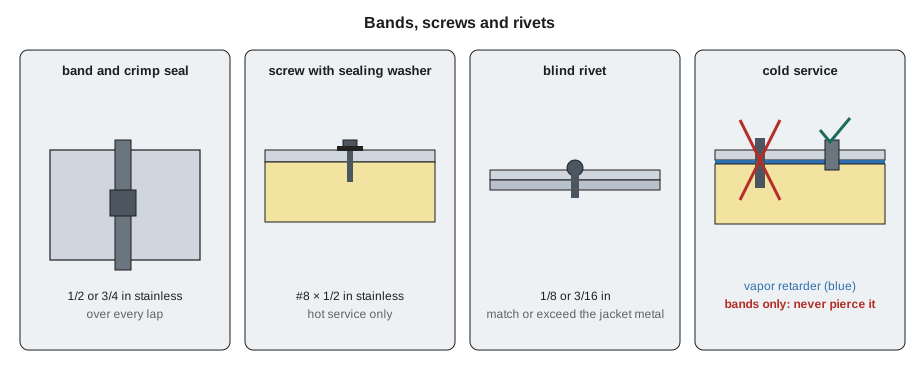
Bands are the main fastener on pipe jacket and on many vessels. A band is a thin strap around the jacket, closed with a seal. Bands do three things: they hold the jacket closed against the springback of the metal, they press each circumferential lap tight, and on hot lines they let the jacket move under them as it expands and contracts, because nothing passes through the metal.
- Materials: stainless steel bands, usually Type 304 and Type 316 where the jacket is Type 316 or the area is corrosive, are the standard on plant work and on all stainless jacket. Aluminum bands are used on some commercial aluminum work. Never use plain carbon steel strapping on jacket.
- Sizes: common bands for pipe jacket are about 1/2 in and 3/4 in wide and about 0.020 in thick. Vessels and large pipe use wider or heavier bands as specified.
- Closures: crimped seals, which are small sleeves crimped onto the overlapped band ends with a crimping tool; wing seals, which have tabs folded over the band; and pre-formed bands with their own buckles or locking closures, sold cut to length for common sizes.
- Spacing: a band over every circumferential lap and bands between laps at the specified spacing, often about 9 to 12 in on pipe; wider spacing is sometimes allowed on large vessels with stiff jacket. Follow the specification.
Bands are tightened with a tensioner, a hand tool that pulls the band through the seal while you hold the seal in place, then the seal is crimped or folded and the tail cut off. The band should be snug enough to close the lap and hold the jacket without movement under hand pressure, but not so tight that it creases or cuts the jacket or crushes the insulation under it. On soft insulation and on elastomeric foam, overtightened bands sink in and leave a groove that collects water. Place seals on the side away from view and weather, keep them in line along the run, and fold or file the cut tail so it has no sharp end.
On large hot vessels and on some large hot pipe, bands include expansion springs: a short spring or a spring clip in the band that lets it grow with the vessel while staying tight. Without springs, a band that was snug when cold may cut into the jacket when the vessel heats, or may be loose when it cools.
Screws
Sheet metal screws are used where bands cannot do the job: on the longitudinal laps of large vessel and equipment jacket, on flat surfaces, on fitting covers and gores, on laps of vertical runs, and to hold pieces in place while they are banded. They are usually stainless steel, self-tapping or self-drilling screws of about #8 × 1/2 in, with a sealing washer where the jacket is outdoors or in washdown areas. Specifications give a spacing, commonly about 6 in along laps on equipment.
Screws have three risks. They make holes in the jacket, so outdoors each one needs a sealing washer or sealant and must be placed where water runs over it rather than into it. They do not allow the jacket to move, so a long run fastened with screws at every lap will buckle as it heats; leave laps free where slip joints are needed. And they go through whatever is under the jacket. A 1/2 in screw passes through the jacket and into the insulation, which is harmless on hot insulation, but on cold service it punches straight through the vapor retarder that lies under the jacket.
That gives the most important fastening rule in this course: no screws, rivets, staples or other fasteners that pierce the vapor retarder on cold service. On chilled water, refrigeration and other below-ambient lines and equipment, jacket is held with bands only, or with adhesives, sealants and clips that do not pass through the retarder. Every hole in a cold-service vapor retarder is a path for moist air, which condenses and freezes inside the insulation. The ice-ringed screw holes in Tomasz's box came from a chilled water line where a crew had screwed every lap.
Rivets
Blind rivets, often called pop rivets, are used to join jacket pieces where a permanent, flush joint is wanted: gores on elbows, tabs on tees, joints on cones and fittings, and seams on fabricated pieces in the shop. They need a drilled hole, a hand or power riveter and rivets of the right material, diameter and grip length. Common sizes for jacket are about 1/8 in and 3/16 in in diameter. The grip length must suit the total thickness being joined: too short and the rivet will not set; too long and it will set loose.
Rivets have the same limits as screws: they make holes, they fix the jacket so it cannot move, and they must never pierce a cold-service vapor retarder. Unlike screws, they cannot be removed without drilling them out, so do not rivet anything that will need to come off for maintenance, such as flange and valve covers or inspection openings.
Galvanic corrosion and matching metals
When two different metals touch in the presence of water, one of them corrodes faster than it would alone. This is galvanic corrosion. Metals can be ranked in a galvanic series: in plant conditions, stainless steel sits near the noble end, copper and brass in the middle, and carbon steel, galvanized steel and aluminum toward the active end. The more active metal of a pair corrodes. How fast depends on how far apart they are in the series and on their relative areas: a small piece of active metal in contact with a large area of noble metal corrodes very fast; a small piece of noble metal in a large area of active metal does little harm.
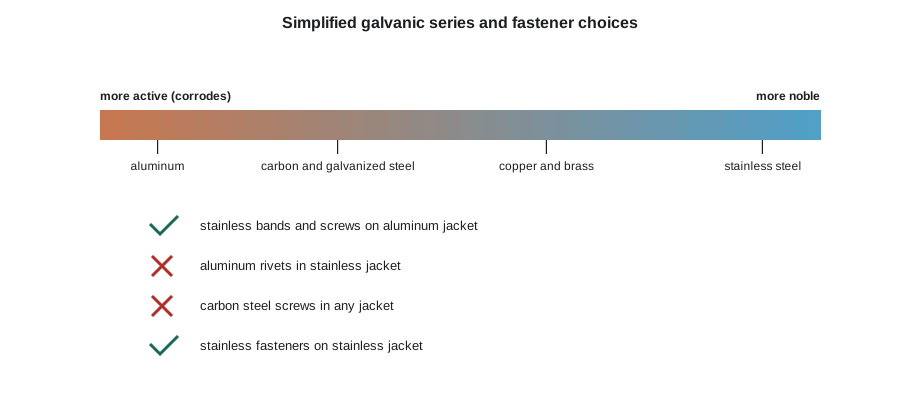
That is why the common pairings are what they are. Stainless steel bands and screws on aluminum jacket work well: the stainless is noble but small in area, and the large area of aluminum around it corrodes very little. Aluminum rivets in stainless jacket fail: the small aluminum rivet is surrounded by noble stainless and corrodes away, which is what turned Tomasz's rivets to powder. Carbon steel screws rust in any jacket and stain it. The rule is to use fasteners of the same metal as the jacket or of a more noble metal, and on stainless jacket, stainless fasteners only. Keep jacket from touching copper, brass or bare steel where you can: a strip of the jacket's own moisture barrier or a compatible tape between them helps.
Worked problem
Fasteners for the receiver shell
The Kellerton receiver shell jacket from lesson 9 is 3 rings, each of 2 sheets 48 in wide, on a girth of 166.5 in. The specification calls for stainless screws with sealing washers at 6 in spacing along each longitudinal lap, including one at each end, and stainless bands at each of the 2 laps between rings, at each outer edge and at the middle of each ring. Each band is cut to the girth plus 6 in for the seal, spring and tensioner. How many screws and bands are needed, and what length of banding?
Show solution
- Longitudinal laps: 3 rings × 2 laps = 6 laps, each 48 in long.
- Spaces per lap = 48 ÷ 6 = 8, so 8 spaces and 9 screws, one at each end. Screws = 6 × 9 = 54.
- Bands: 2 between rings + 2 outer edges + 3 middles = 7 bands.
- Band length = 166.5 + 6 = 172.5 in. Total = 7 × 172.5 = 1,207.5 in, about 100.6 ft.
Answer: 54 screws with washers and 7 bands, about 100.6 ft of banding.
Note how the screw count depends on whether the spacing divides evenly into the lap. Whenever it does not, round the number of spaces up so no space is larger than the specification allows, then add one screw for the extra end.
Fastening PVC
PVC jacket is fastened mainly with the maker's solvent-weld adhesive, which fuses the lap into one piece. Some specifications add stainless steel tacks or PVC rivets on the longitudinal lap of hot-service PVC while the adhesive sets, or bands on vertical runs and in high-traffic areas. On cold service, adhesive only: no tacks or staples. PVC fitting covers are held with adhesive at their seams and ends, or with the maker's tape where the specification allows. Follow the maker's limits for the adhesive's working temperature and setting time; adhesive applied to cold PVC may not grip.
Choosing a fastener
| Fastener | Use it for | Do not use it | Notes |
|---|---|---|---|
| Band and seal | Pipe jacket laps and between laps; vessel shells; most fittings | Over soft insulation pulled so tight it sinks in | The only metal fastener allowed over a cold vapor retarder |
| Sheet metal screw | Equipment laps, flat surfaces, removable covers, vertical runs on hot service | On cold service; through laps that must slide | Stainless; sealing washer outdoors |
| Blind rivet | Gores, tabs, cones, shop seams on hot service | On cold service; on anything that must be removed | Rivet metal to match or be more noble than the jacket |
| Adhesive | PVC laps and fittings | On cold PVC below the maker's temperature | Solvent-weld adhesive made for the PVC |
| Tacks | Hot-service PVC laps while adhesive sets | On cold service | Stainless or PVC |
Checking band tension
A crew that bands every lap by feel will band some too loose and some too tight. Check a few bands on each run: a correctly tensioned band cannot be slid along the jacket by hand, does not leave a visible groove in the jacket or a sunken line in soft insulation, and keeps the lap closed when you press on the jacket beside it. On stainless bands, the tensioner can be set or marked so each band gets about the same pull. Re-check bands on hot lines after the first heat-up: insulation can settle and bands can loosen.
Removable fasteners for covers
Flange covers, valve covers, inspection openings, manway covers and nameplate covers must come off and go back on without damage. They are held with fasteners that can be undone and reused: quick-release bands with buckles, stainless lever latches, hooks and wire loops on removable blankets, or screws into nut inserts on large removable panels. Never rivet or seal a removable cover shut. Mark removable covers so they go back in the same place, and make sure their laps still shed water when they are put back.
Worked problem
Bands for a gore elbow
An NPS 6 gore elbow from lesson 6 has 5 gores on insulation with a girth of 33.38 in. The specification calls for a band over each lap between gores and a band at each end where the elbow laps the straight jacket. Each band is cut to the girth plus 3 in. How many bands, and what length of banding?
Show solution
- Laps between 5 gores = 4. End laps = 2. Bands = 6.
- Band length = 33.38 + 3 = 36.38 in.
- Total = 6 × 36.38 = 218.3 in, about 18.2 ft.
- The bands sit at the sides and heel of each lap; on the throat side they are shorter in effect, so they are tensioned carefully so they do not slide toward the throat.
Answer: Six bands, about 18.2 ft of banding, for each elbow.
On small elbows whose gores are too narrow for bands to sit square, specifications usually allow rivets or screws at the heel and sides of each gore on hot service, or call for a pre-formed cover instead.
Common mistakes
MistakeUsing whatever screws are in the truck.
InsteadUse stainless screws with sealing washers outdoors; never carbon steel.
MistakePutting aluminum rivets in stainless jacket.
InsteadUse stainless rivets in stainless jacket.
MistakeScrewing laps on a chilled water line to hold them neat.
InsteadUse bands only, and adhesive or sealant; never pierce the vapor retarder.
MistakeCranking bands until the jacket creases.
InsteadTighten snug to close the lap without cutting the jacket or crushing insulation.
MistakeRiveting a flange cover shut.
InsteadUse removable fasteners on anything that must come off.
Summary and key terms
- Bands hold jacket closed and press laps tight while letting the jacket move; they are usually stainless with crimped or wing seals.
- Band every circumferential lap and between laps at the specified spacing; tighten snug and finish seals and tails neatly.
- Stainless screws with sealing washers hold equipment laps and flat surfaces on hot service; rivets join gores, tabs and shop seams.
- Never pierce a cold-service vapor retarder with screws, rivets, tacks or staples.
- Fasteners must be the same metal as the jacket or more noble; stainless fasteners on aluminum are fine, aluminum rivets in stainless are not.
- PVC is fastened with solvent-weld adhesive, with tacks on hot service only where specified.
- Band
- A thin strap around jacket, closed with a seal.
- Crimp seal
- A sleeve crimped over the overlapped ends of a band.
- Wing seal
- A band seal with tabs folded over the band.
- Tensioner
- A hand tool that tightens a band through its seal.
- Sealing washer
- A washer with a rubber face that seals a screw hole.
- Blind rivet
- A rivet set from one side with a riveter, often called a pop rivet.
- Galvanic corrosion
- Faster corrosion of one metal where two different metals touch in water.
- Grip length
- The thickness of material a rivet is made to join.
Practice problems
Work each problem on paper first, then reveal the answer to check.
Which fastener can be used over a cold-service vapor retarder?
Show answer
Bands, and adhesives or sealants; no screws or rivets.
Why do aluminum rivets fail in stainless jacket?
Show answer
The small aluminum rivet is the active metal surrounded by noble stainless and corrodes away.
A lap is 36 in long with screws at 6 in including both ends. How many screws?
Show answer
36 ÷ 6 = 6 spaces, so 7 screws.
Why should flange covers not be riveted?
Show answer
They must come off for maintenance.
What happens when a band is overtightened on soft insulation?
Show answer
It sinks in, creases the jacket and leaves a groove that collects water.
Lesson quiz · 5 questions
Score 60% or more to complete this lesson.
Create a free account to save your progress, take quizzes and earn a certificate.