
HSE-405 · Lesson 12 of 12 · 20 min
Small workplaces, representatives and a capstone committee review
Priya Nair is the safety representative at Harrowgate Foods Inc.'s satellite warehouse near Athens. The warehouse has 12 workers across two shifts, stores packaging and dry ingredients for the sauces plant and runs three forklifts. Priya is a lead hand on days. When she was elected, she asked Elena a fair question: 'The committees have eight or twelve people, co-chairs, alternates and a tracking log. I'm one person. What am I supposed to do?'
This final lesson answers Priya's question and then brings the course together. The first half covers how participation works in small workplaces, where a single representative takes the place of a committee. The second half is a capstone: a full review of one committee, the sauces plant committee, using everything in the previous eleven lessons.
Representatives in small workplaces
Federal OSHA does not require safety representatives. Most states that require committees allow smaller employers to meet the requirement in a lighter way; Washington, for example, allows employers with ten or fewer workers, or with workers mostly at separate locations, to hold regular crew safety meetings instead of running a committee. Harrowgate Foods Inc.'s company standard requires any workplace with between five and 19 workers to have an elected safety representative, with broadly the same functions as a committee and the same 21-day written response to recommendations. The model is borrowed from Nova Scotia law.
A representative does the work of a committee with far fewer people. That makes some things harder and some easier. It is harder because there is no one to share the work, no second opinion on a hazard ranking and no co-chair to escalate with. It is easier because the workplace is small enough to know well, the manager is close by and workers can raise concerns face to face.
Making the role work
Elena and Priya agreed on a simplified version of the committee system for the warehouse:
- A monthly half-hour meeting between Priya and the warehouse manager, Tom Barkhouse, with a short written record of concerns, recommendations and actions.
- A monthly inspection of half the warehouse, so the whole site is covered every two months, done by Priya and Tom together or by Priya with a worker from the other shift.
- One page for recommendations, using the same seven-part format the committees use.
- The same tracking log, kept in a shared spreadsheet that Elena can see.
- A link to the sauces plant committee, as lesson 4 described, so Priya attends its meetings as a guest every quarter and can call its co-chairs for advice.
The link to a nearby committee turned out to be the most valuable part. When a forklift at the warehouse developed a steering fault, Priya was not sure whether to treat it as a class A finding. A ten-minute call with the sauces plant's worker co-chair settled it: yes, take it out of service now. When Tom's response to a recommendation about racking inspections was slow, Priya raised it at the company safety council, where she has a seat alongside the co-chairs.
Reaching the other shift
Priya works days. The evening shift, four workers, rarely saw her. She set up a simple way for them to reach her: a concern card in the break room, a box beside it and a promise to reply within two working days, in writing on the card if the worker wanted. She also worked one evening shift a month, by agreement with Tom, to inspect the warehouse at night and talk to the evening crew. In the first year, the evening shift raised more concerns than the day shift, mostly about the lighting in the back racking rows, which was fixed.
Support for small employers
Small employers without a safety specialist can get free help. OSHA's On-Site Consultation Program, run through state agencies and universities, offers free and confidential safety and health advice to small and medium-sized businesses, separate from enforcement. In Georgia, the program is run through the Georgia Institute of Technology. Harrowgate Foods Inc.'s warehouse does not need it, because Elena supports Priya, but the committee guide mentions it for any small site the company might acquire.
Capstone: reviewing the sauces plant committee
At the end of the first full year under the company standard, Elena asked each committee to complete a full review of itself, with an outside reviewer: a co-chair from another site. The sauces plant committee, six members serving about 60 workers, was reviewed by Sam Pellerin from the distribution center. The review followed the course, area by area.
| Area | Lesson | Questions the review asked |
|---|---|---|
| Purpose and support | 1 | Do members, managers and workers understand what the committee is for? Is time protected? |
| Legal and company requirements | 2 | Does the committee meet every legal and company standard requirement? |
| Membership and structure | 3 | Are all shifts and areas covered? Are terms, alternates and quorum working? |
| Training | 4 | Is every member and alternate trained? Is every shift covered by trained members? |
| Inspection planning | 5 | Is the schedule risk-based, covering every shift and zone? |
| Inspection quality | 6 | Are findings specific and ranked? Are class A findings dealt with at once? |
| Investigations | 7 | Does the committee take part as standard requires? Do investigations go beyond the first cause? |
| Refusals and concerns | 8 | Do workers know their rights? Are refusals handled well and debriefed? |
| Recommendations | 9 | Are recommendations specific, sent in writing, answered on time and verified? |
| Meetings and minutes | 10 | Are meetings prepared, on time and decisive? Do minutes record actions with owners and dates? |
| Effectiveness | 11 | What do the scorecard and survey show, and what is the committee doing about it? |
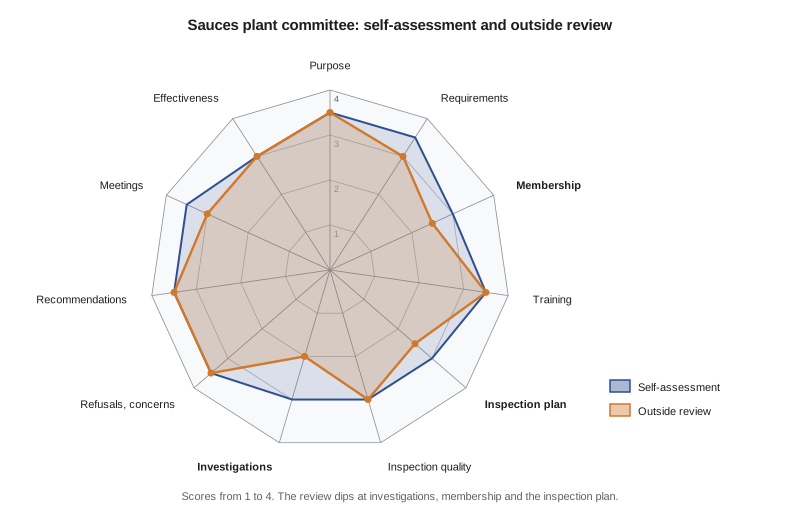
Sam spent a day at the sauces plant. He read a year of minutes, the tracking log, the inspection schedule and reports, two investigation reports and the training record. He joined an inspection of the mixing room, attended a committee meeting and spoke with eight workers on two shifts. Then he scored each area from 1 to 4, using the same scale as the self-assessment from lesson 1.
# Capstone review of the sauces plant committee: self-assessment vs outside review.
areas = ["purpose", "requirements", "membership", "training", "inspection plan",
         "inspection quality", "investigations", "refusals and concerns",
         "recommendations", "meetings", "effectiveness"]
self_score = [3.5, 3.5, 3.0, 3.5, 3.0, 3.0, 3.0, 3.5, 3.5, 3.5, 3.0]
review     = [3.5, 3.0, 2.5, 3.5, 2.5, 3.0, 2.0, 3.5, 3.5, 3.0, 3.0]
print(f"{'area':<22}{'self':>5}{'review':>8}  gap")
for a, s, r in zip(areas, self_score, review):
    flag = "  <- discuss" if s - r >= 0.5 else ""
    print(f"{a:<22}{s:>5}{r:>8}  {s - r:+.1f}{flag}")
print(f"average: self {sum(self_score) / len(areas):.2f}, review {sum(review) / len(areas):.2f}")
weakest = sorted(zip(review, areas))[:3]
print("lowest reviewed:", ", ".join(a for _, a in weakest))area self review gap purpose 3.5 3.5 +0.0 requirements 3.5 3.0 +0.5 <- discuss membership 3.0 2.5 +0.5 <- discuss training 3.5 3.5 +0.0 inspection plan 3.0 2.5 +0.5 <- discuss inspection quality 3.0 3.0 +0.0 investigations 3.0 2.0 +1.0 <- discuss refusals and concerns 3.5 3.5 +0.0 recommendations 3.5 3.5 +0.0 meetings 3.5 3.0 +0.5 <- discuss effectiveness 3.0 3.0 +0.0 average: self 3.27, review 3.00 lowest reviewed: investigations, inspection plan, membership
The committee scored itself a little higher than Sam did, as most committees do. The biggest gap was in investigations, where Sam scored 2.0 against the committee's 3.0. He found that the committee had taken part in only one of the plant's three medical treatment injuries that year. The other two had been investigated by supervisors over a weekend and reviewed at the committee only afterwards. The committee had not noticed because the reviews felt like taking part.
Membership and the inspection plan also showed gaps. The plant had added a weekend sanitation crew in the spring, and nobody on the committee worked weekends. No inspection had been done on a weekend all year, though weekend sanitation used the plant's strongest chemicals. And requirements scored lower because two sets of minutes had not been posted on time.
What the review found going well
Sam was clear that the sauces plant committee was a good committee. Its concern response time was the best in the company. Its recommendations were consistently well written, and 90 percent were verified on time. Its handling of the one refusal that reached an officer, described in lesson 8, had been careful and well documented. Workers he spoke with knew who the members were. One mixer operator told him: 'If I tell them something, it gets done or they tell me why not.' Sam said that was the best measure of a committee he had heard.
The action plan
The committee met with Sam and Elena to agree an action plan. It had four items:
- Investigations: from now on, any medical treatment injury triggers a phone call to the on-call worker member, who joins the investigation from the start, including on weekends. An on-call rota of trained members was set up.
- Membership: a weekend sanitation worker will be elected to the committee at the next election, with an alternate, and until then a weekend worker will be invited as a guest.
- Inspections: two weekend inspections a year, with the chemical dispensing area and the sanitation process added to the zone map and rated high risk.
- Minutes: the minute-taker posts the minutes within four working days, and the worker co-chair checks the board each month.
The committee also agreed to share its concern log method with the other sites, and to host Priya for a day so she could see how a full committee worked.
Bringing it together
Worker participation is more than a legal requirement or a meeting once a month. It is a way of making sure the people closest to the hazards are part of finding and fixing them. Effective committees and representatives share some features that this course has covered: a clear purpose and real support from management; members who represent every part of the workplace and are trained to do the job; inspections that look where the risk is; investigations that look for causes rather than culprits; refusals that are handled with care; recommendations that are specific, answered and verified; meetings that make decisions; and honest measurement of what all of that achieves.
None of it requires a large budget. It requires time, attention and a willingness by everyone involved to listen to each other. Priya's question at the start of this lesson had a simple answer in the end. As Elena put it: 'You're supposed to make sure that the people who work there are heard, and that what they say leads somewhere. That's all a committee does, too.'
Worked problem
Preparing a review of your own committee
Show solution
- Choose an outside reviewer: a co-chair or representative from another workplace who knows the role.
- Gather a year of minutes, the tracking log, the inspection schedule and reports, investigations, the training record and the latest scorecard and survey.
- Have the committee complete the self-assessment before the reviewer arrives.
- Plan a day that includes an inspection, a meeting and conversations with workers on more than one shift.
Answer: The review compares the committee's view with the evidence and with what workers say. The gaps between them become the action plan for the next year.
What the review found at the meetings
Sam also scored meetings half a point lower than the committee had. The meeting he attended ran to time and had a good agenda, but the plant manager, attending as a guest, answered every question put to the committee, including questions meant for worker members. Nobody stopped him. The worker co-chair, Denise Boudreau, said afterwards that she had noticed but had not wanted to embarrass him in front of the committee. Sam suggested the approach Owen had used at the distribution center: agree with guests in advance which items they are there for, and have the chair ask worker members for their view first. Denise tried it the next month and the plant manager, to her surprise, thanked her for it.
Sharing the reviews
Each site's review went to the company safety council, which looked across all of them for common themes. Two appeared at more than one site: weekend and night coverage, and committee involvement in investigations from the start rather than afterwards. The council turned both into changes to the company standard, so that every site would benefit, not just the ones where the gaps had been found. The reviews will be repeated every two years, with reviewers rotating so that every co-chair reviews another site at least once during their term.
Common mistakes
MistakeLeaving a representative to work alone.
InsteadLink them to a nearby committee and give them a seat on the safety council.
MistakeAssuming a representative only covers their own shift.
InsteadGive other shifts a way to reach them and time to inspect at night.
MistakeReviewing a committee only from its own records.
InsteadAdd an outside reviewer, an inspection and conversations with workers.
MistakeTreating committee review as the same as taking part.
InsteadCheck the committee is involved from the start where the standard requires.
MistakeEnding a review with a score.
InsteadEnd it with a short action plan with owners and dates.
Summary and key terms
- The company standard requires an elected safety representative at workplaces with five to 19 workers, based on Nova Scotia's model.
- A representative needs a simplified committee system: monthly meetings, inspections, recommendations and a tracking log.
- Linking a representative to a nearby committee provides advice and support.
- A capstone review covers every area of committee work, with an outside reviewer.
- Gaps between self-assessment and review show priorities for the year ahead.
- Effective participation means the people closest to hazards are heard and what they say leads somewhere.
- Safety representative
- A worker elected to carry out committee functions at a workplace with five to 19 workers.
- Outside reviewer
- A co-chair or representative from another workplace who reviews a committee.
- Capstone review
- A full review of a committee across every area of its work.
- Action plan
- A short list of improvements with owners and dates agreed after a review.
- On-call rota
- A schedule of trained members available to join investigations at any time.
Practice problems
Work each problem on paper first, then reveal the answer to check.
When does the company standard require a safety representative?
Show answer
At workplaces with five to 19 workers that do not have a committee.
What was the most valuable support for Priya?
Show answer
The link to the sauces plant committee.
How did Priya reach the evening shift?
Show answer
A concern card and box with a two-day reply, and working one evening a month.
What was the biggest gap in the sauces plant review?
Show answer
Investigations: the committee took part in only one of three medical treatment injuries.
What did the review find about weekends?
Show answer
No committee member worked weekends and no weekend inspection had been done.
Lesson quiz · 5 questions
Score 60% or more to complete this lesson.
Create a free account to save your progress, take quizzes and earn a certificate.