
HSE-405 · Lesson 9 of 12 · 20 min
Making recommendations and getting responses
When Grace Chen went through two years of the distribution center committee's old minutes, she found 64 items that looked like recommendations. Only nine had a recorded response. Some were vague: 'management to look at lighting in the yard'. Some had been repeated at meeting after meeting: the dock leveler lip had appeared in seven sets of minutes before the injury described in lesson 1. Some had quietly disappeared, never mentioned again and never fixed. Nobody could say which had been done.
Recommendations are how a committee turns what it finds into change. Inspections, investigations, concerns and refusals all lead here. A committee that inspects well but recommends badly achieves little, because its findings never become decisions. This lesson covers how to write recommendations that persuade, how the response process works, and how to track recommendations until they are closed.
What the law says about responses
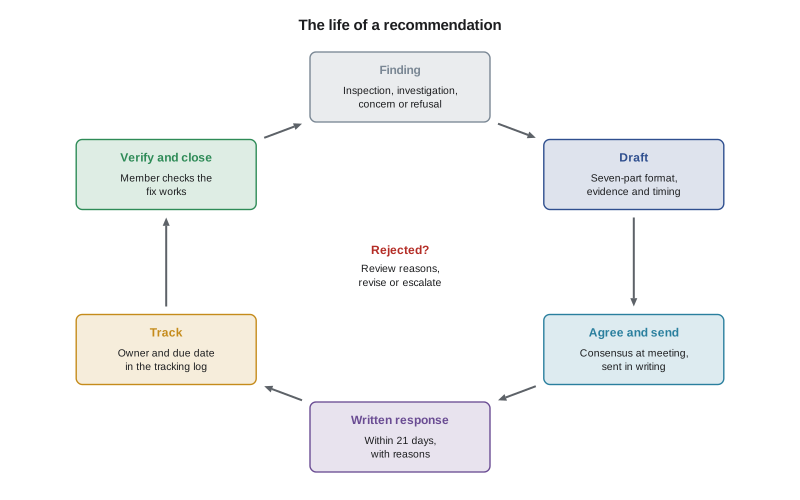
Federal OSHA does not require employers to respond to safety committee recommendations, because it does not require committees. Some states with committee rules do require a response; Oregon, for example, requires the employer to respond in writing within a reasonable time. Harrowgate Foods Inc.'s company standard sets a firm rule for its Georgia sites: the site manager must respond in writing within 21 days, either accepting the recommendation with a timetable or giving reasons for not accepting it. Elena borrowed the 21-day rule from Canadian provinces such as Nova Scotia, where it is the law.
Grace's review explained why so few recommendations had responses. Most had never been sent to anyone. They were discussed at the meeting, written in the minutes and left there. A recommendation only starts the response clock when it is put in writing and given to the person with authority to act on it.
Writing a recommendation that persuades
A recommendation is a short business case. It must convince a manager, who has many competing demands for money and time, that this change is worth making. Sam and Owen adopted a one-page format with seven parts:
| Part | What it says | Example: yard lighting |
|---|---|---|
| Problem | What is wrong, where and since when | Four of eleven yard light poles have failed; the area between docks 6 and 9 is dark at night |
| Evidence | Inspection findings, incidents, measurements, photos | Light readings below 5 lux at night; two near misses with pedestrians and trucks in three months |
| Risk | The harm that could result and its class | A pedestrian struck by a reversing truck; class A |
| Recommendation | The specific action | Replace the four failed fixtures with LED units and add one pole at dock 7 |
| Benefit | What it will achieve | Lighting restored to the site standard; drivers and pedestrians can see each other |
| Cost and effort | An estimate, if known | About $9,000 including the new pole; 2 days of contractor time |
| Timing | When it should be done | Temporary lighting within 48 hours; permanent fix within 30 days |
The old minutes had said 'management to look at lighting in the yard'. The new recommendation said exactly what was wrong, showed why it mattered, proposed a specific fix and estimated what it would cost. The site manager approved it the day she received it.
Good recommendations share some features. They are specific, saying exactly what should happen rather than 'improve' or 'look at'. They are supported by evidence, so the reader does not have to take the committee's word for it. They consider the hierarchy of controls, proposing elimination or engineering controls where possible rather than defaulting to training and signs. And they are realistic: a committee that recommends a new building for every problem soon loses credibility.
Agreeing recommendations in the committee
Recommendations come from the committee as a whole, not from individual members. At Harrowgate Foods Inc., a recommendation is drafted by the members who found the issue, discussed at the meeting and agreed by consensus. Where consensus cannot be reached, the terms of reference allow the co-chairs to send the recommendation with a note that members disagreed and why. Recommendations that are urgent, such as class A findings, do not wait for the meeting: the co-chairs can agree them by phone and send them the same day, with the committee confirming at its next meeting.
Management members of the committee have a particular part to play. They often know whether a fix is already planned, what budget exists, or who can approve the spending. Owen made a habit of telling the committee, before a recommendation was sent, which manager would need to approve it and what that manager would want to see. Recommendations he had shaped this way were rarely rejected.
The response
A response accepts the recommendation, accepts it in part or with changes, or rejects it. In every case, it is in writing and gives reasons. An acceptance includes who will do what by when. A rejection explains why and, ideally, offers an alternative. 'Not in budget' is a reason, but a weak one if the risk is high; a better response explains how the risk will be controlled until budget is found.
The committee reads every response at its next meeting. If members are not satisfied, they can ask for more information, send a revised recommendation or take the matter higher. At Harrowgate Foods Inc., higher means the site manager, then Rachel and Elena through the company safety council. Committees rarely need to go that far. The fact that they can is usually enough.
Tracking until closed
A recommendation is not closed when it is accepted. It is closed when the action is complete and the committee has checked that it works. Grace set up a tracking log with one line per recommendation: the date sent, the response date, the response, the agreed action and due date, the status and the date the committee verified it. The co-chairs review the log at every meeting, and the overdue items are always the first item of business after the minutes.
# Tracking log review: response times and overdue actions.
from datetime import date
today = date(2026, 6, 15)
log = [
    # (item, sent, response received, action due, verified)
    ("yard lighting",        date(2026, 2, 3),  date(2026, 2, 4),  date(2026, 3, 5),  date(2026, 3, 10)),
    ("freezer step stools",  date(2026, 3, 2),  date(2026, 3, 16), date(2026, 4, 1),  date(2026, 4, 8)),
    ("cooler aisle width",   date(2026, 3, 20), date(2026, 4, 8),  date(2026, 5, 30), None),
    ("battery eyewash move", date(2026, 4, 6),  date(2026, 4, 30), date(2026, 6, 1),  None),
    ("dock plate inspections", date(2026, 5, 4), None,             None,              None),
    ("pick module ergonomics", date(2026, 5, 25), None,            None,              None),
]
for item, sent, resp, due, ver in log:
    if resp is None:
        days = (today - sent).days
        flag = "RESPONSE OVERDUE" if days > 21 else "awaiting response"
        print(f"{item:<24} sent {days} days ago - {flag}")
    else:
        rdays = (resp - sent).days
        late = " (late)" if rdays > 21 else ""
        if ver:
            state = "closed"
        elif due < today:
            state = f"action overdue by {(today - due).days} days"
        else:
            state = "in progress"
print(f"{item:<24} response in {rdays} days{late}; {state}")yard lighting response in 1 days; closed freezer step stools response in 14 days; closed cooler aisle width response in 19 days; action overdue by 16 days battery eyewash move response in 24 days (late); action overdue by 14 days dock plate inspections sent 42 days ago - RESPONSE OVERDUE pick module ergonomics sent 21 days ago - awaiting response
The log showed four kinds of problem at a glance. The dock plate inspection recommendation had gone 42 days without a response, double the limit. The battery eyewash response had taken 24 days, just over. The cooler aisle action was past its due date, and so was the eyewash move. The co-chairs raised all four with the site manager the same week. The dock plate response arrived two days later, with an apology.
Verifying the fix
Verification closes the loop. Before an item is marked closed, a committee member checks that the action was done and that it works. This step catches more problems than most committees expect. When the yard lighting was replaced, Marco checked it at night and found that one new fixture pointed at the wall rather than the roadway. The step stools in the freezer were all in place, but two aisles had stools that were too short to reach the top level. Both were fixed before the items were closed.
Worked problem
Rewriting a weak recommendation
Show solution
- Old minutes: 'Concern raised re: forklift speed in shipping. Management to remind drivers.'
- Problem and evidence: three near misses with pedestrians at the shipping crossing in two months; drivers report pressure to load faster since dispatch times changed.
- Hierarchy of controls: a reminder is an administrative control and the weakest option. Engineering options include speed limiters on the trucks and a physical barrier with a gated crossing.
- Recommendation: fit speed limiters set to 5 mph on the six shipping trucks within 30 days, and install a gated pedestrian crossing at the main shipping aisle within 60 days.
Answer: The rewritten recommendation is specific, evidence-based and uses stronger controls. It also asks for a review of dispatch times, which addresses the pressure behind the speeding.
From concerns to recommendations
Not every concern needs a formal recommendation. Most are small and the supervisor can fix them quickly: a burnt-out bulb, a missing sign, a spill. The committee's concern log records each one, who it went to and when it was fixed. Only concerns the supervisor cannot or will not fix, or that point to a wider problem, become recommendations. At the distribution center, about one concern in six became a recommendation in the first year. The rest were fixed directly, usually within a week.
The log also helps the committee spot concerns that keep coming back. When three different workers raised wet floors near the same cooler evaporator over four months, each was fixed by mopping. The committee turned the pattern into a recommendation to repair the evaporator drain pan, which ended the problem for good.
Timing recommendations with the budget
Some recommendations need money that is not in the current budget. Sam learned that Harrowgate Foods Inc. sets its capital budget each autumn for the following year, and that requests submitted after October were rarely funded until the year after. The committee now reviews its open and expected recommendations every September and sends a summary of those needing capital to the site manager in time for the budget. The pick module ergonomics changes, estimated at several tens of thousands of dollars, were funded this way, with interim controls agreed in the meantime: job rotation every two hours and a lift assist for the heaviest products.
Recognizing accepted recommendations
Workers rarely hear what happens to the concerns they raise or the recommendations their committee makes. The distribution center committee changed that with a simple board in the break room headed 'You said, we did'. Each month it lists recommendations closed in the past month, with a photo of the fix and the name of the worker who first raised the concern, if they agree. The board became one of the most read in the building. Within six months, the number of concerns raised had nearly doubled, and Grace was sure the board was the main reason.
Recommendations the committee gets wrong
Committees are not always right. Occasionally a recommendation is rejected for a good reason: a better fix exists, the problem has already been solved another way, or the proposal would create a new hazard. Early on, the committee recommended mirrors at every rack end in the cooler. The site manager replied that mirrors fog and frost in the cooler and suggested blue warning lights on the reach trucks instead. The committee agreed, and the lights worked better than mirrors would have. A good response process improves the committee's ideas as well as testing management's commitment.
Owen summed up the change at the end of the first year. 'We used to argue about whether management cared,' he said. 'Now we just look at the log. It shows what was sent, what was answered, what was done and what wasn't. The arguments are shorter, and they're about the right things.' Of the 41 recommendations sent that year, 34 were accepted in full, five were accepted with changes and two were rejected with reasons the committee accepted.
Common mistakes
MistakeLeaving recommendations in the minutes.
InsteadSend them in writing to the person with authority to act.
MistakeWriting 'management to look at' a problem.
InsteadSay specifically what should be done, by when, with evidence.
MistakeDefaulting to training and reminders.
InsteadConsider the hierarchy of controls and prefer stronger controls.
MistakeClosing items when they are accepted.
InsteadClose them only after the action is complete and verified.
MistakeLetting overdue responses slide.
InsteadReview the log at every meeting and raise overdue items promptly.
Summary and key terms
- The company standard requires a written response within 21 days, borrowed from Nova Scotia law.
- Recommendations must be sent in writing to someone with authority to act.
- A good recommendation states the problem, evidence, risk, action, benefit, cost and timing.
- Recommendations should be specific, evidence-based, use strong controls and be realistic.
- Every response gives reasons, and the committee can revise or escalate.
- Track every recommendation until the action is complete and verified.
- Recommendation
- A written proposal from the committee to the employer for a health and safety change.
- Written response
- The employer's formal reply accepting or rejecting a recommendation, with reasons.
- Tracking log
- A record of each recommendation from sending to verified closure.
- Verification
- A check by the committee that an action was completed and works.
- Escalation
- Taking an unresolved recommendation to a higher level of management.
Practice problems
Work each problem on paper first, then reveal the answer to check.
Why did so few old recommendations have responses?
Show answer
Most were never sent in writing to anyone; they stayed in the minutes.
Name the seven parts of the recommendation format.
Show answer
Problem, evidence, risk, recommendation, benefit, cost and effort, and timing.
What should a rejection include?
Show answer
Reasons and, ideally, an alternative or interim control.
When is a recommendation closed?
Show answer
When the action is complete and the committee has verified it works.
What did verification find with the yard lighting?
Show answer
One new fixture pointed at the wall rather than the roadway.
Lesson quiz · 5 questions
Score 60% or more to complete this lesson.
Create a free account to save your progress, take quizzes and earn a certificate.