
HSE-402 · Lesson 9 of 12 · 20 min
Criminal liability for willful violations
During a break at a supervisors' training day, one of the day-shift supervisors asked Aisha the question everyone was thinking. 'Could one of us go to jail if someone dies on our shift?' The room went quiet. Aisha did not dodge it. 'It's rare, and it takes much more than an honest mistake,' she said. 'The OSH Act has a criminal provision for willful violations that cause a death, and prosecutors sometimes use other federal and state laws. You need to understand where the lines are.' This lesson explains them.
The OSH Act's criminal provisions
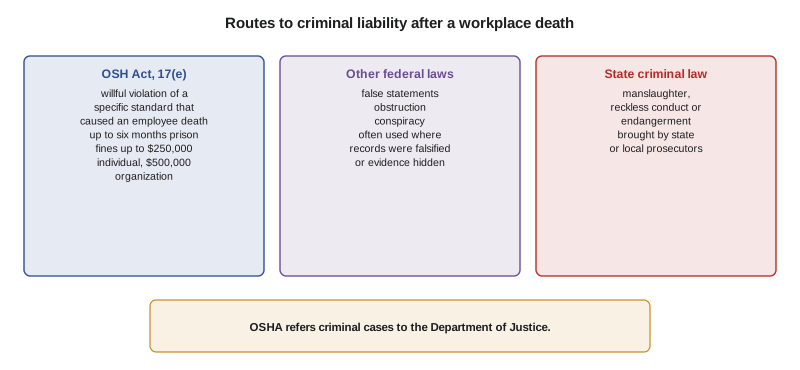
The OSH Act contains a few criminal provisions. The most important is section 17(e). It provides that any employer who willfully violates a standard, rule or order under the Act, where that violation causes the death of an employee, can be prosecuted and, on conviction, fined and imprisoned for up to six months, or up to one year for a second conviction. Under the general federal sentencing laws, the maximum fines for such misdemeanors are much higher than the amounts written in the Act: up to $250,000 for an individual and up to $500,000 for an organization. Other provisions make it a crime to give advance notice of an OSHA inspection without authority, under section 17(f), and to knowingly make false statements in records or reports required under the Act, under section 17(g).
Section 17(e) has three demanding elements. The violation must be of a specific standard, rule or order; a general duty clause violation is not enough. It must be willful, meaning the employer knew of the requirement and intentionally disregarded it, or acted with plain indifference to it. And it must have caused the death of an employee. Serious injuries that do not result in death are not covered. Critics have long argued that these limits, and the misdemeanor penalty, make the provision weak compared with criminal laws for environmental harm, and bills to strengthen it have been introduced in Congress repeatedly without becoming law.
Who can be prosecuted
Section 17(e) applies to employers, and courts have held that this includes corporations and, in some cases, individual corporate officers who are themselves treated as employers. It does not apply to supervisors who are simply employees of a corporation. But that does not mean supervisors are outside criminal law altogether. Federal prosecutors can use general criminal laws, such as making false statements to a federal agency under 18 U.S.C. 1001, obstructing a federal proceeding, or conspiracy, against anyone who lies to investigators, falsifies records or destroys evidence after an incident. And state prosecutors can bring charges under state criminal law, such as involuntary manslaughter or reckless endangerment, against individuals or companies whose conduct caused a death.
In practice, the cases that lead to prosecution share some features. Someone knew about a serious hazard and decided not to fix it, often to save time or money; workers had complained or been injured before; OSHA or others had warned the company; and, frequently, someone tried to cover it up afterwards by falsifying records, coaching witnesses or lying to investigators. The cover-up is often easier to prosecute than the underlying safety failure, and carries longer sentences.
How often prosecutions happen
Criminal prosecutions for workplace deaths in the United States are rare. OSHA refers a small number of cases each year to the Department of Justice, and only some of those are charged. In 2015 the Departments of Labor and Justice agreed to coordinate more closely on worker endangerment cases and to consider using environmental and other criminal laws, which carry stronger penalties, alongside the OSH Act. State and local prosecutors have also brought manslaughter and reckless endangerment charges after some high-profile deaths, particularly in construction trenching collapses and in cases where employers ignored repeated warnings. Each case depends on its facts, but the pattern is consistent: prosecutions follow knowing, repeated disregard of a deadly hazard, often combined with deception.
For Harrowgate Foods Inc., Aisha's assessment was that the spiral conveyor injury could never have led to a criminal case, both because the worker survived and because the company had not willfully disregarded the standard. But she pointed out how close the facts could have come to something worse. If the worker had died, and if senior managers had known that lockout was routinely skipped and decided to do nothing because of the cost of moving the disconnect, a willful violation causing death would have been a real possibility. The difference between a citation and a prosecution can be what people knew and what they chose to do.
What this means for supervisors
Aisha's message to the supervisors was reassuring and sobering at the same time. Reassuring, because criminal liability requires far more than an honest mistake or a gap in a program: it requires a willful violation, reckless conduct or deception. Sobering, because the conduct that crosses the line is not exotic. Telling a worker to go into a trench you know is unsafe, directing a crew to skip lockout to meet a deadline, removing a guard and running the machine anyway, or ignoring a worker's warning and sending someone else in can all lead to criminal exposure if someone dies. So can lying to OSHA, backdating training records or telling workers what to say to investigators.
The protection is the same as in every other lesson: know the hazards, put controls in place, supervise, enforce, respond to concerns, and record what you do. A supervisor who does those things is taking reasonable steps. And if a supervisor is ever told to do something that would put workers in serious danger, the right response is to refuse, to escalate in writing, and to stop the work.
A short self-check
Elena turned the warning signs prosecutors look for into a self-check that supervisors could use when facing pressure to cut a corner on a high-risk task.
# Self-check before allowing high-risk work to proceed under pressure.
questions = [
    ("Could this task kill or seriously injure someone if a control fails?", True),
    ("Is a required control missing, bypassed or not verified?", True),
    ("Has anyone raised a concern or refused this task?", False),
    ("Am I being asked to skip a step to save time or money?", True),
    ("Would I be comfortable explaining this decision to an investigator?", True),
]
red_flags = 0
for q, ans in questions:
    bad = ans if "comfortable" not in q else not ans
    red_flags += bad
    print(f"{'RED ' if bad else 'ok  '} {q}")
print("decision:", "STOP the work and escalate in writing" if red_flags >= 2 else "proceed with controls verified")RED Could this task kill or seriously injure someone if a control fails? RED Is a required control missing, bypassed or not verified? ok Has anyone raised a concern or refused this task? RED Am I being asked to skip a step to save time or money? ok Would I be comfortable explaining this decision to an investigator? decision: STOP the work and escalate in writing
In the example, three red flags appear: a serious hazard, a missing control and pressure to skip a step. The self-check's answer is to stop the work and escalate. Elena told supervisors that if they ever answered 'no' to the last question, that alone was a reason to stop.
Worked problem
Where is the line?
Show solution
- Scenario A: a supervisor misses that a new worker's training did not cover a machine; the worker is injured. This may be a serious OSHA violation, but it is not willful and nobody died.
- Scenario B: a manager is told by two workers that a trench wall is cracking, knows the standard requires protection, says the job must finish today, and sends a worker in; the wall collapses and kills him.
- In B, there is a willful violation of a specific standard that caused a death: a candidate for prosecution under section 17(e), and possibly state manslaughter charges.
- If someone then backdates the trench inspection record, false statement and obstruction charges become possible too.
- The difference is knowledge of serious danger plus a decision to proceed, and any attempt to hide it.
Answer: Honest mistakes are handled by regulators; knowingly exposing workers to deadly danger can be criminal.
Investigations after a death
After a workplace death, OSHA will usually inspect, and its compliance officer will look closely at what managers and supervisors knew and decided. Where the facts suggest willfulness, the area office can refer the case to the regional solicitor and then to the Department of Justice. Local police and the county or district attorney may also investigate, particularly if there are signs of recklessness. Supervisors involved in a serious incident may be interviewed by both. The advice is the same in each case: tell the truth, stick to what you know, preserve records and evidence exactly as they are, and consider getting legal advice if you may personally be at risk. Never alter a record, move evidence without authorization or suggest to anyone what they should say.
Civil liability and other consequences
Criminal prosecution is not the only consequence of a workplace death. Workers' compensation is usually the exclusive remedy against the employer for a covered employee's injury or death, which bars most lawsuits by the worker's family against the employer itself, although some states allow exceptions for intentional or egregious conduct. Lawsuits against third parties, such as equipment manufacturers or contractors, are common. A company can also face debarment from government contracts, increased insurance costs, loss of customers and lasting damage to its reputation. For individuals, losing a job or a career can follow even without any charge. These consequences are another reason why the habits in this course matter.
Why willfulness matters so much
Willfulness is the line between an ordinary OSHA case and one that can lead to criminal charges, much larger civil penalties and placement in the Severe Violator Enforcement Program. OSHA and the courts look for evidence that the employer knew of the requirement and chose to ignore it: earlier citations for the same hazard, internal emails discussing the risk and rejecting a fix because of cost, workers' complaints that were dismissed, safety audits that flagged the problem with no follow-up, or supervisors who told workers to skip a step. Plain indifference can be shown by a pattern of ignoring safety requirements generally. Much of that evidence is created by supervisors and managers in the ordinary course of work, which is why what they write and how they respond to warnings matters so much.
Elena told the supervisors that the best way to avoid ever being near a willful case was simple: never write, say or decide something you would not want read aloud in a courtroom, and when you learn of a serious hazard, act on it and record what you did. 'Every email about a hazard should end with what's being done about it,' she said.
Dev took that advice literally. His shift handover note now ended every open hazard with three words: 'action, owner, date'. Nobody reading it later could think a known hazard had been ignored.
Lessons from the cases
Elena summarized what the prosecuted cases had in common for the supervisors. In almost every one, workers or others had warned someone about the hazard before the death. In most, a cheaper or faster way of working had been chosen over a known safer one. In many, records had been changed or witnesses pressured afterwards. And in none had the people involved set out to hurt anyone. 'Nobody plans to be in one of these cases,' she said. 'They get there one shortcut and one ignored warning at a time.'
Common mistakes
MistakeBelieving criminal liability is impossible under the OSH Act.
InsteadSection 17(e) covers willful violations causing death, and other laws apply to cover-ups.
MistakeThinking any serious violation is a crime.
InsteadSection 17(e) needs a willful violation of a specific standard that caused a death.
MistakeDirecting work to continue despite a known serious danger.
InsteadStop the work, fix the hazard and escalate in writing.
MistakeFixing records after an incident to look better.
InsteadFalsifying records or coaching witnesses can itself be a federal crime.
MistakeAssuming only federal law matters.
InsteadState prosecutors can bring manslaughter or reckless endangerment charges.
Summary and key terms
- Section 17(e) makes a willful violation of a standard that causes an employee's death a federal misdemeanor.
- Penalties: up to six months in prison (one year for a repeat) and fines up to $250,000 for individuals or $500,000 for organizations.
- Sections 17(f) and 17(g) make advance notice of inspections and false statements crimes.
- Cover-ups can be prosecuted under general federal laws, and states can bring manslaughter or reckless endangerment charges.
- Prosecutions are rare and follow knowing disregard of deadly hazards, often with deception.
- Honest mistakes are not criminal; knowingly exposing workers to deadly danger, or lying about it, can be.
- Section 17(e)
- The OSH Act provision making a willful violation causing an employee's death a crime.
- Willful
- Intentional and knowing disregard of a legal requirement, or plain indifference to it.
- Misdemeanor
- A less serious class of crime, with a maximum of one year in prison.
- False statement
- Knowingly making a false statement to a federal agency, a crime under 18 U.S.C. 1001 and section 17(g).
- Criminal referral
- OSHA sending a case to the Department of Justice for possible prosecution.
- Reckless endangerment
- A state crime of recklessly creating a substantial risk of death or serious injury.
Practice problems
Work each problem on paper first, then reveal the answer to check.
What are the three elements of a section 17(e) offense?
Show answer
A violation of a specific standard, rule or order; that is willful; and causes an employee's death.
What are the maximum penalties?
Show answer
Up to six months in prison (one year for a repeat) and fines up to $250,000 for individuals or $500,000 for organizations.
Why are cover-ups often easier to prosecute?
Show answer
False statements and obstruction are clear federal crimes with longer sentences.
Can a general duty clause violation support a 17(e) charge?
Show answer
No, it must be a violation of a specific standard, rule or order.
Who else besides federal prosecutors can bring criminal charges?
Show answer
State and local prosecutors, under state criminal laws such as manslaughter.
Lesson quiz · 5 questions
Score 60% or more to complete this lesson.
Create a free account to save your progress, take quizzes and earn a certificate.