
HSE-402 · Lesson 8 of 12 · 20 min
Defenses, including unpreventable employee misconduct
After the settlement, Rachel asked Aisha a different question. 'Suppose another worker on another shift skips a step tomorrow, despite everything we have done. Could we defend a citation?' Aisha said yes, possibly, if the company could prove what it had done. 'OSHA recognizes defenses,' she said. 'The most important one for us is unpreventable employee misconduct. But it only works if the evidence exists before anything happens.' This lesson explains the main defenses to an OSHA citation and how to build the evidence for them.
The Secretary's burden
Before an employer needs a defense, OSHA, acting for the Secretary of Labor, must prove its case. For a violation of a standard, the Secretary must show that the standard applies, that its terms were not met, that employees had access to the hazard, and that the employer knew or, with the exercise of reasonable diligence, could have known of the violating condition. Knowledge is often the key element. Actual knowledge exists when a supervisor or manager saw or was told about the violation. Constructive knowledge exists when the employer should have known, for example because the condition was in plain view or had existed for a long time, or because the employer had no adequate system for finding such problems.
At Harrowgate Foods Inc., knowledge was easy to prove for the spiral: the previous supervisor admitted he knew, and his knowledge was imputed to the company. For the packaging belt, the missing guard was in plain view in a busy area, so constructive knowledge was likely. That is why Aisha advised settling rather than contesting. In a future case, the company's ability to defend itself would depend on whether supervisors were finding and correcting violations, and whether the violation was truly the act of an individual who went against well-enforced rules.
Unpreventable employee misconduct
The unpreventable employee misconduct defense, sometimes called the isolated employee misconduct defense, recognizes that an employer that has done everything reasonable should not be liable when an employee deliberately or carelessly breaks a well-enforced rule. To establish it, the employer must prove four things: that it had established work rules designed to prevent the violation; that it had adequately communicated those rules to its employees; that it had taken steps to discover violations; and that it had effectively enforced the rules when violations were discovered. The burden of proof is on the employer, and the Review Commission and courts examine the evidence closely.
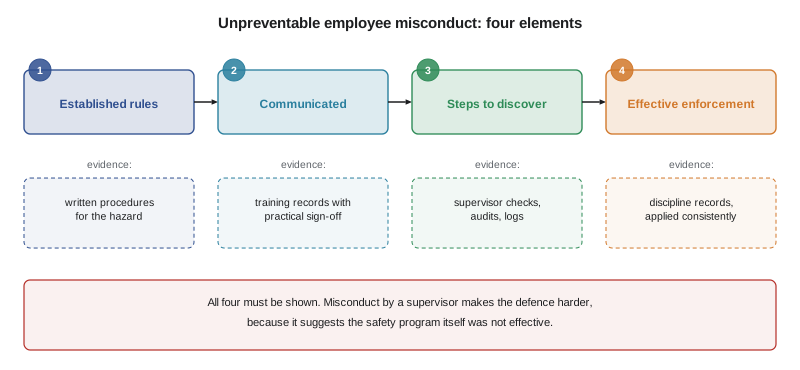
Each element needs evidence. Established rules means a specific written rule addressing the hazard, not a general instruction to 'work safely'. Adequate communication means training records showing employees learned the rule, ideally with practical demonstration for the specific equipment. Steps to discover violations means supervisors actually checking, and audits that look for the problem. Effective enforcement means a history of consistent discipline when violations are found, applied to supervisors as well as workers. A company that has never disciplined anyone for breaking a safety rule will struggle to show effective enforcement, and a company whose supervisors knew about routine violations will struggle to show the misconduct was unpreventable.
When the misconduct is a supervisor's
Supervisor misconduct complicates the defense. If a supervisor breaks a rule himself, or allows his crew to do so, the Commission and courts often treat it as evidence that the employer's safety program was lax, because the supervisor is supposed to be the person enforcing it. There is also a question of knowledge. In ComTran Group v. U.S. Department of Labor (2013), the federal appeals court whose circuit includes Georgia held that a supervisor's knowledge of his own rogue misconduct is not automatically imputed to the employer; OSHA must show the employer could have foreseen and prevented it, for example through a lax safety program. Other circuits have taken different approaches, so where a case is heard can matter.
The practical lesson for supervisors is that their own conduct is the company's first line of defense. A supervisor who follows every rule, checks his crew, corrects and records violations, and escalates when he cannot fix something gives the company the evidence it needs. A supervisor who takes shortcuts himself, or looks the other way, undermines every element of the defense at once.
Other defenses
Several other defenses can apply in particular cases. Infeasibility: the employer can show that complying with the standard was technologically or economically infeasible, or would have prevented the work from being done, and that it used feasible alternative protection. Greater hazard: complying would create a greater hazard than not complying, alternative protection was used, and a variance was not appropriate; this defense is narrow and rarely succeeds. The standard does not apply: for example, the equipment or task falls outside the standard's scope, as the lockout standard does not apply to minor servicing done under effective alternative protection during normal production operations. Lack of employee exposure: no employee had access to the hazard. Time limit: the citation was issued more than six months after the violation.
Most of these defenses turn on facts the employer must document in advance. For example, the minor servicing exception to lockout requires that the alternative protection be effective; an employer relying on it needs a written analysis of the task and the protection used. Elena reviewed every task at the plants where crews worked on machines without full lockout, such as clearing jams, and either wrote up the alternative protection or required full lockout.
Audits that find problems before OSHA does
Steps to discover violations is the element of the misconduct defense that companies most often fail. An audit that never finds anything is a warning sign, not a comfort. Elena designed the lockout audits to catch drift: auditors observed real cleaning on real shifts, including nights and weekends; they asked workers to walk them through the procedure on the machine; they compared the time the procedure took with the time the schedule allowed; and they recorded everything they found, including problems fixed on the spot. OSHA's own periodic inspection requirement for energy control procedures in 1910.147(c)(6) is a built-in version of the same idea.
Testing the evidence
Elena ran a quarterly check of discipline and audit records to see whether the company could show effective enforcement if it ever needed the misconduct defense.
# Enforcement records for lockout breaches found in audits (invented data).
breaches = [
    # (role, response)
    ("worker", "coached"), ("worker", "written warning"), ("worker", "coached"),
    ("supervisor", "written warning"), ("worker", "coached"), ("lead", "verbal warning"),
    ("worker", "final warning"), ("supervisor", "coached"),
]
from collections import Counter
by_role = Counter(r for r, _ in breaches)
formal = Counter(r for r, x in breaches if x != "coached")
for role in by_role:
    print(f"{role:<11} breaches {by_role[role]}  formal discipline {formal[role]}")
print("audits finding breaches show 'steps to discover'; discipline across roles shows 'effective enforcement'")worker breaches 5 formal discipline 2 supervisor breaches 2 formal discipline 1 lead breaches 1 formal discipline 1 audits finding breaches show 'steps to discover'; discipline across roles shows 'effective enforcement'
The records showed breaches found by audits and supervisors, and discipline applied to supervisors and leads as well as workers. Aisha said that was exactly the pattern she would want to show the Review Commission: rules that were checked, breaches that were found, and responses that did not depend on rank.
Worked problem
Would the misconduct defense succeed?
Show solution
- Eight months later, a worker at the sauces plant reaches into a filler to clear a jam without locking out, and cuts a finger.
- Rules: a written filler procedure requires lockout for jam clearing.
- Communication: the worker was trained and signed off on that filler, with a practical demonstration.
- Discovery: the supervisor's log shows lockout checks most shifts; an audit a month earlier observed jam clearing on nights.
- Enforcement: the worker had received a written warning two weeks earlier for the same shortcut, and records show consistent discipline across roles. The defense has a reasonable chance.
Answer: All four elements are supported by records created before the incident.
Building the evidence: a records map
Elena turned the four elements of the misconduct defense into a records map, showing for each element which records proved it, who created them, how often, and where they were kept. The map made gaps visible. The written rules existed, but some procedures were general rather than machine-specific. Training records proved attendance but not competence. Supervisors were correcting unsafe acts but rarely writing it down, so the company's best evidence of discovering and enforcing existed only in people's memories. Discipline records were kept in human resources files that nobody connected to safety.
The fixes were small but deliberate. Every high-risk machine got a machine-specific procedure. Training records gained a practical sign-off: the worker performing the task, observed by an authorized person, for each machine. Supervisors gained a simple log with columns for inspections, coaching and corrections, hazards found and fixed, and concerns raised. Safety-related discipline was summarized quarterly, by role, for Elena and the safety committee. None of these was a new program. Each turned something the company already did into something it could prove.
What OSHA looks for in a program
OSHA's Recommended Practices for Safety and Health Programs, updated in 2016, describe seven core elements: management leadership, worker participation, hazard identification and assessment, hazard prevention and control, education and training, program evaluation and improvement, and communication and coordination for host employers, contractors and staffing agencies. They are not a standard and are not enforceable, but they describe what a mature program looks like and give a useful checklist. An employer with a program built on these elements is more likely to find and fix hazards before an inspection, and better placed to show good faith and to support defenses if a violation is found.
Good faith can also affect penalties. The Field Operations Manual allows OSHA to reduce penalties for good faith in some circumstances, such as an effective written safety and health program, although reductions are not available for willful violations and are limited for high-gravity serious violations. Elena did not count on penalty reductions, but she noted that the same evidence that supports a defense also supports good faith.
A year later
A year after the settlement, Elena repeated the readiness scoring from lesson 6. The spiral clean, which had scored 1, 1 and 0, now scored 3, 3 and 3, with evidence for each point: a hazard assessment reviewed with the crew that month, the floor-level disconnect and interlocked gate, machine-specific training with practical sign-off, and Dev's verification log showing lockout checked on every spiral clean. The outside audit required by the settlement found the energy control program effective, with two minor findings that were closed within a month. There had been no lockout-related injuries in the year, and the number of hazards reported by workers had doubled.
Aisha reviewed the records and gave her honest view: no defense is ever certain, but if a similar citation were issued now, the company would have a credible case for the misconduct defense, provided supervisors kept doing what the records showed. Rachel cared less about that than about the doubled hazard reports. 'That,' she said, 'is what all of this is supposed to produce: people finding problems before they hurt someone.'
What a defense is not
Aisha also listed things that look like a defense but are not. A thick binder nobody on the floor has read is not evidence of communicated rules. Signatures saying a worker 'understands the hazards' prove little unless something shows the worker actually does. Discipline used mainly after injuries, rather than when breaches are found in audits, looks like punishment of bad luck, not enforcement. For supervisors, her advice came down to three habits: check the work, not just the paperwork; fix problems and write down what you found and did; and escalate in writing what you cannot fix.
Common mistakes
MistakeRelying on a general rule to 'work safely'.
InsteadThe misconduct defense needs a specific written rule for the hazard.
MistakeNever disciplining anyone for safety breaches.
InsteadEffective enforcement means a record of consistent discipline.
MistakeSupervisors taking shortcuts themselves.
InsteadSupervisor misconduct undermines every element of the defense.
MistakeAssuming minor servicing is always exempt from lockout.
InsteadDocument the effective alternative protection or require lockout.
MistakeCelebrating audits that never find anything.
InsteadDesign audits to find drift and record what they find.
Summary and key terms
- The Secretary must prove the standard applies, was violated, employees had access and the employer knew or should have known.
- A supervisor's knowledge is usually imputed to the employer.
- The misconduct defense needs established rules, adequate communication, steps to discover violations and effective enforcement.
- Supervisor misconduct makes the defense harder; in the circuit covering Georgia, ComTran limits automatic imputation of a supervisor's own misconduct.
- Other defenses include infeasibility, greater hazard, inapplicability of the standard, lack of exposure and the six-month limit.
- Every defense depends on evidence created before the incident.
- Constructive knowledge
- Knowledge the employer should have had with reasonable diligence.
- Unpreventable employee misconduct
- A defense where a violation resulted from an employee breaking a well-communicated, well-enforced rule.
- Infeasibility defense
- A defense that compliance was impossible or would prevent the work, with alternative protection used.
- Minor servicing exception
- The limited exception to lockout for routine servicing during normal production with effective alternative protection.
- ComTran
- A 2013 federal appeals decision limiting automatic imputation of a supervisor's own misconduct to the employer.
Practice problems
Work each problem on paper first, then reveal the answer to check.
What must the Secretary prove for a violation of a standard?
Show answer
The standard applies, it was not met, employees had access and the employer knew or should have known.
List the four elements of the misconduct defense.
Show answer
Established rules, adequate communication, steps to discover violations and effective enforcement.
Why does supervisor misconduct weaken the defense?
Show answer
It suggests the program was lax, because supervisors are meant to enforce it.
What did ComTran hold?
Show answer
A supervisor's knowledge of his own rogue misconduct is not automatically imputed; OSHA must show it was foreseeable and preventable.
Name two other defenses.
Show answer
Infeasibility, greater hazard, the standard does not apply, no employee exposure, the six-month limit.
Lesson quiz · 5 questions
Score 60% or more to complete this lesson.
Create a free account to save your progress, take quizzes and earn a certificate.