
HSE-402 · Lesson 7 of 12 · 20 min
Citations, penalties and contests
Five weeks after the inspection, a certified letter arrived at the Gainesville plant: a citation and notification of penalty from the OSHA area office. It listed four alleged serious violations with proposed penalties, abatement dates for each, and a page explaining the company's options. A clock had started on the day the letter was received. Dev had never seen a citation before. Elena sat down with him, Marcus and the company's lawyer, Aisha Grant, to go through it line by line. This lesson follows that meeting and the decisions that came out of it.
What a citation contains
A citation describes each alleged violation: the standard or section of the Act that was violated, a short description of the condition, the classification of the violation, the proposed penalty, and the date by which it must be corrected, called the abatement date. The employer must post a copy of the citation at or near the place where each violation occurred, for three working days or until the violation is corrected, whichever is longer, so that workers can see it. Workers and their representatives have the right to contest the abatement date if they think it is too long.
Harrowgate Foods Inc.'s citation had four items. Item 1 cited 1910.147(c)(4)(i) for failing to use energy control procedures when cleaning the spiral. Item 2 cited 1910.147(c)(7)(i) for training that did not give employees the knowledge and skills to apply energy controls on the machines they serviced. Item 3 cited 1910.147(c)(6)(i) for failing to conduct a periodic inspection of the spiral's energy control procedure at least annually. Item 4 cited 1910.212(a)(1) for the unguarded packaging belt. All four were classified as serious.
Classes of violations
OSHA classifies violations by seriousness. A serious violation is one where there is a substantial probability that death or serious physical harm could result, and the employer knew or should have known of the hazard. An other-than-serious violation has a direct relationship to safety and health but would probably not cause death or serious harm. A willful violation is one the employer committed intentionally and knowingly, or with plain indifference to the law. A repeat violation is one where the employer was cited for a substantially similar violation, at any of its establishments, in the past five years and that citation became final. A failure to abate is a failure to correct a cited violation by the abatement date. De minimis conditions, which have no direct effect on safety, are noted but not penalized.
The classification drives the penalty and the consequences. A willful or repeat violation carries a much larger maximum penalty, can lead to placement in OSHA's Severe Violator Enforcement Program, which brings follow-up inspections and public attention, and, for a willful violation that causes a death, can lead to criminal prosecution under section 17(e) of the Act. Elena explained to Dev why the lockout items were serious rather than willful: the company had a lockout program and had not intentionally disregarded the standard. But the previous supervisor's tolerance had come close. If senior managers had known and done nothing, OSHA might have classified the item as willful.
Penalties
OSHA's maximum penalties are adjusted for inflation each year under federal law. For 2025, the maximum was $16,550 per serious or other-than-serious violation and $165,514 per willful or repeat violation, with failure to abate penalties of up to $16,550 per day beyond the abatement date. Because the inflation data needed for the 2026 adjustment were not published on time, OSHA announced in May 2026 that the 2025 maximums would continue to apply. Penalties are proposed per violation, so a single inspection can produce penalties many times the per-item maximum.
Within the maximums, OSHA calculates a gravity-based penalty for each item from the severity of the likely injury and the probability that it would occur, using tables in the Field Operations Manual. It then applies adjustments: reductions for small employers, a reduction for employers with no recent history of serious, willful or repeat violations, and in some circumstances a reduction for good faith, such as an effective safety program. Large employers, such as Harrowgate Foods Inc. with more than 250 workers, get no size reduction. Harrowgate Foods Inc.'s four items carried proposed penalties totaling $58,000.
The 15-working-day decision
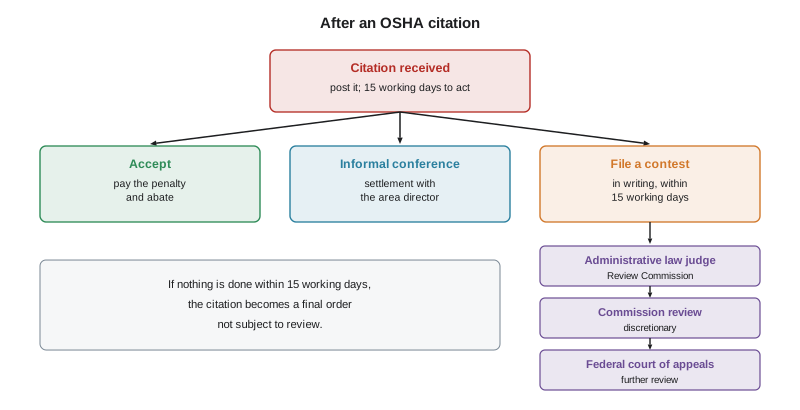
Once a citation is received, the employer has 15 working days to decide what to do. It can accept the citation, pay the penalty and correct the violations, certifying the correction to OSHA as required by 29 CFR 1903.19. It can request an informal conference with the area director to discuss the citation, provide additional information and negotiate a settlement; an informal conference does not stop the 15-day clock, so it must be held, and any settlement signed, within that period or a notice of contest filed. Or it can file a written notice of contest with the area office, contesting the citation, the classification, the penalty or the abatement date, or any combination. If the employer does nothing within 15 working days, the citation becomes a final order of the Review Commission and cannot be challenged.
A contest is heard by an administrative law judge of the Occupational Safety and Health Review Commission, an independent agency separate from OSHA. The Secretary of Labor must prove the violation. Either side can ask the full Commission to review the judge's decision, and its decision can be appealed to a federal court of appeals. Contesting a violation generally suspends the obligation to abate it until the case is decided, although employers are still expected to protect workers, and continuing to expose workers to a known hazard makes little sense whatever the legal outcome.
The informal conference and settlement
Harrowgate Foods Inc. requested an informal conference. Elena brought evidence of every corrective action: the floor-level disconnect and interlocked gate, the extended sanitation window, the rewritten machine-specific procedures, the new training with practical sign-off, the periodic inspection records now completed for every machine, and the guarded packaging belt. Aisha explained that the company accepted the violations had occurred and wanted to settle. The area director agreed to an informal settlement agreement: items 1 and 3 were grouped as a single item, the total penalty was reduced to $40,600, and the company agreed to enhanced abatement, including extending the same changes to its other two sites and having an outside auditor review the energy control program within a year.
Aisha explained why the company settled rather than contesting. The evidence of the previous supervisor's knowledge made the lockout items hard to defend. A contest would have been expensive and slow, and would have kept the violations open, which matters because a final citation counts toward repeat violations for five years. A settlement allowed the company to resolve the case quickly, invest in the enhanced abatement, and put the focus back on preventing the next injury. The settlement also included language that the company did not admit the violations for purposes other than OSHA proceedings, which is common in OSHA settlements.
Calculating the proposed penalty
Elena used a short script to show the leadership team how OSHA's adjustments work, using illustrative gravity-based amounts rather than the exact tables.
# Illustrative only: how OSHA adjusts gravity-based penalties for a large employer.
max_serious = 16550  # 2025 maximum, continued for 2026
items = {
    "1 lockout not used on spiral": 1.00,     # high severity, greater probability
    "2 training not machine-specific": 0.75,
    "3 no periodic inspection": 0.50,
    "4 unguarded packaging belt": 0.75,
}
size_reduction = 0.00     # more than 250 employees: no size reduction
history_reduction = 0.10  # no serious, willful or repeat citations in the past five years (illustrative)
total = 0
for name, share in items.items():
    gbp = round(max_serious * share, -1)
    proposed = round(gbp * (1 - size_reduction - history_reduction), -1)
    total += proposed
    print(f"{name:<34} gravity {gbp:>8,.0f}  proposed {proposed:>8,.0f}")
print(f"total proposed {total:,.0f}")1 lockout not used on spiral gravity 16,550 proposed 14,900 2 training not machine-specific gravity 12,410 proposed 11,170 3 no periodic inspection gravity 8,280 proposed 7,450 4 unguarded packaging belt gravity 12,410 proposed 11,170 total proposed 44,690
The script's illustrative total, about $44,700, was well below the $58,000 OSHA actually proposed, because the area office had rated the items as more severe and more likely than Elena's guesses. That was a lesson in itself: internal estimates tend to be generous, and OSHA's own assessment of severity and probability is what counts. Elena still used the script to show that each item's penalty depended on how severe and how likely the injury was, and that a clean five-year history was worth a reduction. A repeat citation in the next five years, at any of the three sites, would carry a maximum ten times higher.
Worked problem
Choosing a response to a citation
Show solution
- A citation at the distribution center alleges a serious violation for an unguarded mezzanine edge, with a 14-day abatement date.
- The company agrees the hazard is real but cannot get guardrails fabricated in 14 days.
- It installs temporary barriers immediately and requests an informal conference within the 15 working days.
- At the conference it asks for a longer abatement date and documents the interim protection; the area director agrees in a settlement.
- If the conference had not resolved it, the company could have filed a petition for modification of abatement or a notice of contest on the date alone.
Answer: Protect workers now and use the 15 working days to settle or contest only what is genuinely disputed.
After the settlement: abatement and certification
Settling a citation is not the end. Under 29 CFR 1903.19, an employer must certify to OSHA, within ten calendar days after each abatement date, that each cited violation has been corrected, and for many items must provide documents such as photographs, invoices or training records showing the correction. For items with longer abatement periods, OSHA can require abatement plans and progress reports. Employers must also tell affected employees about the abatement by posting the certification or otherwise informing them. Failing to abate or to certify can lead to a failure-to-abate penalty of up to $16,550 per day.
Elena set up a tracker with every abatement step, its owner, its due date and the evidence that would be sent. The enhanced abatement for the other two sites, which Harrowgate Foods Inc. had agreed to in the settlement, went on the same tracker. Dev was the owner for the night sanitation items: completing periodic inspections of every energy control procedure, getting each sanitation worker signed off on practical lockout for every machine they cleaned, and keeping his verification log. When the certification was sent, every item had evidence attached.
Talking to the crew about citations
Citations can feel like an accusation, and workers sometimes worry that they will be blamed. Dev posted the citation by the spiral as required, and the next night he explained it to the crew: what OSHA had found, what the company had changed, and why. He was careful not to suggest that the crew members who had described the skipped lockout had caused the citation. 'They told the truth,' he said. 'The problem was ours to fix, and we've fixed it.' Two workers told him afterwards that it was the first time a supervisor had explained a citation to them rather than just pinning it on the board.
Learning from enforcement elsewhere
OSHA publishes inspection data and press releases on significant cases, and Elena used them as teaching material. Each month she picked one case from food processing or warehousing and asked supervisors at each site: could this happen here, and what would stop it? The questions were often uncomfortable. A case involving a worker caught in an unguarded conveyor at another company led the sauces plant to find two similar gaps of its own, which were guarded before any officer saw them.
Common mistakes
MistakeMissing the 15-working-day deadline.
InsteadDiary the date on receipt; an uncontested citation becomes a final order.
MistakeAssuming an informal conference stops the clock.
InsteadSettle within 15 working days or file a notice of contest.
MistakeForgetting to post the citation.
InsteadPost it near the violation for three working days or until corrected.
MistakeLeaving workers exposed during a contest.
InsteadProtect workers whatever the legal outcome.
MistakeFixing a hazard at one site only.
InsteadRepeat violations count company-wide for five years; fix it everywhere.
Summary and key terms
- A citation lists each alleged violation, its classification, proposed penalty and abatement date, and must be posted.
- Violations are classed as serious, other-than-serious, willful, repeat or failure to abate.
- Maximums in 2025 and 2026: $16,550 per serious violation and $165,514 per willful or repeat violation.
- Penalties start from gravity and are adjusted for size, history and good faith.
- Within 15 working days the employer can accept, settle at an informal conference, or file a notice of contest.
- Contests go to a Review Commission judge, then the Commission, then a federal court of appeals.
- Citation
- OSHA's written notice of an alleged violation, with a proposed penalty and abatement date.
- Abatement
- Correction of a cited violation.
- Serious violation
- A violation with a substantial probability of death or serious physical harm that the employer knew or should have known about.
- Repeat violation
- A violation substantially similar to one in a final citation within the past five years.
- Informal conference
- A meeting with the area director to discuss and possibly settle a citation.
- Contest (notice of contest)
- The employer's written challenge to a citation, filed within 15 working days.
Practice problems
Work each problem on paper first, then reveal the answer to check.
What does a citation contain?
Show answer
The standard violated, a description, the classification, the proposed penalty and the abatement date.
Define a repeat violation.
Show answer
A violation substantially similar to one in a citation that became final within the past five years.
What were the 2025 maximum penalties, continued in 2026?
Show answer
$16,550 per serious violation and $165,514 per willful or repeat violation.
List the employer's three options after a citation.
Show answer
Accept and abate, settle at an informal conference, or file a notice of contest, all within 15 working days.
Why did Harrowgate Foods Inc. settle?
Show answer
The violations were hard to defend, a contest was costly, and settlement allowed quick resolution and enhanced abatement.
Lesson quiz · 5 questions
Score 60% or more to complete this lesson.
Create a free account to save your progress, take quizzes and earn a certificate.