
HSE-402 · Lesson 5 of 12 · 21 min
Workers' rights: information, reporting and refusing imminent danger
At 2:15 a.m. in Dev's fifth week, Priya stopped at the door of the mixer room and said she would not go in. A mixer tank had been drained for cleaning, but the ventilation fan on the room was making a grinding noise and the gas monitor in the room had shown a brief alarm earlier in the night. 'I'm not cleaning that tank until someone checks the air,' she said. 'It's not safe.' Dev had learned about workers' rights in his supervisor course the week before. This was the first time he had to apply it.
How a supervisor responds to a worker who will not do a task because it is dangerous says more about a workplace's safety culture than any poster. It is also one of the moments when supervisors most often get the law wrong. This lesson covers the rights that US law gives workers: to information and training, to report hazards and injuries, to request and take part in OSHA inspections, and, in narrow circumstances, to refuse work that poses an imminent danger, together with the protection against retaliation that makes those rights real.
The right to know
Workers have the right to information about the hazards of their work. Under the hazard communication standard (1910.1200), employers must label hazardous chemicals, keep safety data sheets accessible and train workers in a language they understand. Workers have the right to see their own medical and exposure records under 1910.1020, to see the OSHA 300 log and 300A summary, and to receive copies of citations, which must be posted near the place of the violation. Many standards require training before a worker starts a task. A worker asked to do a task without being told its hazards has been denied this right.
For the mixer room, the right to know included knowing that cleaning chemicals in a closed tank can release hazardous vapors, that the ventilation fan was a control the procedure relied on, and what the gas monitor alarm meant. Priya knew all three because the crew had been trained on that procedure two weeks earlier. Her knowledge was what made her stop.
The right to report and to take part in inspections
Workers have the right to report hazards, injuries and illnesses without retaliation, to file a complaint with OSHA and request an inspection, and to have a representative take part in an OSHA inspection, including speaking privately with the compliance officer. Under 1904.35, employers must establish a reasonable procedure for reporting injuries and illnesses, inform workers of it, and must not discourage reporting or retaliate against workers who report. Workers who are not represented by a union can still talk to the compliance officer, and OSHA can keep a complainant's name confidential.
The right to refuse
The OSH Act does not give a general right to refuse work. But OSHA's regulation at 29 CFR 1977.12(b)(2) protects a worker who refuses in good faith to do a task where all of these conditions are met: the worker has asked the employer to eliminate the danger and the employer has failed to do so; the worker refused in good faith, genuinely believing an imminent danger exists; a reasonable person would agree there is a real danger of death or serious injury; and there is not enough time, given the urgency, to get the hazard fixed through normal channels such as an OSHA inspection. The right is narrow, but where it applies the worker is protected from retaliation.
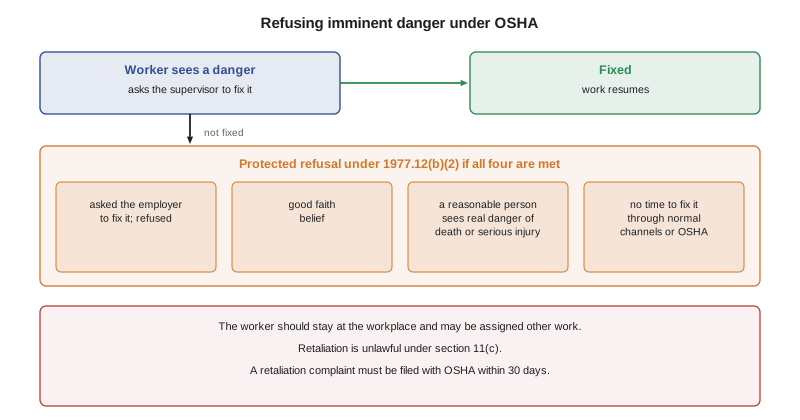
In practice, most workplaces handle unsafe-work concerns well before the legal conditions are tested. Good employers, including Harrowgate Foods Inc., go further than the minimum and give every worker a company stop-work right: anyone can stop a task they believe is unsafe, without proving imminent danger, and the supervisor must respond. Harrowgate Foods Inc.'s procedure set out the steps. The worker tells the supervisor. The supervisor investigates with the worker and fixes the problem or explains why the work is safe. If they still disagree, the safety manager is called. The worker may be assigned other work in the meantime, and is never disciplined for raising the concern in good faith. If the task is given to someone else, that worker must be told about the concern.
Handling the refusal in the mixer room
Dev followed the procedure. He thanked Priya for raising it, stopped all work in the mixer room, and went with her to look. The fan was running but the grinding noise suggested a failing bearing, and the airflow at the vent felt weak. The monitor's log showed a short reading above its first alarm point an hour earlier, when the tank had been sprayed with cleaner. He did not argue that the reading had been brief, and he did not ask anyone else to clean the tank. He called the on-call maintenance technician, who confirmed the bearing was failing and that airflow was well below the design rate.
Dev assigned the crew to other cleaning while the fan was repaired. Once it was fixed, he and Priya checked the airflow and the monitor together, and she agreed the room was safe. The tank was cleaned two hours later than planned. Dev wrote up the refusal: the time, the concern, what was found, what was done, and the outcome. He also recorded that the gas monitor alarm earlier in the night had not been reported to him, and raised that at the morning meeting so that alarms would be reported immediately in future.
Had the fan been fine and the reading explained, Dev would have shown Priya the evidence and explained why he believed the work was safe. If she still disagreed, the next step under Harrowgate Foods Inc.'s procedure would have been the safety manager, and Priya would always have been free to contact OSHA. What he could not do was tell her to get back to work or face discipline, or quietly give the job to someone who did not know about the concern.
Protection against retaliation
Section 11(c) of the OSH Act prohibits any person from discharging or discriminating against an employee for exercising rights under the Act, including filing a complaint, reporting an injury, taking part in an inspection or making a protected refusal. Retaliation includes firing, demotion, discipline, reduced hours or pay, denial of overtime or promotion, intimidation and blacklisting. A worker must file an 11(c) complaint with OSHA within 30 days of the retaliation. OSHA investigates, and if it finds merit the Secretary of Labor can sue in federal court for reinstatement, back pay and damages. Separately, OSHA can cite an employer under 1904.35(b)(1)(iv) for retaliating against a worker for reporting an injury.
Retaliation is not always obvious. Being moved to a worse shift after raising a concern, being left out of overtime, being called a troublemaker in front of the crew, or suddenly receiving discipline for a minor matter that had always been ignored can all be reprisal. Supervisors must watch their own reactions, and those of others, after a worker raises a concern. Dev made a point of thanking Priya in front of the crew at the next shift start and describing what her refusal had found.
Tracking how rights are used
Elena asked supervisors to log every refusal and every formal safety concern, so the company could see whether workers were using their rights, and whether responses were fair and fast. Very few refusals is not always good news: it can mean workers are afraid to refuse.
# Refusals and stop-work events logged in a year at the three sites (invented data).
events = [
    # (site, hours to resolve, outcome, any reprisal complaint)
    ("main", 2.0, "hazard fixed", False), ("main", 0.5, "explained, worker agreed", False),
    ("main", 3.5, "hazard fixed", False), ("main", 1.0, "hazard fixed", False),
    ("dc", 6.0, "escalated to safety manager", False), ("dc", 0.5, "hazard fixed", False),
    ("sauces", 1.5, "hazard fixed", False),
]
workers = {"main": 420, "dc": 110, "sauces": 60}
for site, n in workers.items():
    ev = [e for e in events if e[0] == site]
    rate = 100 * len(ev) / n
    fixed = sum(1 for e in ev if e[2] == "hazard fixed")
    avg = sum(e[1] for e in ev) / len(ev)
    print(f"{site:<7} events {len(ev)}  per 100 workers {rate:4.1f}  hazards confirmed {fixed}  avg hours {avg:3.1f}")
print("reprisal complaints:", sum(e[3] for e in events))main events 4 per 100 workers 1.0 hazards confirmed 3 avg hours 1.8 dc events 2 per 100 workers 1.8 hazards confirmed 1 avg hours 3.2 sauces events 1 per 100 workers 1.7 hazards confirmed 1 avg hours 1.5 reprisal complaints: 0
Most refusals found a real hazard, which is what you would expect if workers only refuse when something is wrong. The distribution center had the lowest rate relative to its high-risk work, and the one escalated case took six hours. Elena planned listening sessions there to find out whether workers felt able to stop work.
Worked problem
Is this a protected refusal?
Show solution
- A forklift operator at the distribution center will not use a truck whose brakes feel soft.
- He asks the supervisor to take it out of service; under 1910.178(p)(1), a truck in need of repair must be taken out of service anyway.
- The supervisor removes the truck and has it inspected; the brake fluid is low and a line is leaking.
- The truck is repaired and the operator agrees it is safe. The concern is recorded.
- Even if the brakes had been fine, disciplining him for raising a good-faith safety concern could be retaliation under section 11(c).
Answer: Fix the hazard; never punish a good-faith safety concern.
Why workers do not use their rights
Surveys of workers in many countries find that a large share have, at some point, done a task they believed was unsafe without refusing or reporting it. The reasons are consistent. Workers fear being seen as lazy or difficult, or losing hours, shifts or their job. They are not sure the danger is serious enough to count. They do not know the process, or they believe nothing will change. New, young, temporary and migrant workers are especially reluctant, because they have the least security. And in crews where a shortcut has become normal, the worker who insists on the rule is the one who looks out of step.
Supervisors can lower these barriers more than anyone else. Dev's crew talk on rights, held in his fourth week, covered four points in plain words: what the rights are; exactly what to say and do if you think a task is unsafe; what Dev would do in response; and his promise that nobody would lose hours or face any penalty for raising a concern in good faith. He asked the crew which tasks they had ever felt pushed to do unsafely. The first answer came after a long silence, from an agency worker who had cleaned a slicer with the blade guard off because 'that's how they showed me'. The list grew to seven items, and Dev worked through them over the next month.
Rights during an OSHA inspection
Workers' rights extend into OSHA inspections. An authorized employee representative has the right to accompany the compliance officer on the walkaround. Where there is no union, the officer may talk privately with a reasonable number of employees during the inspection, and employees may speak to the officer without a manager present. Workers also have the right to receive a copy of any citation, which the employer must post at or near the place of the violation for three working days or until it is corrected, whichever is longer, and to object to the abatement period the employer is given. Supervisors should never discourage workers from talking to the officer or coach them on what to say.
A supervisor's script
Elena gave every supervisor a short script for the first minute of any refusal or stop-work, because the first words set the tone. Thank the worker for raising it. Stop the task and make the area safe. Ask what they saw and why they are concerned, and listen without arguing. Go and look together. Then decide the next step together: fix it, get help, or explain the evidence that it is safe. Dev kept the script on the back of his authority card. He said the hardest part was the third step, listening without arguing, because his instinct was to explain why the worker was wrong before he had heard the whole concern.
Common mistakes
MistakeTelling a refusing worker to get back to work or face discipline.
InsteadInvestigate with the worker, fix or explain, and follow the legal or company process.
MistakeQuietly giving the refused task to another worker.
InsteadTell any replacement worker about the concern and their own rights.
MistakeTreating the refusal as resolved only if the worker was right.
InsteadAn honest, reasonable belief is protected even if the work proves safe.
MistakeMoving the worker to a worse shift afterwards.
InsteadWatch for subtle retaliation; thank workers for raising concerns.
MistakeSeeing a low number of refusals as proof all is well.
InsteadLow numbers can mean fear; look at whether workers feel able to stop work.
Summary and key terms
- Workers have rights to information and training, to report hazards and injuries, and to request and take part in inspections.
- A refusal is protected under 1977.12 only for imminent danger, in good faith, with no time to use normal channels.
- Good employers give a broader company stop-work right and a clear response process.
- During a refusal the worker can be assigned other work; any replacement must be told about the concern.
- Section 11(c) prohibits retaliation; complaints must reach OSHA within 30 days.
- Supervisors should respond calmly, investigate with the worker, record the outcome and watch for subtle reprisal.
- Hazard communication
- The OSHA standard requiring labels, safety data sheets and training for hazardous chemicals.
- Imminent danger
- A danger that could reasonably be expected to cause death or serious harm before it can be eliminated through normal channels.
- Section 11(c)
- The OSH Act provision that prohibits retaliation against workers for exercising safety rights.
- Good faith
- A genuine, honest belief, not a pretext.
- Stop-work right
- A company policy allowing any worker to stop a task they believe is unsafe.
Practice problems
Work each problem on paper first, then reveal the answer to check.
Name three rights workers have under OSHA.
Show answer
Information and training, reporting hazards and injuries without retaliation, requesting and taking part in inspections.
List the conditions for a protected refusal under 1977.12.
Show answer
Request made and refused, good faith belief, a reasonable person would see real danger of death or serious injury, no time for normal channels.
Within what time must a worker file an 11(c) complaint?
Show answer
Within 30 days of the retaliation.
What should happen if the task is given to another worker?
Show answer
Tell that worker about the concern so they can decide for themselves.
Give two examples of subtle retaliation.
Show answer
Moving the worker to a worse shift, cutting overtime, calling them a troublemaker, sudden discipline for minor matters.
Lesson quiz · 5 questions
Score 60% or more to complete this lesson.
Create a free account to save your progress, take quizzes and earn a certificate.