
HSE-402 · Lesson 2 of 12 · 21 min
The general duty clause and shared responsibility
In his second week, Dev found a worn guard on the bread slicer at the start of night shift. The day crew had taped a piece of cardboard over a gap in the guard and left a note: 'Maintenance knows.' The day supervisor had gone home, maintenance had no work order, and the slicer was scheduled to be cleaned at 1 a.m. Dev's question to Elena the next morning was simple: 'Whose problem was that?' Her answer was the core idea of the OSH Act: 'Legally it's the company's. But the company acts through people, and at 1 a.m. the company was you.'
The employer's two duties
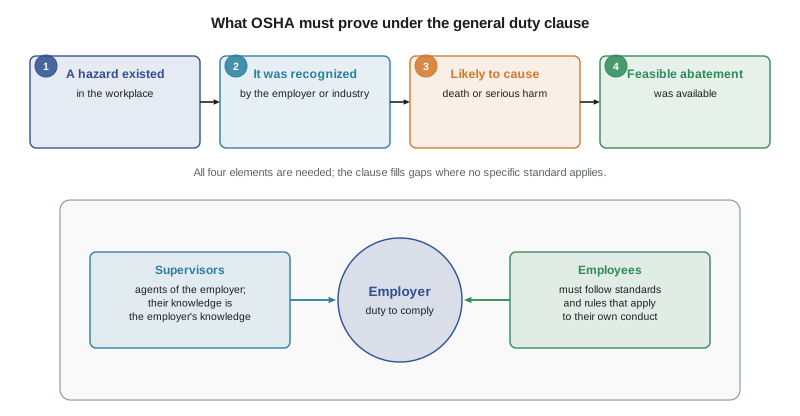
Section 5(a) of the OSH Act gives every employer two duties. The first, in section 5(a)(2), is to comply with the occupational safety and health standards OSHA has adopted. The second, in section 5(a)(1), is the general duty clause: to furnish each employee employment and a place of employment free from recognized hazards that are causing or are likely to cause death or serious physical harm. Section 5(b) gives employees a matching duty to comply with standards and rules that apply to their own actions, but the enforcement weight of the Act falls on employers. OSHA does not issue citations to individual workers or supervisors.
That does not mean supervisors have no responsibility. A supervisor is the employer's agent. When a supervisor knows about a hazard or a violation, that knowledge is generally imputed to the employer. When a supervisor allows unsafe work, the employer is treated as allowing it. And when a supervisor fails to enforce the rules, the employer may lose a defense it would otherwise have. In practice, supervisors carry most of the employer's duties on the floor, because they are the people who decide how the work is actually done on each shift.
The general duty clause in practice
OSHA uses the general duty clause when no specific standard covers a serious hazard: for example, heat stress, workplace violence, ergonomic hazards, combustible dust in some settings, or new hazards that standards have not caught up with. To prove a general duty violation, OSHA must show four things: that a hazard existed, that the employer or its industry recognized it, that the hazard was causing or likely to cause death or serious physical harm, and that there was a feasible and useful way to reduce it. Industry recognition can come from consensus standards, manufacturer warnings, trade association guidance or the employer's own safety rules.
An employer's own rules matter more than many supervisors realize. If Harrowgate Foods Inc. has a written rule that a hazard must be controlled, that rule is evidence the company recognized the hazard. A supervisor who ignores the company's own rule therefore makes the general duty case easier to prove. Elena put it bluntly: 'Our rules are a promise we made in writing. If we don't keep it, they become the evidence against us.'
Shared responsibility on sites with several employers
Many workplaces have more than one employer on site: contractors, temporary staffing agencies, delivery drivers, cleaning companies. OSHA's multi-employer citation policy explains how it decides which employer to cite. It describes four roles. The exposing employer's own workers are exposed to the hazard. The creating employer created the hazard. The correcting employer is responsible for fixing it. The controlling employer has general supervisory authority over the site, with power to correct hazards or require others to correct them. More than one employer can be cited for the same hazard, depending on its role and whether it took reasonable steps.
For Harrowgate Foods Inc., the multi-employer policy matters most with temporary workers at the distribution center and with contractors in the plants. OSHA's guidance on temporary workers treats the staffing agency and the host employer as joint employers: the host is usually responsible for site-specific hazards and training, and the agency for general training and for checking that the host is meeting its duties. When Dev's sanitation crew was short-staffed, the plant used agency workers for the night clean. Dev, as the supervisor directing their work, was responsible for making sure they received the same lockout and chemical training as Harrowgate Foods Inc.'s own employees.
The slicer guard
The slicer guard was a small example of shared responsibility. The day crew had noticed the hazard and done something, but had passed responsibility to maintenance without making sure anyone with authority acted. If an operator had been hurt reaching through the gap, OSHA could have cited Harrowgate Foods Inc. under the machine guarding standard, and the day supervisor's note would have been evidence that the company knew. Dev locked out the slicer, tagged it, reported it to the maintenance manager by email with a photo, and told Marcus at the morning meeting. The guard was fixed by noon.
Elena added a reminder that employees also have duties under section 5(b), and that Harrowgate Foods Inc.'s own rules require workers to follow procedures and report hazards. 'Workers have a part to play,' she said. 'But when OSHA looks at this, the question will be what the company did. And on night shift, what the company did is what you did.'
Measuring whether shared responsibility works
Elena wanted a quick way to see whether responsibility was really being shared at each site, or whether problems were piling up waiting for someone else. She suggested tracking how quickly reported hazards were closed, and at what level they were closed. A hazard that sits open for weeks, or that can only be fixed by the plant manager, is a sign that the system below has stalled.
# Hazard reports closed last quarter at each site: (site, level that fixed it, days open).
reports = [
    ("main", "worker", 0), ("main", "supervisor", 1), ("main", "supervisor", 2), ("main", "manager", 21),
    ("main", "manager", 34), ("main", "supervisor", 1), ("main", "maintenance", 6), ("main", "maintenance", 15),
    ("dc", "supervisor", 1), ("dc", "worker", 0), ("dc", "manager", 40), ("dc", "maintenance", 9),
    ("sauces", "supervisor", 2), ("sauces", "worker", 0), ("sauces", "maintenance", 4),
]
from statistics import median
for site in ("main", "dc", "sauces"):
    rs = [r for r in reports if r[0] == site]
    days = [r[2] for r in rs]
    low = sum(1 for r in rs if r[1] in ("worker", "supervisor"))
    slow = sum(1 for d in days if d > 14)
print(f"{site:<7} reports {len(rs):>2} median days {median(days):>4} fixed on the floor {low / len(rs):4.0%} open > 14 days {slow}")main reports 8 median days 4.0 fixed on the floor 50% open > 14 days 3 dc reports 4 median days 5.0 fixed on the floor 50% open > 14 days 1 sauces reports 3 median days 2 fixed on the floor 67% open > 14 days 0
The numbers showed that at the main plant and the distribution center, items that had to go up to a manager stayed open for weeks. When Elena looked at those items, most needed a small amount of money or a decision about staffing. The fix was not to tell people to try harder, but to give supervisors a small budget and a clear way to escalate. Within two months, the median time open for manager-level items fell to under a week.
Worked problem
Who could be cited for the slicer guard?
Show solution
- The hazard: an unguarded point of operation on the slicer, covered by the machine guarding standard in subpart O.
- Harrowgate Foods Inc. is the employer of the exposed workers, so it is the exposing employer.
- The day supervisor knew of the damage; that knowledge is generally imputed to Harrowgate Foods Inc..
- No contractor was involved, so the multi-employer policy does not change the answer: Harrowgate Foods Inc. alone would be cited.
- Dev's lockout, tag and report are evidence of the reasonable steps the company takes when it finds a hazard.
Answer: Harrowgate Foods Inc. would be cited; the supervisors' actions decide whether the company looks careful or careless.
Employees' duties and why they matter
Section 5(b) of the OSH Act says each employee shall comply with occupational safety and health standards and all rules, regulations and orders issued under the Act that apply to their own actions and conduct. OSHA cannot cite or fine employees for breaking that duty. But employees' compliance still matters in three ways. First, an employer's own work rules, backed by fair discipline, are how it makes sure standards are followed. Second, an employee's misconduct can sometimes support the employer's defense if the employer can prove it had good rules, communicated and enforced them, and that the employee's act was unforeseeable, as lesson 8 explains. Third, workers who follow procedures and report hazards are the employer's best source of information about where its controls are weak.
At Harrowgate Foods Inc., the employee handbook required every worker to follow lockout and guarding procedures, wear required PPE, report hazards and injuries, and stop work that could not be done safely. Dev made a point of explaining each item to his crew in the first week, not as a list of things they could be punished for but as a list of things he would back them on. 'If you stop the line because the spiral isn't locked out,' he told them, 'I'll take the call from the day shift, not you.' That message mattered, because the night crew had learned under the previous supervisor that following the rules made you the slow one.
Responsibility goes up as well as down
Shared responsibility is often described as flowing downward: managers set rules, supervisors enforce them, workers follow them. But the most important flow is upward. A supervisor who discovers that a rule cannot be followed in the time allowed has a duty to say so to the people who set the schedule. A manager who learns that supervisors lack the authority to fix hazards has a duty to change that. Investigations of serious incidents regularly find that the people at the bottom knew about the problem and the people at the top did not, because nothing in the system carried the information up.
Dev's first upward report was about the sanitation window. He timed three spiral cleans with full lockout and found they took 45 minutes longer than the schedule allowed. He wrote a short note to Marcus with the times, the risk and two options: start sanitation 45 minutes earlier, or move the spiral clean to the weekend shutdown. Marcus chose the first option and adjusted the bread schedule. The decision cost a little production flexibility. It removed the pressure that had made skipped lockout normal.
A short test for shared responsibility
Elena gave Dev a three-question test he could use whenever he found a hazard. Who can make it safe right now? Who needs to know so it gets fixed properly? Who will check that it stays fixed? If he could name a person for each answer, responsibility was being shared. If any answer was 'someone' or 'they', the hazard was at risk of falling through the cracks.
Dev tried the test on the slicer guard. Who could make it safe right now? He could, by locking it out. Who needed to know so it got fixed properly? The maintenance manager, by a work order with a photo, and Marcus, at the morning meeting. Who would check that it stayed fixed? The day supervisor, at the start of each shift, and the committee on its monthly inspection. Every answer had a name. A month later, when another guard on a packaging line was found damaged, the day crew used the same three questions without being asked, and the line was locked out, reported and repaired within the shift.
Elena pointed out that the test also protects supervisors. A supervisor who can show that he made the area safe, told the right people in writing and checked back has done what the law expects of someone in his position, even if the final repair is slow for reasons outside his control. A supervisor who only told someone in passing, and never followed up, has nothing to show.
Common mistakes
MistakeAssuming only standards matter.
InsteadThe general duty clause covers recognized serious hazards with no standard.
MistakePassing a hazard on without checking that someone with authority acted.
InsteadReport it, make the situation safe in the meantime, and follow up until it is fixed.
MistakeAssuming temporary workers are the agency's responsibility alone.
InsteadThe host employer directing the work has duties for site-specific hazards and training.
MistakeIgnoring the company's own rules because they go beyond the legal minimum.
InsteadThe company's own rules are evidence of what it recognized and promised.
MistakeMeasuring only injuries.
InsteadTrack how quickly hazards are closed and at what level, to see whether shared responsibility is working.
Summary and key terms
- Section 5(a) requires employers to comply with standards and to keep the workplace free of recognized serious hazards.
- Supervisors act for the employer; their knowledge and actions are generally treated as the employer's.
- A general duty case needs a hazard, recognition, likely serious harm and a feasible fix.
- Under the multi-employer policy, exposing, creating, correcting and controlling employers can all be cited.
- Host employers have duties to temporary workers they direct, including site-specific training.
- Track how fast hazards are closed and at what level to see whether responsibility is really shared.
- General duty clause
- Section 5(a)(1) of the OSH Act: a workplace free of recognized hazards likely to cause death or serious physical harm.
- Recognized hazard
- A hazard known to the employer or its industry, or obvious to a reasonable person.
- Multi-employer citation policy
- OSHA's policy for deciding which employers on a shared site can be cited.
- Controlling employer
- An employer with general supervisory authority over a site, including power to correct hazards.
- Joint employment
- An arrangement, such as with temporary workers, where two employers share duties.
Practice problems
Work each problem on paper first, then reveal the answer to check.
What are the two duties of employers in section 5(a)?
Show answer
Comply with OSHA standards and keep the workplace free of recognized serious hazards.
List the four elements of a general duty clause case.
Show answer
A hazard, recognition, likely death or serious harm, and a feasible means of abatement.
Why can a company rule help OSHA prove recognition?
Show answer
It shows the company knew the hazard needed control.
Name the four employer roles in the multi-employer policy.
Show answer
Exposing, creating, correcting and controlling.
Who must train agency workers on site-specific hazards?
Show answer
Usually the host employer, such as Harrowgate Foods Inc. through its supervisor, with the agency checking.
Lesson quiz · 5 questions
Score 60% or more to complete this lesson.
Create a free account to save your progress, take quizzes and earn a certificate.