
HSE-402 · Lesson 11 of 12 · 20 min
Documentation that protects workers
By the end of his first year, Dev had filled two notebooks and a shared spreadsheet with entries about his shift. Some were careful and useful. Others, he admitted, said things like 'talked to crew about safety' and nothing more. Aisha Grant, the company's lawyer, had told the leadership team that most supervisors write too little, and that what they do write often fails to say what anyone actually did. Elena asked Dev to help her rebuild the supervisor's documentation around one question: if a worker were hurt tomorrow, would these records show what we did to prevent it, and would they help the worker?
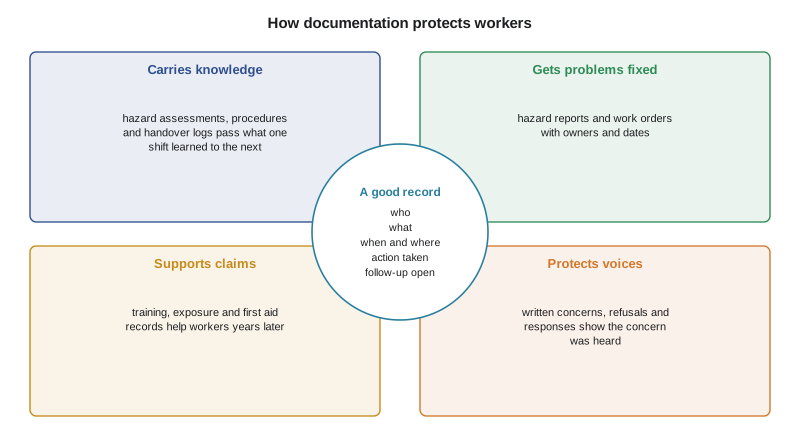
Earlier lessons treated records mainly as evidence for defenses and good faith. This lesson takes the worker's point of view. Good documentation protects workers in at least four ways: it carries hazard knowledge from one shift and one person to the next, it makes sure problems that are reported are fixed, it supports workers' compensation claims and occupational illness claims years later, and it protects workers who raise concerns from being ignored or retaliated against. The same records also protect the supervisor and the company, but that is a by-product of doing them well.
The documents a supervisor touches
A supervisor does not write the company's safety and health program, but works with its documents every shift. At Harrowgate Foods Inc., Dev's list included the written hazard assessments for his area, the machine-specific energy control procedures required by 1910.147, the sanitation chemical safety data sheets and labels under the hazard communication standard, the training matrix showing who was signed off on what, inspection checklists, permits for confined space entry and hot work, the shift handover log, his own supervisor's log, incident and near-miss reports, records of refusals and their resolution, and copies of safety committee recommendations affecting his area. Each had an owner and a place. Dev's job was to keep the ones he created complete and to make sure the ones he used were current.
What a good record says
Aisha's test for a useful entry was that someone who was not there could understand it a year later. That meant five elements: who was involved, what was observed or done, when and where, what action was taken, and what follow-up remained open. 'Talked to crew about safety' failed every element except, perhaps, who. A rewritten entry read: 'Night shift, 22:40, spiral 2. Observed new hire Tomas begin washdown without applying personal lock. Stopped the work, walked him through the procedure at the disconnect, watched him apply lock and verify zero energy. He said he thought the lead's lock covered everyone. Corrected; reminded all five crew at the 23:00 break that each person locks on. Follow-up: check Tomas's lockout on next three shifts; told Elena the training may need to say this more clearly.'
That entry took two minutes to write. It shows the hazard was found, the work was stopped, the worker was coached rather than simply blamed, the crew was reminded, a training gap was escalated and follow-up was planned. It also protects Tomas: if he were later hurt, the record would show he had been trained and corrected, which helps the company, but it would also show that the training material itself had a gap, which helps him.
| Weak entry | Strong entry |
|---|---|
| Talked to crew about safety. | 23:00 break, five crew: each person applies a personal lock on spiral cleans; asked each to show their lock. |
| Guard issue on line 3. | Line 3 infeed guard bolt missing, 01:15. Tagged out, work order 4471 to maintenance, fixed 02:30, checked before restart. |
| Priya complained about chemicals. | Priya reported eye irritation at the foam station, 03:10. Checked dilution: 4 percent against a 2 percent setting. Station shut, dispenser reset, Elena informed. Priya given eye wash; declined further treatment. |
| Everything fine. | Inspection of sanitation area complete, 04:00; two items found (frayed hose, blocked eyewash), both fixed this shift. |
Strong entries are specific, factual and short. They record what was seen and done, not opinions about people's character. They use times, places and names. And they close the loop or say clearly that it is still open.
Facts, not judgments
A record that blames can harm a worker unfairly and can damage the company's position. 'Tomas was careless' is an opinion. 'Tomas began washdown without applying a personal lock' is a fact. The second version leaves room for the investigation to find why, which in Tomas's case was a training gap. Aisha also warned against speculating in writing about legal fault, such as 'this was a violation' or 'we were negligent'. Supervisors should record what happened and what they did; legal conclusions belong to other people.
Dev found this harder than he expected. After a shift where a forklift driver at the distribution center clipped a rack, his first draft said the driver was 'going too fast as usual'. He rewrote it as: 'Forklift 7 struck rack upright in aisle 14 at 02:20. No injury; upright dented. Driver said he was turning to avoid a pallet left in the aisle. Pallet was present when I arrived. Aisle closed, rack inspected by maintenance, upright replaced before reopening.' The second version was fairer to the driver and more useful, because it pointed to the real problem: pallets left in aisles.
Never alter, backdate or destroy records
A record is only worth something if it can be trusted. Supervisors must never change an entry to make it look better after the fact, backdate an inspection that was not done, fill in a checklist without doing the inspection, or throw away records after an incident. If an entry needs correcting, the correction should be added with the date and the reason, leaving the original readable. Section 17(g) of the OSH Act makes knowingly making a false statement, representation or certification in a required record a federal crime, and destroying or altering records after an incident can lead to obstruction charges. It also destroys the worker's ability to rely on the record.
Elena found one example in the company's own past. Before the conveyor injury, a monthly guard inspection checklist at the sauces plant had been signed for three months running by a supervisor who later admitted he had not done the inspections. The checklists looked fine. The guards were not. When the problem came to light, the company treated it as a serious disciplinary matter and changed the checklist so that each item needed an observation, not just a tick, and added spot checks by the safety committee.
Written concerns and escalation
Some of the most important documents protect workers who speak up. When a worker raises a safety concern, the supervisor's record of it shows that the concern was heard, what was done and when. When a supervisor cannot fix a problem, a written escalation to someone who can puts responsibility where it belongs and creates a trail that is hard to ignore. Dev's rule became: if a problem cannot be fixed this shift, it goes in an email to the person who can fix it, with the hazard, the risk, what has been done in the meantime and what is needed, and a copy goes to Elena. If there is no response in a reasonable time, he follows up in writing.
Escalation in writing also protects the supervisor. In lesson 4, the course discussed supervisors who were told by their managers to keep production running despite a hazard. A supervisor who has raised the hazard in writing, proposed a fix and asked for a decision has done what a reasonable supervisor could do within his authority, and has made it much harder for the company to say later that nobody knew.
Refusals deserve particular care. Lesson 5 described Priya's refusal and the conditions in 1977.12. The record of a refusal should show what the worker said, when, the danger identified, the supervisor's investigation, what was done to correct the hazard, the outcome, and confirmation that no adverse action followed. A worker who files a section 11(c) complaint, which must be filed within 30 days, depends heavily on what was written down at the time.
Records that matter years later
Some records protect workers long after they leave. Under 29 CFR 1910.1020, employers must generally preserve employee exposure records for at least 30 years and medical records for the duration of employment plus 30 years, and must give employees and their representatives access to them. Exposure monitoring results, records of chemicals used, noise surveys and audiograms can be essential evidence when a worker develops an occupational illness decades later and files a workers' compensation claim. Harrowgate Foods Inc. kept its sanitation chemical records, ammonia monitoring results from the refrigeration plant and noise surveys in a central system, and Elena made sure supervisors knew where workers could ask to see them.
Privacy and access
Documentation must respect workers' privacy. Medical information belongs with the people who need it, such as the workers' compensation carrier, health professionals and those arranging return to work, not in the supervisor's general log. Dev recorded that a worker had been injured and sent for treatment, but not the diagnosis details the clinic later provided. OSHA's rules also protect privacy: privacy cases are entered on the 300 log without the employee's name, and medical records under 1910.1020 have their own access rules. Records the safety committee needs, such as inspection reports, incident summaries and monitoring results, should be shared with it, without unnecessary personal details.
Measuring documentation quality
Elena wanted a way to tell whether the new approach was working. She sampled twenty entries from each supervisor's log each quarter and scored each against the five elements: who, what, when and where, action taken and follow-up. The script below shows the calculation on invented data for three supervisors.
# Share of sampled log entries containing each of the five elements (invented data).
elements = ["who", "what", "when/where", "action", "follow-up"]
samples = {
    # supervisor: count of 20 sampled entries containing each element
    "Dev (nights)":       [20, 19, 20, 18, 15],
    "Marcus (days)":      [18, 14, 17, 12, 6],
    "Grace (distribution)": [20, 18, 19, 17, 13],
}
for sup, counts in samples.items():
    pct = [100 * c / 20 for c in counts]
    weakest = elements[pct.index(min(pct))]
print(f"{sup:<22} overall {sum(pct) / len(pct):5.1f}% weakest: {weakest} ({min(pct):.0f}%)")Dev (nights) overall 92.0% weakest: follow-up (75%) Marcus (days) overall 67.0% weakest: follow-up (30%) Grace (distribution) overall 87.0% weakest: follow-up (65%)
Follow-up was the weakest element for everyone, which matched what Dev had found in his own log: problems were reported but the record did not say whether they were fixed. Marcus's log was weakest overall. Elena did not treat that as a disciplinary matter. She sat with him for an hour, rewrote five entries together, and gave him a one-page guide. His next quarter's score rose by more than twenty points.
Worked problem
Rewrite a weak entry
Show solution
- Weak entry: 'Hose problem at sanitation. Told maintenance.'
- Who: Dev, night supervisor; reported by sanitation worker Lina.
- What, when, where: 01:40, sanitation station 2, hot water hose cracked near the coupling and spraying at head height.
- Action: hose isolated and tagged out, area roped off, work moved to station 1, work order 4512 raised.
- Follow-up: hose replaced 06:15 by day maintenance; Dev to confirm before tonight's shift; Lina thanked.
Answer: Five elements turn a vague note into a record that shows the hazard was controlled and the loop closed.
Common mistakes
MistakeWriting 'talked about safety' or 'everything fine'.
InsteadRecord who, what, when and where, the action and the follow-up.
MistakeRecording opinions about workers' character.
InsteadRecord observed facts and what was said; leave fault to the investigation.
MistakeCorrecting a record by overwriting or deleting it.
InsteadAdd a dated correction with the reason and leave the original readable.
MistakeSigning a checklist without doing the inspection.
InsteadEach item needs an actual observation; falsifying records is serious misconduct.
MistakePutting diagnosis details in the shift log.
InsteadKeep medical information with those who need it; log only what the shift needs.
Summary and key terms
- Documentation protects workers by carrying knowledge, getting problems fixed, supporting claims and protecting voices.
- A good record says who, what, when and where, what was done and what follow-up is open.
- Write facts, not judgments or legal conclusions.
- Never alter, backdate, falsify or destroy records; correct openly with a date and reason.
- Escalate problems you cannot fix in writing, and follow up.
- Keep exposure and health-related records long, protect privacy and share what the committee needs.
- Supervisor's log
- A running record of inspections, coaching, hazards found and fixed and concerns raised on a shift.
- Written escalation
- A written report of a hazard to someone with authority to fix it, with a request for action.
- Closing the loop
- Recording that a reported problem was fixed and checked.
- Contemporaneous record
- A record made at or near the time of the events it describes.
- Exposure record
- A record of a worker's exposure to a hazardous substance or physical agent, such as monitoring results.
Practice problems
Work each problem on paper first, then reveal the answer to check.
Name the five elements of a good log entry.
Show answer
Who; what; when and where; action taken; follow-up.
Rewrite "Tomas was careless" as a fact.
Show answer
For example: "Tomas began washdown without applying a personal lock."
How should an incorrect record be fixed?
Show answer
Add a dated correction with the reason, leaving the original readable.
Why put an escalation in writing?
Show answer
It places the problem with someone who can fix it and creates a trail that protects workers and the supervisor.
Why keep exposure records for a long time?
Show answer
Occupational diseases can appear decades later, and the records support the worker's claim.
Lesson quiz · 5 questions
Score 60% or more to complete this lesson.
Create a free account to save your progress, take quizzes and earn a certificate.