
HSE-394 · Lesson 8 of 12 · 21 min
Latex and other sensitizers
▶ Video coming soon A video version of this lesson is on the way.
Most chemical hazards harm everyone in proportion to the dose. Sensitizers are different. The first exposures may cause no problem at all, but in some people they prime the immune system, and from then on even a tiny exposure can set off a reaction: a rash, wheezing, or in the worst cases anaphylaxis, a life-threatening allergic reaction. Once a worker is sensitized, the sensitivity usually lasts for life. In healthcare, the best known sensitizer is natural rubber latex, which caused an epidemic of allergy among health workers in the 1980s and 1990s. The same pattern applies to several disinfectants, some cleaning products, some drugs and chemicals, and even to hand hygiene itself. This lesson covers how skin and breathing problems develop, how latex allergy was brought under control, and how to prevent and manage work-related dermatitis and asthma.
Irritation and allergy
Problems with the skin and airways at work come in two broad kinds, and the difference matters for prevention.
- Irritant reactions happen to anyone exposed enough. Irritant contact dermatitis, the most common work-related skin disease in healthcare, is caused by frequent hand washing, alcohol rubs, wet work, detergents and wearing gloves for long periods. The skin becomes dry, red, cracked and sore. Irritant effects on the airways include coughing and a burning throat from bleach, ammonia or formaldehyde.
- Allergic reactions happen only in people who have become sensitized. They need much less exposure than irritation, and they get worse with each exposure. They include allergic contact dermatitis, a delayed rash that appears a day or two after contact (a type IV reaction); immediate allergy, with hives, swelling, runny nose, wheezing or anaphylaxis within minutes (a type I reaction); and sensitizer-induced occupational asthma.
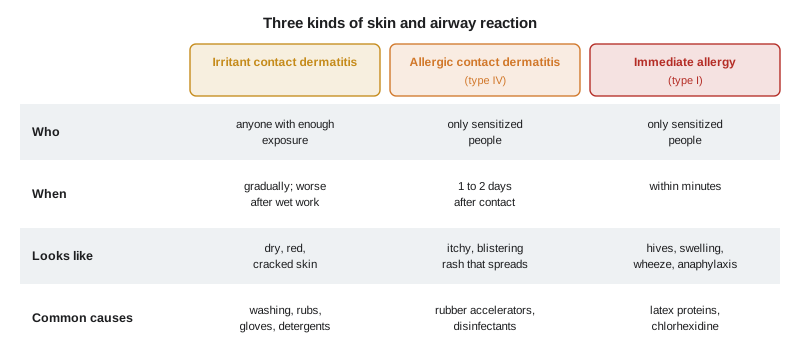
Irritant dermatitis often comes first and opens the door to allergy. Cracked, inflamed skin lets proteins and chemicals in more easily, which makes sensitization more likely. Protecting the skin barrier is therefore one of the most important prevention steps for all sensitizers.
The latex story
Natural rubber latex is made from the sap of the rubber tree. It makes thin, stretchy, comfortable gloves that give a good barrier against blood. When universal precautions against bloodborne viruses were introduced in the late 1980s, glove use in healthcare multiplied, and so did latex allergy. Several things made it worse: gloves made quickly and cheaply had high levels of latex proteins; many gloves were dusted with cornstarch powder, which absorbed the proteins and carried them into the air when gloves were snapped on and off; and nobody yet recognized the problem.
By the 1990s, studies found that a substantial share of health workers who used latex gloves regularly had become sensitized, and some had severe reactions, including deaths from anaphylaxis among workers and patients. Workers with latex allergy were sometimes forced to leave their professions. Patients who had many surgeries, such as children with spina bifida, were also at high risk.
Latex reactions take all three forms. Irritant dermatitis comes from wearing any gloves. Allergic contact dermatitis is usually a reaction not to latex itself but to the chemical accelerators used to make the rubber, which are also found in some synthetic gloves. Immediate allergy is the reaction to latex proteins, and it is the dangerous one, because it can progress to asthma and anaphylaxis.
How latex allergy was brought under control
Latex allergy is one of the clearest success stories in occupational health, and it shows what the hierarchy of controls can do.
- Substitution: most hospitals replaced latex examination gloves with nitrile, which gives an equal or better barrier against blood and many chemicals. Where latex is still needed, for example in some surgical gloves, low-protein, powder-free latex is used.
- Removal of powder: the FDA banned powdered surgeon's gloves and powdered patient examination gloves in a rule that took effect in January 2017, removing the airborne route that caused much of the asthma.
- Latex-safe environments: many hospitals, including Northbridge, became latex safe, removing latex from gloves, catheters, balloons and many other products, and labeling the few items that still contain it.
- Identification and care: patients and workers are asked about latex allergy, and allergic people are protected. OSHA has no latex standard, but recommends powder-free, low-protein gloves and non-latex alternatives.
After these changes, new cases of latex allergy among health workers fell sharply in hospitals that made them. The lesson for other sensitizers is clear: when a substance causes allergy, the most effective response is to remove or replace it, and to remove the route by which it reaches people.
Other sensitizers in healthcare
Latex is no longer the only concern. Other substances that can sensitize health workers include:
- Glutaraldehyde and ortho-phthalaldehyde, the high-level disinfectants from Lesson 5, which cause both skin allergy and asthma.
- Formaldehyde, from Lesson 7.
- Some cleaning products, particularly quaternary ammonium compounds and products with fragrances, which are linked to asthma in cleaners and nurses.
- Chlorhexidine, a common skin antiseptic, which can cause immediate allergy, including rare anaphylaxis.
- Rubber accelerators, such as thiurams and carbamates, in some synthetic as well as latex gloves; accelerator-free nitrile gloves are available for workers with this allergy.
- Some drugs handled by workers, including certain antibiotics such as penicillins, which can sensitize staff who crush, mix or give them.
- Acrylates, used in some dental and orthopedic materials and in nail products, which cause allergic contact dermatitis.
- Isocyanates in some spray paints and foams used by maintenance staff.
Protecting the skin
Healthcare workers wash and sanitize their hands dozens of times a shift, which makes skin care a basic safety issue, not a cosmetic one. A skin protection program includes:
- Using alcohol-based hand rub instead of soap and water when hands are not visibly soiled, because modern rubs with added moisturizers are gentler on skin than repeated washing.
- Not washing with soap and water immediately before or after using alcohol rub.
- Rinsing and drying hands well, patting rather than rubbing.
- Putting gloves on only over completely dry hands, and not wearing gloves longer than needed.
- Using hospital-approved moisturizers often, especially at breaks and at the end of a shift, from dispensers or personal tubes that do not interfere with glove integrity.
- Choosing the right glove for the task, and offering alternatives such as accelerator-free gloves to workers with reactions.
- Teaching workers to recognize early signs, such as dryness, redness and itching, and to report them before the skin cracks.
Joanne's office ran a short skin survey at Northbridge after several nurses on 4 West reported cracked hands in the winter. Each participant rated their hands on a simple scale and noted how many times they washed or used rub on a typical shift.
# Hand skin survey: washes per shift and skin score (0 = healthy, 4 = cracked and bleeding)
staff = [
    # (area, soap washes, rub uses, skin score)
    ("4 West", 22, 30, 3), ("4 West", 18, 35, 2), ("4 West", 25, 20, 3),
    ("4 West", 10, 45, 1), ("ED", 20, 40, 2), ("ED", 8, 50, 1),
    ("ICU", 12, 55, 1), ("ICU", 24, 25, 3), ("EVS", 15, 5, 3),
    ("EVS", 18, 4, 3), ("Maple Court", 20, 15, 2), ("Maple Court", 9, 30, 1),
]

def mean(xs):
    return sum(xs) / len(xs)

heavy = [s for s in staff if s[1] >= 18]
light = [s for s in staff if s[1] < 18]
print(f"staff surveyed: {len(staff)}")
print(f"18 or more soap washes: {len(heavy)}, mean skin score {mean([s[3] for s in heavy]):.1f}")
print(f"fewer than 18 washes:   {len(light)}, mean skin score {mean([s[3] for s in light]):.1f}")
bad = sum(1 for s in staff if s[3] >= 3)
print(f"score 3 or worse: {bad} of {len(staff)}")staff surveyed: 12 18 or more soap washes: 7, mean skin score 2.6 fewer than 18 washes: 5, mean skin score 1.4 score 3 or worse: 5 of 12
The pattern was clear even in a small survey: staff who washed with soap most often had the worst skin, and those who mainly used alcohol rub did better. Environmental services staff, who did a lot of wet work and wore gloves for long periods, also scored poorly. The fixes were small: more rub dispensers in rooms, a new moisturizer at every sink, a reminder in unit huddles that rub is gentler than soap when hands are not soiled, and glove liners for environmental services staff during long cleaning tasks. A repeat survey after the winter found fewer scores of 3 or worse.
Occupational asthma
Occupational asthma is asthma caused or made worse by something at work. It can follow exposure to sensitizers such as latex, glutaraldehyde and some cleaning products, or to high levels of irritants. Typical warning signs are coughing, wheezing, chest tightness and shortness of breath that get worse during the work week and improve on days off or on vacation. Early diagnosis matters: workers who are removed from the cause soon after symptoms begin are much more likely to recover fully. Workers with these symptoms should report them and be assessed by a physician with an interest in occupational lung disease.
Occupational asthma and dermatitis are recognized occupational illnesses. Cases are recorded on the OSHA 300 log when they meet the recording criteria, and the worker may have a claim with the workers' compensation insurer.
When a worker is sensitized
A worker with a confirmed allergy needs a plan, not just sympathy. For latex allergy, that means a latex-safe work area, non-latex gloves for everyone who works near them, and checking supplies, medical devices and even balloons in the gift shop. For allergy to a disinfectant, it may mean moving the worker away from tasks that use it, or replacing the product. Workers with a history of anaphylaxis should carry their own epinephrine auto-injector and have a plan their co-workers know. Accommodation is part of the employer's legal duty, and moving a valued worker out of their profession should be the last option, not the first.
Worked problem
Rash on a new nurse
Three weeks after starting on the ICU, a new nurse develops an itchy, blistering rash on the backs of her hands and wrists that appears a day or two after long shifts. She has used the same nitrile gloves as everyone else. What might be going on, and what should happen?
Show solution
- The delayed, itchy, blistering rash where gloves touch the skin suggests allergic contact dermatitis, possibly to rubber accelerators in the nitrile gloves, or to a chemical such as a disinfectant or antiseptic.
- She should report it to the Employee Health and Safety office and see a physician, who may refer her for patch testing to find the cause.
- Meanwhile, she can be given accelerator-free nitrile gloves and cotton glove liners, and advised on skin care and the use of alcohol rub rather than soap when hands are not soiled.
- If patch testing confirms an accelerator allergy, accelerator-free gloves become her permanent supply, and the unit keeps a stock. If the cause is a disinfectant, the unit reviews whether it can be replaced.
- The case is recorded as a work-related skin condition and reviewed by the safety committee.
Answer: Likely allergic contact dermatitis to glove chemicals or a disinfectant; report, assess and patch test, switch to accelerator-free gloves and liners, and record the case.
Common mistakes
MistakeThinking that nitrile gloves cannot cause allergy.
InsteadRemember that accelerators in some nitrile gloves cause allergic contact dermatitis.
MistakeWashing with soap and water after every patient when hands are not soiled.
InsteadUse alcohol rub, which is gentler on skin.
MistakePutting gloves on over damp hands.
InsteadDry hands completely first.
MistakeWaiting until skin cracks before reporting a problem.
InsteadReport early signs such as dryness, redness and itching.
MistakeExpecting a sensitized worker to tolerate small exposures.
InsteadRemove the cause from their environment, because tiny exposures can trigger reactions.
Summary and key terms
- Sensitizers prime the immune system so that later small exposures cause allergic reactions that usually last for life.
- Irritant dermatitis affects anyone exposed enough and opens the door to allergy.
- Latex allergy was controlled by switching to nitrile, removing powder and making hospitals latex safe.
- Other sensitizers include glutaraldehyde, formaldehyde, some cleaning products, chlorhexidine, rubber accelerators and some drugs.
- Protect the skin barrier: prefer alcohol rub, dry hands, moisturize and choose the right gloves.
- Occupational asthma that improves away from work needs early assessment.
- Sensitized workers need a written plan and accommodation.
- Sensitizer
- A substance that can cause an allergic reaction after the immune system has been primed by earlier exposure.
- Irritant contact dermatitis
- Skin damage from repeated contact with water, soaps, chemicals or gloves.
- Allergic contact dermatitis
- A delayed allergic rash after contact with a substance a person is sensitized to.
- Anaphylaxis
- A severe, life-threatening allergic reaction.
- Rubber accelerators
- Chemicals used to make rubber gloves that can cause allergic contact dermatitis.
- Latex safe
- An environment where latex products have been removed or clearly labeled.
- Occupational asthma
- Asthma caused or made worse by exposures at work.
Practice problems
Work each problem on paper first, then reveal the answer to check.
What is the difference between irritant and allergic contact dermatitis?
Show answer
Irritant dermatitis affects anyone with enough exposure; allergic dermatitis affects only sensitized people and appears a day or two after contact.
Why did powdered latex gloves cause so much asthma?
Show answer
The powder carried latex proteins into the air when gloves were snapped on and off.
Name three sensitizers other than latex found in hospitals.
Show answer
Any three of glutaraldehyde, OPA, formaldehyde, quats and fragranced cleaners, chlorhexidine, rubber accelerators, some antibiotics, acrylates, isocyanates.
Why is alcohol rub better for skin than repeated soap washing?
Show answer
Rubs with moisturizers remove less of the skin's natural oils than soap and water.
What pattern of symptoms suggests occupational asthma?
Show answer
Symptoms worse during the work week that improve on days off or vacation.
What did the Northbridge skin survey show?
Show answer
Staff who washed with soap most often had the worst skin, and environmental services staff scored poorly.
Lesson quiz · 5 questions
Score 60% or more to complete this lesson.
Create a free account to save your progress, take quizzes and earn a certificate.