
HSE-394 · Lesson 12 of 12 · 22 min
Capstone: a hazardous drug safety plan
▶ Video coming soon A video version of this lesson is on the way.
The register in Lesson 1 pointed Northbridge's first year of work at hazardous drugs on the oncology day unit and at the waste and linen that leave it. Then the hospital announced that the day unit would double in size: eight more treatment chairs, a second nursing team, and a satellite pharmacy room next to the unit so that doses no longer travel from the main pharmacy across the building. This capstone follows the group that wrote the hazardous drug safety plan for the expanded unit, and uses it to pull together everything in Lessons 1 to 11 that applies to hazardous drugs. The same structure works for any area that handles them, from a long-term care home to a veterinary clinic.
Who wrote the plan
A plan written by one person in an office rarely survives contact with the unit. The group included Priya Shah from pharmacy, Rachel Kim and another nurse from the day unit, Marta Kowalski from environmental services, a laundry supervisor, Kevin Tran for the transporters, the facilities engineer responsible for the new pharmacy room, Joanne Pelletier from the Employee Health and Safety office, and Amira Haddad and Tom Bergstrom from the safety committee. USP 800 requires a designated person to develop and oversee the hazardous drug program; at Northbridge that is the pharmacy manager, who chaired the group.
The structure of the plan
The group used a structure that covers the whole path of a hazardous drug, from its arrival to its destruction, plus the program elements that keep it working.
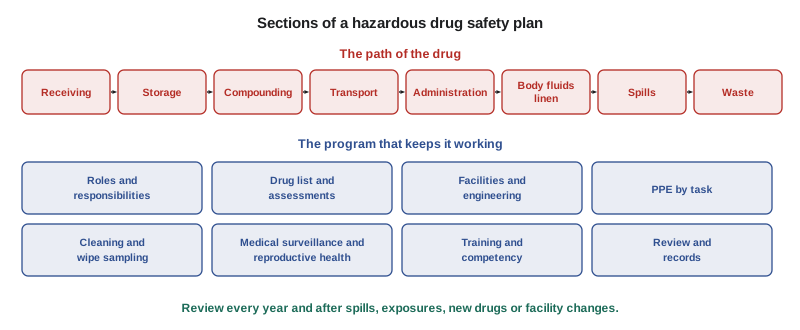
1. Scope, roles and responsibilities
The plan covers every worker who handles hazardous drugs, contaminated equipment, waste, linen or patient body fluids in the expanded day unit and the satellite pharmacy, including physicians, nurses, pharmacy staff, transporters, environmental services, laundry, maintenance and volunteers. It names who is responsible for each part: the pharmacy manager for the overall program and the drug list; the unit manager for nursing practice and training; the environmental services lead for cleaning, spills outside the pharmacy and waste; facilities for the room ventilation and cabinets; the Employee Health and Safety office for medical surveillance and exposure records; and the safety committee for review.
2. The hazardous drug list and assessments
The plan attaches the hospital's hazardous drug list, based on the 2024 NIOSH list, with each drug's handling category from Lesson 2. For drugs handled under an assessment of risk, such as intact tablets of a Table 2 drug, the plan includes the written assessment with the alternative controls, as USP 800 requires, and the list and every assessment are reviewed at least every 12 months.
3. Facilities and engineering controls
The satellite pharmacy is designed as a negative-pressure buffer room with an anteroom, exhausted outside, with a Class II biological safety cabinet exhausted to the outside, a hazardous drug refrigerator, a pass-through to the unit, an eyewash, and a sink in the anteroom. Facilities confirms the pressure difference, air change rate and cabinet certification before the room opens and on a set schedule after. The treatment area has a dedicated hazardous drug waste container and spill kit at every two chairs, and patient bathrooms have lidded toilets.
4. Personal protective equipment
The PPE table from Lesson 3 becomes the unit's standard, posted in the anteroom and the treatment area: double ASTM D6978 chemotherapy gloves and a permeation-resistant gown for compounding, giving doses, handling body fluids within 48 hours and cleaning; eye and face protection where splashing is possible; fit-tested N95 respirators for powder spills and damaged shipments. The plan names the products stocked and requires the unit to keep at least two weeks of supply.
5. Receiving, storage and transport
Shipments for the satellite pharmacy are delivered directly to it, unpacked in the anteroom by trained staff wearing gloves and a gown, with any damaged carton opened only in the cabinet. Doses go from the cabinet through the pass-through to the unit, sealed and labeled, which removes most transport through the hospital. The few doses still sent to inpatient units travel in rigid, labeled containers with a spill kit, carried by trained transporters, never by pneumatic tube.
6. Compounding and administration
Compounding follows the technique and glove-change rules from Lesson 3, with two technicians scheduled whenever the batch list is long. Every dose leaves the pharmacy with a closed-system connector attached, and nurses use the matching CSTD at the chair. Tubing is primed in the cabinet or with drug-free fluid, connections are checked by two nurses before clamps are opened, and pump doors carry the "clamp before opening" sticker from Lesson 4.
7. Body fluids, linen and patients going home
For 48 hours after a dose, patients' body fluids are handled with double gloves and a gown, toilets are flushed with the lid down, and soiled linen goes into labeled bags that the laundry handles separately. Patients and families receive written advice for home, and the home health team is told when a client has had treatment in the last 48 hours.
8. Spills
The spill procedure from Lesson 4 applies, with kits checked weekly, spill drills twice a year on the unit and with each environmental services shift, and a clear split: nurses and pharmacy staff clean small spills on the spot; the environmental services spill team, trained and fit tested, handles large spills and powders.
9. Waste
Trace chemotherapy waste goes into lidded yellow containers at the point of use; bulk waste, such as partly used bags and spill materials, goes into the black hazardous waste container in the satellite pharmacy, managed under the EPA rule for hazardous waste pharmaceuticals. Environmental services collects both on a schedule set by how fast they fill, and the holding room is always accessible to the night lead. Manifests are kept by the environmental services lead.
10. Cleaning and wipe sampling
Cleaning follows the four steps of deactivation, decontamination, cleaning and disinfection, with a schedule for every surface: the cabinet each shift, pharmacy counters and floors daily, chairs, IV poles, pumps and keypads after every patient, transport containers after every trip. Surface wipe sampling is done twice a year in the satellite pharmacy and the treatment area, at the locations where the first round found contamination plus new ones chosen by the group.
11. Medical surveillance and reproductive health
Workers who handle hazardous drugs complete a health and exposure history when they start and at intervals, and any acute exposure, such as a splash or a large spill, is recorded and followed up by the Employee Health and Safety office. The reproductive health policy from Lesson 1 applies: any worker who is pregnant, breastfeeding or trying to conceive may choose not to compound or give hazardous drugs, confidentially and with no loss of pay.
12. Training, competency and review
Everyone in the scope is trained before they start and at least every year, with content matched to their job: a full program for pharmacy and nursing staff, with a competency check on PPE, CSTD use and spill response; shorter sessions for transporters, environmental services, laundry and volunteers. The plan is reviewed every year by the group and the safety committee, and after any significant spill, exposure, change in drugs or change in the facility. Wipe sampling results, spill reports, glove-change audits and training records all feed the review.
Checking the draft
Before sending the draft to the hospital's leaders, Joanne ran it through the checklist she uses for every safety program review: each required element is either present, partial or missing, with the critical elements weighted more heavily.
# Review of the draft hazardous drug safety plan
# status: 2 = present, 1 = partial, 0 = missing; weight 2 = critical
elements = [
    ("scope and roles", 2, 1),
    ("drug list and assessments", 2, 2),
    ("engineering controls specified", 2, 2),
    ("PPE by task", 2, 2),
    ("receiving and transport", 2, 1),
    ("compounding and administration", 2, 2),
    ("body fluids and linen", 1, 2),
    ("spill procedure and drills", 2, 2),
    ("waste handling", 2, 2),
    ("cleaning schedule", 1, 1),
    ("wipe sampling", 1, 1),
    ("medical surveillance", 1, 2),
    ("reproductive health policy", 2, 1),
    ("training and competency", 1, 2),
    ("annual review and triggers", 2, 1),
]
score = sum(s * w for _, s, w in elements)
best = sum(2 * w for _, _, w in elements)
print(f"plan score: {score} of {best} ({round(100 * score / best)} in 100)")
gaps = [(name, s, w) for name, s, w in elements if s < 2]
for name, s, w in gaps:
    tag = "CRITICAL" if w == 2 else "minor"
print(f" {'missing' if s == 0 else 'partial':8}{tag:9}{name}")plan score: 40 of 48 (83 in 100) partial CRITICAL body fluids and linen partial minor cleaning schedule partial minor wipe sampling partial CRITICAL medical surveillance partial CRITICAL training and competency
The draft scored well, but the review found five partial elements. The training section covered pharmacy and nurses in detail but said only "other staff as needed" for transporters, laundry and volunteers, which was exactly the gap the register had found. The cleaning schedule left out the pump keypads, the place where wipe sampling had found contamination. The reproductive health policy was attached but did not say how a worker could ask for a change of duties without going through the unit manager. The scope did not mention the laundry, and the annual review did not list the events that should trigger an early review. All five were fixed before the plan went forward.
Putting the plan to work
A plan is only as good as what happens on the unit. In the first three months after the expanded unit opened, the group met monthly and tracked a few simple measures: glove-change audits in the satellite pharmacy, spill reports, the results of the first wipe sampling round, completion of training by job group, and the number of workers who had asked for alternative duties. The first wipe sampling round found contamination on a single chair arm and nowhere else; the cleaning procedure for chair arms was rewritten. Training completion for laundry staff lagged at first because their shifts did not match the session times, so the trainer ran a session at 0600.
The register in Lesson 1 had ranked cytotoxic waste and linen as the highest priority because the workers who handled them had the weakest controls and the least knowledge. A year later, when Joanne repeated her question to each group, every transporter, every environmental services worker on the unit and every laundry worker could say which patients and materials might carry hazardous drug contamination and what to do about it. That, more than any score, was the measure of success.
Beyond hazardous drugs
The same approach works for every hazard in this course. A formaldehyde plan for pathology and the operating rooms, an anesthetic gas program, a radiation protection program for fluoroscopy and nuclear medicine, a laser safety program and an MRI safety program all share the same elements: know what the hazard is and who meets it, put engineering controls first, set clear procedures and PPE, train everyone in the chain, measure whether it works, and review it with the people who do the work. The hazards in this course are invisible. A good plan makes the controls visible.
Worked problem
A late change to the plan
Two weeks before the expanded unit opens, the oncology program announces a new drug given as a subcutaneous injection in the treatment chairs. It is on the NIOSH list. The plan has no section on subcutaneous injections. What should the group do?
Show solution
- Add the drug to the hazardous drug list with its handling category: it is prepared in the satellite pharmacy cabinet and supplied in a syringe with a closed-system connector, so nurses handle a ready-to-give dose.
- Check the PPE and procedure: double chemotherapy gloves and a gown to give the injection; a safety-engineered needle; the syringe disposed of whole in the hazardous drug sharps container, never recapped.
- Check waste: the unit needs sharps containers approved for hazardous drug waste at the chairs where the injection is given.
- Train the nurses on the new procedure before the first dose, and update the competency checklist.
- Record the change, and make "a new drug or dosage form" an explicit trigger for early review in the plan.
Answer: Treat the new drug as a trigger for review: add it to the list, set its handling, PPE and waste, train staff before the first dose and record the change.
Common mistakes
MistakeWriting the plan without the workers who handle waste and linen.
InsteadInclude everyone in the chain, especially the least protected.
MistakeSaying "other staff as needed" for training.
InsteadName each job group and the training it needs.
MistakeTreating the plan as finished once it is approved.
InsteadReview it every year and after spills, exposures and changes in drugs or facilities.
MistakeMeasuring success only by injury reports.
InsteadUse wipe sampling, audits, spill reports, training completion and worker knowledge.
MistakeLeaving the reproductive health policy vague.
InsteadSay clearly how a worker can ask for a change of duties confidentially.
Summary and key terms
- A hazardous drug safety plan covers the drug's whole path, from receiving to waste, plus the program that keeps it working.
- Write it with the people who do the work, including pharmacy, nursing, porters, environmental services, laundry, facilities and the committee.
- Attach the drug list and the handling decisions for each drug.
- Specify engineering controls, PPE by task, transport, compounding, administration, body fluids, spills, waste and cleaning.
- Include medical surveillance, a clear reproductive health policy, training by job group and wipe sampling.
- Review the plan every year and whenever drugs, facilities or incidents change.
- Success means every worker in the chain knows the hazard and the controls.
- Hazardous drug safety plan
- A written program covering how a facility controls exposure to hazardous drugs.
- Designated person
- The person responsible for overseeing a facility's hazardous drug program, a role named in USP 800.
- Satellite pharmacy
- A pharmacy room close to a clinical unit, reducing transport of doses.
- Competency check
- An observed assessment that a worker can perform a task correctly.
- Review trigger
- An event, such as a new drug or a significant spill, that requires the plan to be reviewed early.
Practice problems
Work each problem on paper first, then reveal the answer to check.
Why did the group include porters, environmental services and laundry staff?
Show answer
They handle contaminated containers, waste and linen and were the least protected in the register.
Name six sections of the hazardous drug safety plan.
Show answer
Any six of scope and roles, drug list, engineering controls, PPE, receiving and transport, compounding and administration, body fluids and linen, spills, waste, cleaning and wipe sampling, medical surveillance and reproductive health, training and review.
How did the satellite pharmacy reduce exposure?
Show answer
Doses no longer travel across the hospital; they pass straight to the unit through a pass-through.
What were two of the gaps found in the draft review?
Show answer
Any two of vague training for other staff, pump keypads missing from cleaning, an unclear process for duty changes, laundry missing from the scope, no early review triggers.
What measures did the group track after opening?
Show answer
Glove-change audits, spill reports, wipe sampling results, training completion by job group and requests for alternative duties.
What should trigger an early review of the plan?
Show answer
A new drug or dosage form, a significant spill or exposure, or a change in the facility.
Lesson quiz · 5 questions
Score 60% or more to complete this lesson.
Create a free account to save your progress, take quizzes and earn a certificate.