
HSE-394 · Lesson 1 of 12 · 23 min
Chemical and radiation hazards in healthcare
▶ Video coming soon A video version of this lesson is on the way.
Most of the hazards covered in the earlier healthcare courses are easy to see: a heavy patient, a needle, a person who is angry. The hazards in this course are mostly invisible. A drop of a cancer drug dried on the outside of an IV bag, a trace of anesthetic gas breathed out by a patient in the recovery room, formaldehyde vapor above a specimen bucket, the scattered X-rays around a patient during a fluoroscopy procedure: none of them can be seen, and most cannot be smelled or felt. Some do their harm years later, which makes them easy to ignore and hard to connect to their cause.
This course is for everyone who meets these hazards: nurses who give hazardous drugs and care for patients afterward, pharmacy staff who receive and prepare them, laboratory and pathology staff who work with chemicals, imaging and nuclear medicine staff, operating room and recovery staff, and the transporters, environmental services and laundry workers who handle the containers, waste, linen and spills that everyone else leaves behind. This first lesson maps the hazards, explains how they get into the body, introduces the exposure limits and the rules that apply, and shows how Northbridge Community Hospital built a register of them.
The main groups of hazard
Chemical and radiation hazards in a hospital fall into a handful of groups. Each is the subject of one or two later lessons.
| Group | Examples | Who is most exposed | Lesson |
|---|---|---|---|
| Hazardous drugs | Cancer drugs (antineoplastics), some hormones, some antivirals and antiseizure drugs | Pharmacy, oncology and other nurses, environmental services, laundry, shipping and receiving | 2 to 4 |
| Disinfectants and sterilants | Bleach, hydrogen peroxide, peracetic acid, glutaraldehyde, ortho-phthalaldehyde, ethylene oxide | Device reprocessing, endoscopy, environmental services | 5 |
| Anesthetic gases | Nitrous oxide, sevoflurane, desflurane, isoflurane | Operating room, recovery room, dental and labor staff | 6 |
| Laboratory chemicals | Formaldehyde, xylene, alcohols, acids, stains, cryogenic liquids | Laboratory and pathology staff | 7 |
| Sensitizers | Natural rubber latex, glutaraldehyde, some cleaning products, chlorhexidine | Anyone who wears gloves or cleans | 8 |
| Ionizing radiation | X-ray, fluoroscopy, CT, nuclear medicine, radioactive implants | Imaging, cardiology, operating room, nuclear medicine and nursing staff | 9 and 10 |
| Non-ionizing energy | Surgical and dermatology lasers, MRI magnetic fields | Operating room, clinic and MRI staff, transporters, cleaners | 11 |
The groups differ in where the hazard comes from, but they have a lot in common. All of them depend on the dose a worker receives. All of them can be controlled with the same hierarchy of controls taught in HSE-102: remove or substitute the hazard where you can, enclose or ventilate it, set procedures and training, and use personal protective equipment as the last line. And for all of them, the people with the least training are often the most exposed, because the cleaner who empties the waste or the transporter who carries the bag was never told what was in it.
How chemicals get into the body
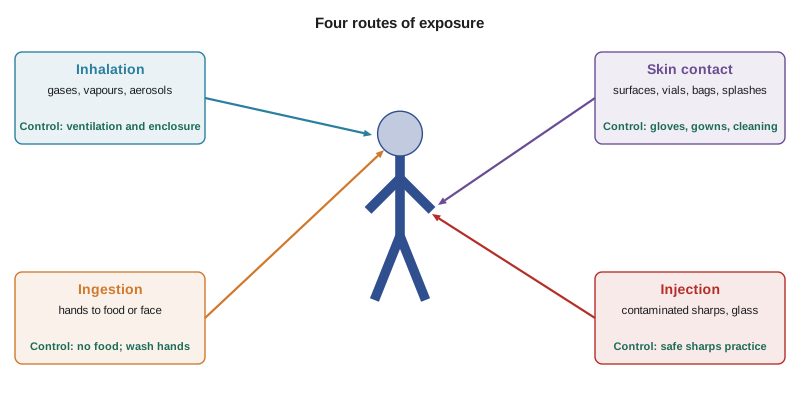
A chemical can only harm a worker if it reaches the body. There are four routes, and each calls for different controls.
- Inhalation: breathing in gases, vapors, mists or fine powders. This is the main route for anesthetic gases, formaldehyde, glutaraldehyde, ethylene oxide and aerosols from drug preparation. Ventilation, enclosures and respirators control it.
- Skin contact: absorption through skin, or damage to the skin itself. Hazardous drugs dried on surfaces, vials and bags reach many workers this way, and so do solvents and disinfectants. Gloves, gowns, cleaning and closed systems control it.
- Ingestion: swallowing the chemical, usually from contaminated hands touching food, drinks, gum, cosmetics or the face. This is why no one eats or drinks where drugs or chemicals are handled, and why hand washing after removing gloves matters.
- Injection: a needlestick or cut from a contaminated sharp, or a broken vial. The controls from HSE-392 apply.
Radiation is different. Ionizing radiation from an X-ray tube does not need to enter the body through any route; it passes through the body from outside, and it stops the moment the machine is switched off. Radioactive materials used in nuclear medicine can do both: they give off radiation from outside, and if they are spilled they can contaminate skin or be swallowed or breathed in, just like a chemical. Lessons 9 and 10 cover these differences.
Dose, time and the body's response
Every one of these hazards follows a basic rule of toxicology: the dose makes the harm. A small amount of formaldehyde vapor causes no symptoms; more causes stinging eyes and a sore throat; much more over years raises the risk of cancer of the nose and throat. Dose depends on two things: how much of the substance is present, and how long the worker is exposed to it.
Effects can be acute, appearing soon after exposure, or chronic, appearing after months or years of repeated exposure. Acute effects of hazardous chemicals include skin rashes, eye irritation, headaches, nausea and dizziness. Chronic effects include occupational asthma, contact allergy, damage to the liver or kidneys, harm to fertility and pregnancy, and cancer. Chronic effects are the hard ones to manage, because the worker feels fine at the time of exposure and the link to work is easily missed.
Some substances have no known safe level for certain effects. For carcinogens, and for drugs that damage genetic material, regulators and health agencies assume that any exposure carries some risk, so the goal is to keep exposure as low as reasonably achievable rather than just below a limit. The same idea, under the name ALARA, is the core of radiation protection.
Exposure limits
For many airborne chemicals, occupational exposure limits set the maximum concentration a worker may breathe. They come in three forms:
- A time-weighted average (TWA), the average concentration allowed over an 8-hour shift. Short peaks above it are allowed as long as the average stays below.
- A short-term exposure limit (STEL), the average allowed over any 15 minutes, which caps the peaks.
- A ceiling, a concentration that must never be exceeded at any moment.
In the United States, OSHA sets permissible exposure limits (PELs) in its air contaminants standard, and has detailed substance standards for a few chemicals that matter in hospitals, including formaldehyde and ethylene oxide. Many OSHA limits date from 1971 and are higher than current science supports, so employers also look at the NIOSH recommended exposure limits (RELs) and the ACGIH threshold limit values (TLVs). Limits are written in parts per million (ppm) for gases and vapors, or milligrams per cubic meter for dusts and mists.
There is an important gap. Most hazardous drugs have no airborne exposure limit at all, because they are dangerous in tiny amounts and the main route is skin contact, not breathing. For these, the approach is to treat any contamination as unacceptable and to measure success by surface wipe testing and by how carefully procedures are followed. Lesson 2 explains why.
The rules that apply
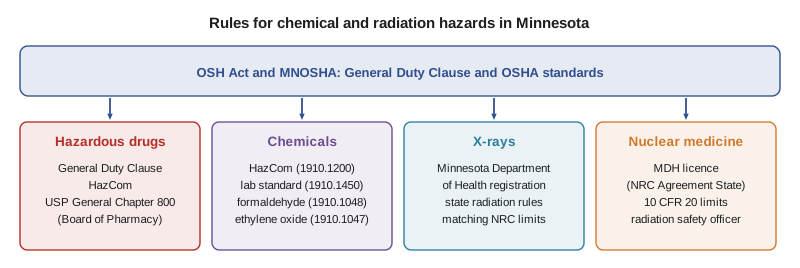
In the United States, several layers apply in Minnesota. The OSH Act's General Duty Clause requires employers to protect workers from recognized serious hazards. OSHA's Hazard Communication standard (29 CFR 1910.1200) requires labels, safety data sheets and training for hazardous chemicals, and hazardous drugs are covered by it. The laboratory standard (1910.1450) requires a chemical hygiene plan, and substance standards cover formaldehyde (1910.1048) and ethylene oxide (1910.1047). There is no OSHA standard for hazardous drugs, but OSHA expects employers to follow recognized guidance, and USP General Chapter 800, enforced by state boards of pharmacy and accrediting bodies, sets detailed handling rules. For radiation, the Nuclear Regulatory Commission sets the rules for radioactive materials; Minnesota is an Agreement State, so the Minnesota Department of Health licenses radioactive materials and registers X-ray equipment under state rules that match the federal limits.
Northbridge's chemical and radiation register
When Joanne Pelletier reviewed last year's injury data with the safety committee, chemical exposures looked small: 11 reports, 2 claims and 1 lost-time case. But Joanne knew that number missed most of the story. Chronic effects rarely produce an injury report, and nobody reports breathing anesthetic gas in the recovery room or touching a contaminated IV bag. She proposed a register: a list of every chemical and radiation hazard in the hospital, the departments and jobs exposed, how many workers, how bad the possible harm, and what controls were in place.
The committee spent two months on it. Priya Shah listed the hazardous drugs used in pharmacy and their dosage forms. Daniel Okafor listed the laboratory chemicals and the pathology grossing station. The diagnostic imaging manager listed the X-ray rooms, the portable machines, the fluoroscopy suite, the CT scanner, the nuclear medicine department and the MRI. Marta Kowalski walked the routes environmental services takes with waste and linen, and found that the cytotoxic waste bins on the oncology day unit were emptied by the same staff who cleaned the cafeteria, with no specific training.
To decide what to tackle first, the committee scored each hazard by severity of the possible harm and by how many workers were exposed, and adjusted the score down for strong controls already in place.
# Northbridge chemical and radiation register: a simple ranking
# severity: 1 (irritant) to 5 (cancer, reproductive harm)
# workers: number of staff regularly exposed
# control: 1.0 (no controls) to 0.2 (strong engineering controls)
register = [
    ("Hazardous drugs, oncology day unit", 5, 34, 0.6),
    ("Hazardous drugs, pharmacy compounding", 5, 9, 0.3),
    ("Cytotoxic waste and linen", 5, 41, 0.9),
    ("Formaldehyde, pathology grossing", 4, 6, 0.5),
    ("Glutaraldehyde, endoscopy", 3, 8, 0.6),
    ("Anesthetic gases, recovery room", 3, 22, 0.7),
    ("Fluoroscopy scatter", 4, 18, 0.5),
    ("Portable X-ray on wards", 2, 60, 0.4),
    ("MRI magnetic field", 4, 25, 0.5),
    ("Latex and glove sensitizers", 3, 900, 0.3),
]

def score(sev, n, ctrl):
    # severity counts most; worker numbers grow slowly (square root)
    return round(sev * sev * (n ** 0.5) * ctrl, 1)

ranked = sorted(register, key=lambda r: -score(r[1], r[2], r[3]))
print(f"{'hazard':40}{'sev':>4}{'staff':>6}{'ctrl':>6}{'score':>7}")
for name, sev, n, ctrl in ranked:
print(f"{name:40}{sev:4}{n:6}{ctrl:6.1f}{score(sev, n, ctrl):7}")hazard sev staff ctrl score Cytotoxic waste and linen 5 41 0.9 144.1 Hazardous drugs, oncology day unit 5 34 0.6 87.5 Latex and glove sensitizers 3 900 0.3 81.0 MRI magnetic field 4 25 0.5 40.0 Fluoroscopy scatter 4 18 0.5 33.9 Anesthetic gases, recovery room 3 22 0.7 29.5 Hazardous drugs, pharmacy compounding 5 9 0.3 22.5 Formaldehyde, pathology grossing 4 6 0.5 19.6 Glutaraldehyde, endoscopy 3 8 0.6 15.3 Portable X-ray on wards 2 60 0.4 12.4
The ranking surprised people. Pharmacy compounding, the area everyone thought of first, ranked lower than expected because Priya's team already worked in a negative-pressure room with a biological safety cabinet and closed-system devices. At the top were the workers with the weakest controls: the environmental services and laundry staff handling cytotoxic waste and linen, and the nurses on the oncology day unit. Latex ranked high because of the sheer number of glove users, even though most of the hospital had already switched to nitrile.
A score like this is a tool for discussion, not a measurement. The weights are judgments, and the committee changed them twice during the review. Its value was in forcing everyone to look at every hazard on the same page, and in pointing the first year of work at waste handling and the oncology day unit, which became the subject of the hazardous drug safety plan in Lesson 12.
Pregnancy, fertility and these hazards
Several hazards in this course can harm fertility or a developing pregnancy: many hazardous drugs, some anesthetic gases at high levels, some laboratory solvents and ionizing radiation. Workers who are pregnant, breastfeeding or planning a pregnancy, of any gender, need clear information so they can make choices, and employers need a policy for alternative duties. The policy should let a worker ask for a temporary change of duties without having to explain why, and should not push workers out of jobs they want and can do safely with good controls.
Northbridge's policy offers any worker who is pregnant, breastfeeding or trying to conceive the option of not preparing or giving hazardous drugs and not working in the fluoroscopy suite, with no loss of pay or seniority, and it treats the request as confidential medical information handled by the Employee Health and Safety office. It also meets the employer's duties under the Pregnant Workers Fairness Act and the Minnesota pregnancy accommodation law.
Worked problem
The unlabeled spray bottle
During a committee inspection of Maple Court, Tom Bergstrom finds a spray bottle in the Cedar tub room with no label. The night cleaner says it holds a mix of the floor cleaner and some bleach, because the mix "cuts through soap scum faster". What hazards does this show, and what should be done?
Show solution
- The immediate hazard is the mix. Many floor cleaners contain ammonia compounds or acids. Bleach mixed with ammonia releases chloramine gases, and bleach mixed with acids releases chlorine gas, both of which can cause serious lung injury in a small, steamy room.
- Tom asks the cleaner to leave the room, opens the window and the door, and asks the environmental services lead to dispose of the bottle safely, without pouring it down a drain where it could react further.
- The missing label is a HazCom breach: any container a product is moved into needs a label with the product name and enough information on the hazards, or the original label.
- The deeper cause is training and supply: the cleaner did not know the danger, and the approved tub cleaner was out of stock on nights. The committee asks environmental services to stock the approved product on every shift and to include "never mix" in refresher training.
Answer: Remove the worker and ventilate, dispose of the mixture safely, label every transferred container, and fix the training and supply problem that led to the mix.
Common mistakes
MistakeJudging chemical risk by the number of injury reports.
InsteadRemember that chronic effects rarely produce reports; build a register of exposures and controls.
MistakeAssuming only pharmacy staff are exposed to hazardous drugs.
InsteadInclude nurses, environmental services, laundry, receiving and transport staff, who are often less protected.
MistakeTreating an exposure limit as a safe line for carcinogens.
InsteadKeep exposure as low as reasonably achievable for carcinogens and drugs that damage genetic material.
MistakeRelying on gloves and masks first.
InsteadUse the hierarchy: substitution, enclosure and ventilation before PPE.
MistakeExpecting pregnant workers to explain why they want a change of duties.
InsteadOffer alternative duties on request, confidentially, with no loss of pay.
Summary and key terms
- Chemical and radiation hazards in healthcare are mostly invisible and many cause harm years later.
- The main groups are hazardous drugs, disinfectants and sterilants, anesthetic gases, laboratory chemicals, sensitizers, ionizing radiation, lasers and MRI.
- Chemicals enter by inhalation, skin contact, ingestion and injection; each route has its own controls.
- The dose makes the harm; for carcinogens and genotoxic drugs, keep exposure as low as reasonably achievable.
- Exposure limits come as time-weighted averages, short-term limits and ceilings, but most hazardous drugs have none.
- In Minnesota the General Duty Clause, HazCom, the lab, formaldehyde and ethylene oxide standards, USP 800 and state radiation rules apply.
- A register that scores severity, numbers exposed and existing controls helps set priorities.
- Route of exposure
- The way a substance enters the body: inhalation, skin contact, ingestion or injection.
- Acute effect
- A harmful effect that appears soon after exposure.
- Chronic effect
- A harmful effect that appears after months or years of repeated exposure.
- Time-weighted average (TWA)
- The average concentration of an airborne substance over an 8-hour shift, used in exposure limits.
- Short-term exposure limit (STEL)
- The maximum average concentration allowed over 15 minutes.
- Ceiling limit
- A concentration that must never be exceeded.
- Hazard register
- A list of hazards, the people exposed, the possible harm and the controls in place.
Practice problems
Work each problem on paper first, then reveal the answer to check.
Name the four routes by which a chemical can enter the body.
Show answer
Inhalation, skin contact, ingestion and injection.
Why is the number of chemical injury reports a poor measure of chemical risk?
Show answer
Chronic effects such as cancer, asthma and reproductive harm appear years later and are rarely reported or linked to work.
What is the difference between a TWA and a ceiling limit?
Show answer
A TWA is an 8-hour average that allows short peaks; a ceiling must never be exceeded at any moment.
Why do most hazardous drugs have no airborne exposure limit?
Show answer
They are harmful in tiny amounts and the main route is skin contact, so the aim is no contamination at all.
In the Northbridge register, why did pharmacy compounding rank lower than waste handling?
Show answer
Pharmacy already had strong engineering controls, while waste handlers had few controls and little training.
What should happen to the unlabeled bottle of mixed cleaners?
Show answer
Ventilate, remove the worker, dispose of it safely, label transferred containers and fix the training and supply gap.
Lesson quiz · 5 questions
Score 60% or more to complete this lesson.
Create a free account to save your progress, take quizzes and earn a certificate.