
HSE-394 · Lesson 2 of 12 · 23 min
Hazardous drugs: what they are and why they matter
▶ Video coming soon A video version of this lesson is on the way.
Drugs are made to change how the body works. That is what makes them useful to a patient, and it is also what makes some of them dangerous to the people who handle them every day. A patient receives a cancer drug for a few months, at a dose chosen because the benefit outweighs the harm. A nurse or pharmacy technician who is exposed to small amounts of the same drug, again and again over a career, gets none of the benefit and some of the risk. This lesson explains what makes a drug hazardous, how the official list works, what the evidence shows about harm to workers, and who is exposed.
What makes a drug hazardous
The definition used across North America comes from the U.S. National Institute for Occupational Safety and Health (NIOSH). A drug is hazardous to workers if, in studies in people or animals, it shows one or more of these properties:
- Carcinogenicity: it can cause cancer.
- Developmental toxicity: it can harm a developing embryo or fetus, including causing birth defects or miscarriage.
- Reproductive toxicity: it can harm fertility in women or men.
- Organ toxicity at low doses: it can damage organs such as the liver, kidneys or bone marrow at doses close to those used in treatment.
- Genotoxicity: it can damage genetic material (DNA).
- Structure and toxicity profile: a new drug that closely resembles a drug already known to be hazardous.
The best known hazardous drugs are antineoplastics, the drugs used in chemotherapy for cancer. Many of them work by damaging the DNA of rapidly dividing cells or by stopping cells from dividing, which is exactly the kind of action that can harm a worker's own cells or a pregnancy. But the definition reaches well beyond cancer care. Some hormones, some drugs used for transplant and autoimmune disease, some antivirals, some antiseizure drugs and some drugs used in pregnancy and fertility treatment also meet one or more of the criteria.
The NIOSH list
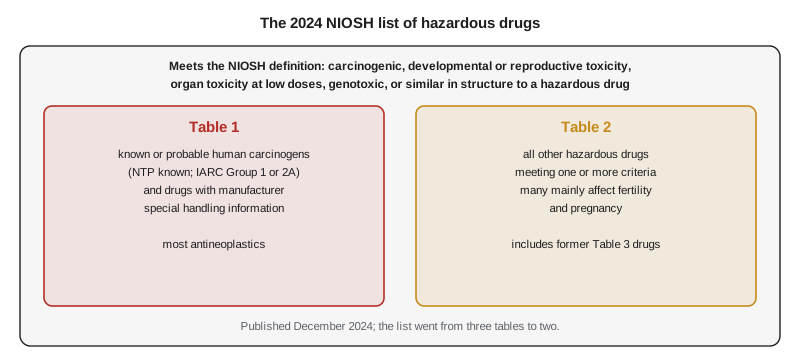
NIOSH publishes the List of Hazardous Drugs in Healthcare Settings, reviewing new drugs and new evidence every few years. The 2024 list, published in December 2024, simplified the structure from three tables to two:
- Table 1 holds drugs that meet the NIOSH definition and are also known or probable human carcinogens (classified by the U.S. National Toxicology Program as known carcinogens or by the International Agency for Research on Cancer as Group 1 or 2A), along with drugs whose manufacturers include special handling instructions in the package information. Most antineoplastics are in Table 1.
- Table 2 holds all other drugs that meet one or more of the NIOSH criteria, including drugs whose main concern is harm to reproduction or a developing pregnancy. Many of these drugs mainly matter for workers who are pregnant, breastfeeding or trying to conceive.
The list names drugs, not products, and it does not tell a hospital exactly how to handle each one. A tablet that is swallowed whole by the patient is a much smaller hazard to the nurse than a powder that must be reconstituted, or a tablet that must be crushed. NIOSH also publishes guidance on the controls suited to each type of activity and dosage form, and hospitals use both the list and that guidance to decide how to handle each drug.
In the United States, the NIOSH list is the starting point for USP General Chapter 800, Hazardous Drugs: Handling in Healthcare Settings. USP 800 requires every facility that handles hazardous drugs to keep its own list, drawn from the NIOSH list and any other drugs it considers hazardous, and to review that list at least every 12 months and whenever a new drug or dosage form is added. USP 800 became enforceable on November 1, 2023, and state boards of pharmacy, including Minnesota's, along with accrediting bodies, apply it. OSHA has no hazardous drug standard, but it treats hazardous drugs as hazardous chemicals under the HazCom standard and can cite serious failures under the General Duty Clause.
Assessing the risk drug by drug
USP 800 allows a facility to make an assessment of risk for some drugs: Table 2 drugs, and antineoplastics that only need to be counted or packaged in their final dosage form. The assessment documents the drug and dosage form, the risk of exposure, the packaging and how the drug is handled, and the alternative controls chosen. It must be reviewed at least every 12 months. All antineoplastics that must be manipulated, and all active pharmaceutical ingredients of antineoplastics, must follow the full requirements of the chapter.
In practice, this produces a handling category for each drug on the hospital's list. Priya Shah keeps the Northbridge list as a spreadsheet, and each spring she runs a short script over it to check that every drug has a category that matches its table and dosage form, and to flag any drug that needs a decision.
# Northbridge hazardous drug list: check handling categories
# table: 1 or 2 (NIOSH 2024); form: what staff do with it
drugs = [
    ("cyclophosphamide", 1, "powder for injection"),
    ("fluorouracil", 1, "injection"),
    ("methotrexate", 1, "tablet"),
    ("tamoxifen", 1, "tablet"),
    ("cisplatin", 1, "injection"),
    ("valproic acid", 2, "capsule"),
    ("finasteride", 2, "tablet"),
    ("misoprostol", 2, "tablet"),
    ("ganciclovir", 1, "powder for injection"),
    ("warfarin", 2, "tablet"),
]
MANIPULATED = {"powder for injection", "injection"}

def category(table, form):
    if form in MANIPULATED:
        return "A: full controls (BSC, CSTD, double gloves, gown)"
    if table == 1:
        return "B: intact tablets, gloves; no crushing outside BSC"
    return "C: intact form, gloves; reproductive risk notice"

for name, table, form in drugs:
print(f"{name:18}T{table} {form:22}{category(table, form)}")cyclophosphamide T1 powder for injection A: full controls (BSC, CSTD, double gloves, gown) fluorouracil T1 injection A: full controls (BSC, CSTD, double gloves, gown) methotrexate T1 tablet B: intact tablets, gloves; no crushing outside BSC tamoxifen T1 tablet B: intact tablets, gloves; no crushing outside BSC cisplatin T1 injection A: full controls (BSC, CSTD, double gloves, gown) valproic acid T2 capsule C: intact form, gloves; reproductive risk notice finasteride T2 tablet C: intact form, gloves; reproductive risk notice misoprostol T2 tablet C: intact form, gloves; reproductive risk notice ganciclovir T1 powder for injection A: full controls (BSC, CSTD, double gloves, gown) warfarin T2 tablet C: intact form, gloves; reproductive risk notice
The script is only a check on Priya's work; the categories themselves are the pharmacy and therapeutics committee's decision. The real list at Northbridge has more than 90 entries, and some need more thought than a rule can give. Methotrexate tablets, for example, are safe to hand to a patient intact, but when a nurse on Maple Court is asked to crush one for a resident who cannot swallow, the drug becomes a powder that can be breathed in and spread. The handling instructions for every Category B drug say: never crush, split or open in the open air; ask pharmacy for a liquid form or for preparation in a cabinet.
What the evidence shows
Concern about hazardous drugs is not theoretical. Since the 1970s, studies have found:
- Contamination on surfaces wherever hazardous drugs are handled: on the outside of vials as they arrive from the manufacturer, on counters and floors in pharmacies and on patient care units, on IV poles, on bathroom surfaces used by patients, and on chairs and keyboards in nursing stations.
- Drug traces in the urine of nurses and pharmacy staff who handle these drugs, showing that the drugs get into workers' bodies, even in facilities that follow recommended practices.
- Short-term effects in exposed workers, including skin rashes, hair loss, headaches, nausea, eye irritation and allergic reactions.
- Reproductive effects: several studies of nurses and pharmacy workers found higher rates of miscarriage, and some found higher rates of infertility and birth defects, among workers who handled antineoplastics, especially before modern controls were common.
- Genetic damage: studies have found more chromosome changes in the blood cells of exposed workers than in unexposed workers.
The risk of cancer in workers is harder to measure, because the cancers would take many years to appear and the exposed groups are small. But because the same drugs cause cancer in patients and in animals, and because exposed workers show genetic damage, health agencies treat the risk as real. The aim is to keep exposure as low as possible, which in practice means preventing contamination and preventing it from reaching skin.
Who is exposed
Hazardous drugs travel through a hospital, and they leave traces at every stop. Anyone who touches a step in the chain can be exposed, and the people at the ends of the chain are often the least protected.
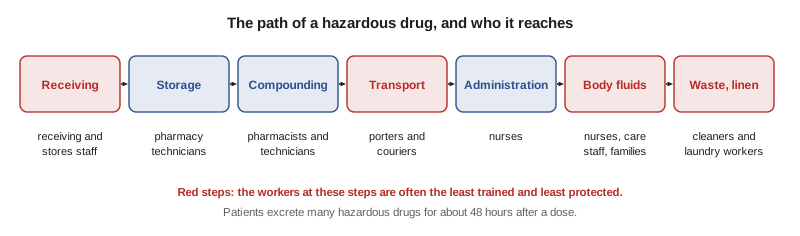
- Receiving and stores staff unpack shipments, and the outside of vials and cartons is often contaminated.
- Pharmacy staff store, count, prepare and check doses.
- Transporters and couriers carry prepared doses to units.
- Nurses check, hang, give and disconnect doses, care for patients, and handle body fluids.
- certified nursing assistants and families help patients use the toilet and change soiled linen. Patients excrete many of these drugs in urine, stool, vomit and sweat for about 48 hours after a dose, and longer for some drugs.
- Environmental services workers clean rooms, bathrooms and spills and empty waste.
- Laundry workers handle contaminated linen.
- Physicians, physician assistants and others give drugs in procedures, and veterinary staff give the same drugs to animals.
Joanne asked each group on the Northbridge register a simple question: have you been told which patients or materials might carry hazardous drug contamination? Every pharmacy technician and oncology nurse said yes. Fewer than half of the transporters and none of the laundry staff did.
Worked problem
The new oncology nurse
Rachel Kim, a nurse who has just moved from 3 East to the oncology day unit, asks Amira Haddad, who sits on the safety committee, why she needs to wear two pairs of gloves and a gown just to hang a bag that the pharmacy has already sealed. What should Amira explain?
Show solution
- The drug inside the bag is a Table 1 antineoplastic. Even when it is prepared carefully in a cabinet, studies show the outside of bags, tubing and vials is often contaminated.
- The main route is skin contact, and some of these drugs pass through skin. Gloves tested for chemotherapy drugs, worn double, and a gown that resists liquids keep drug off the skin, especially if a connection leaks.
- Repeated small exposures add up over a career, and the drugs can cause cancer, harm fertility and harm a pregnancy. The patient accepts that risk for a benefit; Rachel gets no benefit.
- The hospital's hazardous drug procedures, based on USP 800, set the PPE for each task; Rachel can see them in the hazardous drug manual and ask the unit educator for the training record.
Answer: Because sealed bags can still be contaminated, skin contact is the main route, and the harm from repeated exposure is serious, the procedure calls for double chemotherapy gloves and a gown.
Questions staff ask
When Joanne ran information sessions on the register, the same questions came up on every unit. Her answers are worth repeating.
"If I have handled these drugs for years without a problem, am I safe?" Not necessarily. The effects that matter most, such as cancer and harm to a future pregnancy, do not show up as a problem at the time. Feeling well is not evidence of no exposure. The right response is not alarm but steady good practice from now on, because reducing exposure today reduces risk from today.
"Can a blood or urine test tell me how much I have absorbed?" Research studies have measured some drugs in urine, but there is no routine test that tells an individual worker their dose or their risk. That is why medical surveillance programs focus on a health history, a record of the drugs and tasks a worker has handled, and follow-up after spills or other acute exposures, rather than on a single test.
"Are tablets safe?" Intact tablets and capsules handed to a patient in their packaging carry little risk, but they are not risk free: tablets can shed dust, and counting machines and pill splitters spread it. Gloves are worn for handling, counting is done on dedicated trays that are cleaned after use, and crushing or splitting is done only in a cabinet.
"What about the patient's family at home?" Patients going home after treatment are given simple advice for the first 48 hours: flush the toilet twice with the lid down, wash soiled clothes and linen separately, and have carers wear gloves when handling body fluids. Home health staff who visit these patients follow the same rules as hospital staff.
"Who decides what goes on our list?" The pharmacy and therapeutics committee reviews the list every year with the safety committee, adding new drugs as they are approved and checking each against the latest NIOSH list. Anyone can ask for a drug to be reviewed.
Common mistakes
MistakeThinking that hazardous drugs means only chemotherapy.
InsteadCheck the facility list; some hormones, antivirals, antiseizure and transplant drugs are also hazardous.
MistakeAssuming a sealed bag or vial is clean on the outside.
InsteadTreat the outside of hazardous drug packaging as contaminated.
MistakeCrushing a hazardous tablet in a pill crusher at the nursing station.
InsteadAsk pharmacy for a liquid form or for preparation in a cabinet.
MistakeForgetting that patients excrete drugs for about 48 hours.
InsteadUse gloves and gown for body fluids and soiled linen during that period.
MistakeTraining only pharmacy and oncology nurses.
InsteadTrain everyone in the chain, including receiving, transport, cleaning and laundry staff.
Summary and key terms
- A hazardous drug is one that can cause cancer, harm development or fertility, damage organs at low doses or damage DNA, or resembles one that does.
- Antineoplastics are the main group, but some hormones, antivirals, antiseizure and transplant drugs also qualify.
- The 2024 NIOSH list has two tables: carcinogens and drugs with special handling information in Table 1, and all other hazardous drugs in Table 2.
- In the US, USP 800 requires a facility list reviewed every 12 months, with documented assessments of risk for some drugs.
- Studies show surface contamination, drug traces in workers' urine, skin and reproductive effects and genetic damage.
- Everyone along the path of a drug is exposed, from receiving to waste and laundry.
- Hazardous drug
- A drug that can harm workers who handle it because it is carcinogenic, toxic to development, reproduction or organs, or genotoxic.
- Antineoplastic
- A drug used to treat cancer by killing or stopping the growth of cancer cells.
- Genotoxic
- Able to damage genetic material.
- NIOSH list
- The List of Hazardous Drugs in Healthcare Settings published by NIOSH.
- Dosage form
- The form a drug comes in, such as tablet, capsule, powder or injection.
- Assessment of risk
- A documented decision on how to handle a specific hazardous drug and dosage form safely.
Practice problems
Work each problem on paper first, then reveal the answer to check.
List the six NIOSH criteria for a hazardous drug.
Show answer
Carcinogenicity, developmental toxicity, reproductive toxicity, organ toxicity at low doses, genotoxicity, and a structure and toxicity profile like a known hazardous drug.
How did the 2024 NIOSH list change the structure of the list?
Show answer
It went from three tables to two; the former Table 3 drugs moved into Table 2.
Why is a methotrexate tablet a bigger hazard when crushed?
Show answer
Crushing turns it into a powder that can be breathed in and spread onto surfaces and skin.
For how long after a dose do many patients excrete hazardous drugs?
Show answer
About 48 hours, and longer for some drugs.
Name three kinds of evidence that workers are exposed.
Show answer
Any three of surface contamination, drug in urine, skin and other short-term effects, reproductive effects, genetic damage.
Which Northbridge groups were least aware of hazardous drug contamination?
Show answer
The transporters and laundry staff.
Lesson quiz · 5 questions
Score 60% or more to complete this lesson.
Create a free account to save your progress, take quizzes and earn a certificate.