
HSE-394 · Lesson 7 of 12 · 21 min
Laboratory chemicals and formaldehyde
▶ Video coming soon A video version of this lesson is on the way.
A hospital laboratory uses hundreds of chemicals: fixatives and stains in pathology, solvents for processing tissue, acids and bases for cleaning and testing, reagents in automated analyzers, and cryogenic liquids for storing samples. Most are used in small amounts by trained staff, and the laboratory is often the best-run area of the hospital for chemical safety. But a few chemicals, above all formaldehyde, are used in larger amounts, outside the lab as well as inside it, and they cause real harm when controls slip. This lesson covers how laboratory chemical safety is organized, the hazards of formaldehyde and xylene, safe storage, fume hoods, cryogens, and the formaldehyde that travels with specimens to the operating room and the morgue.
How laboratory chemical safety is organized
In the United States, most clinical and research laboratories are covered by OSHA's laboratory standard, Occupational Exposure to Hazardous Chemicals in Laboratories (29 CFR 1910.1450). It requires a written chemical hygiene plan, a chemical hygiene officer, training, procedures for working with particularly hazardous substances such as carcinogens and reproductive toxins, exposure monitoring where there is reason to believe exposures exceed limits, and medical consultation after exposures. HazCom labeling and safety data sheet rules still apply, and accrediting bodies such as the College of American Pathologists check the laboratory safety program.
In practice, a good laboratory safety program has the same elements in both countries: an up-to-date inventory of chemicals with their safety data sheets; written procedures for each hazardous chemical and task; engineering controls such as fume hoods and ventilated grossing stations; PPE; training before work begins and when anything changes; spill kits and emergency equipment; and regular inspections.
Formaldehyde
Formaldehyde is a colorless gas with a sharp, pungent smell. In hospitals it is used as formalin, a dilute water solution of formaldehyde, usually neutral buffered formalin, which preserves (fixes) tissue specimens so that they can be examined under a microscope. Formalin is used in the pathology laboratory, in the operating rooms and procedure rooms where specimens are placed in containers, in endoscopy, in the morgue, and in clinics that take biopsies.
Formaldehyde vapor rises from any open container of formalin. Its effects depend on the concentration:
- At low levels, it irritates the eyes, nose and throat, causing watering eyes, a burning nose and coughing. Most people can smell it at levels below 1 ppm, but people get used to the smell, so smell is not a reliable warning.
- It is a skin and respiratory sensitizer: repeated contact can cause allergic contact dermatitis, and some workers develop asthma.
- It is a known human carcinogen, linked to cancer of the nose and throat (nasopharyngeal cancer) and to leukemia in workers with high exposures.
- Splashes of formalin in the eye can cause serious injury.
OSHA's formaldehyde standard (29 CFR 1910.1048) sets a permissible exposure limit of 0.75 ppm as an 8-hour average and a short-term limit of 2 ppm over 15 minutes, with an action level of 0.5 ppm that triggers periodic monitoring and medical surveillance. It also requires training every year for workers exposed at or above 0.1 ppm, labels on formalin containers, eyewash and quick-drench facilities where splashes can occur, and medical evaluation for workers with symptoms. Because the ACGIH lowered its values in 2016 to 0.1 ppm and 0.3 ppm, Northbridge uses those as its internal targets.
Controlling formaldehyde in pathology
The highest exposures in a hospital usually occur at the pathology grossing station, where pathologists' assistants and pathologists open specimen containers, cut and describe tissue, and put pieces into cassettes for processing. Daniel Okafor's laboratory uses a layered set of controls.
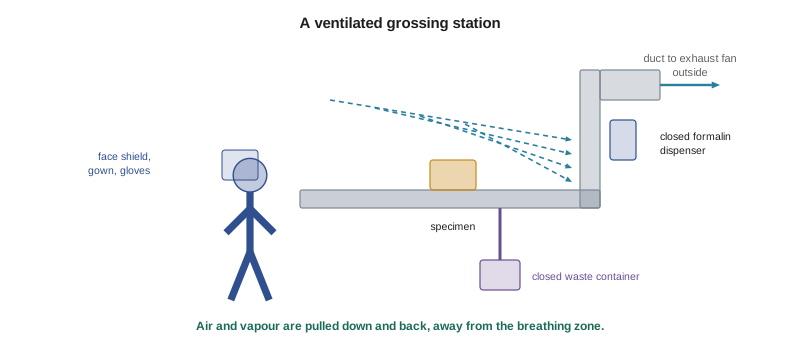
- Engineering: the grossing station is a ventilated bench that draws air downward and backward, away from the worker's face, through slots at the work surface. Specimen containers are opened only on the station. Formalin is dispensed from a closed system with a tap, not poured from large jugs, and waste formalin drains to a closed container.
- Substitution and reduction: prefilled specimen containers with the right amount of formalin, sent sealed to the operating rooms, replace open buckets filled by hand. Some specimens are sent fresh in sealed containers on a timed schedule and fixed in the laboratory.
- Work practices: lids are kept on containers at all times except when tissue is being removed; specimen buckets are never left open on counters; spills are cleaned at once with a formaldehyde spill kit that neutralizes the liquid.
- PPE: nitrile gloves (thin gloves changed often, or heavier gloves for longer contact), a fluid-resistant gown or apron, and safety glasses or goggles with a face shield for pouring and for large specimens.
- Monitoring and medical surveillance: personal sampling at the grossing station and in the histology room, repeated after changes.
Xylene and other solvents
Tissue processing and staining use solvents, traditionally xylene, along with alcohols and other clearing agents. Xylene vapor causes headaches, dizziness and nausea, irritates the eyes and airways, removes oils from the skin causing dermatitis, and is flammable. Long-term high exposure can affect the nervous system. Modern laboratories have replaced much of their xylene with less toxic substitutes, use enclosed automated tissue processors and stainers with built-in exhaust, and recycle solvents in closed stills. Where xylene is still used, it is handled in a fume hood or at a ventilated station, stored in a flammables cabinet, and kept away from ignition sources.
Storing chemicals safely
Chemicals that react with each other must be stored apart, so that a leak, a broken bottle or a fire does not bring them together. The basic groups are:
- Flammable liquids, such as alcohols and xylene, in an approved flammables cabinet away from heat and sparks, with only the amount needed for a day or a shift on the bench.
- Acids, such as hydrochloric and acetic acid, separate from bases.
- Bases (alkalis), such as sodium hydroxide, separate from acids.
- Oxidizers, such as concentrated hydrogen peroxide, nitric acid and sodium hypochlorite, away from flammables and organic materials.
- Toxic chemicals, including carcinogens, in a labeled, secured location.
- Water-reactive chemicals kept dry.
Other rules follow from the same logic: store heavy and corrosive containers low, never above eye level; use secondary containers or trays that can hold a spill; keep incompatible chemicals in separate cabinets, not just separate shelves; and date chemicals that can form dangerous by-products as they age.
When the laboratory moved its reagent storage during a renovation, Daniel used a short script to check the new shelf layout against the compatibility groups before anyone put a bottle on a shelf.
# Check a proposed shelf layout for incompatible chemical groups
INCOMPATIBLE = {
    ("acid", "base"), ("acid", "oxidizer"), ("flammable", "oxidizer"),
    ("acid", "cyanide"), ("bleach", "acid"), ("bleach", "ammonia"),
}

shelves = {
    "Cabinet A, shelf 1": [("acetic acid", "acid"), ("hydrochloric acid", "acid")],
    "Cabinet A, shelf 2": [("sodium hydroxide", "base"), ("nitric acid", "acid")],
    "Cabinet B, shelf 1": [("ethanol", "flammable"), ("xylene", "flammable")],
    "Cabinet B, shelf 2": [("isopropanol", "flammable"), ("hydrogen peroxide 30", "oxidizer")],
    "Cabinet C, shelf 1": [("sodium hypochlorite", "bleach"), ("ammonium hydroxide", "ammonia")],
}

def clash(a, b):
    return (a, b) in INCOMPATIBLE or (b, a) in INCOMPATIBLE

problems = 0
for shelf, items in shelves.items():
    for i in range(len(items)):
        for j in range(i + 1, len(items)):
            (n1, g1), (n2, g2) = items[i], items[j]
            if clash(g1, g2):
                problems += 1
                print(f"{shelf}: {n1} ({g1}) with {n2} ({g2})")
print(f"conflicts found: {problems}")Cabinet A, shelf 2: sodium hydroxide (base) with nitric acid (acid) Cabinet B, shelf 2: isopropanol (flammable) with hydrogen peroxide 30 (oxidizer) Cabinet C, shelf 1: sodium hypochlorite (bleach) with ammonium hydroxide (ammonia) conflicts found: 3
The script found three conflicts in the proposed layout: a base next to an acid, a flammable solvent next to concentrated hydrogen peroxide, and bleach next to ammonium hydroxide, a pair that releases toxic chloramine gas if they mix. The final layout moved the bases, oxidizers and bleach into their own cabinets. A script like this only checks what it is told; the real check is the safety data sheet for each chemical, which lists the materials it must not be stored with.
Fume hoods
A chemical fume hood is an enclosure that draws room air in through the front opening and exhausts it outside, carrying vapors away from the worker. It works only when used correctly.
- Work at least 6 in (15 cm) inside the opening, so that vapors are captured.
- Keep the sash, the sliding front window, as low as practical, and at or below the marked working height.
- Do not store bottles and equipment in the hood, because they block the airflow.
- Check the airflow monitor before starting; if it shows low flow or alarms, do not use the hood.
- Have the hood tested at least once a year, with the measured face velocity, typically about 0.4 to 0.6 m/s (80 to 120 ft per minute), posted on a label.
A fume hood is not the same as a biological safety cabinet. A fume hood protects the worker from chemical vapors but does not protect the work from germs; a biological safety cabinet protects both the worker and the work from germs, and only some types are suitable for volatile chemicals.
Cryogenic liquids and gases
Laboratories store samples in liquid nitrogen at about minus 196 °C (minus 321 °F). Liquid nitrogen causes severe cold burns on contact, and as it evaporates it expands to several hundred times its liquid volume, pushing oxygen out of the air. In a small, closed room, a spilled or leaking dewar can lower oxygen to dangerous levels without any warning, because nitrogen has no smell. Rooms where liquid nitrogen is stored or dispensed need good ventilation and an oxygen monitor with an alarm, and staff wear a face shield, insulated gloves and closed shoes when pouring. Dry ice used for shipping gives off carbon dioxide and must not be stored in sealed containers or small unventilated rooms.
Formalin outside the laboratory
Operating room nurses, endoscopy staff and clinic nurses handle formalin every day, but often with much less training and fewer controls than laboratory staff. Prefilled sealed containers are the most important control, because they remove the need to pour formalin at all. Where pouring cannot be avoided, it should be done at a ventilated station, with gloves and eye protection, and spills should be cleaned up with a formaldehyde spill kit, not paper towels. Specimen containers should be closed tightly, wiped and bagged before they leave the room, and transported in leak-proof secondary containers.
Worked problem
The specimen fridge
Kevin Tran, a transporter, picks up specimens from the operating room each afternoon. He notices that his eyes water and his throat burns every time he opens the specimen fridge outside OR 3. Inside, some containers have loose lids and there is a puddle of liquid at the bottom. What should happen?
Show solution
- Kevin should close the fridge, step away and report it to the OR charge nurse and the laboratory. He should not mop up the liquid himself, because it is almost certainly formalin.
- The laboratory sends a trained staff member with a formaldehyde spill kit and PPE to neutralize and clean the spill and check the containers.
- The cause is found: containers filled by hand from a large jug, with lids not tightened, stacked in a fridge with no secondary trays.
- The fixes are prefilled sealed containers for the operating rooms, a tray in the fridge to catch leaks, a rule that every container is closed and wiped before it goes in, and short training for OR staff and transporters on formalin hazards.
- Kevin's symptoms are recorded, and he is told to report any that continue to the Employee Health and Safety office.
Answer: Treat it as a formalin spill: report it, let trained staff clean it, and fix the containers, storage and training that caused it.
Common mistakes
MistakeRelying on the smell of formaldehyde as a warning.
InsteadUse ventilation and monitoring; people get used to the smell.
MistakeOpening specimen containers on an open counter.
InsteadOpen them only on a ventilated grossing station or in a hood.
MistakeStoring chemicals alphabetically.
InsteadStore by compatibility group: acids, bases, flammables, oxidizers and toxics apart.
MistakeKeeping bottles in the fume hood.
InsteadKeep the hood clear so the airflow works.
MistakeStoring liquid nitrogen in a small closed room.
InsteadUse a ventilated room with an oxygen monitor.
Summary and key terms
- Laboratories follow OSHA's laboratory standard, with a chemical hygiene plan, plus HazCom.
- Formaldehyde is an irritant, a sensitizer and a carcinogen; smell is not a reliable warning.
- OSHA's formaldehyde PEL is 0.75 ppm (8-hour) with a 2 ppm short-term limit and a 0.5 ppm action level; Northbridge targets the lower ACGIH values.
- Ventilated grossing stations, closed dispensing and prefilled containers are the key formaldehyde controls.
- Xylene and other solvents need enclosure, ventilation and flammables storage, and can often be replaced.
- Store chemicals by compatibility group, low and in trays.
- Use fume hoods correctly, and control cryogens with ventilation and oxygen monitors.
- Formalin
- A water solution of formaldehyde used to preserve tissue.
- Grossing station
- A ventilated bench where tissue specimens are examined and cut.
- Chemical hygiene plan
- A written program for laboratory chemical safety required by OSHA's laboratory standard.
- Compatibility group
- A class of chemicals that can be stored together safely, such as acids or flammables.
- Fume hood
- A ventilated enclosure that draws chemical vapors away from the worker and exhausts them outside.
- Face velocity
- The speed of air moving into the front opening of a fume hood.
- Cryogenic liquid
- A very cold liquefied gas, such as liquid nitrogen.
Practice problems
Work each problem on paper first, then reveal the answer to check.
Name three health effects of formaldehyde.
Show answer
Any three of eye, nose and throat irritation, skin allergy, asthma, cancer, eye injury from splashes.
Why are prefilled specimen containers an important control?
Show answer
They remove the need to pour formalin, which is when most vapor and splashes occur.
What three conflicts did the shelf script find?
Show answer
A base with an acid, a flammable with an oxidizer, and bleach with ammonium hydroxide.
How far inside a fume hood should work be done?
Show answer
At least 6 in (15 cm) inside the opening.
Why is liquid nitrogen dangerous in a small closed room?
Show answer
It evaporates and pushes out oxygen without any smell, which can cause asphyxiation.
What caused the formalin smell in the specimen fridge?
Show answer
Hand-filled containers with loose lids leaking formalin into a fridge with no trays.
Lesson quiz · 5 questions
Score 60% or more to complete this lesson.
Create a free account to save your progress, take quizzes and earn a certificate.