
HSE-392 · Lesson 9 of 12 · 21 min
After an exposure: first steps
▶ Video coming soon A video version of this lesson is on the way.
Even with the best devices and habits, exposures will sometimes happen. When one does, the first hour matters. Simple first aid, an immediate report and a prompt assessment give the exposed worker the best chance of protection, especially if post-exposure prophylaxis for HIV or hepatitis B immune globulin is needed, because both work best when started quickly. This lesson covers what to do in those first minutes and hours. Lesson 10 covers the testing and follow-up that come after.
Each hospital's own exposure procedure sets out the local details, such as which clinic to call and who covers nights. Every worker should know where their workplace's procedure is posted and the number to call, day and night.
What counts as an exposure
An exposure that needs assessment is any of these, involving blood or one of the body fluids listed in Lesson 1:
- A needlestick, cut or other injury from a used sharp, even a small one and even through a glove.
- A splash into the eyes, nose or mouth.
- Contact with skin that is broken, chapped, scratched or affected by dermatitis.
- A human bite that breaks the skin.
Blood on intact skin is not an exposure, though it should be washed off promptly. A scratch from a sharp that was never used on a patient is not a bloodborne exposure. When in doubt, treat it as an exposure and let Employee Health and Safety decide.
First aid, right away
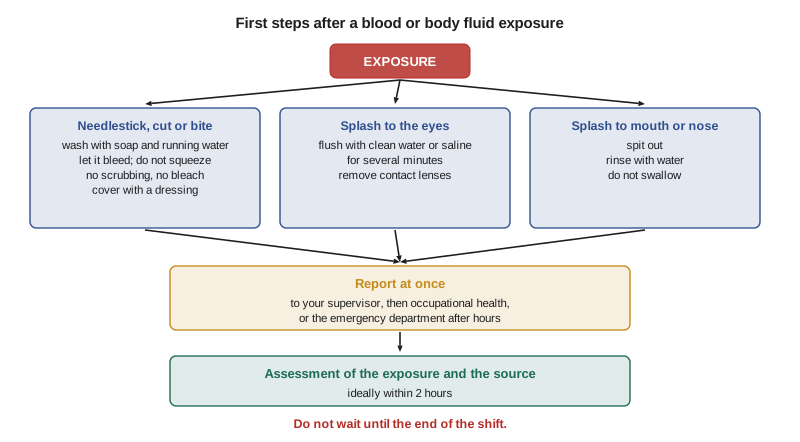
- Needlestick, cut or bite: wash the area right away with soap and running water. Let it bleed freely for a moment, but do not squeeze, scrub or try to suck the wound. Do not use bleach or other harsh chemicals on the skin; there is no evidence they help, and they damage the skin. Cover it with a waterproof dressing.
- Splash to the eyes: flush with clean water, saline or an eyewash for several minutes, holding the eyelids open. Remove contact lenses if you can do so easily, and do not put them back in.
- Splash to the mouth: spit it out and rinse your mouth with water several times. Do not swallow.
- Splash to the nose: blow gently and rinse with water.
- Splash onto broken skin: wash with soap and water.
If the injury itself needs care, such as a deep cut that needs stitches, that care comes first. But for most exposures, first aid takes a minute or two, and the next step should follow immediately.
Report at once
The worker stops what they are doing, makes the patient safe and tells their supervisor or charge nurse straight away. The charge nurse finds someone to take over the worker's patients. This is the most important moment in the whole process, and the one where things most often go wrong. Workers delay because they are busy, because the injury seems small, because they feel embarrassed, or because they do not want to leave the unit short. Lesson 1 noted that about half of sharps injuries are never reported at all.
Delay matters because the treatments that may be needed work best early. HIV post-exposure prophylaxis is most effective when started within a couple of hours and is generally not started more than 72 hours after the exposure. Hepatitis B immune globulin for a non-immune worker is best given within 24 hours. Neither can be decided on until the exposure has been assessed.
At Northbridge, the route depends on the time of day. During weekday business hours, the worker calls Employee Health and Safety, whose nurse assesses them in the clinic within the hour. Evenings, nights, weekends and holidays, the worker goes straight to the emergency department, which follows the same protocol and hands the case to Employee Health and Safety the next working day. Northbridge Home Health staff call the on-call line and go to the nearest emergency department. The hospital also displays the number of the national clinician consultation line for post-exposure prophylaxis, which clinicians can call for expert advice at any hour.
The assessment
The nurse or physician who assesses the exposure asks a series of questions to judge how serious it was:
- What happened, exactly? A needlestick from a hollow-bore needle that was in a vein is very different from a splash of blood onto chapped skin.
- What device or fluid was involved, and was there visible blood?
- How deep was the injury, and was a glove worn?
- When did it happen? This sets the clock for any treatment.
- Who is the source patient, and what is known about them?
- What is the worker's own hepatitis B vaccination and antibody status?
- Does the worker have any health conditions, medications or pregnancy that affect treatment choices?
Baseline blood tests are taken from the worker, usually for hepatitis B, hepatitis C and HIV, so that any later change can be shown to have happened after the exposure. If HIV post-exposure prophylaxis is recommended, the first dose is often given at this visit, before all test results are back, because waiting would reduce its effect. It can be stopped later if the source turns out to be negative.
The source patient
Knowing whether the source patient has one of the viruses makes a large difference. If the source tests negative, most follow-up can stop. If the source is positive or the results are unclear, the follow-up is more intensive.
In Minnesota, as in most states, testing a patient's blood for HIV, hepatitis B and hepatitis C after a worker exposure follows state law on consent and confidentiality. The patient's physician or the emergency physician, not the exposed worker, explains why the test is being asked for and obtains consent. Minnesota law sets out a detailed process for testing source patients after exposures to emergency medical services personnel and other out-of-hospital responders, including the use of blood already drawn when consent cannot be obtained, and hospitals follow their own policies, consistent with state law, for their employees. If the patient refuses, the refusal is respected, and the worker is managed as if the source status were unknown.
The source patient's results are given to the exposed worker's clinician, who tells the worker what they need to know for their own care. The worker must keep the source patient's information confidential. And under no circumstances should the exposed worker approach the patient to ask about their health, or look up the patient's chart for that reason.
When the source is unknown, such as a needle found in linen or a container, the assessment is based on the circumstances: where the needle was found, how likely it is to have been used on a patient with one of the viruses, and how long ago. The needle itself is not tested for viruses, because testing a discarded needle is unreliable and can be dangerous to the person handling it.
The emotional side
An exposure is frightening, even for experienced staff who know the numbers. Workers describe a wave of fear in the first minutes, followed by worry about their partners and children, embarrassment at having been hurt, and sometimes anger at a colleague who left a sharp behind. All of these are normal. The people who handle the assessment are trained to answer questions plainly, to explain what the actual risk is for this exposure, which is usually very low, and to make sure the worker knows what happens next and whom to call. Northbridge also offers its employee assistance program to every exposed worker, and the Employee Health and Safety nurse calls each one the day after the assessment to check how they are doing.
Colleagues can help too. The most useful thing a coworker can do is take over the exposed worker's patients without fuss, so they can leave at once, and avoid gossip about what happened. Questions about the source patient's status must never be discussed on the unit.
The timing in practice
Joanne tracks the time from exposure to assessment for every case, because it is the measure that most directly affects whether treatment can work.
# Hours from exposure to assessment for last year's blood exposures
cases = [
    ("needlestick", "day", 0.6), ("needlestick", "day", 0.9), ("needlestick", "night", 1.4),
    ("needlestick", "night", 6.5), ("needlestick", "day", 0.5), ("needlestick", "night", 2.8),
    ("needlestick", "day", 1.1), ("needlestick", "evening", 1.8), ("needlestick", "night", 26.0),
    ("splash", "day", 0.8), ("splash", "evening", 3.5), ("splash", "night", 1.2),
    ("cut", "day", 0.7), ("cut", "evening", 1.6), ("bite", "night", 12.0),
]

def band(h):
    if h <= 2:
        return "within 2 h"
    if h <= 24:
        return "2 to 24 h"
    if h <= 72:
        return "24 to 72 h"
    return "over 72 h"

order = ["within 2 h", "2 to 24 h", "24 to 72 h", "over 72 h"]
for shift in ("day", "evening", "night"):
    hs = [h for kind, s, h in cases if s == shift]
    counts = {b: 0 for b in order}
    for h in hs:
        counts[band(h)] += 1
    row = "  ".join(f"{b}: {counts[b]}" for b in order)
print(f"{shift:8} n={len(hs):2} {row}")day n= 6 within 2 h: 6 2 to 24 h: 0 24 to 72 h: 0 over 72 h: 0 evening n= 3 within 2 h: 2 2 to 24 h: 1 24 to 72 h: 0 over 72 h: 0 night n= 6 within 2 h: 2 2 to 24 h: 3 24 to 72 h: 1 over 72 h: 0
Every day-shift case was assessed within 2 hours, and so were most evening cases. Nights were the problem: of the six night cases, only two were seen within 2 hours, and one, a needlestick, was not reported until the next day. When Joanne asked night staff why, the answers were that they did not want to leave the unit short, and that some did not know they could go to the emergency department at night. The committee asked managers to make it clear that a charge nurse will always cover a worker who needs to be assessed, and posted the night route on every unit.
Worked problem
Amira's needlestick at 0300
At 0300 on a night shift, Amira is starting an IV on a patient in room 412 when the patient moves suddenly. The catheter's stylet pricks her finger through her glove before the safety shield engages. The unit has two nurses for 16 patients, and she is worried about leaving her colleague alone. What should she do?
Show solution
- She makes the patient safe, removes her glove, washes the finger with soap and running water, lets it bleed briefly without squeezing, and covers it.
- She tells the charge nurse right away. The charge nurse calls the nursing supervisor, who sends a float nurse to cover Amira's patients.
- Amira goes to the emergency department, where she is assessed within the hour. The emergency physician reviews her hepatitis B status, which shows she is immune, and takes baseline blood.
- The emergency physician speaks with the patient, who agrees to testing using blood already drawn that evening. Until the results are back, the physician discusses whether to start HIV post-exposure prophylaxis, based on what is known about the patient. Amira files her report before going home, and Employee Health and Safety follows up the next morning.
Answer: First aid, an immediate report, cover for her patients, and assessment within the hour in the emergency department, with source testing arranged by the physician.
Common mistakes
MistakeFinishing the shift before reporting a needlestick.
InsteadReport at once; treatment works best within hours.
MistakeSqueezing the wound or washing it with bleach.
InsteadWash with soap and running water and let it bleed freely without squeezing.
MistakeAsking the source patient about their HIV status yourself.
InsteadLeave the conversation and consent to the patient's physician, and keep the information confidential.
MistakeSending a discarded needle to the lab for testing.
InsteadDo not test needles; assess the risk from the circumstances.
MistakeNot knowing where to go at night.
InsteadKnow the after-hours route, which at Northbridge is the emergency department.
Summary and key terms
- An exposure is a used-sharp injury, a splash to the eyes, nose or mouth, contact with broken skin, or a bite that breaks the skin.
- First aid: wash with soap and water, flush eyes with water or saline, rinse the mouth; do not squeeze, scrub or use bleach.
- Report at once to a supervisor and to occupational health, or the emergency department after hours.
- HIV prophylaxis works best within a couple of hours and is generally not started after 72 hours; hepatitis B immune globulin is best within 24 hours.
- The assessment covers the exposure, the source and the worker's own status, with baseline blood tests.
- Source testing needs consent, obtained by the patient's physician; the worker keeps the information confidential.
- Discarded needles are not tested; risk is judged from the circumstances.
- Exposure incident
- A specific eye, mouth, other mucous membrane, non-intact skin or percutaneous contact with blood or other potentially infectious materials during work.
- Post-exposure prophylaxis (PEP)
- Treatment given after an exposure to prevent infection, such as a 28-day course of HIV drugs.
- Baseline test
- A blood test taken right after an exposure, to show the worker's status before any infection could develop.
- Source patient
- The person whose blood or body fluid was involved in the exposure.
- Substitute decision-maker
- A person legally entitled to make health care decisions for someone who cannot make them.
Practice problems
Work each problem on paper first, then reveal the answer to check.
What is the first aid for a needlestick?
Show answer
Wash with soap and running water, let it bleed freely without squeezing, and cover it.
What should you do after a blood splash to the eye?
Show answer
Flush with clean water, saline or an eyewash for several minutes, holding the eyelids open, and remove contact lenses if easy.
Why must an exposure be reported right away?
Show answer
Treatments such as HIV prophylaxis and hepatitis B immune globulin work best when started within hours.
Who obtains consent to test the source patient?
Show answer
The patient's physician or the emergency physician, not the exposed worker.
Why are discarded needles not tested for viruses?
Show answer
Testing them is unreliable and handling them is dangerous.
What did the Northbridge data show about night shifts?
Show answer
Night exposures were assessed much later, because staff did not want to leave the unit short or did not know the night route.
Lesson quiz · 5 questions
Score 60% or more to complete this lesson.
Create a free account to save your progress, take quizzes and earn a certificate.