
HSE-392 · Lesson 2 of 12 · 22 min
Laws and regulations for sharps and blood exposure
▶ Video coming soon A video version of this lesson is on the way.
Sharps injuries are one of the few healthcare hazards with their own federal standard. OSHA's Bloodborne Pathogens standard, 29 CFR 1910.1030, was issued in 1991 and strengthened in 2001 after Congress passed the Needlestick Safety and Prevention Act. In Minnesota it is enforced by MNOSHA, which has adopted the federal standard and covers public as well as private employers. It sets out what Northbridge Community Hospital must do, and what its workers can expect. This lesson explains those rules in plain language, so that staff know what to expect and what to ask for when something is missing.
Nothing in this lesson is legal advice. The regulations themselves, and the guidance from the regulator, are the authority; this lesson is a map.
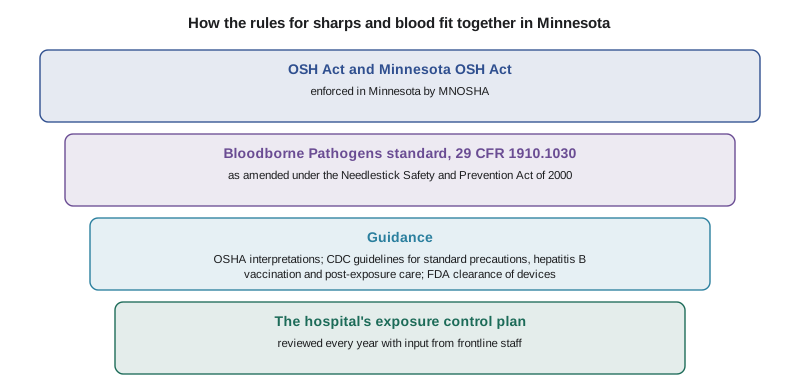
The OSH Act and the standard
The OSH Act requires employers to keep workplaces free of recognized hazards and to follow OSHA standards. For bloodborne pathogens, the standard is specific. It applies to every employer with employees who have occupational exposure, defined as reasonably anticipated contact with blood or other potentially infectious materials as a result of doing their job. That covers far more than nurses: it includes lab staff, transporters who handle specimens, environmental services workers, laundry workers who sort soiled linen, maintenance staff who work on plumbing in patient areas, and anyone designated to give first aid.
The standard is built around a written exposure control plan and a set of required elements, which the rest of this lesson walks through. Employees do not have duties under the OSH Act the way they do under Canadian law, but the hospital's policies require them to follow the plan, use the safer devices provided and report every exposure, and the standard gives them rights to training, to vaccination at no cost and to confidential medical follow-up.
The exposure control plan
Every employer covered by the standard must have a written exposure control plan. It must be accessible to employees, reviewed and updated at least once a year and whenever tasks or procedures change, and it must contain:
- An exposure determination: a list of the job classifications in which all, and in which some, employees have occupational exposure, and the tasks that cause it, made without regard to PPE.
- The schedule and method for putting each part of the standard into practice: engineering and work practice controls, PPE, housekeeping, hepatitis B vaccination, post-exposure evaluation and follow-up, communication of hazards, training and recordkeeping.
- The procedure for evaluating the circumstances of each exposure incident.
- A record of the annual review, showing that the employer considered and put in place appropriate commercially available safer medical devices.
- A record of how the employer solicited input from non-managerial frontline employees in identifying, evaluating and selecting those devices.
OSHA has said that a simple open request for input from frontline staff is enough, and that the method can suit the workplace: a safety committee, surveys, suggestion boxes, incident investigations or device trials. At Northbridge, frontline nurses, lab staff and environmental services workers sit on the device evaluation team, and the safety committee reviews the plan each spring with Joanne Pelletier. The review is recorded in the plan itself.
Engineering and work practice controls
The standard requires employers to use engineering and work practice controls to eliminate or minimize exposure, and PPE for whatever exposure remains. Since the 2001 revision, engineering controls explicitly include safer medical devices: sharps with engineered sharps injury protections and needleless systems. In practice this means:
- Safer devices wherever an appropriate one is commercially available: retracting, shielded or blunted needles, needleless IV connectors, safety scalpels and lancets.
- Contaminated needles must not be bent, recapped or removed unless no alternative is feasible or a specific medical procedure requires it, and then only with a mechanical device or a one-handed technique.
- Contaminated sharps go into containers that are closable, puncture resistant, leakproof on the sides and bottom, labeled or red, and kept upright, close to where sharps are used and replaced before they are overfilled.
- No eating, drinking, smoking, applying cosmetics or handling contact lenses where exposure is likely, and no food in refrigerators that hold blood.
- Handwashing facilities, and hand hygiene after removing gloves.
- Procedures done in ways that minimize splashing and spraying.
OSHA treats these as minimums. A hospital that keeps a conventional device when a safer one exists and is appropriate for the task is likely to be cited, unless the annual review documents why the safer option was not appropriate.
Some states have their own needlestick laws, many passed before the federal act, and states with their own OSHA plans must have standards at least as effective as the federal one.
PPE, vaccination, communication and training
- PPE: gloves, gowns, face shields, masks and eye protection provided at no cost, in the right sizes, and cleaned, repaired or replaced by the employer.
- Hepatitis B vaccination: offered at no cost within 10 working days of assignment to a job with exposure, after training. A worker who declines signs the declination statement in the standard and can change their mind later.
- Post-exposure evaluation and follow-up: provided at no cost, confidentially, following current Public Health Service guidelines, as Lessons 9 and 10 explain.
- Communication of hazards: biohazard labels, fluorescent orange or orange-red with the biohazard symbol, on containers of regulated waste, refrigerators holding blood and containers used to ship or store it, or red bags and containers instead.
- Training: at the time of initial assignment and at least every year after, during paid time, in language and at a level employees understand, with an opportunity for questions with a knowledgeable trainer.
- Records: training records kept for 3 years; medical records kept confidential for the length of employment plus 30 years; and a sharps injury log.
The sharps injury log
Employers who must keep OSHA injury and illness records must also keep a sharps injury log, recording each percutaneous injury from a contaminated sharp in a way that protects the injured worker's confidentiality. Each entry must include at least the type and brand of device involved, the department or work area, and an explanation of how the incident happened. OSHA has said the brand must name the specific product, not just the manufacturer, because the point of the log is to find devices and places that are causing injuries. Joanne reviews it every quarter and brings it to the annual plan review.
Joanne uses a short script to check whether the main documents are up to date, which she runs before each committee meeting.
from datetime import date

today = date(2026, 3, 2)
# (document, date of last review, required interval in days)
docs = [
    ("sharps and bloodborne pathogens procedure", date(2025, 4, 14), 365),
    ("device evaluation record", date(2025, 4, 14), 365),
    ("hepatitis B vaccination program", date(2025, 6, 2), 365),
    ("blood spill procedure", date(2024, 11, 20), 365),
    ("post-exposure protocol", date(2025, 9, 8), 365),
    ("4 West training sign-off", date(2025, 2, 10), 365),
]

for name, last, every in docs:
    due = date.fromordinal(last.toordinal() + every)
    days = (due - today).days
    if days < 0:
        state = f"OVERDUE by {-days} days"
    elif days <= 60:
        state = f"due in {days} days"
    else:
        state = "current"
print(f"{name:42} last {last} due {due} {state}")sharps and bloodborne pathogens procedure last 2025-04-14 due 2026-04-14 due in 43 days device evaluation record last 2025-04-14 due 2026-04-14 due in 43 days hepatitis B vaccination program last 2025-06-02 due 2026-06-02 current blood spill procedure last 2024-11-20 due 2025-11-20 OVERDUE by 102 days post-exposure protocol last 2025-09-08 due 2026-09-08 current 4 West training sign-off last 2025-02-10 due 2026-02-10 OVERDUE by 20 days
Two items are overdue: the blood spill procedure, which slipped last year, and the 4 West training sign-off. Two more are due within two months. A list like this is a simple way for a committee to spot drift before an inspector does.
Who is covered beyond the hospital
The standard covers far more than hospitals. Any employer with employees who have occupational exposure is covered: clinics, dental offices, long-term care, home health agencies, labs, blood banks, funeral homes, research labs, schools with designated first aiders, police and fire departments, corrections facilities, and companies that clean up crime scenes or handle medical waste. Northbridge Home Health's nurses are covered by the same exposure control plan as hospital staff, with a section on sharps in clients' homes. Workers in other jobs who may meet discarded needles, such as custodians, sanitation workers and parks staff, are covered when that contact is reasonably anticipated in their job, and their employers need a plan too. MNOSHA has also issued its own guidance for public employers, such as cities and school districts, that the federal standard did not originally reach.
What an inspector looks for
Inspectors rarely start by reading the whole program. They walk the units and ask staff simple questions, and they compare what they see and hear with what the documents promise. On a typical visit to a medical unit, an inspector might:
- Look inside supply carts, procedure trays and patient rooms for conventional sharps where safety devices should be.
- Check sharps containers: are they within reach, mounted at a sensible height, below the fill line and closed when full?
- Ask a nurse to show how the safety feature on the blood collection set works, and when it should be activated.
- Ask a worker what they would do if they had a needlestick right now, and who they would call.
- Ask whether staff have been asked for their opinion on the devices they use.
- Look at the training records for the unit and the date of the last review of the written program.
- Read a sample of exposure reports and check that each one was followed up and investigated.
Most findings are not dramatic. The common ones are sharps containers mounted too high or filled past the line, out-of-date training, a written program that has not been reviewed in more than a year, conventional devices that crept back in through a substitution or an old stock room, and staff who are not sure what to do after an exposure. Each of these is easy to fix and easy to prevent with regular committee inspections, which is why the next lessons keep returning to them.
Raising a concern
A worker who finds a gap does not need to know which section of which regulation applies. The path is the same as for any other hazard. Tell your supervisor first, because most gaps are fixed fastest at the unit. If the problem is not fixed, raise it with a committee member, who can put it on the agenda and ask for a written response. Report it on the hospital's incident or hazard system, so there is a record. And if the hazard is serious and nothing is being done, workers can contact the regulator, which is also the route for anyone who believes they were punished for raising a safety concern. Northbridge's posters by every staff room say this in four lines, with the phone extensions for Employee Health and Safety and the committee co-chairs.
Worked problem
The insulin syringes on 4 West
A supply shortage leads purchasing to send 4 West a box of conventional insulin syringes with no safety feature. A nurse uses one before noticing. Amira spots the box on the supply cart during a committee inspection. What does the law expect, and what should happen?
Show solution
- The Bloodborne Pathogens standard requires safer devices where they are commercially available and appropriate. A substitution made only for convenience would not be documented as a reason in the exposure control plan.
- Amira tells Sarah MacLeod, the unit manager, who removes the box from the cart and gets safety syringes from another unit until the supply is restored.
- Amira raises it at the next safety committee meeting. Purchasing agrees that substitutions of sharps devices must be approved by Employee Health and Safety and the unit before they are sent out.
- The exposure control plan is updated to say so, and the change and the frontline input behind it are recorded.
Answer: Remove the conventional syringes, restore the safety devices, and change the purchasing procedure so the substitution cannot happen again.
Common mistakes
MistakeAssuming the standard applies only to nurses.
InsteadIt applies to every employee with reasonably anticipated exposure, including lab, environmental services, laundry and maintenance staff.
MistakeKeeping a conventional device because staff are used to it.
InsteadHabit is not a valid reason; use the safer device unless a documented reason fits the rules.
MistakeTreating the written plan as a binder that never changes.
InsteadReview it at least once a year, and whenever tasks, devices or procedures change.
MistakeChoosing devices without asking the people who use them.
InsteadSolicit and document input from non-managerial frontline employees.
MistakeLetting purchasing substitute sharps devices without review.
InsteadRequire approval from occupational health and the unit before any sharps substitution.
Summary and key terms
- The Bloodborne Pathogens standard (29 CFR 1910.1030) applies to every employer with employees who have occupational exposure.
- It requires a written exposure control plan, reviewed at least every year, with an exposure determination and documented consideration of safer devices.
- Since the Needlestick Safety and Prevention Act, employers must use safer devices and solicit input from frontline employees.
- Hepatitis B vaccination, PPE and post-exposure follow-up are provided at no cost.
- Training is required at assignment and yearly; training records are kept 3 years and medical records for employment plus 30 years.
- Employers who keep OSHA records must also keep a confidential sharps injury log with the device type and brand.
- Occupational exposure
- Reasonably anticipated contact with blood or other potentially infectious materials as a result of doing one's job.
- Exposure control plan
- The written plan required by the Bloodborne Pathogens standard, reviewed at least every year.
- Engineered sharps injury protection
- A built-in feature of a sharp device, such as a shield or retracting needle, that reduces the risk of injury.
- Sharps injury log
- The confidential record of percutaneous injuries from contaminated sharps, with device type and brand, work area and how each happened.
- Other potentially infectious materials
- Body fluids and materials other than blood that the standard treats as infectious, such as semen, cerebrospinal fluid and unfixed tissue.
Practice problems
Work each problem on paper first, then reveal the answer to check.
What is occupational exposure under the standard?
Show answer
Reasonably anticipated contact with blood or other potentially infectious materials as a result of doing one's job.
How often must the exposure control plan be reviewed?
Show answer
At least once a year, and whenever tasks or procedures change.
What must the annual review document about safer devices?
Show answer
That the employer considered and put in place appropriate commercially available safer devices, and how it solicited input from frontline employees.
Within how many working days must the hepatitis B vaccine be offered?
Show answer
Within 10 working days of assignment to a job with occupational exposure.
What must a sharps injury log entry include?
Show answer
The type and brand of device, the department or work area, and how the incident happened.
How long are medical records kept?
Show answer
For the length of employment plus 30 years.
Lesson quiz · 5 questions
Score 60% or more to complete this lesson.
Create a free account to save your progress, take quizzes and earn a certificate.