
HSE-392 · Lesson 12 of 12 · 24 min
Capstone: an exposure control plan
▶ Video coming soon A video version of this lesson is on the way.
This capstone pulls the whole course together into one document: an exposure control plan for a small clinic. Northbridge Community Hospital is opening a new outpatient clinic, Riverside Family Health, in a former bank building across the river from the main site. It will have two family physicians, a nurse practitioner, three nurses, a blood collection room, a small procedure room for minor surgery and IUD insertions, and a reception and cleaning staff of four. The clinic will be part of the hospital, but it will be the first Northbridge site without a sharps program already built around it.
Joanne Pelletier has asked Amira Haddad, who is moving from 4 West to be the clinic's lead nurse, to draft the plan with her, with input from the people who will work there. This lesson follows them through it, section by section. At the end, you will have a template you could adapt for any workplace where people handle sharps or blood.
What the standard requires
Under the Bloodborne Pathogens standard, every employer with employees who have occupational exposure must have a written exposure control plan. It must contain an exposure determination, the schedule and methods for putting each part of the standard into effect, and the procedure for evaluating exposure incidents. It must be reviewed and updated at least once a year and whenever tasks or procedures change, it must reflect changes in technology that reduce exposure, it must document the annual consideration and use of safer medical devices, and it must record how the employer asked frontline employees for input on choosing them. Employees must be able to get a copy within 15 working days of asking. MNOSHA enforces the same requirements in Minnesota.
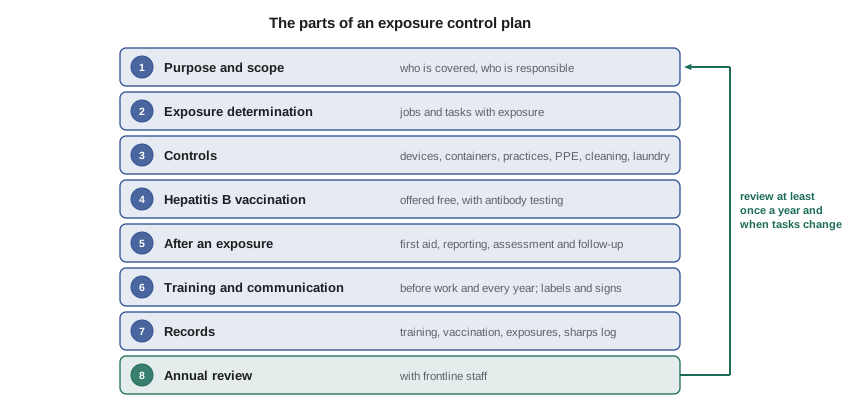
Section 1: purpose, scope and responsibilities
The plan starts with who it covers and who does what. Riverside's version covers every person who works at the clinic, including the physicians, students on placement and the cleaning staff, whether they are hospital employees or contracted. It names the people responsible: the clinic manager owns the plan and its budget, Amira as lead nurse keeps it current and runs the training, Employee Health and Safety provides vaccination and post-exposure care, and the safety committee reviews it every year. Naming people matters because a plan that belongs to everyone is maintained by no one.
Section 2: exposure determination
The exposure determination lists the jobs in which workers have occupational exposure, meaning reasonably anticipated contact with blood or other potentially infectious materials as part of the job. It is based on the tasks, and it is done without regard to PPE: a nurse who wears gloves to draw blood still has an exposed job. The plan has two lists:
- Jobs in which all workers have exposure: physicians, the nurse practitioner, nurses, the blood collection technician and the cleaning staff, who empty sharps containers and clean the procedure room.
- Jobs in which some workers have exposure for some tasks: reception staff, who are not expected to handle blood but may accept a specimen bag at the front desk or find a needle in the waiting room washroom.
For the second list, the plan names the tasks. Reception staff are trained not to handle specimens with bare hands and never to pick up a sharp, and they know to call a nurse. That keeps their exposure low while still recognizing it.
Section 3: controls
This is the longest section, and it follows the hierarchy of controls from HSE-390.
Eliminating sharps and using safer devices
Amira and the clinic nurses went through every procedure the clinic will do and listed the sharps involved. For each, they asked first whether a sharp was needed at all. Needleless connectors replace needles for any IV access, and pre-filled syringes with retracting needles replace drawing up from vials for most vaccines. For the remaining sharps, they chose safety-engineered devices, trying samples as Lesson 4 described. The plan lists each device by product name, not just by type, so that substitutions can be checked.
# Riverside Family Health: sharps inventory review for the exposure control plan
devices = [
    # (procedure, device, safety feature, staff rating out of 5, conventional allowed?)
    ("blood collection", "blood collection set A", "passive shield", 4.6, False),
    ("vaccines", "prefilled syringe B", "retracting needle", 4.4, False),
    ("intramuscular injection", "safety syringe C", "hinged shield", 3.9, False),
    ("finger stick", "safety lancet D", "single-use retracting", 4.8, False),
    ("minor surgery", "safety scalpel E", "retractable blade", 3.1, False),
    ("suturing", "blunt suture needle F", "blunt tip", 4.0, False),
    ("local anesthetic", "dental-style syringe G", "none (recapping device)", 3.5, True),
]
print(f"{'procedure':24}{'device':26}{'rating':>6}  note")
for proc, dev, feature, rating, conventional in devices:
    note = []
    if conventional:
        note.append("CONVENTIONAL: justify in plan, review each year")
    if rating < 3.5:
        note.append("low rating: retry samples")
    print(f"{proc:24}{dev:26}{rating:6.1f}  {'; '.join(note) or 'ok'}")
safe = sum(1 for d in devices if not d[4])
print(f"\n{safe} of {len(devices)} sharps have an engineered safety feature")procedure device rating note blood collection blood collection set A 4.6 ok vaccines prefilled syringe B 4.4 ok intramuscular injection safety syringe C 3.9 ok finger stick safety lancet D 4.8 ok minor surgery safety scalpel E 3.1 low rating: retry samples suturing blunt suture needle F 4.0 ok local anesthetic dental-style syringe G 3.5 CONVENTIONAL: justify in plan, review each year 6 of 7 sharps have an engineered safety feature
Six of the seven sharps have a safety feature. The exception is the anesthetic syringe used for some minor surgery, where the physicians need to give several small injections into the same site. For that one, the plan explains why no suitable safety device was found, requires a recapping device mounted on the tray, and puts the question back on the agenda for next year's review. The safety scalpel had a low rating: the physicians found the blade guard awkward. Rather than drop it, the team will try two other models before the clinic opens.
Containers, work practices and PPE
The plan then sets out the rest of the controls, each tied to an earlier lesson:
- Sharps containers in every room where sharps are used, mounted at the height and reach Lesson 6 described, with a fill line, and changed when three quarters full. The cleaning staff check them daily, and the plan names the container model.
- Work practices: never recap except with the recapping device for the anesthetic syringe, activate safety features right away, dispose at the point of use, use the neutral zone in the procedure room, and never pass sharps hand to hand.
- PPE chosen by task, as in Lesson 3: gloves for blood collection and injections where there is contact with blood, and gloves, a fluid-resistant gown, a mask and eye protection or a face shield for procedures with splashing. PPE is provided free, in every size, in each room.
- Hand hygiene stations at every point of care, and no eating, drinking or applying cosmetics where blood is handled.
Housekeeping, spills, laundry and waste
The procedure room is cleaned after each procedure and at the end of the day with the hospital's approved disinfectant, at the contact time on its label. Each floor has a spill kit, checked monthly, and the spill procedure from Lesson 7 is posted beside it. The clinic uses disposable drapes and gowns where possible, and the little reusable linen it has goes in leak-proof bags to the hospital laundry. Biomedical waste and full sharps containers are picked up weekly by the hospital's contractor, stored until then in a locked room, and handled according to the hospital's waste procedure.
Section 4: hepatitis B vaccination
Every worker in an exposed job is offered the hepatitis B vaccine at no cost within 10 working days of assignment and after training, with an antibody test afterwards, as Lesson 8 described. Workers who are already vaccinated provide their records. Those who decline sign the declination statement set out in the standard, and they can change their minds at any time. Employee Health and Safety keeps the records, and the clinic manager receives only a list showing who has completed the program.
Section 5: after an exposure
The plan describes the steps in Lessons 9 and 10 in the order a worker will need them: first aid, telling the lead nurse at once, assessment by Employee Health and Safety during clinic hours or at the hospital's emergency department after hours, source testing with consent, follow-up and reporting. Because Riverside is across the river from the main site, the plan adds two local details. The clinic keeps a PEP starter pack in a locked cupboard, under the control of the physicians, so the first dose can be given without delay. And the lead nurse arranges cover so that an exposed worker can leave right away, even on a busy afternoon.
A one-page summary of this section, with the phone numbers, goes on the wall of every clinical room and the staff room.
Section 6: training and communication
Workers in exposed jobs are trained before they start and at least once a year, during working hours and at no cost, by someone who knows the subject and the clinic. The training covers what the course has covered: the viruses and how they spread, the plan and where to find it, the jobs and tasks with exposure, the devices and how to use them, PPE, vaccination, what to do after an exposure, and the labels and signs used. It ends with time for questions, and each worker shows that they can use each safety device they will handle.
Labels and signs complete the communication: biohazard labels on waste containers, specimen refrigerators and bags of contaminated items, and the posted spill and exposure procedures.
Section 7: records
The plan lists the records kept and where: training records with dates, content, trainers' names and job titles, kept for 3 years; medical records for each exposed employee, including vaccination status and exposure follow-up, kept confidentially by Employee Health and Safety for the length of employment plus 30 years; the sharps injury log, kept for 5 years after the end of the year it covers; the device evaluations; and the annual review.
Section 8: annual review
The plan is reviewed at least once a year, and sooner when a new procedure or device is introduced or an exposure shows a gap. The review is done with frontline staff, not just signed off by a manager. At Riverside, Amira will meet the clinic nurses, a physician and a cleaning staff member each spring to go over the year's exposures, the device ratings, new products on the market, training completion and the results of the monthly inspections. The safety committee receives the updated plan and a short report.
Joanne uses a checklist to make sure no section is missing before a plan goes to the committee. She ran it on Amira's first draft.
draft = {
    "purpose, scope and responsibilities": True,
    "exposure determination (all and some workers)": True,
    "task list for partly exposed jobs": True,
    "safer devices by product name": True,
    "justification for any conventional device": True,
    "sharps containers: model, placement, changing": True,
    "work practices and PPE by task": True,
    "housekeeping, spills, laundry and waste": False,
    "hepatitis B vaccination and antibody testing": True,
    "post-exposure steps with local phone numbers": False,
    "training: content, frequency, records": True,
    "records and confidentiality": True,
    "annual review with frontline staff": True,
}
missing = [k for k, v in draft.items() if not v]
print(f"sections complete: {len(draft) - len(missing)} of {len(draft)}")
for k in missing:
print("missing:", k)sections complete: 11 of 13 missing: housekeeping, spills, laundry and waste missing: post-exposure steps with local phone numbers
The draft was missing the housekeeping section, which Amira had left until she knew the cleaning contractor, and the after-hours phone numbers, which the switchboard had not yet assigned. Both were added before the plan went to the committee. A checklist like this does not judge whether the plan is good, but it stops a plan from going forward with a hole in it.
Putting it into practice
A plan on paper protects nobody until it is in use. Before Riverside opens, Amira will walk through the clinic with the staff and check each room against the plan: are the containers mounted where the plan says, are the right devices in the drawers and no conventional ones left over from a supplier's sample box, are the spill kits complete, are the exposure posters up? Then, a month after opening, she will do the walk again, the way HSE-390's capstone described a unit safety walk, because the gap between the plan and the clinic is always widest in the first weeks.
Worked problem
The plan meets its first test
Six weeks after Riverside opens, a nurse is cut by a safety scalpel while removing the blade from the handle at the end of a minor procedure. The model chosen after the sample trials needs the blade removed by hand for disposal. What should the plan's review process do with this exposure?
Show solution
- The nurse gets first aid, reports at once and is assessed, following Section 5. The source patient agrees to testing, which is negative, so follow-up stops early.
- The exposure is recorded and reviewed. The review finds that the injury happened during disposal, at the step the device design left to the user.
- Amira and the physicians look again at scalpels that are disposed of whole, without removing the blade, and trial two models. They choose one and update Section 3, with the product name.
- The change is reported to the committee, training is updated for the new device, and the case is noted for the annual review as an example of the plan working as intended.
Answer: Treat the exposure as information: review it, change the device so blade removal is not needed, update the plan and training, and report the change.
Common mistakes
MistakeWriting the plan once and filing it.
InsteadReview it at least yearly and whenever tasks or devices change.
MistakeLeaving out jobs because those workers wear gloves.
InsteadDecide exposure by tasks, without regard to PPE.
MistakeListing devices only by type, such as "safety syringes".
InsteadName each product, so substitutions can be checked.
MistakeHaving managers review the plan alone.
InsteadReview it with the frontline workers who use the devices.
MistakeLeaving phone numbers and after-hours steps to be added later.
InsteadPut the local numbers and routes in the plan and on the walls before the first patient is seen.
Summary and key terms
- The Bloodborne Pathogens standard requires a written exposure control plan, reviewed yearly with frontline input.
- The plan names who is responsible and covers every worker at the site.
- Exposure determination lists jobs with exposure by task, without regard to PPE.
- Controls follow the hierarchy: eliminate sharps, use safer devices named by product, then containers, work practices and PPE.
- Vaccination, post-exposure steps with local numbers, training, labels and records each have their own section.
- The plan is checked against the workplace before opening and again soon after.
- Every exposure is a test of the plan and a reason to update it.
- Exposure control plan
- A written plan describing how an employer eliminates or minimizes workers' exposure to blood and other potentially infectious materials.
- Exposure determination
- The list of jobs and tasks in which workers have reasonably anticipated contact with blood or other potentially infectious materials.
- Occupational exposure
- Reasonably anticipated contact with blood or other potentially infectious materials that results from doing one's job.
- Declination statement
- A signed statement that a worker was offered the hepatitis B vaccine and declined it.
- Annual review
- The yearly check and update of the plan, including new devices and lessons from exposures.
Practice problems
Work each problem on paper first, then reveal the answer to check.
Why is exposure determination done without regard to PPE?
Show answer
Because PPE reduces exposure but does not remove the task that causes it; the job is still exposed.
Why should devices be listed by product name?
Show answer
So that substitutions with conventional or different devices can be spotted.
What must happen when a conventional device is kept?
Show answer
The plan explains why no suitable safety device was found, adds safe work practices such as a recapping device, and reviews it each year.
Who should take part in the annual review?
Show answer
Frontline staff who use the devices, along with the plan owner and the committee.
What two sections were missing from Amira's first draft?
Show answer
Housekeeping, spills, laundry and waste, and the post-exposure steps with local phone numbers.
What did the scalpel injury at Riverside lead to?
Show answer
A change to a scalpel that is disposed of whole, an updated plan and training, and a report to the committee.
Lesson quiz · 5 questions
Score 60% or more to complete this lesson.
Create a free account to save your progress, take quizzes and earn a certificate.