
HSE-392 · Lesson 4 of 12 · 21 min
Safety-engineered sharps devices
▶ Video coming soon A video version of this lesson is on the way.
The most effective controls for any hazard are the ones that do not depend on people being careful every time. For sharps, that means two things: removing needles from tasks that do not need them, and, where a sharp is needed, using a device with a built-in feature that covers, blunts or retracts the sharp end after use. These devices have been in widespread use for more than 20 years, and studies after the Canadian and American laws took effect found large drops in needlestick injuries in hospitals that adopted them, often by half or more for the devices that were replaced.
This lesson describes the main kinds of devices, what makes one better than another, and how a hospital chooses them with the people who will use them.
Eliminating the needle
The safest needle is the one that is not there. Several common tasks used to need a needle and no longer do:
- Needleless IV connectors let nurses give medications and flush lines through a valve, with a syringe tip instead of a needle.
- Jet injectors and needle-free transfer devices draw up and mix medications without a needle.
- Plastic capillary tubes and point-of-care blood collection systems replace glass tubes that could break in the hand.
- Tissue adhesives, staples and surgical tapes replace sutures for some wound closures.
- Electrocautery and other cutting devices reduce scalpel use in some surgery.
- Prefilled syringes and blunt cannulas are used to access vials.
Each of these removes a sharp from a step where it added risk and no benefit. When the device evaluation team at Northbridge looks at a task, its first question is whether a sharp is needed at all.
Kinds of safety features
Where a sharp is needed, the device should have an engineered sharps injury protection: a feature built into the device that reduces the chance of injury during or after use.
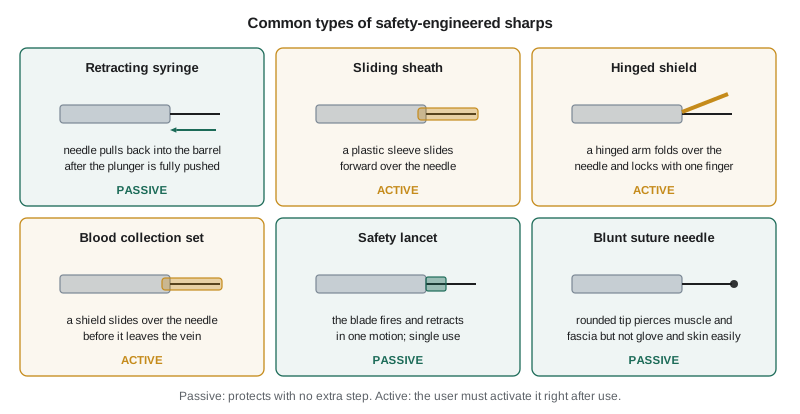
- Retracting needles: after use, the needle withdraws into the syringe barrel or the device body, often triggered by pushing the plunger all the way down. Retracting IV catheters pull the stylet into a protective chamber as it is removed.
- Sliding sheaths and shields: a sleeve slides forward over the needle and locks.
- Hinged shields: a hinged arm folds down over the needle and locks, activated with a thumb or by pressing against a hard surface.
- Blunting needles: a blunt inner cannula moves forward past the sharp tip before the needle is withdrawn.
- Self-sheathing blood collection sets: the shield is moved over the needle with one hand, sometimes while it is still in the vein.
- Safety lancets: the blade fires and retracts in one motion and cannot fire again.
- Safety scalpels: a shield or retracting blade covers the edge between uses, and blade removers take reusable blades off handles without fingers near the edge.
- Blunt-tip suture needles: rounded tips that pass through muscle and fascia but are much less likely to pierce gloves and skin. They are recommended for closing fascia and other tissue where they work well.
- Safety pen needles: shields on insulin pen needles that cover both ends, an important feature because pen needles have a sharp at the back as well as the front.
Passive and active features
A passive safety feature works automatically, with no extra step by the user. A retracting syringe that withdraws the needle when the plunger bottoms out is passive. So is an IV catheter whose stylet is shielded as it is withdrawn. An active safety feature needs the user to do something: slide the sheath, push the hinged arm closed or press a button.
Passive features are generally preferred, because active ones protect only if the worker activates them, and studies of active devices show that the feature is sometimes not used, especially when staff are rushed or the device is awkward. Active devices can still give excellent protection, particularly if activation is one-handed and natural, and for some tasks there is no good passive device. The evaluation team weighs the evidence for each task.
What makes a good device
NIOSH and the FDA have described the features of a good safety device. It should:
- Have the safety feature built in, not added as a separate accessory.
- Work passively if possible, or else need only one hand, with the hands staying behind the sharp.
- Make it clear to the user that the feature has been activated, by a click, a color change or a locked shield.
- Stay protected: once activated, the feature cannot be undone and stays in place through disposal.
- Work reliably every time.
- Be easy to use and practical for the tasks it is meant for.
- Be safe and effective for patient care, without harming the patient, causing more pain or making the procedure harder.
The last point matters. OSHA's standard requires safer devices that are appropriate for the procedure, and the annual review documents why a device was or was not chosen. The better the device evaluation, the less often anyone needs to make an exception.
Choosing devices with the people who use them
A device that looks good in a sales brochure can fail on the unit. It may be awkward with gloves, hard to activate with one hand, too long for a small patient or prone to activating before the procedure is finished. The only reliable way to know is to try it in real work with the people who will use it every day. Northbridge's device evaluation team includes frontline nurses from medical, surgical and emergency units, a medical laboratory scientist, a CNA from Maple Court, a home health nurse, an infection control practitioner, a purchasing officer and Joanne from Employee Health and Safety. Its process follows the steps recommended in the CDC's sharps injury prevention workbook:
- Set priorities using injury data: which devices and tasks are causing injuries?
- Gather information on the devices available for those tasks.
- Set criteria, including safety, patient care, ease of use and cost.
- Run a trial on one or two units, with training first, for long enough that staff get past the learning curve, usually two to four weeks.
- Survey the staff who used the device, and look at any injuries or problems during the trial.
- Decide, then train every user before the device goes live across the hospital.
- Monitor injuries and feedback after the change.
Last year the team trialled two blood collection sets, A and B, on 4 West and the emergency department to replace an older active device. Staff rated each on a scale of 1 to 5 for several criteria.
# Survey scores from the blood collection set trial (1 = poor, 5 = excellent)
weights = {"safety feature": 3, "ease of activation": 2, "patient comfort": 2,
           "works with small veins": 2, "fits workflow": 1}

scores = {
    "A": {"safety feature": [5, 4, 5, 5, 4, 5], "ease of activation": [4, 4, 5, 3, 4, 4],
          "patient comfort": [4, 4, 4, 5, 4, 4], "works with small veins": [3, 2, 3, 3, 2, 3],
          "fits workflow": [4, 5, 4, 4, 4, 5]},
    "B": {"safety feature": [4, 5, 4, 4, 5, 4], "ease of activation": [5, 5, 4, 5, 5, 4],
          "patient comfort": [4, 5, 4, 4, 4, 5], "works with small veins": [4, 4, 5, 4, 4, 4],
          "fits workflow": [4, 4, 4, 5, 4, 4]},
}

for dev, crit in scores.items():
    total = 0
    print(f"device {dev}")
    for name, w in weights.items():
        avg = sum(crit[name]) / len(crit[name])
        total += w * avg
        print(f"  {name:24}{avg:5.2f}  x{w}")
    best = 5 * sum(weights.values())
print(f" weighted score {total:.1f} of {best}\n")device A safety feature 4.67 x3 ease of activation 4.00 x2 patient comfort 4.17 x2 works with small veins 2.67 x2 fits workflow 4.33 x1 weighted score 40.0 of 50 device B safety feature 4.33 x3 ease of activation 4.67 x2 patient comfort 4.33 x2 works with small veins 4.17 x2 fits workflow 4.17 x1 weighted score 43.5 of 50
Device A had a slightly stronger safety feature, but staff found it hard to use on small or fragile veins, a common problem with older patients on 4 West. Device B scored better overall, and in the comments several staff said they would be tempted to switch back to a conventional needle for difficult draws with Device A. That kind of comment is exactly why trials matter: a device that pushes staff toward a workaround can end up less safe in practice. The team chose Device B, trained all users before the change and checked the sharps injury reports for the following six months.
The cost question
Safety devices usually cost more per unit than conventional ones, sometimes a few cents and sometimes much more. Purchasing departments are right to ask whether the cost is justified. The answer usually comes from counting the cost of injuries, which is larger than it looks. Each reported needlestick at Northbridge costs the hospital several hundred dollars for the occupational health visit, baseline and follow-up blood tests for the worker and the source patient, staff time to report and investigate, and in some cases a month of post-exposure drugs, which alone can cost more than a thousand dollars. Add the time the worker spends at appointments, the stress, and the small but real chance of a lifelong infection and a compensation claim, and the business case is strong. Joanne presents both columns, device costs and injury costs, at the annual review, so the decision is made with the whole picture in view.
Training and the learning curve
A new device often brings a short rise in injuries while staff learn it, especially if training is rushed. Hands that have done a task one way for years will try to do it the old way. Good training is hands-on: each worker uses the device on a practice pad, activates the feature several times, and learns how to tell that it has locked. Training is repeated for new staff, agency and float staff, and anyone returning from a long absence. Supervisors watch for workarounds, such as staff activating a feature against their own fingers instead of a hard surface, in the first weeks after a change.
Worked problem
The new pen needles at Maple Court
Maple Court changes to a safety pen needle for residents' insulin. Two weeks later, Lina reports that a nurse in Cedar was pricked by the back end of a pen needle while removing it from the pen. What went wrong, and what should happen?
Show solution
- Pen needles have a sharp at the back, which pierces the insulin cartridge, as well as the front. The new device shields both ends, but only if the user removes it from the pen in the right way.
- The nurse had not been on shift for the training session and was removing the needle the old way, by unscrewing it with her fingers. The back end was exposed.
- She reports the injury and is assessed by Employee Health and Safety. The source resident's history is reviewed as Lesson 9 describes.
- The team arranges training for every nurse who gives insulin at Maple Court, including part-time, casual and agency staff, and adds the device to the orientation checklist. The sharps injury log records the brand and model, so the team can see whether the problem continues.
Answer: The device was safe but the worker had not been trained on it; training is extended to every user, including casual and agency staff, and injuries are monitored.
Common mistakes
MistakeAssuming a safety device makes care with sharps unnecessary.
InsteadUse the device correctly, activate the feature immediately and still dispose of it at the point of use.
MistakeChoosing devices from a brochure without a trial.
InsteadTrial devices on real units with the staff who will use them, and survey them afterwards.
MistakeActivating a hinged shield with a finger in front of the needle.
InsteadKeep hands behind the sharp and activate with one hand or against a hard surface.
MistakeTraining only staff on duty on the day of the change.
InsteadTrain every user, including part-time, casual, agency and returning staff.
MistakeIgnoring staff who say a device does not work for some patients.
InsteadTreat it as a sign of a possible workaround, and look for a better device or a better method.
Summary and key terms
- The best control is to remove the needle where it is not needed, using needleless systems and other alternatives.
- Where a sharp is needed, use one with a built-in safety feature that covers, blunts or retracts the sharp.
- Passive features work automatically and are generally preferred; active features protect only if used.
- A good device is built in, one-handed, clearly activated, permanent once activated, reliable and safe for patients.
- Devices are chosen with frontline staff through trials, surveys and injury data.
- Hands-on training for every user, including casual and agency staff, prevents the rise in injuries after a change.
- Engineered sharps injury protection
- A built-in feature, such as a shield, sheath or retracting needle, that reduces the risk of a sharps injury.
- Needleless system
- A device, such as an IV connector, that replaces a needle for a task where one used to be needed.
- Passive safety feature
- A safety feature that works automatically, with no extra step by the user.
- Active safety feature
- A safety feature the user must activate, such as sliding a sheath or closing a hinged shield.
- Blunt-tip suture needle
- A suture needle with a rounded tip that is less likely to pierce gloves and skin.
- Device evaluation
- A structured process for choosing safer devices, including trials and feedback from users.
Practice problems
Work each problem on paper first, then reveal the answer to check.
Give three examples of ways to remove a needle from a task entirely.
Show answer
Any three of needleless IV connectors, needle-free transfer devices, plastic capillary tubes, tissue adhesive or staples instead of sutures, and prefilled syringes or blunt cannulas.
What is the difference between a passive and an active safety feature?
Show answer
A passive feature works automatically; an active feature needs the user to activate it.
Why must safety pen needles shield both ends?
Show answer
Pen needles have a sharp at the back, which pierces the cartridge, as well as the front.
List four features of a good safety device.
Show answer
Any four of built in, passive or one-handed, clear activation, permanent once activated, reliable, easy to use, safe for patients.
Why did Northbridge choose Device B even though Device A had a slightly stronger safety feature?
Show answer
Device B scored better overall and worked better on small veins, so staff were less likely to switch to a conventional needle.
Why can injuries rise briefly after a new device is introduced?
Show answer
Staff are learning the device and may use it the old way, especially if training was rushed or missed.
Lesson quiz · 5 questions
Score 60% or more to complete this lesson.
Create a free account to save your progress, take quizzes and earn a certificate.