
HSE-390 · Lesson 9 of 12 · 23 min
Environmental services and laundry hazards
▶ Video coming soon A video version of this lesson is on the way.
Environmental services staff clean every room, corridor, bathroom and surface in the hospital, empty every bin, change every curtain and strip and make thousands of beds a year. Laundry staff wash, dry, iron and fold everything those beds and patients use. Both departments are essential to infection control, and both have injury rates as high as many clinical units. They also get less attention: their work is often done at night, out of sight, by staff who are not always included in unit huddles, training and committee work. This lesson looks at the hazards of both departments.
Environmental services at Northbridge
Northbridge's environmental services department has about 85 staff working across three shifts, plus a night lead. Marta and her colleagues are each assigned to a group of units, with a mix of daily cleaning, discharge cleaning when a patient leaves, isolation cleaning and responding to spills and requests. On a typical day the department completes about 60 discharge cleans and about 15 terminal cleans of isolation rooms.
Their hazards draw on almost every earlier lesson:
- Chemicals: disinfectants, sporicides, bowl cleaners, floor strippers and finishes, used many times a shift (Lesson 6).
- Sharps: needles and other sharps left in beds, linen, bins, under furniture and on floors, which are a common cause of needlesticks for staff who never use needles themselves.
- Body fluids and infection: blood, vomit, urine and stool on surfaces, in bathrooms and in waste, and rooms that held patients with C. difficile, norovirus, tuberculosis or drug-resistant organisms (Lesson 5).
- Slips and trips: wet floors they have just mopped, and floors other people have spilled on (Lesson 4).
- Lifting and repetitive work: mopping, wiping, bagging, carrying, high dusting and bed making (Lesson 8).
- Violence: patients who are confused, agitated or intoxicated do not distinguish between nurses and housekeepers.
- Working alone: night staff may be the only person in a part of the building.
- Equipment: floor machines, UV disinfection devices and hydrogen peroxide vapor systems.
Cleaning isolation rooms
When a patient on transmission-based precautions is discharged, their room gets a terminal clean: every surface, the bed, the mattress, the equipment, the bathroom and the curtains. Environmental services staff wear the same protection that the sign on the door calls for, and for some organisms more. A C. difficile room is cleaned with a sporicidal product, because ordinary disinfectants do not kill the spores, and hands are washed with soap and water afterwards. A room that held a patient on airborne precautions is left empty with the door closed until enough air changes have passed to clear it, which is usually set by the infection control team for each room, and staff who enter sooner wear an N95.
Two newer technologies need care. Ultraviolet (UV-C) disinfection robots are wheeled into an empty room after cleaning and run for several minutes. UV-C can burn the skin and eyes, so the devices must be run only in an empty room with the door closed and the motion sensors working, and the room must not be entered until the cycle is over. Hydrogen peroxide vapor systems fill a sealed room with a fine mist; the room must be sealed, signed and not entered until the vapor has been broken down to a safe level, which the device measures. Only trained staff run either device.
Sharps where they should not be
Marta has found needles in bed sheets, in a pillowcase, in a bag of regular garbage, on the floor under a bed and once inside a folded blanket on a chair. Each one was left by someone who was busy and meant to deal with it later. The person who finds it is rarely the person who left it, and environmental services and laundry staff find more stray sharps than anyone else.
The rules for sharps start with the person who uses them: dispose of every sharp at the point of use, in a sharps container within reach, and never leave one on a bed, tray or in a pocket. For environmental services staff, the rules are about not being the next victim:
- Never reach into a bin or bag with your hand, and never push waste down with your hands or feet.
- Hold bags away from your body by the top, and do not hug or carry them against your legs.
- Strip beds by rolling linen inward from the edges, never by gathering it in your arms.
- Look before you touch: under pillows, in folds and on the floor around the bed.
- Pick up a found sharp with tongs or forceps, not your fingers, and put it straight into a sharps container.
- Replace sharps containers when they reach the fill line, not when they are overflowing, and never push items down into a full container.
- Report every sharp found out of place, with where it was found, so the unit can find out how it got there.
Waste streams
A hospital produces several kinds of waste, each with its own container, labeling and handling rules. Regulated medical waste is defined by each state, and Minnesota regulates it as infectious waste under its own law, while hazardous waste is regulated under the federal Resource Conservation and Recovery Act. The main streams are:
- General waste, which is most of the volume: packaging, paper, food waste and most used gloves, gowns and dressings that are not soaked in blood.
- Regulated medical or infectious waste: blood and body fluids in amounts that could drip, pathological waste from surgery, microbiology lab waste and sharps. It goes in labeled red bags or containers and is treated before disposal.
- Sharps, in puncture-resistant containers, which are sealed and collected as infectious waste.
- Hazardous drug waste: trace chemotherapy waste in specially labeled containers, and bulk hazardous drug waste handled as hazardous waste. HSE-394 covers it.
- Pharmaceutical waste and chemical waste, collected separately and never poured down the drain.
- Recycling, confidential paper and electronic waste.
Putting waste in the wrong stream is a safety problem as well as a cost problem. A needle in a general waste bag can injure a housekeeper, a transporter or a worker at the waste contractor. Too much ordinary waste in biomedical bins costs money and fills the storage room. The waste rooms themselves need to be secure, ventilated, cool and easy to clean.
The laundry
Northbridge processes 4,200 lb (about 1,900 kg) of linen a day in its own laundry, for the hospital, Maple Court and a small contract with a clinic. The laundry runs two shifts with about 22 staff, and Marta works there one week in four. Linen moves through the building in one direction, from soiled to clean, so that clean linen never meets dirty linen or the air from the soiled side.
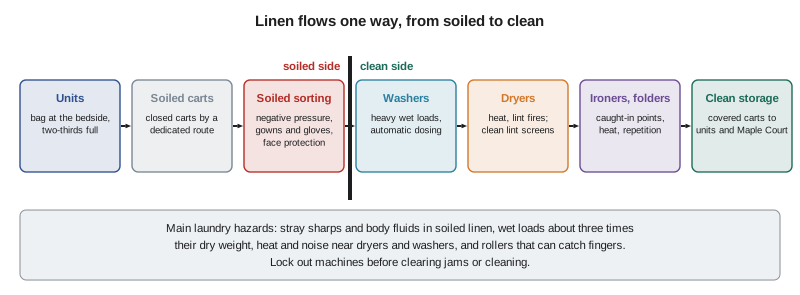
- Collection: soiled linen is bagged at the bedside in fluid-resistant bags, never shaken, sorted or carried against the body, and bags are filled only about two-thirds full so they can be closed and are not too heavy.
- Soiled sorting: this is the riskiest step for infection and sharps. The sorting room is kept under negative pressure so that air flows in, not out. Staff wear gowns, gloves and face protection, use sorting tables at a good height and never put their hands into the middle of a pile. Many hospitals now wash without sorting, or sort only after washing, which removes much of this hazard.
- Washing: wet linen is heavy, often three times its dry weight. Tunnel washers and washer-extractors that load and unload automatically, and spring-loaded carts, reduce lifting. Laundry chemicals are dosed automatically.
- Drying: dryers are hot and their lint is flammable. Lint screens are cleaned every shift, and dryers are never opened mid-cycle or overloaded.
- Ironing and folding: flatwork ironers and folding machines have rollers that can catch fingers, hands and hair. They must have guards and finger bars that stop the machine, an emergency stop within reach, and they are locked out before any clearing of jams or cleaning. HSE-210 covers lockout. Folding is also highly repetitive work.
Heat is a hazard throughout the laundry, especially in summer, when the area around the dryers and ironers can be several degrees warmer than the rest of the building. Ventilation, cool drinking water, breaks in a cooler area and rotation between hot and cooler tasks help. HSE-243 Heat and Cold Stress covers heat in detail. Noise from tunnel washers and dryers can also be high enough that hearing protection is needed in some areas.
Tracking sharps in linen
Every sharp found in linen in the sorting room is logged with the unit the bag came from. Joanne uses the log to see which units are sending sharps to the laundry, adjusting for how much linen each sends.
# Sharps found in soiled linen at the laundry, last 6 months
finds = {"Emergency": 7, "4 West": 5, "3 East (surgical)": 4, "ICU": 2,
         "Maple Court": 1, "Birthing": 1, "Mental health": 0}
linen_kg = {"Emergency": 31000, "4 West": 38000, "3 East (surgical)": 36000, "ICU": 14000,
            "Maple Court": 61000, "Birthing": 12000, "Mental health": 9000}

total_finds = sum(finds.values())
total_kg = sum(linen_kg.values())
overall = total_finds / total_kg * 10000
print(f"overall: {total_finds} sharps in {total_kg:,} kg = {overall:.2f} per 10,000 kg\n")

rates = sorted(((finds[u] / linen_kg[u] * 10000, u) for u in finds), reverse=True)
for rate, unit in rates:
    flag = "  <-- above twice the overall rate" if rate > 2 * overall else ""
print(f"{unit:20} {finds[unit]:2} finds {rate:4.2f} per 10,000 kg{flag}")overall: 20 sharps in 201,000 kg = 1.00 per 10,000 kg Emergency 7 finds 2.26 per 10,000 kg <-- above twice the overall rate ICU 2 finds 1.43 per 10,000 kg 4 West 5 finds 1.32 per 10,000 kg 3 East (surgical) 4 finds 1.11 per 10,000 kg Birthing 1 finds 0.83 per 10,000 kg Maple Court 1 finds 0.16 per 10,000 kg Mental health 0 finds 0.00 per 10,000 kg
The emergency department stands out: it sends less linen than 4 West or 3 East but more sharps, at more than twice the hospital's overall rate. The investigation finds that sharps containers in two emergency bays are mounted on the far wall, away from where staff work, so used sharps get put down on the stretcher for a moment and are wrapped up with the sheet. Moving the containers to the point of use cuts the finds. Without the log, the laundry staff would simply have kept finding needles.
For supervisors: the people nobody sees
Environmental services and laundry staff are often left out of the unit's safety conversations: they are not at the huddle, nobody tells them which patient is on airborne precautions or has a violence flag, and their reports go to a different manager. If you manage a clinical unit, make sure the housekeeper assigned to your unit gets the same safety information as your nursing staff, including isolation signs that are up to date and alerts about patients with a history of violence. If you manage environmental services or the laundry, make sure your staff are on the safety committee, in the training and in the injury reviews, and that their reports of sharps and spills go back to the units that caused them.
Working alone at night
At night, the environmental services department runs with a small crew spread across the whole building. Staff may be alone in basement corridors, waste rooms, the laundry or an empty clinic. Northbridge gives night staff a phone or radio, a check-in with the night lead every two hours, access to the security team and a rule that they do not enter a patient room alone where there is a violence flag. HSE-352 Working Alone and Late-Night Safety covers check-in systems in detail.
Worked problem
A needle in a blanket
During a laundry shift, Marta is sorting washed linen on the clean side when she feels a sharp prick through her glove from inside a folded blanket. There is a small bleeding puncture on her finger. The needle has been through the wash. What should she and the laundry lead do?
Show solution
- Marta stops, lets the wound bleed freely, washes it with soap and water, and does not squeeze or scrub it. She removes the needle with tongs and places it in the sharps container, keeping it in case it is needed.
- She reports the injury to the laundry lead right away and goes to occupational health, or the emergency department after hours, for assessment. Even a washed needle is treated as a possible exposure, because nobody knows what it was used for or whether the wash fully cleaned it. The decision about testing and any follow-up belongs to the clinicians who assess her.
- The laundry lead completes the incident report, including which cart and unit the blanket came from if the tag allows it, and notifies the Employee Health and Safety office.
- The investigation asks two questions: how the needle got into the linen on the unit, and how it got past the soiled-side sort. The answers lead to a reminder and point-of-use containers on the unit, and to a check of whether the sorting step catches sharps or whether more linen should be washed without hand sorting.
Answer: Let it bleed, wash, remove the needle with tongs, report immediately and get assessed; then trace the source unit and review the sorting process.
Common mistakes
MistakePushing waste down in a bin to make more room.
InsteadNever put hands or feet into waste; change the bag or container.
MistakeGathering bed linen in your arms to carry it.
InsteadRoll linen inward, bag it at the bedside and hold bags away from the body.
MistakeEntering a room while a UV-C device is running.
InsteadRun UV-C only in an empty, closed room and wait for the cycle to finish.
MistakeClearing a jam in an ironer with the machine running.
InsteadStop and lock out the machine before clearing jams or cleaning.
MistakeLeaving housekeepers out of isolation and violence alerts.
InsteadGive environmental services staff the same safety information as nursing staff.
Summary and key terms
- Environmental services staff face chemicals, sharps, body fluids, infections, slips, lifting, violence and working alone.
- Terminal cleans of isolation rooms need the right protection and products, and time for the air to clear after airborne cases.
- UV-C and hydrogen peroxide vapor devices are run only by trained staff in empty, closed rooms.
- Stray sharps injure the people who find them; dispose at the point of use and never reach into waste.
- Waste goes into separate streams: general, biomedical or infectious, sharps, hazardous drug, pharmaceutical and chemical, and recycling.
- Linen flows one way from soiled to clean; sorting, wet loads, heat and ironers are the main laundry hazards.
- Tracking where stray sharps come from lets the source be fixed.
- Terminal clean
- A thorough cleaning and disinfection of a room after a patient, especially one on isolation, has left.
- Sporicidal
- Able to kill bacterial spores, such as those of C. difficile.
- Negative pressure
- A room kept at lower air pressure than its surroundings so that air flows in rather than out.
- Flatwork ironer
- A large heated roller machine that dries and presses sheets and other flat linen.
- Point of use
- The place where an item such as a sharp is used, where it should be disposed of immediately.
Practice problems
Work each problem on paper first, then reveal the answer to check.
Name five hazards faced by environmental services staff.
Show answer
Any five of: chemicals, sharps, body fluids, infection, slips, lifting and repetition, violence, working alone, equipment such as UV-C devices.
Why is a sporicidal product used to clean a C. difficile room?
Show answer
Ordinary disinfectants do not kill C. difficile spores.
Give three rules for avoiding stray sharps when handling waste and linen.
Show answer
Never reach into bins or push waste down, hold bags away from the body, roll linen inward, look before touching, pick up sharps with tongs.
Why is the soiled sorting room kept under negative pressure?
Show answer
So that air flows into the room rather than out, keeping contaminated air away from clean areas.
What must be done before clearing a jam in a flatwork ironer?
Show answer
Stop the machine and lock it out.
What did the sharps-in-linen log show about the emergency department, and what was the cause?
Show answer
It had more than twice the overall rate, because sharps containers in two bays were out of reach.
Lesson quiz · 5 questions
Score 60% or more to complete this lesson.
Create a free account to save your progress, take quizzes and earn a certificate.