
HSE-390 · Lesson 6 of 12 · 22 min
Chemical hazards in healthcare
▶ Video coming soon A video version of this lesson is on the way.
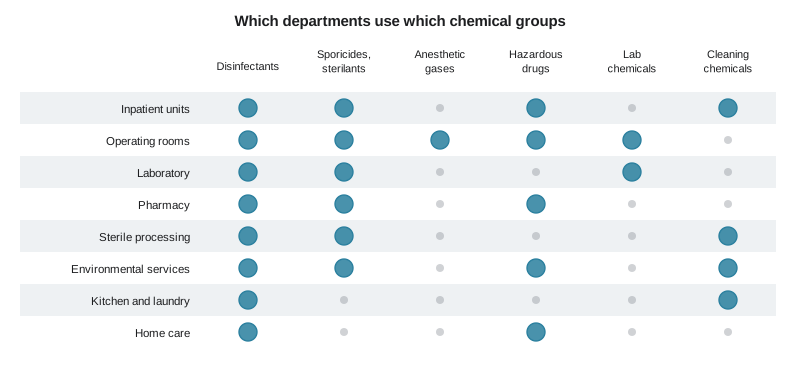
A hospital uses more kinds of chemicals than most factories. Every unit has disinfectant wipes and hand rub. Environmental services has floor strippers, bowl cleaners and sporicidal disinfectants. The operating rooms use anesthetic gases. The lab uses formalin, xylene, stains and reagents. Sterile processing uses high-level disinfectants and, in some hospitals, ethylene oxide. The pharmacy and oncology units handle drugs that are themselves hazardous to the staff who prepare and give them. And the kitchen and laundry have their own detergents, degreasers and caustic cleaners.
This lesson gives a worker's view of these hazards: what they are, where they are found, how they get into the body, and the controls that matter most. HSE-102 Hazard Communication (HazCom) Awareness covers labels and safety data sheets, HSE-312 Chemical Handling and Storage covers storage and spills in detail, and HSE-394 covers hazardous drugs, sterilants, anesthetic gases and radiation in depth.
How chemicals get into the body
- Breathing them in: fumes from disinfectants and solvents, gases that leak from anesthetic equipment or sterilizers, mists from spray bottles, and dust or aerosols from crushed or spilled drugs.
- Skin contact: splashes, wet wipes held in bare hands, contaminated surfaces, and leaks through damaged or unsuitable gloves. Some chemicals pass through intact skin into the blood.
- Eye contact: splashes while pouring, mixing or cleaning at or above eye level.
- Swallowing: contaminated hands touching food, drink or the mouth.
- Injection: needlesticks from syringes containing hazardous drugs.
The effects can be immediate, such as a burn, a cough or a headache, or slow, such as asthma, dermatitis, reproductive harm or cancer after years of low exposure. The slow effects are harder to notice and easier to dismiss, which is why exposure limits, monitoring and controls exist even for chemicals that do not seem to bother anyone.
The main chemical hazards
| Chemical or group | Where used | Main hazards | Key controls |
|---|---|---|---|
| Quaternary ammonium and alcohol disinfectant wipes | Every unit, for equipment and surfaces | Skin and eye irritation; some linked to asthma | Gloves, ready-to-use products, dispose of used wipes promptly |
| Bleach (sodium hypochlorite) | C. difficile rooms, blood spills, environmental services | Corrosive to eyes and skin; respiratory irritant; toxic gases if mixed with acids or ammonia | Ready-to-use or pre-measured products; never mix; eye protection and gloves |
| Hydrogen peroxide and peracetic acid | Sporicidal disinfectants, endoscope reprocessing | Corrosive; respiratory irritant | Ventilation, enclosed reprocessors, eye and skin protection |
| Glutaraldehyde and ortho-phthalaldehyde | High-level disinfection of scopes and probes | Sensitizers that can cause asthma and dermatitis | Automated enclosed reprocessors, local exhaust, substitution where possible |
| Formaldehyde (formalin) | Lab, operating rooms and clinics for tissue specimens | Carcinogen, sensitizer, eye and airway irritant | Prefilled specimen containers, fume hoods, monitoring |
| Ethylene oxide | Low-temperature sterilization in some hospitals | Carcinogen, flammable | Enclosed sterilizers with aeration, leak detection, monitoring |
| Anesthetic gases | Operating rooms, recovery rooms | Headache, drowsiness; reproductive concerns | Scavenging systems, leak checks, good mask fit on patients |
| Hazardous drugs | Pharmacy, oncology, inpatient units, home care | Some cause cancer, birth defects or organ damage | Biological safety cabinets, closed system devices, gowns, double gloves |
| Lab solvents, stains and reagents | Lab, pathology | Flammable; toxic to the nervous system and organs | Fume hoods, small quantities, flammable storage |
| Floor strippers, degreasers, oven cleaners | Environmental services, kitchen | Corrosive; slippery residues | Dispensing systems, goggles, gloves, good ventilation |
| Latex | Some gloves and medical devices | Allergy, from rashes to severe reactions | Latex-free gloves and products |
Two other hazards are worth a mention. Oxygen is not toxic, but it makes fires start more easily and burn much faster, so oxygen equipment must be kept away from flames and sparks and free of oil and grease. And mercury, once common in thermometers and blood pressure gauges, still turns up in older equipment and needs a mercury spill kit and careful cleanup if anything breaks.
HazCom in a hospital
HazCom applies to hazardous chemicals in a hospital as it does anywhere else. OSHA's Hazard Communication standard was updated in 2024 to stay aligned with the Globally Harmonized System. Every hazardous chemical must have a label with pictograms, signal words and hazard and precautionary statements, and a safety data sheet (SDS) that workers can get to quickly. When a chemical is moved into another container, such as a spray bottle filled from a jug, the new container needs a workplace label unless it is used up by the person who filled it during the same shift. Workers must be trained on the chemicals they use: what the hazards are, how to read the label and SDS, and what to do in an emergency.
Some products in hospitals are partly exempt from HazCom because other laws regulate them. Drugs in solid, final form for patients are one example. Hazardous drugs are still hazardous to workers, though, and NIOSH's list of hazardous drugs and USP General Chapter 800 set out how they should be handled, as HSE-394 explains.
Never mix cleaning products
Many injuries from cleaning chemicals in healthcare come from mixing. Bleach mixed with an acid, such as some toilet bowl cleaners and descalers, releases chlorine gas. Bleach mixed with ammonia, found in some glass cleaners and in urine, releases chloramine gases. Both can cause severe coughing, chest tightness and lung damage in a small, poorly ventilated bathroom. Mixing two disinfectants does not make them stronger; it usually makes them weaker and more dangerous.
The safest way to prevent mixing is to make it unnecessary. Northbridge uses ready-to-use products on the units and a wall-mounted dispensing system in environmental services that measures and dilutes concentrates automatically. Staff do not bring cleaning products from home, and spray bottles are always labeled.
Skin: the overlooked hazard
Healthcare workers wash and sanitize their hands many times a shift and wear gloves for hours. The result, for many, is irritant dermatitis: dry, cracked, sore skin, mostly on the hands. Cracked skin is painful, lets germs in and makes hand hygiene harder to keep up. Some workers develop allergic dermatitis to glove materials, disinfectants or other chemicals. Using the hospital's moisturizer, choosing well-fitting gloves, drying hands fully before putting gloves on, and reporting a rash early to occupational health all help. A rash that does not settle can be the first sign of an allergy that will get worse with continued exposure.
Eyewash and emergency showers
Wherever corrosive chemicals are used, such as in environmental services, sterile processing, the lab and the pharmacy, there must be an eyewash station close by and, for larger quantities, an emergency shower. Common practice is to place them no more than about 10 seconds' walk from the hazard with a clear path, and to flush eyes or skin for at least 15 minutes after a splash. An eyewash that has not been run for months may deliver a burst of rusty, contaminated water, so each one is flushed weekly and the date recorded. Daniel checks the four in the lab every Monday.
Reviewing the chemical inventory
Joanne asked each department for its list of hazardous products. She used a short script to check them for missing safety data sheets, missing workplace labels and duplicate products doing the same job.
# Hazardous product inventory review (sample of the full list)
products = [
    # name, department, purpose, has_sds, labels_ok
    ("QuatWipe Plus",        "units", "surface disinfectant", True,  True),
    ("OxyGuard RTU",         "units", "surface disinfectant", True,  True),
    ("CleanSure Q",          "units", "surface disinfectant", False, True),
    ("Hypo 5000 RTU",        "EVS",   "sporicidal",           True,  True),
    ("PeraClean 2",          "EVS",   "sporicidal",           True,  False),
    ("BowlBrite Acid",       "EVS",   "toilet bowl cleaner",  True,  True),
    ("StripMax",             "EVS",   "floor stripper",       True,  True),
    ("Formalin 10 prefill",  "lab",   "tissue fixative",      True,  True),
    ("Xylene",               "lab",   "solvent",              True,  True),
    ("GluterAid 2.4",        "SPD",   "high-level disinfect", False, False),
    ("OPA Solution",         "SPD",   "high-level disinfect", True,  True),
    ("KitchenDegreaser",     "kitchen", "degreaser",          True,  True),
]

missing_sds = [p[0] for p in products if not p[3]]
bad_labels = [p[0] for p in products if not p[4]]
print("missing SDS:", ", ".join(missing_sds))
print("label problems:", ", ".join(bad_labels))

by_purpose = {}
for name, dept, purpose, *_ in products:
    by_purpose.setdefault(purpose, []).append(name)
print("\npurposes with more than one product:")
for purpose, names in by_purpose.items():
    if len(names) > 1:
        print(f"  {purpose:22} {len(names)}: {', '.join(names)}")

acids = [p[0] for p in products if "Acid" in p[0]]
bleach = [p[0] for p in products if "Hypo" in p[0]]
print("\nmixing risk in EVS (never combine):", acids, "with", bleach)missing SDS: CleanSure Q, GluterAid 2.4 label problems: PeraClean 2, GluterAid 2.4 purposes with more than one product: surface disinfectant 3: QuatWipe Plus, OxyGuard RTU, CleanSure Q sporicidal 2: Hypo 5000 RTU, PeraClean 2 high-level disinfect 2: GluterAid 2.4, OPA Solution mixing risk in EVS (never combine): ['BowlBrite Acid'] with ['Hypo 5000 RTU']
The review found two products without a current safety data sheet, two with label problems, three different surface disinfectants on the units where one would do, and two high-level disinfectants in sterile processing. Each extra product is another label to learn, another SDS to keep current and another chance of the wrong product being used. The safety committee recommended reducing the unit disinfectants to one and removing glutaraldehyde from sterile processing, since the department already had a less sensitizing alternative. That is elimination and substitution, the top two levels of the hierarchy of controls.
For supervisors: how new chemicals get in
Most of the chemicals in a hospital arrive one at a time: a sales representative leaves samples, a physician asks for a new product, a department orders a cheaper version through a different supplier. Northbridge now requires every new hazardous product to go through a short review by purchasing, infection control and the Employee Health and Safety office before it is ordered, with the safety data sheet attached. If you manage a department, make sure products only come in through that route, and that staff know not to bring in products of their own.
When there is a spill or exposure
If a chemical splashes into someone's eyes or onto their skin, start flushing with water right away, use the eyewash or shower, and keep going for at least 15 minutes. Remove contaminated clothing. Get medical help, take the SDS or label with you, and report it. For a spill, keep people away, ventilate if it is safe to do so, and follow the spill procedure on the SDS and the department's spill plan. Small spills can be cleaned by trained staff with the right spill kit. Large spills, spills of very toxic products such as formaldehyde or hazardous drugs, and anything that makes people cough or feel unwell are called in to the hospital's hazardous spill response, announced at Northbridge as a hazardous materials spill with its location.
Worked problem
The bathroom on 4 West
At 0230, a certified nursing assistant covering 4 West from the float pool finds a patient bathroom with a badly stained toilet. She sprays it with the bleach-based product from the dirty utility room and then, when the stain does not lift, adds the acidic bowl cleaner from the environmental services cart parked in the corridor. Within a minute she is coughing hard and her eyes are streaming. What should happen, and how can this be prevented?
Show solution
- Get her and anyone else out of the bathroom and close the door. Turn on the bathroom exhaust fan from outside if possible. Do not go back in to clean up.
- She should get fresh air, flush her eyes at the nearest eyewash station, and be assessed by the emergency department because chlorine gas can cause breathing problems that get worse over several hours. The charge nurse moves the patient to another bathroom.
- The charge nurse calls the hazardous spill response, and the night environmental services lead ventilates and cleans the bathroom with proper respiratory protection once the gas has cleared. An incident report is filed, and because the worker needed medical care, the Employee Health and Safety office records it as required.
- The investigation finds that environmental services carts were left unlocked in corridors overnight, that float staff had no training on unit cleaning products, and that stained toilets had no clear owner at night. The fixes: locked carts, a short product orientation for float staff, and a rule that stains are left for environmental services.
Answer: Evacuate and ventilate, flush and get medical assessment, call the spill response, then fix the access, training and ownership gaps that allowed the mixing.
Common mistakes
MistakeMixing two cleaning products to make them stronger.
InsteadNever mix; bleach with acids or ammonia releases toxic gases.
MistakeFilling an unlabeled spray bottle from a jug.
InsteadEvery secondary container needs a workplace label.
MistakeIgnoring sore, cracked hands as part of the job.
InsteadMoisturize, use the right gloves and report rashes early to occupational health.
MistakeAssuming a drug is safe to handle because it is a medicine.
InsteadHazardous drugs can harm the staff who prepare and give them; follow the handling rules.
MistakeLetting new products arrive as samples or personal purchases.
InsteadNew hazardous products go through a review, with the SDS, before they are used.
Summary and key terms
- Hospitals use a wide range of chemicals: disinfectants, sterilants, anesthetic gases, hazardous drugs, lab chemicals and cleaning products.
- Chemicals enter by breathing, skin and eye contact, swallowing and needlesticks, with immediate or long-term effects.
- HazCom requires labels, safety data sheets and training for hazardous chemicals.
- Never mix cleaning products; ready-to-use products and dispensing systems make mixing unnecessary.
- Hand dermatitis is common and should be reported early.
- Eyewash stations must be close, clear and flushed weekly; flush splashes for at least 15 minutes.
- Reducing the number of products, and substituting safer ones, is elimination and substitution in action.
- Safety data sheet (SDS)
- A document from the supplier describing a product's hazards, safe handling and emergency measures.
- Workplace label
- A label on a container the product has been transferred into, naming the product and its safe handling.
- Sensitizer
- A substance that can cause an allergic reaction, such as asthma or dermatitis, that gets worse with repeated exposure.
- Scavenging system
- A system that captures waste anesthetic gases and removes them from the room.
- Irritant dermatitis
- Skin damage from repeated contact with water, soaps, disinfectants or gloves.
Practice problems
Work each problem on paper first, then reveal the answer to check.
Name four ways chemicals can enter the body.
Show answer
Breathing in, skin contact, eye contact, swallowing and injection by needlestick.
What happens when bleach is mixed with an acidic bowl cleaner?
Show answer
Chlorine gas is released, which can cause severe coughing and lung damage.
Why is glutaraldehyde a concern in sterile processing?
Show answer
It is a sensitizer that can cause asthma and dermatitis.
For how long should eyes be flushed after a chemical splash?
Show answer
At least 15 minutes.
What did the inventory review recommend for unit disinfectants, and which level of the hierarchy is that?
Show answer
Reduce three products to one, which is elimination.
Why should a rash on the hands be reported early?
Show answer
It may be the start of an allergy that gets worse with continued exposure, and cracked skin lets germs in.
Lesson quiz · 5 questions
Score 60% or more to complete this lesson.
Create a free account to save your progress, take quizzes and earn a certificate.