
HSE-390 · Lesson 8 of 12 · 23 min
Lifting, repetitive work and ergonomics outside patient care
▶ Video coming soon A video version of this lesson is on the way.
When people think of back injuries in healthcare, they think of nurses lifting patients, and that is the largest single cause. HSE-391 covers it. But a hospital is also a place where truckloads of linen, food, waste, supplies and equipment are moved every day, where beds and stretchers are pushed for long distances along corridors, where instrument trays are lifted onto high shelves, and where lab and pharmacy staff spend hours in the same posture at a bench, a microscope or a screen. These jobs cause a large share of musculoskeletal injuries in healthcare, and they are often overlooked because they are not about patients.
Musculoskeletal injuries from lifting, pushing, carrying and repetitive work outside patient care make up a large share of injuries in hospitals and nursing homes, and they affect support staff as much as nurses. At Northbridge, other lifting, pushing and repetitive work produced 31 reports and 4 days-away cases last year. HSE-107 Manual Handling and Ergonomics covers the general principles. This lesson applies them to the support work of a hospital.
The risk factors
Musculoskeletal injuries rarely come from a single event. They usually build up from repeated strain, and then something small, a twist, a slip or a heavy bag, tips them over. The risk factors are the same in every job:
- Force: how hard the muscles have to work, as when lifting a wet laundry bag or starting a heavy bed rolling.
- Posture: how far the body is from a neutral, upright position, as when reaching into the bottom of a deep laundry cart or above shoulder height to a supply shelf.
- Repetition: how often the same movement is made, as when wiping, pipetting or scanning.
- Duration: how long the work goes on without a break or a change of task.
- Contact stress: pressure on soft tissue from hard edges, as when leaning a forearm on the edge of a lab bench or gripping a thin cart handle.
- Other factors: cold, vibration, poorly fitting gloves, and working in a hurry.
Most of the jobs in this lesson combine several of these. Emptying a soiled linen hamper involves force, poor posture and repetition at the same time, many times a shift.
Jobs and their hazards
| Job | Typical tasks | Main risk factors |
|---|---|---|
| Transporter | Pushing beds, stretchers and wheelchairs; moving equipment and supplies | High push and pull forces, especially starting, turning and on ramps; long distances |
| Environmental services | Mopping, wiping, emptying bins, making beds, high and low dusting | Repetition, twisting, reaching, bending, carrying |
| Laundry | Sorting soiled linen, loading and unloading washers and dryers, folding | Heavy wet loads, deep bins, repetitive arm work, heat |
| Food services | Loading tray carts, lifting pots and food boxes, washing dishes | Lifting, pushing heavy carts, standing, heat |
| Sterile processing | Lifting instrument trays, loading washers and sterilizers, assembling sets | Heavy trays, reaching to high shelves, repetitive hand work |
| Laboratory | Pipetting, microscopy, centrifuge loading, computer work | Repetitive thumb and wrist work, static neck posture |
| Pharmacy | Compounding in hoods, picking and stocking, computer order entry | Sustained reaching, repetitive hand work, standing |
| Maintenance and stores | Moving furniture, gas cylinders and supplies; working overhead | Heavy and awkward loads, ladders, overhead work |
| Home health | Carrying supply bags, equipment and laptops; working in clients' homes | Carrying, awkward spaces, low beds, getting in and out of the car |
Pushing beds and stretchers
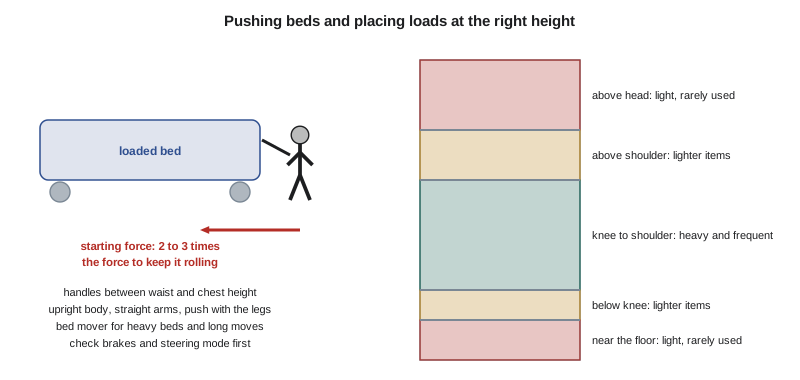
Kevin pushes beds and stretchers for most of his shift. An occupied hospital bed can weigh well over 440 lb (200 kg), and a bariatric bed with a patient much more. Pushing is usually easier on the body than lifting, but beds and stretchers produce large forces at three moments: starting, turning and stopping. The force needed to start a loaded bed moving can be two or three times the force needed to keep it rolling, and turning a corner, getting over an elevator threshold or going up a ramp adds more.
The controls start with the equipment:
- Powered bed movers or beds with a built-in drive wheel remove most of the force for long or heavy moves. Northbridge has three movers, kept at the transporter station, and uses them for every bariatric bed and every move longer than the length of a corridor.
- Beds with a steering mode lock one or two wheels so the bed tracks straight instead of drifting.
- Wheels and brakes need regular maintenance. A bed with a sticking brake or a flat-spotted wheel can take twice the force to move. Kevin reports them, and maintenance tags them out until they are fixed.
- Handles at the right height let the worker push with straight arms and an upright body.
Then the way the work is done. Push rather than pull where you can see over the load. Start slowly and build up speed rather than heaving. Turn with your feet, not your back. Use two people for heavy beds, ramps and long moves without a mover. Slow down before turns and thresholds. And plan the route: the freight elevator to imaging has a smaller threshold gap than the public ones, and the long ramp to the old wing is a two-person job.
Store heavy things at the right height
The simplest ergonomic control in a hospital costs nothing: put heavy and often-used items between knee and shoulder height, and keep the floor and the top shelf for light things that are rarely used. In Northbridge's sterile processing department, the heaviest orthopedic trays used to be stored on the top shelf because that was where they fitted. Moving them to the middle shelves, and splitting two of them into smaller sets, removed one of the department's main causes of shoulder strain. Many reprocessing departments set an upper limit of 25 lb (about 11 kg) for a single instrument tray, a figure from widely used American guidance, and Northbridge has adopted it.
The same idea applies everywhere: supply rooms where the boxes of IV fluid sit on the bottom shelf, laundry carts that are so deep the worker has to bend double to reach the last bag, and kitchen storerooms where sacks are stacked on the floor. Spring-loaded carts, which raise the load as it is emptied, and adjustable shelving are the usual fixes.
Rating a lift
For lifting tasks, the NIOSH lifting equation is a widely used way to check whether a lift is likely to be safe for most workers. It starts with a load of 51 lb (23 kg), the most that should be lifted in ideal conditions, and reduces it for each way the real lift is less than ideal: how far the load is from the body, how high or low it starts, how far it moves, how much twisting there is, how often it is lifted and how good the grip is. The result is the recommended weight limit. Dividing the actual weight by the recommended limit gives the lifting index. An index above 1 means the lift is a risk for some workers; above 3, for most.
Joanne used the equation for a task the laundry staff do about 60 times a shift: lifting a wet linen bag from the bottom of a deep cart into the washer.
# NIOSH lifting equation (metric version) for the laundry bag lift
LC = 23.0                          # load constant, kg

def rwl(H, V, D, A, FM, CM):
    HM = min(1.0, 25 / H)          # horizontal distance, cm
    VM = 1 - 0.003 * abs(V - 75)   # starting height of hands, cm
    DM = min(1.0, 0.82 + 4.5 / D)  # vertical travel, cm
    AM = 1 - 0.0032 * A            # twist, degrees
    return LC * HM * VM * DM * AM * FM * CM

weight = 13.0  # wet linen bag, kg
# Before: bag at the bottom of a deep cart, reached over the side, lifted
# into a front-loading washer with a twist. About 1 lift a minute for 8 h.
before = rwl(H=50, V=15, D=70, A=45, FM=0.75, CM=0.90)
# After: spring-loaded cart keeps the bag near 70 cm, worker stands
# square to the washer, bag has handles.
after = rwl(H=35, V=70, D=25, A=0, FM=0.75, CM=1.00)

for label, limit in (("before", before), ("after", after)):
    print(f"{label:6} recommended limit {limit:5.1f} kg   lifting index {weight / limit:4.2f}")

print("\nbags heavier than the 'after' limit should be split:",
weight > after)before recommended limit 4.8 kg lifting index 2.70 after recommended limit 12.1 kg lifting index 1.07 bags heavier than the 'after' limit should be split: True
Before the change, the recommended limit was under 11 lb (5 kg) for a 29 lb (13 kg) bag, and the lifting index was 2.7, a high-risk lift for most workers. With a spring-loaded cart, bags with handles and a better position at the washer, the limit rises to 26 lb (about 12 kg) and the index falls to about 1.1. That is much better but still just above 1, so the department also limited bags to 22 lb (about 10 kg) by filling them less full, which brings the index under 1. Equations like this are not exact, but they are good at showing which changes make the biggest difference.
Repetitive and static work
Daniel spends much of his day pipetting, loading specimens into analyzers and reading slides at the microscope. Priya spends hours compounding in a hood, reaching forward through the opening with her arms held out, and then entering orders at a computer. These jobs involve little force but a great deal of repetition and fixed posture, and the injuries they cause build up slowly: sore thumbs and wrists, tendon problems, and neck and shoulder pain.
- Electronic or lighter pipettes with low plunger force, and alternating hands, reduce thumb strain.
- Microscopes with adjustable eyepieces, and an adjustable chair and bench, let the worker keep the neck upright.
- Footrests, anti-fatigue mats and sit-stand stools help at benches where staff stand for long periods.
- In the pharmacy hood, keeping supplies close to the front and setting the chair height so the elbows are near the level of the work surface cut the reach.
- Computer workstations should have the screen at about eye level and an arm's length away, the keyboard and mouse at elbow height, and feet flat on the floor or a footrest. Many workstations on units are shared and on wheels, so staff need to adjust them each time.
- Micro-breaks of a minute every half hour, and rotating between tasks, give tissues time to recover.
For supervisors: listen for the early signs
Musculoskeletal injuries almost always give warning. Staff mention stiffness, aching or tingling for weeks or months before they file an injury report. Treat these mentions as reports: ask what task causes it, look at the task, and involve the Employee Health and Safety office early. A change to a workstation, a cart or a rotation made when someone first mentions a sore wrist is far cheaper, and far kinder, than a claim six months later. Make it clear that reporting discomfort is expected, not a complaint.
Home health: carrying the clinic
Nadia carries her clinic with her: a supply bag, a laptop, sometimes a scale or a portable lift sling, and wound care supplies for the day. She lifts them in and out of the car several times a visit and carries them up stairs and along icy paths. Northbridge Home Health has replaced shoulder bags with wheeled bags and backpacks, limits what each nurse carries to the supplies for that day, and arranges for heavier equipment to be delivered to clients' homes rather than carried by staff. In the client's home, low beds and cramped bathrooms create poor postures for any care task; the first-visit safety check records them and the care plan says how to deal with them.
Worked problem
Kevin and the bariatric bed
Lesson 1 described Kevin straining his shoulder pushing a bariatric bed whose brake was partly on. The bed and patient together weighed 880 lb (about 400 kg). He was moving it alone from the emergency department to 4 West, a route with a long corridor, two corners and an elevator. What went wrong, and what controls should be in place?
Show solution
- The risk factors were very high force, made worse by the dragging brake, plus turning at corners and getting over the elevator threshold, all done by one person.
- The bed mover was available at the transporter station, but Kevin was asked to move the bed urgently and the mover was at the far end of the building. The partly applied brake had not been noticed because nobody checked the bed before the move.
- Engineering controls: a fourth bed mover kept in the emergency department for bariatric beds, and a planned replacement of the older bariatric beds with ones that have a built-in drive.
- Administrative controls: a rule that bariatric beds are always moved with a mover or by two people, a pre-move check of brakes and steering, and a way for staff to flag a bed that is hard to push so it is tagged out.
- Kevin reports the injury, and the Employee Health and Safety office arranges modified duties while his shoulder recovers. The investigation is shared with the transporter team so the pattern is not repeated.
Answer: High force from a heavy bed with a dragging brake, moved alone; fix with bed movers, a two-person or mover rule, and a pre-move check of brakes and steering.
Common mistakes
MistakeThinking ergonomics only matters for patient handling.
InsteadSupport work causes as many musculoskeletal injuries as patient handling in many hospitals.
MistakeHeaving a heavy bed to get it started.
InsteadUse a bed mover or a second person, check the brakes, and build up speed slowly.
MistakeStoring the heaviest items on the top shelf or the floor.
InsteadKeep heavy and frequent items between knee and shoulder height.
MistakeWaiting for an injury before changing a task.
InsteadTreat early reports of aching or tingling as hazard reports and act on them.
MistakeUsing a shared workstation without adjusting it.
InsteadAdjust the chair, screen and keyboard every time; it takes a minute.
Summary and key terms
- Lifting, pushing and repetitive work outside patient care cause a large share of healthcare musculoskeletal injuries.
- The risk factors are force, posture, repetition, duration, contact stress, cold and vibration.
- Beds and stretchers produce the highest forces at the start, at turns and on ramps; bed movers and maintenance are the key controls.
- Store heavy and frequent items between knee and shoulder height.
- The NIOSH lifting equation gives a recommended weight limit and a lifting index; an index above 1 is a risk.
- Lab, pharmacy and computer work cause slow-building injuries from repetition and fixed posture.
- Early reports of discomfort are the best chance to prevent an injury.
- Musculoskeletal disorder
- An injury to muscles, tendons, ligaments, joints or nerves, often from force, posture or repetition.
- Lifting index
- The actual weight of a load divided by the recommended weight limit from the NIOSH lifting equation.
- Bed mover
- A powered device that attaches to a bed or stretcher and does most of the work of moving it.
- Spring-loaded cart
- A cart with a spring-loaded base that rises as it is emptied, keeping the load near waist height.
- Neutral posture
- A position of the body with joints near the middle of their range, which puts least strain on tissues.
Practice problems
Work each problem on paper first, then reveal the answer to check.
Name four risk factors for musculoskeletal injury.
Show answer
Any four of: force, posture, repetition, duration, contact stress, cold, vibration.
At which three moments does pushing a bed produce the highest forces?
Show answer
Starting, turning and stopping, plus thresholds and ramps.
Where should heavy and frequently used items be stored?
Show answer
Between knee and shoulder height.
What does a lifting index above 1 mean?
Show answer
The lift is a risk for some workers; above 3, for most.
Give two controls for pipetting strain.
Show answer
Electronic or low-force pipettes, alternating hands, micro-breaks and task rotation.
Why should early reports of aching be treated as hazard reports?
Show answer
Musculoskeletal injuries usually give warning, and changing the task early prevents a more serious injury.
Lesson quiz · 5 questions
Score 60% or more to complete this lesson.
Create a free account to save your progress, take quizzes and earn a certificate.