
HSE-390 · Lesson 12 of 12 · 23 min
Capstone: a care unit safety walk
▶ Video coming soon A video version of this lesson is on the way.
This last lesson brings the course together in one practical task: a safety walk of a care unit. A safety walk is a planned inspection in which a small team walks through a unit, looks at it with the hazards of this course in mind, talks to the people working there, records what it finds and turns the findings into actions. It is the single most useful habit a unit can build, and it uses every lesson: the hazard groups of Lesson 1, the duties of Lesson 2, the rating method of Lesson 3, and the specific hazards of Lessons 4 to 10, with Lesson 11's reports as the background.
The lesson follows a walk of 4 West and the Birch home area at Maple Court, carried out by Tom, Amira, Sarah, Lina and Marta, with Kevin joining for part of it.
Planning the walk
The safety committee at Northbridge inspects a different part of the hospital every month. A unit safety walk is more focused: it covers one unit in depth, it includes staff who work there, and it is timed for when the unit is busy. Tom and Sarah plan the walk a week ahead.
- Who: a worker member of the committee, the unit manager, a frontline worker from the unit on each shift, and someone from environmental services. A transporter or a lab assistant who visits the unit often brings a useful outside view.
- When: on a weekday morning at about 1000, when care, discharges, rounds and cleaning are all happening, and a shorter second walk at night, because many hazards only appear then.
- What to bring: the checklist, the last walk's findings, the unit's injury and near-miss reports for the past six months, a flashlight, and gloves and hand rub.
- What to respect: patient privacy and dignity. The team does not go into rooms where care is under way, photographs only equipment and spaces with no patients in view, and follows the isolation sign on every door.
- What to read first: the reports. Knowing that 4 West had four slips near the north bathroom and two needlesticks in the med room tells the team where to look hardest.
The checklist
Northbridge's unit safety walk checklist has ten sections, one for each group of hazards in the course and its support areas. Each section has a few items, and some items are marked critical: if any of them fail, they are fixed or controlled before the team leaves the unit.
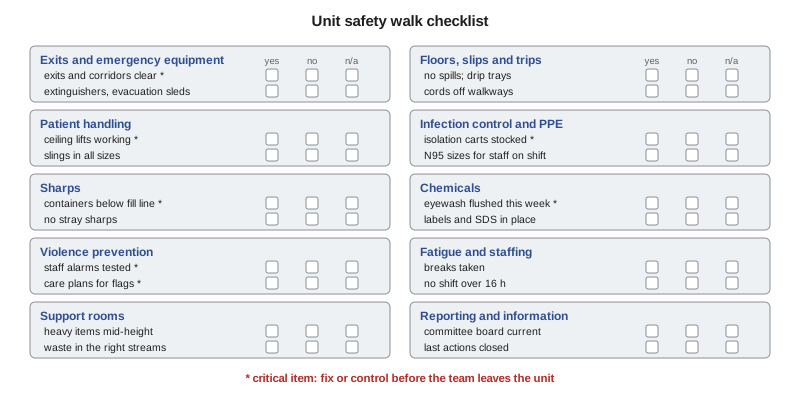
Some example items from each section:
| Section | Example items |
|---|---|
| Exits and emergency equipment | Exits and corridors clear; fire extinguishers charged and accessible; evacuation equipment in place; code cards posted |
| Floors, slips and trips | No spills or drips; gel dispensers have drip trays; cords routed away from walkways; entrance mats in place |
| Patient handling | Ceiling lifts working and inspected; slings available in all sizes and in good condition; mobility status on each patient's board |
| Infection control and PPE | Isolation signs current; isolation carts fully stocked; N95 models and sizes for the staff on shift; hand rub at every room |
| Sharps | Containers at the point of use and below the fill line; safety-engineered devices in every cart; no stray sharps |
| Chemicals | Products labeled; safety data sheets accessible; no mixing; eyewash flushed this week |
| Violence prevention | Staff alarms worn and tested; flagged patients have care plans; security number posted; safe room layout |
| Fatigue and staffing | Breaks taken; no one beyond 16 hours; schedule check done before posting |
| Support rooms | Heavy items between knee and shoulder height; dirty utility clean and organized; waste in the right streams |
| Reporting and information | Committee board current; staff know how to report; last walk's actions closed |
Talking to the people who work there
A checklist finds things. Conversations find the reasons behind them. At each stop, the team asks the staff working there a few short questions, chosen so that people can answer honestly without feeling tested:
- What is the hardest part of your shift from a safety point of view?
- Is there anything you have reported that has not been fixed?
- What do you do when the lift, the alarm or the right PPE is not there?
- If you could change one thing about this unit to make it safer, what would it be?
- Do you know how to report a near miss, and have you heard back when you did?
On 4 West, a certified nursing assistant from the float pool tells them she was never shown where the unit's portable lift is kept. A night nurse says the staff alarms often fail their test at the start of the night shift because the chargers in the nursing station are unreliable. Marta says nobody tells environmental services which rooms have patients with violence flags. None of these would have shown up on a checklist alone.
Scoring the walk
After the walk, Amira enters the results into a short script that scores each section, lists the failed critical items and compares the unit with its last walk.
# Unit safety walk results: section -> list of (item, result, critical)
# result: "Y" pass, "N" fail, "NA" not applicable
walk = {
 "Exits and emergency":  [("exits clear", "Y", True), ("extinguishers", "Y", False), ("evac sled", "Y", False)],
 "Floors and slips":     [("no spills", "Y", False), ("drip trays", "N", False), ("cords routed", "N", False), ("mats", "NA", False)],
 "Patient handling":     [("ceiling lifts working", "Y", True), ("slings all sizes", "N", False), ("mobility boards", "Y", False)],
 "Infection and PPE":    [("isolation carts stocked", "N", True), ("signs current", "Y", False), ("N95 sizes", "Y", False), ("hand rub", "Y", False)],
 "Sharps":               [("below fill line", "Y", True), ("safety devices", "Y", False), ("no stray sharps", "Y", False)],
 "Chemicals":            [("labels ok", "Y", False), ("SDS access", "Y", False), ("eyewash flushed", "N", True)],
 "Violence prevention":  [("alarms tested", "N", True), ("care plans", "Y", True), ("security number", "Y", False)],
 "Fatigue and staffing": [("breaks taken", "N", False), ("no shift over 16 h", "Y", False), ("schedule check", "Y", False)],
 "Support rooms":        [("heavy items mid-height", "Y", False), ("dirty utility", "Y", False), ("waste streams", "N", False)],
 "Reporting and info":   [("board current", "Y", False), ("staff know how", "Y", False), ("last actions closed", "N", False)],
}

total_pass = total_items = 0
critical_fails = []
for section, items in walk.items():
    scored = [(i, r, c) for i, r, c in items if r != "NA"]
    passed = sum(1 for i, r, c in scored if r == "Y")
    total_pass += passed; total_items += len(scored)
    print(f"{section:22} {passed}/{len(scored)}")
    critical_fails += [f"{section}: {i}" for i, r, c in scored if r == "N" and c]

score = round(100 * total_pass / total_items)
print(f"\noverall: {total_pass}/{total_items} items passed, score {score} out of 100 (last walk: 74)")
print("critical items to fix before leaving the unit:")
for f in critical_fails:
print(" *", f)Exits and emergency 3/3 Floors and slips 1/3 Patient handling 2/3 Infection and PPE 3/4 Sharps 3/3 Chemicals 2/3 Violence prevention 2/3 Fatigue and staffing 2/3 Support rooms 2/3 Reporting and info 2/3 overall: 22/31 items passed, score 71 out of 100 (last walk: 74) critical items to fix before leaving the unit: * Infection and PPE: isolation carts stocked * Chemicals: eyewash flushed * Violence prevention: alarms tested
4 West scores 71, three points below its last walk, and three critical items fail: an isolation cart missing gowns in two sizes, an eyewash station in the dirty utility room that has not been flushed for three weeks, and staff alarms that failed their test. Before the team leaves, Sarah has the isolation cart restocked, Marta flushes the eyewash and adds it to her weekly round, and the charge nurse swaps the failed alarms for spares from the security office. The rest go into the action plan.
From findings to actions
A walk that ends with a list of problems has done half the job. The other half is the action plan: each finding with a rating, a control chosen as high on the hierarchy as is practical, an owner, a date, and a way of checking it is done.
| Finding | Score | Control | Owner | Due |
|---|---|---|---|---|
| Staff alarms failing their test; chargers unreliable | 4 x 4 = 16 | Replace the charging station; add a spare alarm bank; test at every shift change | Sarah and the security manager | 2 weeks |
| Environmental services not told about violence flags | 3 x 4 = 12 | Add a door symbol for flagged rooms; include housekeepers in the huddle | Sarah and the environmental services manager | 1 month |
| Float staff not shown the portable lift | 3 x 4 = 12 | Add the lift location and lift check to the float pool unit orientation card | Amira | 2 weeks |
| Slings missing in the largest size | 3 x 3 = 9 | Increase the par level; order two more | Sarah | 2 weeks |
| Gel dispenser in the north corridor has no drip tray | 3 x 3 = 9 | Fit drip trays to every dispenser on the unit | Maintenance, via work order | 1 month |
| Cords across the walkway in two rooms | 3 x 3 = 9 | Cord clips on beds; reminder at huddle | Amira | 1 week |
| Breaks missed on three of the last five night shifts | 3 x 3 = 9 | Assign break relief on the night schedule | Sarah | 1 month |
| Sharps found in a general waste bin | 2 x 4 = 8 | Move a container to the point of use in the med room; trace the source | Amira and Marta | 1 week |
| Two actions from last walk still open | - | Escalate to the director with dates | Tom | Next committee meeting |
The plan goes to the safety committee and is posted on the unit's safety board, so that the staff who were asked for their views can see what is being done about them. The two actions still open from the last walk are a warning sign: a walk that keeps finding the same problems teaches people that walks are for show.
The Birch home area
The same team walks the Birch home area at Maple Court the following week, with Lina as the frontline member. The tub room changes from Lesson 3 are in place and working. The new findings are different from 4 West's: a resident's room cluttered with furniture brought from home, which makes transfers awkward; two residents whose responsive behaviors have changed but whose care plans have not been updated; a staff room with no window that the night staff use for breaks with the lights off; and a medication cart with no lock on its sharps drawer. The walk scores 76. Because Maple Court is a home as well as a workplace, some controls, such as asking a family to remove a piece of furniture, take a conversation rather than a work order.
For supervisors: walk with your committee
If you manage a unit, take part in its safety walks yourself rather than receiving the results. You will see what your staff see, you will hear what they tell the committee, and you will be the person who can fix most of it on the spot. Walk at night at least once a year. Close every action before the next walk, or say why you cannot. Thank the people who spoke up, by name if they are happy for you to. The best predictor of whether a unit gets safer is not the score of its first walk but whether the second walk finds fewer of the same problems.
Worked problem
The night walk on 4 West
Two weeks after the day walk, Tom and Amira do a short night walk of 4 West at 0300. What should they look for that the day walk could not see, and what do they find?
Show solution
- At night, the hazards are about lighting, staffing, fatigue, working alone and what has been left behind by the day. They look at corridor and room lighting, whether staff are taking breaks, how many staff are on the unit and where they are, whether alarms are worn, and what is parked in the corridors.
- They find that the corridor lights are dimmed to the point where the floor is hard to see near the north bathroom, where four of the unit's slips happened. Maintenance is asked to set a higher minimum level.
- Only two of the five night staff are wearing alarms; the others say the replacement chargers are not yet installed. The interim spare bank is there but nobody told the night shift. Sarah adds it to the night huddle.
- A night nurse has worked 0700 to 1900 and is now on the second half of a double shift. She has not had a break. Under the fatigue policy, the charge nurse arranges a break and the nurse is sent home at 0700 with a taxi.
- Environmental services' night lead says she has started getting violence flag information at the huddle, the first of the day walk's actions to reach the night shift.
Answer: Look at lighting, staffing, fatigue, alarms and working alone; they find dim lighting at the slip hot spot, alarms not worn, a worker on a double shift without a break, and one action already working.
Where the course goes next
This course has introduced the main hazards of healthcare work. The five courses that follow it in the Healthcare Safety program take the biggest ones in depth, using the same hospital and the same people: HSE-391 Safe Patient Handling and Mobility, HSE-392 Sharps Safety and Bloodborne Pathogens, HSE-393 Workplace Violence Prevention in Healthcare, HSE-394 Hazardous Drugs, Chemicals and Radiation in Healthcare, and HSE-395 Healthcare Emergency Codes and Preparedness.
Common mistakes
MistakeWalking the unit only on a quiet afternoon.
InsteadWalk when it is busy, and at night, when different hazards appear.
MistakeRelying on the checklist alone.
InsteadTalk to the staff working there; they know the reasons behind what you see.
MistakeLeaving critical findings for the action plan.
InsteadFix or control critical items before the team leaves the unit.
MistakeEnding the walk with a list of problems.
InsteadTurn every finding into an action with a control, an owner and a date, and check it is done.
MistakePhotographing patients or entering rooms during care.
InsteadRespect privacy and dignity, and follow isolation signs.
Summary and key terms
- A unit safety walk is a planned, focused inspection with frontline staff, timed for when the unit is busy and repeated at night.
- Read the unit's reports first, so the team knows where to look hardest.
- Use a checklist with sections for each hazard group and critical items that are fixed before leaving.
- Talk to staff; conversations find the reasons behind what the checklist finds.
- Score the walk to track the unit over time, and list failed critical items.
- Turn findings into an action plan with controls high on the hierarchy, owners and dates, and post it.
- Close actions before the next walk; repeated findings teach people that walks are for show.
- Safety walk
- A planned inspection of a unit by a small team that includes frontline staff, followed by an action plan.
- Critical item
- A checklist item serious enough that a failure must be fixed or controlled before the team leaves.
- Action plan
- A list of findings with controls, owners, due dates and a way of checking they are done.
- Par level
- The standard quantity of a supply item a unit should keep on hand.
- Closing the loop
- Telling the people who raised a concern what was done about it.
Practice problems
Work each problem on paper first, then reveal the answer to check.
Who should be on a unit safety walk team?
Show answer
A worker member of the committee, the unit manager, frontline workers from each shift and someone from environmental services, and ideally an outside visitor such as a transporter or lab assistant.
Why read the unit's reports before the walk?
Show answer
They show where incidents have happened, so the team knows where to look hardest.
Name three critical items on the Northbridge checklist.
Show answer
Any three of: exits clear, ceiling lifts working, isolation carts stocked, sharps containers below the fill line, eyewash working, staff alarms tested, violence care plans in place.
What did talking to staff on 4 West reveal that the checklist did not?
Show answer
Float staff not shown the portable lift, unreliable alarm chargers, and environmental services not told about violence flags.
What should happen to a failed critical item?
Show answer
It is fixed or controlled before the team leaves the unit.
What does the night walk look for that the day walk cannot?
Show answer
Lighting, night staffing, fatigue and breaks, alarms worn, working alone and what is left from the day.
Lesson quiz · 5 questions
Score 60% or more to complete this lesson.
Create a free account to save your progress, take quizzes and earn a certificate.