
HSE-390 · Lesson 11 of 12 · 21 min
Reporting injuries, exposures and near misses
▶ Video coming soon A video version of this lesson is on the way.
Every lesson so far has ended with someone filing a report. This lesson is about why reports matter, what has to be reported and to whom, the legal deadlines that apply to the hospital, and the reasons healthcare workers so often do not report. HSE-101 covered the basics of reporting in any workplace. Here the focus is on healthcare, where under-reporting is common and where some reports, such as a needlestick, start a clock that cannot wait.
Why report?
A report does three jobs at once. It gets the worker the care and follow-up they need, and protects their right to compensation if a minor injury turns out to be serious. It tells the people who can fix a hazard that the hazard exists. And, added up over months, reports show patterns that no single person can see: the unit where violence is rising, the bed model that strains backs, the shift where needlesticks cluster.
Near misses matter as much as injuries. For every serious injury there are many minor ones and far more near misses, and the near misses are the cheapest warnings a hospital will ever get. A gel dispenser that drips, a resident who swung at a certified nursing assistant and missed, a needle found in a bed before anyone touched it: each is a chance to fix a hazard before it hurts someone.
What to report
At Northbridge, staff report all of these through the online incident reporting system, or on a paper form when the system is down:
- Any injury at work, however minor, including strains, cuts, bruises, bites and scratches.
- Any exposure: needlesticks and other sharps injuries, splashes of blood or body fluids, contact with a patient later found to have a reportable infection, and chemical exposures.
- Any act of violence, threat or harassment from a patient, resident, visitor or colleague, whether or not it caused an injury.
- Near misses: events that could have caused an injury but did not.
- Hazards: anything that could cause an injury if it is not fixed.
- Symptoms that may be work-related, such as aching wrists, a rash on the hands or a cough that started after a chemical was introduced.
Injuries and exposures should also be reported in person to the supervisor or charge nurse right away, before the end of the shift, so that treatment and follow-up can start. Needlesticks and blood splashes go straight to occupational health or, after hours, the emergency department, because follow-up is time-sensitive.
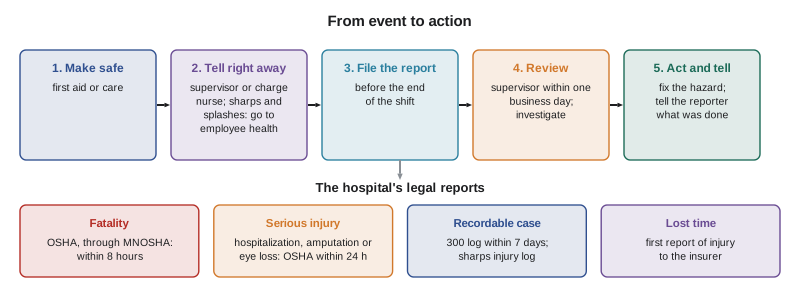
The hospital's legal duties
Once a worker has reported, OSHA's recordkeeping rules and Minnesota's workers' compensation law give the hospital several duties, each with its own deadline:
| Event | Report to | Deadline |
|---|---|---|
| A work-related fatality | OSHA (in Minnesota, MNOSHA) | Within 8 hours |
| An inpatient hospitalization, amputation or loss of an eye | OSHA (in Minnesota, MNOSHA) | Within 24 hours |
| A recordable injury or illness (medical treatment beyond first aid, days away, restricted work, and every contaminated sharps injury) | OSHA 300 log and 301 incident report, kept at the hospital | Within 7 calendar days |
| A sharps injury from a contaminated sharp | The sharps injury log required by the Bloodborne Pathogens standard, without the worker's name on the 300 log | With the 300 log entry |
| An injury that causes lost time | The workers' compensation insurer (First Report of Injury) | As Minnesota law requires, within 10 days for an injury keeping a worker off three or more days |
Hospitals and nursing homes are also among the industries that must submit injury data to OSHA electronically each year: establishments with 20 or more employees submit the annual summary (Form 300A), and those with 100 or more submit their 300 and 301 data too. The summary must be posted in the workplace from February 1 to April 30. Minnesota's hospital violence law adds its own requirements: the hospital's plan must include a reporting procedure for violence, a policy against retaliation, and a review of the previous year's incidents at the annual review.
These duties belong to the hospital, and Joanne's office makes sure they are met. But they all depend on the first step: the worker telling someone. A critical injury cannot be reported within the deadline if the manager hears about it three days later.
Why healthcare workers do not report
Surveys of healthcare workers consistently find that a large share of injuries, and most incidents of violence, are never formally reported. The reasons are familiar to anyone who has worked on a unit:
- It is part of the job. Being hit, scratched or sworn at by a confused patient is so common that many staff no longer see it as an incident.
- The patient did not mean it. Workers do not want to blame a patient with dementia or delirium, and some worry that a report will lead to the patient being treated badly.
- There is no time. The form takes twenty minutes and the unit is short.
- Nothing happens. Staff who have reported before and heard nothing back stop reporting.
- Fear of blame. Some workers worry that a report about a needlestick or a lifting injury will be used to say they did not follow procedure.
- It seemed minor. A small cut, a sore back that might go away, a splash that seemed clean.
Each of these can be addressed. A report about violence is not a complaint about the patient; it is information about a hazard to staff, and it is how the unit gets the care plan, the extra staff and the security support it needs. The form can be made shorter, and supervisors can give staff time to complete it during the shift. Feedback can be built in, so every reporter hears what happened. And a just culture, in which honest mistakes are treated as information about the system rather than reasons for discipline, removes the fear.
For supervisors: what happens after a report
What you do in the first 24 hours after a report decides whether the next one gets filed. Thank the person for reporting. Check that they have had care and follow-up. Look at the hazard yourself, or ask someone to, within a day. Tell the reporter what you are going to do and, later, what you did. If the answer is that nothing can be done right now, say so and say why. Share near misses and lessons at the unit huddle, without naming people. Never treat a report as evidence of a worker's failing unless there is a clear reason, such as a deliberate refusal to follow a rule; even then, ask why the rule was not followed before you decide.
Investigating reports
Not every report needs a full investigation, but every one needs a look. At Northbridge the supervisor reviews each report within one business day. Lost-time injuries, critical injuries, serious exposures, repeated incidents and near misses with serious potential are investigated by the supervisor together with a worker member of the safety committee and, where needed, Joanne's office. The aim is to find causes, not someone to blame: what about the equipment, the task, the staffing, the training, the patient's care plan or the environment allowed this to happen, and what would stop it happening again? HSE-103 covers investigation methods in more depth.
What the reports show
Joanne analyzes reports every month. This year she added two measures that show how well reporting is working: how many near misses are reported for each injury, and how long reports take to arrive.
# Northbridge incident reports by category this year: (injuries, near misses, median hours to report)
data = {
    "Patient handling":   (52, 9, 6),
    "Violence":           (47, 4, 20),
    "Slips and falls":    (39, 11, 3),
    "Other lifting":      (31, 3, 30),
    "Sharps and splashes": (28, 7, 1),
    "Struck by/against":  (17, 2, 5),
    "Chemical":           (11, 2, 2),
}
print(f"{'category':22}{'injuries':>9}{'near misses':>13}{'ratio':>7}{'hours':>7}")
tot_i = tot_n = 0
for cat, (inj, nm, hrs) in data.items():
    tot_i += inj; tot_n += nm
    print(f"{cat:22}{inj:9}{nm:13}{nm / inj:7.2f}{hrs:7}")
print(f"{'all':22}{tot_i:9}{tot_n:13}{tot_n / tot_i:7.2f}")

# Violence reports by month after the reporting campaign began in month 7
violence_by_month = [2, 3, 2, 3, 2, 3, 5, 6, 5, 6, 5, 5]
before = sum(violence_by_month[:6]); after = sum(violence_by_month[6:])
print(f"\nviolence reports, months 1-6: {before}; months 7-12: {after}")category injuries near misses ratio hours Patient handling 52 9 0.17 6 Violence 47 4 0.09 20 Slips and falls 39 11 0.28 3 Other lifting 31 3 0.10 30 Sharps and splashes 28 7 0.25 1 Struck by/against 17 2 0.12 5 Chemical 11 2 0.18 2 all 225 38 0.17 violence reports, months 1-6: 15; months 7-12: 32
The near-miss ratio is low everywhere, which confirms what Lesson 1 suggested: near misses are not being reported. Violence stands out in two ways. Its near-miss ratio is the lowest of any category, because staff rarely report a swing that missed, and its reports arrive late, a median of 20 hours after the event, often filed by a worker on their next shift. Other lifting is late too, because strains often do not hurt until the next day.
Halfway through the year, the hospital ran a campaign on violence reporting: a two-minute report option for violence with no injury, posters in every staff room, and managers who replied to every report within a day. Violence reports more than doubled in the second half of the year, from 15 to 32. That does not mean violence doubled. It means more of it was being seen, which is the first step to reducing it. Joanne warns the committee that a successful reporting campaign always looks like a worsening problem at first.
Worked problem
Lina and the resident in Birch
During evening care in the Birch home area, a resident with dementia grabs Lina's wrist hard and scratches her forearm while she helps him change. The skin is broken and bleeding slightly. It is the third time this week he has grabbed a staff member, but nobody else has reported it. Lina's shift ends in an hour, and she would rather not make a fuss because he is usually gentle. What should she do, and what should happen next?
Show solution
- Lina makes the resident and herself safe, steps back, and asks a colleague to finish the care. She washes the scratch with soap and water and covers it.
- She tells the charge nurse before the end of the shift. Because the skin was broken, the charge nurse arranges an assessment through occupational health in case the scratch counts as a body fluid exposure.
- She files a report. It takes her about five minutes with the short violence form. The report is about a hazard, not a complaint about the resident: three grabs in a week suggests something has changed, such as pain, an infection or a new medication, and that the care plan needs to change.
- The charge nurse reviews the resident's care plan the same evening, and the team meets the next day to look at triggers. Joanne's office checks whether the injury needs to be recorded on the 300 log, and whether a first report of injury is needed.
- The other two staff who were grabbed are encouraged to file late reports so that the pattern is complete. The resident is found to have a urinary tract infection, and the grabbing stops once it is treated.
Answer: Get safe, get first aid and assessment, tell the charge nurse before the end of the shift, file the report, and let the team use it to find and fix the cause.
Common mistakes
MistakeNot reporting violence because the patient did not mean it.
InsteadA report is about a hazard to staff, not blame; it is how the care plan and support improve.
MistakeLeaving a needlestick report until the end of the shift.
InsteadReport immediately and go straight to occupational health or the emergency department.
MistakeThinking near misses are not worth reporting.
InsteadNear misses are the cheapest warnings a hospital gets.
MistakeTreating a rise in reports as a rise in incidents.
InsteadBetter reporting shows more of what was already happening.
MistakeFiling reports and never telling the reporter what happened.
InsteadFeedback to the reporter is what keeps people reporting.
Summary and key terms
- Reports get workers care, tell people about hazards and reveal patterns over time.
- Report injuries, exposures, violence, near misses, hazards and work-related symptoms.
- Needlesticks and blood splashes need immediate follow-up.
- OSHA requires fatalities within 8 hours, hospitalizations, amputations and eye loss within 24 hours, and 300 log entries within 7 days, with sharps injuries on the sharps injury log.
- Healthcare workers under-report because violence feels like part of the job, time is short, fear of blame and a sense that nothing happens.
- Fast feedback, short forms, time to report and a just culture improve reporting.
- A successful reporting campaign often looks like a worsening problem at first.
- Near miss
- An event that could have caused an injury but did not.
- Critical injury
- In Ontario law, a serious injury such as one that endangers life; the closest OSHA equivalents are hospitalizations, amputations and loss of an eye.
- Just culture
- An approach in which honest mistakes are treated as information about the system, while reckless behavior is still addressed.
- Recordable case
- An injury or illness that must be entered on the OSHA 300 log, such as one needing medical treatment beyond first aid.
- Under-reporting
- The failure to report injuries, incidents or hazards that have happened.
Practice problems
Work each problem on paper first, then reveal the answer to check.
Name the three jobs that a report does.
Show answer
It gets the worker care and protects compensation, tells people who can fix the hazard, and reveals patterns over time.
What must Northbridge do if a worker is admitted to hospital as an inpatient after a work injury?
Show answer
Report it to OSHA, through MNOSHA in Minnesota, within 24 hours, and record it on the 300 log within 7 days.
Give three reasons healthcare workers do not report violence.
Show answer
Any three of: it feels part of the job, the patient did not mean it, no time, nothing happens, fear of blame, it seemed minor.
Why did violence reports more than double after the campaign?
Show answer
More of the violence that was already happening was being reported, not because violence doubled.
What should a supervisor do in the first 24 hours after a report?
Show answer
Thank the reporter, check they have had care, look at the hazard, and tell the reporter what will be done.
Why was the resident in Birch grabbing staff?
Show answer
He had a urinary tract infection; the reports revealed a change that led the team to find it.
Lesson quiz · 5 questions
Score 60% or more to complete this lesson.
Create a free account to save your progress, take quizzes and earn a certificate.