
HSE-332 · Lesson 5 of 12 · 26 min
Process chemicals and special hazards
Hydrocarbons and hydrogen sulfide are the hazards everyone expects at an oil and gas facility. But facilities also use and produce a long list of other chemicals: amine solutions that strip acid gas, glycol that dries gas, methanol that prevents hydrates, corrosion inhibitors, biocides, scale inhibitors, molten sulfur, and by-products such as benzene vapor, mercury and naturally occurring radioactive material. Some of these are hazardous in normal operation; others become hazardous only when equipment is opened, cleaned or repaired. This lesson surveys the special hazards that facility workers meet beyond the main hydrocarbon stream. It builds on HSE-330's introduction to toxic exposures, HSE-244 for hydrogen sulfide and HSE-312 for chemical storage and handling, and it does not repeat their general content on safety data sheets, labels and storage.
Know what is in the stream
The first rule of chemical safety in a facility is to know what is in each stream and each vessel, not just what the drawing says. Compositions change as wells age, as new wells come on and as upstream facilities change. A water tank that once held clean produced water may now hold water with hydrocarbons, H2S and bacteria; a line that once carried sweet gas may now carry sour gas from a new tie-in. Sample results, process flow diagrams, the safety data sheets for chemicals added and the facility's hazard register tell workers what to expect, and the permit for any task that opens equipment should state the contents and their hazards.
Amine systems
Amine units remove H2S and CO2 from sour gas by contacting it with a solution of an amine such as monoethanolamine (MEA), diethanolamine (DEA) or methyldiethanolamine (MDEA) in water. The rich amine, loaded with acid gas, is heated in a regenerator to drive the acid gas off, and the lean amine is cooled and returned to the contactor. The hazards include:
- Amine solutions are alkaline and can burn skin and eyes; hot amine adds thermal burns.
- Rich amine contains dissolved H2S, which flashes off when the pressure drops, for example when a sample is taken or a filter is changed.
- The acid gas leaving the regenerator can contain very high concentrations of H2S, often tens of percent, so a small leak can be immediately dangerous.
- Amine degradation products and heat-stable salts accelerate corrosion, especially in hot, rich amine piping.
- Amine filters and carbon beds collect H2S, hydrocarbons and pyrophoric iron sulfide, which matters when they are changed.
- Foaming and carryover can send amine downstream into equipment that was not designed for it.
Sampling rich amine is a routine task with a non-routine hazard. Sample points should be designed for closed or controlled sampling, workers should wear the H2S protection the hazard assessment requires, and samples should be taken from the upwind side with gas monitors on. A sample bottle of rich amine can release enough H2S in a confined lab or truck cab to cause harm.
Sulfur recovery and molten sulfur
The Claus sulfur recovery unit burns part of the acid gas to make sulfur dioxide and then reacts it with the remaining H2S over catalyst beds to make elemental sulfur, which is condensed and drained as a liquid. Molten sulfur is stored and handled at 266 to 302 °F (about 130 to 150 °C), the range in which it flows best. Its hazards are distinctive:
- Molten sulfur causes deep burns, and it solidifies on skin, which makes removal difficult; first aid is to cool the area with water and get medical care rather than pulling the sulfur off.
- Liquid sulfur releases dissolved H2S into the vapor space of pits and tanks, which can reach both toxic and flammable levels.
- Sulfur vapor and dust can ignite; sulfur fires produce sulfur dioxide, which is highly irritating and toxic.
- Sulfur pits and tanks are confined spaces with H2S, SO2, low oxygen and heat, and entries need full confined space controls under HSE-211.
- Solid sulfur handling, crushing and loading create dust that can explode and that irritates eyes and lungs.
Sulfur pits are usually swept with air or degassed to keep H2S below a fraction of its lower explosive limit, and sweep air fans and vents are safety-critical equipment. Workers should never lean over or into a pit opening, and they should treat the area around pit vents as a possible toxic zone.
Glycol dehydration and benzene
Glycol dehydrators contact wet gas with triethylene glycol, which absorbs water. The rich glycol is heated in a reboiler to boil off the water, and the vapor leaves through a still column vent. That vapor carries not only water but also benzene, toluene, ethylbenzene and xylenes (BTEX), which dissolve in glycol along with the water. Benzene is a known human carcinogen, and the still vent of an uncontrolled dehydrator can be one of the largest benzene sources at a facility. Many jurisdictions now require still vent emissions to be captured, condensed or burned, but workers should treat the area around the still vent, the reboiler and any glycol sampling as a possible benzene exposure. Hot glycol also causes burns, and glycol reboilers are fired equipment with burner management hazards similar to those of treaters.
Benzene exposure is usually assessed by air sampling during specific tasks, such as gauging tanks, changing filters, sampling glycol or opening equipment, and then calculating an eight-hour time-weighted average. The program below combines invented task samples for one operator's shift. The exposure limit in the program is illustrative; limits differ between jurisdictions and have been lowered over time, so always use the limit that applies to your workplace.
# Eight-hour time-weighted average benzene exposure from task samples (invented data).
tasks = [
    # task, minutes, measured benzene (ppm)
    ("Rounds, outdoors", 300, 0.02),
    ("Glycol sampling at reboiler", 15, 1.8),
    ("Changing glycol filter", 30, 2.6),
    ("Tank gauging (remote gauge used)", 20, 0.05),
    ("Control room and truck", 115, 0.0),
]
limit_twa = 0.5      # illustrative 8-hour limit only; check your jurisdiction's current value

total_min = sum(m for _, m, _ in tasks)
twa = sum(m * c for _, m, c in tasks) / 480
print(f"Shift length covered: {total_min} min")
for name, m, c in tasks:
    print(f"  {name:34s} {m:>3} min at {c:4.2f} ppm -> {m*c/480:.3f} ppm of TWA")
print(f"8-hour TWA: {twa:.3f} ppm  ({twa/limit_twa*100:.0f} % of illustrative limit)")
top = max(tasks, key=lambda t: t[1] * t[2])
print(f"Largest contributor: {top[0]}")Shift length covered: 480 min Rounds, outdoors 300 min at 0.02 ppm -> 0.013 ppm of TWA Glycol sampling at reboiler 15 min at 1.80 ppm -> 0.056 ppm of TWA Changing glycol filter 30 min at 2.60 ppm -> 0.163 ppm of TWA Tank gauging (remote gauge used) 20 min at 0.05 ppm -> 0.002 ppm of TWA Control room and truck 115 min at 0.00 ppm -> 0.000 ppm of TWA 8-hour TWA: 0.233 ppm (47 % of illustrative limit) Largest contributor: Changing glycol filter
The two short glycol tasks, 45 minutes out of 480, contribute most of the dose. That is typical: exposures in facilities are dominated by short, specific tasks rather than general work. Controlling those tasks with closed sampling, local ventilation, task-specific respiratory protection and good work positioning has more effect than anything else.
Methanol, inhibitors and other added chemicals
Methanol is injected widely to prevent and dissolve hydrates. It is highly flammable, burns with an almost invisible flame in daylight, is toxic if swallowed and can be absorbed through the skin. Methanol tanks and injection pumps sit at almost every remote site, and methanol should never be stored in unlabeled containers or drinking bottles. Corrosion inhibitors, scale inhibitors, demulsifiers, biocides and oxygen scavengers are added at injection points across facilities. Many are flammable, corrosive or toxic, and some biocides are sensitizers. Workers who fill chemical tanks, change pump settings or clean up spills need the safety data sheet, the right gloves and eye protection, and a plan for spills under HSE-251.
Mercury
Some natural gas and condensate streams contain traces of elemental mercury, picked up from the reservoir. Mercury can accumulate in equipment, especially at low points, cold sections and in aluminum heat exchangers, which it can attack and crack. Workers can be exposed when opening, cleaning or cutting equipment that has collected mercury, and heating or welding contaminated metal releases mercury vapor. Plants that handle mercury-bearing gas use mercury removal beds, test equipment before maintenance and treat contaminated equipment and waste as hazardous.
NORM in facilities
HSE-330 introduced naturally occurring radioactive material: radium and its decay products carried up with produced water and deposited in scale and sludge, and radon and its decay products, including lead-210, carried with gas and natural gas liquids. In facilities NORM concentrates in specific places: scale in water handling equipment, tank bottoms, separator and treater sludge, filters, and the internal surfaces of gas plant equipment that handles ethane and propane streams, where radon decay products deposit as a thin film. External radiation from these deposits is usually low, but the greater risk comes from inhaling or swallowing contaminated dust during cleaning, cutting or grinding. Equipment from suspect services should be surveyed before it is opened or sent for repair, and work on NORM-contaminated equipment uses wet methods, respiratory protection and controlled disposal under the applicable guidelines.
Pyrophoric iron sulfide
In sour systems, iron sulfide forms on steel surfaces and in deposits. When a vessel, filter or pipe that has been in sour service is opened and the deposit dries out in air, it can oxidize so rapidly that it glows and ignites, sometimes hours after opening. If hydrocarbons are present, the result can be a fire or explosion inside equipment that everyone believed was safe. Controls include keeping deposits wet during and after opening, chemical treatment before opening, removing deposits to a safe place under water, and monitoring opened equipment for heat. Filters from amine, sour gas and sour water services should be bagged wet and disposed of as directed.
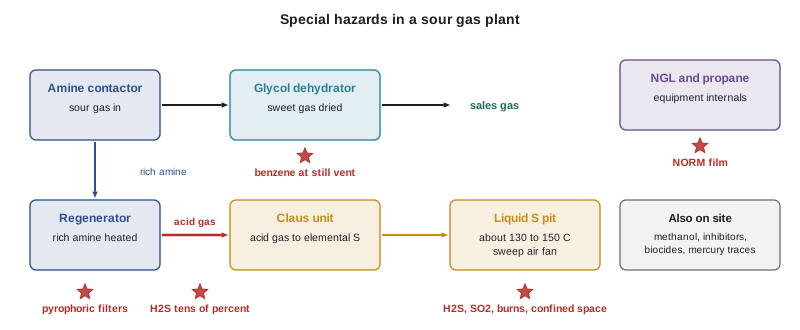
Putting it together: the task hazard check
Because so many of these hazards appear only when equipment is opened, cleaned or repaired, the most important control is a good task hazard assessment that asks the right questions for each job. The table summarizes the questions to add when work involves the services in this lesson.
| If the job involves | Ask about | Typical controls |
|---|---|---|
| Rich amine, acid gas or sour water | H2S flashing, acid gas concentration, alkaline burns | Closed sampling, H2S monitors and SCBA as assessed, face and hand protection |
| Sulfur pits, tanks or loading | Molten sulfur burns, H2S and SO2, dust, confined space | Sweep air checks, confined space permit, thermal PPE, no leaning into openings |
| Glycol reboilers and still vents | Benzene and BTEX, hot glycol, fired equipment | Emission controls, task sampling, respirators as assessed, burner management |
| Methanol and injection chemicals | Flammability, toxicity, skin absorption, spills | SDS, correct gloves and eye protection, bonding, labeled containers |
| Opening sour equipment or filters | Pyrophoric iron sulfide, residual H2S | Keep deposits wet, chemical treatment, monitor for heat, wet bagging |
| Scale, sludge or gas plant internals | NORM, mercury | Survey before opening, wet methods, respiratory protection, controlled disposal |
Worked problem
Changing an amine filter at Spruce Ridge
A maintenance crew at Spruce Ridge is assigned to change the cartridge filter on the rich amine line. The filter housing has been isolated and drained by operations. What hazards should the crew plan for, and what controls apply?
Show solution
- Confirm the isolation and draining with operations, and check that the housing has been depressured and purged as the permit requires; residual rich amine can still release H2S.
- Plan for H2S: monitors on each worker, a gas test at the housing before opening and the breathing protection the hazard assessment calls for.
- Plan for alkaline amine: face shield, goggles, chemical-resistant gloves and clothing, and an eyewash and shower within reach.
- Plan for pyrophoric iron sulfide in the used cartridges: keep them wet, bag them wet and move them to the designated disposal container.
- Ask whether NORM or mercury surveys apply to this service at this plant, and follow the plant's waste rules.
Answer: A filter change on rich amine combines H2S, corrosive liquid and pyrophoric deposits. Confirming isolation, testing the atmosphere, wearing chemical protection and keeping the spent filters wet control the main hazards.
Common mistakes
MistakeAssuming a stream contains only what the original drawing says.
InsteadCheck current samples and the hazard register; compositions change over time.
MistakeTaking rich amine samples without H2S protection because it is only liquid.
InsteadTreat rich amine as an H2S source; sample upwind with monitors and assessed protection.
MistakePulling solidified sulfur off a burn.
InsteadCool with water and get medical care; leave removal to medical staff.
MistakeLeaving opened sour filters to dry in the sun.
InsteadKeep iron sulfide deposits wet and bag them wet for disposal.
MistakeCutting or grinding scale-covered equipment without a NORM survey.
InsteadSurvey suspect equipment first and use wet methods and respiratory protection.
Summary and key terms
- Facilities use and produce many chemicals beyond hydrocarbons and H2S, and compositions change over time.
- Amine systems add alkaline burns, H2S flashing from rich amine and very rich acid gas streams.
- Molten sulfur causes deep burns and releases H2S; sulfur pits are confined spaces with toxic and flammable atmospheres.
- Glycol still vents can release benzene and other BTEX compounds; exposures are dominated by short tasks.
- Methanol and treatment chemicals are flammable, toxic or corrosive and need SDS-based controls.
- Mercury, NORM and pyrophoric iron sulfide create hazards mainly when equipment is opened, cleaned or cut.
- Task hazard assessments should ask service-specific questions whenever equipment is opened.
- Amine
- A chemical solution used to absorb H2S and CO2 from sour gas.
- Rich amine
- Amine solution loaded with absorbed acid gas.
- Claus process
- A process that converts H2S in acid gas into elemental sulfur.
- Sulfur pit
- A heated, covered pit or tank where molten sulfur is collected.
- Still vent
- The vent on a glycol regenerator through which water vapor and BTEX leave.
- BTEX
- Benzene, toluene, ethylbenzene and xylenes.
- Time-weighted average
- An exposure averaged over a reference period, usually eight hours.
- Pyrophoric
- Able to ignite spontaneously on contact with air.
Practice problems
Work each problem on paper first, then reveal the answer to check.
Why can rich amine release H2S during sampling?
Show answer
Dissolved H2S flashes off when the pressure drops.
Roughly how hot is molten sulfur in storage?
Show answer
About 130 to 150 °C.
What first aid applies to a molten sulfur burn?
Show answer
Cool with water and get medical care without pulling the sulfur off.
Why are sulfur pits confined spaces of special concern?
Show answer
They can hold H2S, SO2, low oxygen and heat.
Where does benzene leave a glycol dehydrator?
Show answer
Through the still column vent.
In the program, which tasks dominated the benzene dose?
Show answer
The short glycol sampling and filter change tasks.
Why is a methanol fire hard to see?
Show answer
Methanol burns with an almost invisible flame in daylight.
What can mercury do to aluminum heat exchangers?
Show answer
Attack and crack them.
Where does NORM collect in gas plants handling ethane and propane?
Show answer
As a thin film of radon decay products on internal surfaces.
How should spent filters from sour service be handled?
Show answer
Kept wet, bagged wet and placed in the designated disposal container.
Lesson quiz · 5 questions
Score 60% or more to complete this lesson.
Create a free account to save your progress, take quizzes and earn a certificate.