
HSE-332 · Lesson 11 of 12 · 27 min
Pigging and pipeline maintenance
A pig is a device sent through a pipeline, pushed by the flow, to clean it, remove liquids, separate products, measure its geometry or inspect its wall. Pigging is one of the most common pipeline maintenance tasks and one of the most hazardous, because it requires opening a pressure vessel, the pig trap, that is connected to a live pipeline and that receives whatever the pig pushes out: liquids, sludge, sour gas, pyrophoric scale and sometimes radioactive deposits. Pig trap incidents have killed workers when closures were opened with pressure still trapped inside. This lesson explains why and how lines are pigged, the hazards of launching and receiving pigs and the wider hazards of pipeline maintenance work such as repairs, hot tapping and blowdowns. It describes procedures at the level needed to understand the hazards; the detailed steps belong in each company's site-specific procedures and in the permit and isolation system covered in HSE-333.
Why lines are pigged
Pigs do many jobs:
- Cleaning: scraping wax, scale, sand and black powder off the pipe wall.
- Liquid removal: sweeping water and condensate out of gas lines so that they do not collect at low points, cause corrosion or arrive at a facility as a large slug.
- Batching: separating different products in the same line.
- Commissioning and dewatering: removing test water after a hydrostatic test and drying the line.
- Gauging: running a pig with a soft metal plate to show whether the line has dents or restrictions.
- Inspection: carrying in-line inspection tools, the smart pigs described in Lesson 9, that measure wall loss, cracks, dents and position.
- Chemical treatment: spreading corrosion inhibitor along the pipe wall between two pigs.
Pigs range from simple foam cylinders and polyurethane spheres to steel-bodied pigs with cups, discs and brushes, and instrumented inspection tools that can weigh several metric tons and be several meters long. Regular cleaning and liquid removal pigging is part of the corrosion control described in Lesson 4: a gathering line that is pigged on schedule collects less water and corrodes more slowly.
Launchers and receivers
A pig is loaded into a launcher, an enlarged section of pipe at one end of a pipeline segment, and removed from a receiver at the other end. Each is a pressure vessel with:
- A closure, the door that is opened to load or remove the pig, often a quick-opening type with a locking mechanism.
- Isolation valves between the trap and the mainline, and a kicker or bypass line that diverts flow behind the pig to launch it.
- Vent and drain valves to depressure and drain the barrel.
- A pressure gauge, and on well-designed traps a pressure relief valve.
- A pressure-warning or interlock device on the closure that prevents it from being opened while the barrel is pressurized.
- A pig signaler that shows when a pig has passed.
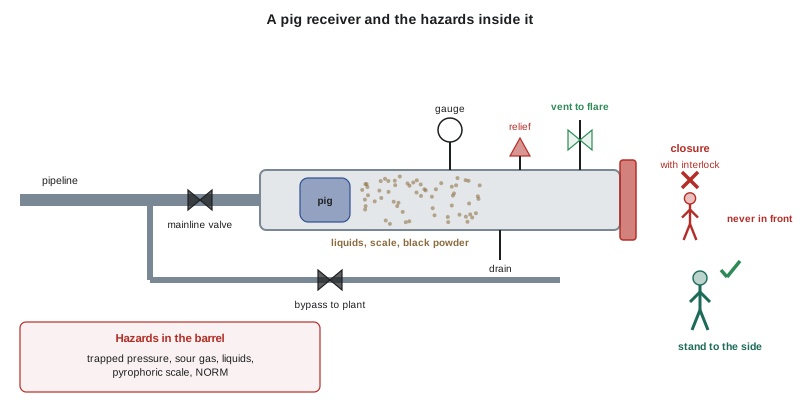
The most dangerous moment: opening the closure
Pigging procedures differ in detail, but every one has the same critical point: before the closure is opened, the barrel must be isolated from the pipeline, depressured to zero, drained and, in sour or hazardous service, purged. If pressure remains when the closure is opened, it can throw the closure, the pig and the contents of the barrel out with tremendous force. The US offshore regulator's Safety Alert No. 173 describes a 1997 incident in which two workers on a Gulf of Mexico platform were killed while trying to vent a 16-inch gas pipeline through the lid of a pig launcher that had no gauge or relief valve. With all valves closed, they could not tell that roughly 1,020 psi (about 7,000 kPa) was still trapped inside; when they began opening the lid, the gas tore it off its hinges. The alert recommended gauges and relief valves on all traps and not using closures to blow down lines.
The force on a closure is large even at modest pressures, because it acts over the whole area of the door. The program below calculates the force on closures of different sizes at residual pressures that a worker might not notice on a coarse gauge.
# Force on a pig trap closure from residual pressure (F = P x A).
import math
for nps, door_id_in in (("NPS 8", 10.0), ("NPS 12", 14.0), ("NPS 16", 18.0)):
    area = math.pi * door_id_in ** 2 / 4                    # in2 (barrel is one size larger)
    for p_psi in (5, 15, 100):
        force_lb = p_psi * area
        print(f"{nps} trap, {p_psi:>3} psi residual: {force_lb:7,.0f} lbf "
f"(about {force_lb/2000:4.1f} tons)")NPS 8 trap, 5 psi residual: 393 lbf (about 0.2 tons) NPS 8 trap, 15 psi residual: 1,178 lbf (about 0.6 tons) NPS 8 trap, 100 psi residual: 7,854 lbf (about 3.9 tons) NPS 12 trap, 5 psi residual: 770 lbf (about 0.4 tons) NPS 12 trap, 15 psi residual: 2,309 lbf (about 1.2 tons) NPS 12 trap, 100 psi residual: 15,394 lbf (about 7.7 tons) NPS 16 trap, 5 psi residual: 1,272 lbf (about 0.6 tons) NPS 16 trap, 15 psi residual: 3,817 lbf (about 1.9 tons) NPS 16 trap, 100 psi residual: 25,447 lbf (about 12.7 tons)
A residual pressure that looks like zero on a gauge reading in thousands can still push on a closure with a force equal to the weight of a car. That is why procedures require more than one confirmation of zero pressure: a gauge with a suitable range, an open vent showing no flow, the closure's pressure-warning device and a check that the vent is not plugged by hydrates, wax or debris. And it is why the worker opening a closure always stands to the side of the door, never in front of it, and opens it slowly so that any trapped pressure shows itself before the door is free.
Other hazards of receiving pigs
When a pig arrives, it brings everything it has swept from the line. In a wet sour gas line that can include:
| What arrives | Hazard | Typical controls |
|---|---|---|
| Liquid slug of water and condensate | Overfills receivers, separators and slug catchers; flammable liquids | Plan receiving capacity, slow the pig, monitor levels |
| Sour gas and gas in liquids | H2S exposure when the barrel is vented, drained or opened | Purge, gas test, breathing protection as assessed, upwind position |
| Black powder and fine solids | Dust exposure, valve and filter damage | Keep wet, respiratory protection, filtration |
| Iron sulfide scale | Pyrophoric ignition when exposed to air | Keep debris wet, remove to a water-filled container |
| NORM-bearing scale and sludge | Radiation exposure, mainly by inhaling or swallowing dust | Survey debris, wet handling, controlled disposal |
| Wax and hydrates | Plug vents and drains, hiding trapped pressure | Confirm vents are clear, methanol, controlled heat |
| Stuck or damaged pig | Pressure build-up behind the pig, line damage | Track the pig, engineering plan before raising differential pressure |
Liquid slugs are a process hazard as well as a handling hazard. A gathering line that has not been pigged for a long time can hold a large volume of liquid at low points, and a pig can push it all into the receiving facility within minutes. If the slug catcher or inlet separator cannot hold it, liquid carries over into compressors, which can be destroyed, or into flare systems, causing burning liquid at the flare as Lesson 6 described. The program below estimates the liquid a pig might push ahead of it in an invented line and compares it with the receiving capacity.
# Liquid that a pig may push into the receiving facility (invented gathering line).
import math
length_ft = 14 * 5280      # Kettle Creek to Spruce Ridge
inner_d_ft = 12.19 / 12    # NPS 12, 0.281 in wall
holdup = 0.02              # fraction of line volume occupied by liquid before pigging (assumed)
line_volume_bbl = math.pi * inner_d_ft ** 2 / 4 * length_ft / 5.615
slug = line_volume_bbl * holdup
capacity = 160.0           # usable slug catcher volume between normal and high-high level, bbl

print(f"Line volume: {line_volume_bbl:,.0f} bbl")
print(f"Expected liquid ahead of the pig: about {slug:,.0f} bbl")
print(f"Slug catcher usable volume: {capacity:.0f} bbl")
if slug > capacity:
    print(f"Excess of {slug - capacity:.0f} bbl: pig more often, reduce the rate or drain ahead")
else:
print("Within capacity")Line volume: 10,670 bbl Expected liquid ahead of the pig: about 213 bbl Slug catcher usable volume: 160 bbl Excess of 53 bbl: pig more often, reduce the rate or drain ahead
In this invented case the slug would exceed the receiving capacity, so the operators would need to pig more often, run the pig more slowly so that liquid arrives over a longer time, or plan to drain liquids ahead of the pig. Coordinating pig runs between the launching and receiving sites, and with the control room, is therefore part of every pigging plan.
Handling pigs and inspection tools
Pigs and inspection tools are heavy, awkward and sometimes contaminated. Large steel pigs and smart tools are moved with cranes, loading trays and specialized handling equipment, under lift plans covered in HSE-219. Removed pigs may carry sour liquids, iron sulfide and NORM, so they are washed down, kept wet and surveyed before they are handled closely or shipped. Workers wear chemical-resistant gloves and clothing, eye protection and the respiratory protection the task assessment requires. Inspection tool vendors bring their own procedures and may need to handle the tool's batteries, which are often lithium cells with their own fire hazards.
Pipeline maintenance work
Beyond pigging, pipeline maintenance includes valve servicing, repairs to defects found by inspection, replacing sections, adding connections and abandoning old lines. Several of these tasks carry distinctive hazards.
Excavation digs to examine or repair a pipe bring trenching hazards, work beside a pressurized line and, if the pipe is leaking, a flammable or toxic atmosphere in the trench. Before a dig on a line with a known defect, operators usually reduce the pipeline's pressure to a safe level, often a set percentage below the pressure at which the defect could fail. Workers in the excavation need protective systems against cave-in, gas monitoring and a clear escape route.
Repairs may use full-encirclement steel sleeves, composite wraps or clamps over a defect, or cut out the damaged section. Cutting out a section requires isolating, blowing down and purging the segment, which can release large volumes of gas to the flare or atmosphere, and then welding in new pipe, which brings hot work hazards under HSE-216.
Hot tapping is the technique of welding a fitting onto a live, pressurized pipeline and cutting into it with a special machine, so that a new connection can be made without shutting down the line. It avoids a blowdown but carries serious risks: burn-through, where the welding arc penetrates the thin, pressurized wall; cracking of welds cooled quickly by flowing gas; and failure of the tapping machine or fitting. Hot tapping is done only by qualified crews under engineering procedures that set minimum wall thickness, flow and pressure limits, with H2S and fire controls in place. Field workers who are not on the hot tap crew should stay clear of the work area.
Blowdowns of pipeline segments, to repair or tie in a line, vent or flare large volumes of gas. A blowdown stack can produce high noise, cold temperatures at the valve and stack, a flammable or toxic plume if vented and radiation if flared. Blowdowns are planned for the weather, notified to neighbors and regulators as required, and done with the area controlled.
Worked problem
Receiving a pig at Spruce Ridge
The night operator at Spruce Ridge is told that a cleaning pig launched from Kettle Creek has arrived in the receiver. The barrel gauge, which reads up to 1,450 psi (10,000 kPa), shows close to zero after he closed the mainline valve and opened the vent to flare. He is preparing to open the closure to remove the pig. What should he check and how should he proceed?
Show solution
- Confirm that the barrel is isolated from the mainline and that the bypass is set as the procedure requires.
- Do not trust a coarse gauge reading close to zero: confirm zero with the vent open and flowing freely, check that the vent and drain are not plugged by hydrates or wax, and check the closure's pressure-warning device.
- Drain liquids to the closed drain and purge the barrel as the sour service procedure requires, then gas test at the vent.
- Wear the assessed breathing protection and monitors, stand to the side of the closure and open it slowly, ready to stop if any pressure or gas appears.
- Keep the debris wet, check it for NORM and pyrophoric material, and remove the pig with suitable handling equipment.
Answer: A near-zero reading on a high-range gauge is not proof of zero pressure. Multiple confirmations, purging, correct body position and slow opening protect the operator from the trapped pressure that has killed workers at pig traps.
Common mistakes
MistakeOpening a closure because the gauge looks close to zero.
InsteadConfirm zero with an open, flowing vent, a clear drain, the pressure-warning device and a suitable gauge.
MistakeStanding in front of a closure while opening it.
InsteadStand to the side and open slowly.
MistakeLaunching a pig without telling the receiving facility.
InsteadCoordinate every pig run with the receiving site and control room.
MistakeLeaving pig debris to dry out in the sun.
InsteadKeep debris wet, survey it for NORM and dispose of it as directed.
MistakeWatching a hot tap from beside the fitting.
InsteadStay clear unless you are part of the qualified hot tap crew.
Summary and key terms
- Pigs clean lines, remove liquids, separate products, gauge geometry, carry inspection tools and spread inhibitor.
- Launchers and receivers are pressure vessels with closures, isolation valves, vents, drains, gauges, relief valves and interlocks.
- Opening a closure with trapped pressure can kill; even small residual pressures produce large forces on a closure.
- Confirm zero pressure in several ways, check that vents are not plugged, stand to the side and open slowly.
- Pigs push liquids, sour gas, black powder, pyrophoric scale and NORM into receivers, which must be planned for.
- Liquid slugs can overwhelm slug catchers and damage compressors, so pig runs are coordinated with the receiving facility.
- Digs, repairs, hot taps and blowdowns each carry distinctive hazards and need qualified crews and controlled work areas.
- Pig
- A device sent through a pipeline by the flow to clean, separate, gauge or inspect it.
- Launcher
- The pig trap where a pig is loaded into a pipeline.
- Receiver
- The pig trap where a pig is removed from a pipeline.
- Closure
- The door on a pig trap that is opened to load or remove a pig.
- Pressure-warning device
- A device on a closure that warns or prevents opening while the barrel is pressurized.
- Slug catcher
- A vessel or piping array that receives and holds liquid slugs arriving from a pipeline.
- Black powder
- Fine iron sulfide and oxide particles that collect in gas pipelines.
- Hot tapping
- Making a connection to a live, pressurized pipeline by welding on a fitting and cutting through.
Practice problems
Work each problem on paper first, then reveal the answer to check.
Name four reasons for pigging a pipeline.
Show answer
Any four of: cleaning, liquid removal, batching, dewatering, gauging, inspection, chemical treatment.
What is a kicker line used for?
Show answer
To divert flow behind the pig to launch it.
What did the 1997 offshore incident show?
Show answer
A launcher without a gauge or relief valve held trapped pressure that killed two workers when the lid was opened.
Why can a small residual pressure be dangerous on a closure?
Show answer
It acts over the whole door area and produces a very large force.
Give three ways to confirm a barrel is at zero pressure.
Show answer
A suitable-range gauge, an open vent flowing freely, a clear drain and the closure pressure-warning device.
Where should a worker stand when opening a closure?
Show answer
To the side of the door, never in front of it.
Why must pig runs be coordinated with the receiving facility?
Show answer
The liquid slug can overfill slug catchers and damage compressors.
Why are pig debris kept wet?
Show answer
To prevent pyrophoric ignition and dust exposure, including NORM dust.
What is burn-through in hot tapping?
Show answer
The welding arc penetrating the thin, pressurized pipe wall.
Why are pipeline pressures often reduced before digs on known defects?
Show answer
To keep the defect well below the pressure at which it could fail while people work beside it.
Lesson quiz · 5 questions
Score 60% or more to complete this lesson.
Create a free account to save your progress, take quizzes and earn a certificate.