
HSE-321 · Lesson 3 of 12 · 28 min
Qualified and unqualified persons, training and roles
Almost every electrical safety rule depends on one question: is this person qualified for this task on this equipment? The answer decides who may cross the limited approach boundary, who may open a panel, who may test for absence of voltage, who may operate a switching device and who may work on energized parts under a permit. HSE-214 Lesson 8 introduced qualified and unqualified persons, and HSE-224 Lesson 2 explained how an electrical safety program defines them. This lesson applies those ideas to the many roles found in a critical facility, where a single maintenance window can involve a dozen people with very different skills, and where being qualified on one piece of equipment does not mean being qualified on the one beside it.
What qualified means
Both CSA Z462 and NFPA 70E define a qualified person as one who has demonstrated skills and knowledge related to the construction and operation of electrical equipment and installations and has received safety training to identify the hazards and reduce the associated risk. Three features of this definition matter in data centers.
First, qualification is specific. A person can be qualified for some equipment and tasks and unqualified for others. A licensed electrician who installs branch circuits every day may be unqualified to rack a medium-voltage breaker or to work inside a particular model of UPS. Most data center electrical safety programs therefore record qualification by equipment type and task, not just by trade.
Second, qualification must be demonstrated. A certificate of trade, a license or a training course is evidence of knowledge, but the standards require the employer to determine, through observation or another method, that the person can actually perform the task safely. Many critical facilities use task-specific sign-offs, where an experienced qualified person observes the worker performing the task, often several times, before the worker is authorized to do it alone.
Third, qualification includes safety knowledge, not only technical skill. A qualified person must be able to distinguish exposed energized parts from other parts, determine the nominal voltage, know the approach distances and boundaries, select and use PPE and test instruments correctly, and perform the risk assessment and job planning that the standards require. An excellent technician who cannot explain the arc flash label on the equipment in front of them is not qualified for energized tasks on it.
Unqualified persons in a data hall
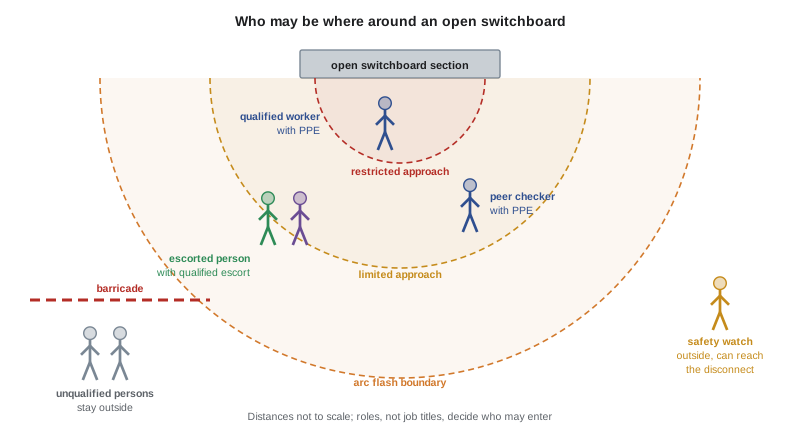
Most of the people in a data center on a typical day are unqualified persons for electrical purposes, and that is entirely appropriate. IT technicians install servers, cable installers run fiber, security officers patrol and cleaners clean. They need electrical awareness training, which HSE-320 provided: recognizing electrical rooms and equipment, staying outside the limited approach boundary unless escorted by a qualified person, never opening panels, never touching busway or tap-off units, knowing where EPO buttons are and how to avoid pressing them accidentally, and knowing what to do in an electrical emergency.
Data centers also create some gray areas that the program must settle clearly:
- Plugging server power cords into rack PDUs is normally treated as an ordinary task for trained IT staff, because the plugs and receptacles are designed for it. Plugging tap-off units into energized busway is different: it involves a higher-energy system and is treated by most sites as electrical work by qualified persons, and Lesson 9 discusses when it is permitted energized.
- Resetting a tripped breaker on a rack PDU may be allowed for trained IT staff; resetting a breaker in an RPP or a branch panel should be reserved for qualified persons, and only after the cause of the trip is understood.
- Reading values on a UPS front panel or monitoring screen is not electrical work. Opening the UPS cabinet doors is.
- Infrared scanning through closed IR windows can be done by trained thermographers who are not electricians, but removing covers for an infrared scan is energized work by qualified persons (Lesson 11).
Roles in a critical facility
Beyond the basic split between qualified and unqualified, a critical facility electrical safety program usually defines several specific roles. The names vary, but the functions are common.
| Role | Typical holder | Main responsibilities |
|---|---|---|
| Electrical safety program owner | Senior facilities or safety manager | Owns the program, approves procedures, ensures audits and training |
| Qualified electrical worker | Licensed electrician, critical environment technician | Performs electrical tasks for which they are qualified; applies locks; tests for absence of voltage |
| Switching authority | Designated operations engineer or chief engineer | Approves and directs switching on the critical power system; holds switching orders |
| Switching operator and peer checker | Qualified operators | Execute switching steps; independently verify each step before it is performed |
| Lockout coordinator | Operations engineer or lead electrician | Controls group lockout, lockbox and the energy isolation record |
| Energized work approver | Facility manager or delegated senior person | Reviews justification and approves or rejects energized work permits |
| Safety watch (standby person) | Qualified person trained in contact release, CPR and AED | Watches energized work, ready to de-energize and to rescue |
| Manufacturer field service engineer | UPS, switchgear or generator vendor | Performs model-specific work under the site program and MOP |
| Unqualified person | IT technicians, cable installers, security, cleaners, visitors | Stays outside the limited approach boundary unless escorted; follows awareness rules |
The switching authority role deserves special attention. In a data center, the act of opening or closing a breaker affects not only the worker but also the critical load. A mistaken switching step can drop thousands of servers, and the wrong breaker opened during an isolation can leave the equipment being worked on still energized. For both reasons, most facilities restrict switching on the critical power system to a small group of authorized operators, working from written switching orders with independent peer verification at each step. Lesson 8 covers switching in detail.
The safety watch role also matters more in critical facilities than in many other workplaces, because energized work, when it is justified, may take place in confined electrical rooms at night with few people around. Both CSA Z462 and NFPA 70E expect the job planning for energized work to consider whether a standby person is needed. That person must be trained and ready to de-energize the equipment if possible, to release a victim from contact safely, to call for help and to start CPR and use an AED.
Training requirements
Training is how people become qualified and stay qualified. The standards require training that is appropriate to the person's duties and the hazards they face, delivered in the classroom, on the job or both, and documented. For qualified persons in a critical facility, a training program typically covers the following.
- The site electrical safety program, its procedures and forms.
- The specific power systems of the site: the one-line diagram, the redundancy scheme, the location and function of every isolation point and the behavior of the UPS, generators, transfer switches and STSs.
- Hazard recognition, shock and arc flash risk assessment and reading arc flash labels.
- Establishing an electrically safe work condition in redundant systems, including group lockout.
- Selection, inspection, use and care of PPE, insulating gloves and test instruments.
- Switching orders and peer verification.
- Energized work justification and permits.
- Emergency response: contact release, first aid, CPR and AED.
- Manufacturer training for the specific UPS, switchgear and generator models the person will work on.
Both standards set intervals. Retraining in safety-related work practices must occur at intervals not exceeding three years, and sooner when an audit or supervision shows that the person is not following the practices, when new technology or equipment is introduced, or when the person must use practices they do not normally use. Training in methods of releasing victims from contact with exposed energized conductors must be refreshed annually for employees exposed to shock hazards. First aid, CPR and AED training must be kept current, and the employer must verify it at least annually. The employer must also document the training, including the content, the date and the name of each person trained.
Critical facilities usually add a site qualification step on top of trade qualification and standards training. A new electrician joining the site team, however experienced, spends time learning the site's one-line diagrams, walking down every switchboard and UPS, shadowing switching operations and passing a site-specific assessment before being added to the list of people authorized to work on the critical power system.
Auditing qualified persons
Training alone does not guarantee safe work. The standards require employers to audit the work of qualified persons in the field, at intervals not exceeding one year, to confirm that the procedures in the electrical safety program are being followed. The program itself must be audited at intervals not exceeding three years. When an audit finds gaps, the employer must change the program, retrain workers or both.
In a data center, field audits fit naturally into the MOP process. A supervisor or safety professional can observe a planned maintenance task, checking that the switching order is followed step by step with peer verification, that locks are applied at every isolation point, that absence of voltage is tested correctly, that PPE matches the label and that the job briefing covered the hazards. These observations are the best evidence that the program works in practice.
The code below shows a simple training records check of the kind a site might run each month, flagging qualified persons whose retraining, contact release training or field audit is overdue. Real sites use learning management systems, but the logic is the same.
import random
from datetime import date, timedelta

# Illustrative training records check (seeded so the output is repeatable).
random.seed(321)
TODAY = date(2026, 10, 1)
LIMITS = {"safety_practices": 3 * 365, "contact_release": 365, "cpr_aed_check": 365, "field_audit": 365}
names = ["Ahmed", "Beatriz", "Chen", "Dana", "Emeka", "Farah"]

def last_done(max_days):
    return TODAY - timedelta(days=random.randint(30, int(max_days * 1.3)))

records = {n: {k: last_done(v) for k, v in LIMITS.items()} for n in names}
for name, rec in records.items():
    overdue = [k for k, d in rec.items() if (TODAY - d).days > LIMITS[k]]
    status = "OK" if not overdue else "OVERDUE: " + ", ".join(overdue)
    print(f"{name:8s} {status}")

allowed = [n for n, rec in records.items()
           if all((TODAY - d).days <= LIMITS[k] for k, d in rec.items())]
print("Authorized for critical power work this month:", allowed)Ahmed OK Beatriz OVERDUE: safety_practices, field_audit Chen OK Dana OVERDUE: safety_practices Emeka OVERDUE: contact_release Farah OK Authorized for critical power work this month: ['Ahmed', 'Chen', 'Farah']
The output shows how quickly records drift. A site that schedules maintenance windows months ahead should check qualification status when the MOP is approved and again on the day, so that a person whose contact release training has lapsed is not assigned as the safety watch for energized work.
Worked problem
Assigning roles for a maintenance window
Cedar Ridge Colocation is planning a night maintenance window to replace a failed breaker in the A-side low-voltage distribution switchboard in Hall 1. Available people are: Dana, a licensed electrician on the site team, qualified on all A-side switchboards and an authorized switching operator; Emeka, an operations engineer and the site's switching authority; Farah, a contract electrician who is qualified on switchboards generally but is new to the site; and Chen, an IT technician. How should roles be assigned?
Show solution
- Emeka, as switching authority, approves the switching order and directs the switching from the operations center or on site.
- Dana performs the switching steps, with a second authorized operator as peer checker; if no second operator is available, Emeka can act as peer checker if he is qualified to do so.
- Farah can work on the de-energized breaker once the electrically safe work condition is established, applying her personal lock to the group lockbox, but she should not operate critical power switching until she has completed the site qualification.
- A lockout coordinator, likely Dana or Emeka, controls the group lockout and the energy isolation record.
- Chen stays outside the electrical room. If server owners need to be told about the window, he can coordinate with customers, but he has no electrical role.
Answer: Emeka holds switching authority, Dana switches with an independent peer checker and coordinates lockout, Farah performs the de-energized replacement under group lockout and Chen has no electrical role. Qualification is matched to each task, not to job titles.
When people are not sure
The most important behavior you can expect from qualified and unqualified persons alike is to stop when they are unsure. A qualified electrician who finds that the equipment in front of them does not match the drawings, that a label is missing or that a breaker will not open as expected must stop, make the situation safe and ask, rather than improvising. An IT technician asked by a contractor to hold a panel cover or pass a tool inside a limited approach boundary should decline. A well-run critical facility rewards this behavior; Lesson 8 shows how the switching process builds in hold points for exactly this reason.
Common mistakes
MistakeTreating a trade license as qualification for every task on every piece of equipment.
InsteadRecord and demonstrate qualification by equipment type and task, including manufacturer training for specific UPS and switchgear models.
MistakeLetting a contractor who is new to the site operate critical power switching on the first night.
InsteadRequire site qualification, including one-line diagram training and walk-downs, before adding anyone to the switching authority list.
MistakeAssigning a safety watch whose contact release training has lapsed.
InsteadCheck training status when the MOP is approved and on the day of the work.
MistakeAllowing a worker to approve their own energized work permit.
InsteadKeep the energized work approver separate from the person doing the work.
MistakeRelying on classroom training without checking how people actually work.
InsteadAudit qualified persons in the field at least once a year and use the findings to improve the program.
Summary and key terms
- A qualified person has demonstrated skills and knowledge of the equipment and received safety training to identify hazards and reduce risk.
- Qualification is specific to equipment and tasks, must be demonstrated and includes safety knowledge.
- Unqualified persons, the majority in a data hall, need awareness training and must stay outside the limited approach boundary unless escorted by a qualified person.
- Critical facilities define roles such as switching authority, switching operator and peer checker, lockout coordinator, energized work approver and safety watch.
- Retraining is required at intervals not exceeding three years, contact release training annually, with first aid, CPR and AED verified annually.
- Field audits of qualified persons are required at least annually and program audits at least every three years.
- Qualified person
- A person who has demonstrated the skills and knowledge for specific electrical equipment and tasks and received safety training to identify and reduce the hazards.
- Unqualified person
- A person who is not qualified for a particular electrical task or piece of equipment.
- Switching authority
- The person or role that approves and directs switching on the critical power system.
- Peer checker
- A second qualified person who independently verifies each switching or isolation step before it is carried out.
- Safety watch
- A trained person who observes energized work, ready to de-energize equipment and perform rescue and first aid.
- Contact release
- Methods of safely separating a victim from an energized conductor.
- Site qualification
- A site-specific assessment that confirms a worker knows the facility's systems before being authorized to work on them.
- Field audit
- An observation of work in progress to confirm that safety procedures are being followed.
Practice problems
Work each problem on paper first, then reveal the answer to check.
What three features of the definition of a qualified person matter most in data centers?
Show answer
Qualification is specific to equipment and tasks, it must be demonstrated, and it includes safety knowledge.
Can an experienced electrician be unqualified for a task? Give an example.
Show answer
Yes; for example racking a medium-voltage breaker or working inside an unfamiliar UPS model.
Why is plugging tap-off units into energized busway treated differently from plugging servers into rack PDUs?
Show answer
Busway is a higher-energy system and the task is electrical work by qualified persons, not a routine plug-in.
What is the role of a peer checker in switching?
Show answer
To independently verify each step before it is carried out.
How often must retraining in safety-related work practices occur?
Show answer
At intervals not exceeding three years, and sooner when needed.
How often must contact release training be refreshed?
Show answer
Annually for employees exposed to shock hazards.
How often must qualified persons be audited in the field?
Show answer
At intervals not exceeding one year.
Why should the energized work approver be separate from the worker?
Show answer
So that the justification is independently challenged rather than self-approved.
What should a qualified electrician do if equipment does not match the drawings?
Show answer
Stop, make the situation safe and ask before proceeding.
What does site qualification add to trade qualification?
Show answer
Knowledge of the specific facility: one-line diagrams, isolation points, redundancy and equipment behavior, confirmed by assessment.
Lesson quiz · 5 questions
Score 60% or more to complete this lesson.
Create a free account to save your progress, take quizzes and earn a certificate.