
HSE-313 · Lesson 7 of 12 · 27 min
Housekeeping and fugitive dust control
Lesson 2 showed that settled dust is the fuel for secondary explosions, and Lesson 1 showed that secondary explosions caused most of the deaths in the major incidents. Controlling dust that escapes from equipment is therefore one of the most important things a facility can do. This lesson covers two linked ideas. Fugitive dust control keeps dust inside the equipment in the first place. Housekeeping removes the dust that escapes before it builds up to a dangerous level. Neither is enough alone: a plant that relies only on cleaning will always be chasing dust, and a plant that relies only on containment will still have leaks.
HSE-106 introduced housekeeping as a way to prevent slips, trips and falls. In a combustible dust area, housekeeping takes on a much more serious role, and the methods used must not themselves create a cloud or an ignition source.
Start at the source: fugitive dust control
The best place to control dust is where it is generated. Equipment should be enclosed as far as practical, with seals at shafts, doors and inspection ports kept in good repair. Transfer points between conveyors, chutes and bins are common leak points and can be fitted with enclosures and local exhaust. Bag dumping stations should have hoods with exhaust. Leaking flanges, worn seals and damaged ducts should be repaired promptly rather than tolerated. The dust collection system described in Lesson 8 must be designed and balanced so that it captures dust at each source and keeps enough air velocity in the ducts to prevent dust from settling inside them.
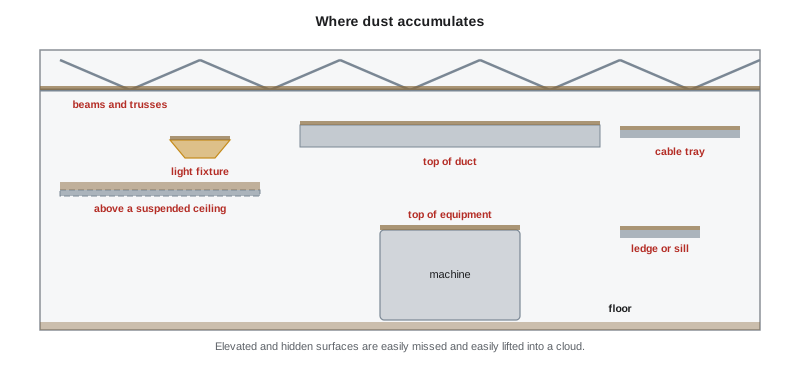
Building design also matters. Flat horizontal surfaces such as ledges, beam flanges, cable trays and the tops of equipment collect dust. Where practical, such surfaces can be eliminated, sloped steeply so that dust slides off, or enclosed. Suspended ceilings and other concealed spaces should be sealed so that dust cannot get into them, or provided with access so they can be inspected and cleaned. Lesson 1 described how dust above a suspended ceiling fueled the West Pharmaceutical explosion.
How much dust is too much?
A layer of dust that seems thin can produce a dangerous cloud if lifted into a room. A widely used rule of thumb, long used in NFPA 654 and its guidance, is that a dust layer about 1/32 inch thick (about 0.8 mm) covering more than 5 percent of the floor area of a room is enough to present a hazard. For a typical organic dust, a layer 1/32 inch thick is roughly as thick as a paper clip wire, and it is thin enough that you can still see the color of the surface beneath it. If you can write your name in the dust, it is probably already too thick.
The rule was based on a dust with a bulk density of about 75 lb/ft³ (1,200 kg/m³). Lighter dusts can be allowed a proportionally thicker layer for the same mass, and denser dusts a thinner layer. NFPA 660 now uses more detailed methods for building compartments that consider the mass of dust, the room volume and the properties of the dust, but the 1/32 inch rule remains a useful quick check during inspections. Always confirm the criterion used in your facility's DHA.
Worked problem
Applying the 5 percent area rule of thumb
A packing room is 80 ft by 130 ft. During an inspection you estimate that 650 ft² of surfaces (floor, beams, ledges and equipment tops) are covered by dust about 1/25 inch thick. Using the rule of thumb of 1/32 inch over more than 5 percent of the floor area, is the room over the criterion?
Show solution
- Floor area = 80 × 130 = 10,400 ft².
- 5 percent of the floor area = 0.05 × 10,400 = 520 ft².
- The layer is about 1/25 inch, which is thicker than 1/32 inch, so it counts.
- The dusty area is 650 ft², which is more than 520 ft².
- Elevated surfaces count toward the total, and dust on high surfaces is more easily dispersed.
Answer: Yes. The room exceeds the rule of thumb and needs cleaning now, and the source of the escaping dust should be found and fixed.
Measuring layer depth
In practice, layer depth is estimated during inspections by comparing the dust with a known reference, using a depth gauge or a simple comb gauge, or by scraping a measured area and weighing the collected dust. Weighing gives the most reliable result and also gives the mass per unit area, which is what the more detailed NFPA methods use. Inspectors should look up as well as down: the tops of beams, ducts, light fixtures and equipment are often dustier than the floor, and dust there falls more easily into the air.
Accumulation rate and cleaning frequency
The right cleaning frequency depends on how fast dust accumulates. If you know the rate, you can calculate how long it takes to reach the action level and set a schedule with a safety margin. Rates are found by cleaning an area thoroughly and measuring the depth or mass of dust that builds up over a known time. Different areas will have different rates; the area next to a leaking transfer point may need cleaning every shift, while a storage room may need it monthly. A facility should set an action level well below the hazard criterion so that cleaning happens long before the criterion is reached.
Worked problem
Setting a cleaning frequency
Measurements show dust accumulating on beams above a sanding line at about 0.002 inch per day. The facility sets an action level at half the 1/32 inch (0.031 inch) rule of thumb. How often should the beams be cleaned?
Show solution
- Action level = 0.031 ÷ 2 ≈ 0.016 inch.
- Days to reach action level ≈ 0.016 ÷ 0.002 ≈ 8 days.
- Set a schedule shorter than this, for example weekly, and verify by inspection.
- Investigate why so much dust reaches the beams and fix the source.
Answer: About every 8 days to reach the action level, so clean at least weekly while working to reduce the source.
# Cleaning interval from measured accumulation rates (illustrative values)
criterion_mm = 0.8          # rule-of-thumb layer depth
action_fraction = 0.5       # clean at half the criterion
areas = {
    "Beams above sanding line": 0.05,   # mm per day
    "Floor near bag dump":      0.20,
    "Warehouse racking":        0.01,
    "Top of dust collector duct": 0.04,
}
action = criterion_mm * action_fraction
for area, rate in areas.items():
    days = action / rate
print(f"{area:28s} rate {rate:.2f} mm/day -> reach {action:.1f} mm in {days:5.1f} days")Beams above sanding line rate 0.05 mm/day -> reach 0.4 mm in 8.0 days Floor near bag dump rate 0.20 mm/day -> reach 0.4 mm in 2.0 days Warehouse racking rate 0.01 mm/day -> reach 0.4 mm in 40.0 days Top of dust collector duct rate 0.04 mm/day -> reach 0.4 mm in 10.0 days
Cleaning methods
How dust is cleaned matters as much as how often. The wrong method can create the very cloud and ignition source that housekeeping is meant to prevent.
| Method | When appropriate | Precautions |
|---|---|---|
| Vacuum cleaning | Preferred method for most combustible dust | Use vacuums designed and approved for combustible dust in the area; bond and ground; use conductive hoses |
| Sweeping and scooping | Coarser dust and floors where vacuum is impractical | Use soft brooms and gentle technique to avoid raising a cloud; use non-sparking tools where needed |
| Water wash-down | Where water does not react with the dust or create other hazards | Never use on water-reactive metal dusts; consider electrical equipment and slip hazards |
| Compressed air blowdown | Only where other methods are impractical, as a last resort | Clean by vacuum first, shut down and control ignition sources, use reduced pressure, keep people clear and clean the area afterward |
| Central vacuum system | Large facilities with frequent cleaning needs | Design as part of the dust collection system with its own explosion protection |
Ordinary shop vacuums and household vacuums are not suitable for most combustible dusts. Their motors and switches can ignite a dust cloud inside the vacuum, and their plastic hoses and bodies can build up static charge. Vacuums for combustible dust should be designed and approved for the material and the hazardous location, as discussed in Lesson 10. For metal dusts, special vacuums are often required, and some wet-type vacuums used for metal dust can produce hydrogen.
Compressed air blowdown deserves special attention because it was a common practice in many of the incident facilities. Blowing dust off beams creates exactly the kind of cloud that fuels an explosion. NFPA standards permit blowdown only after other cleaning methods have been used as far as practical and only with precautions, such as shutting down and controlling ignition sources in the area. OSHA's rule on compressed air for cleaning, 29 CFR 1910.242(b), also limits nozzle pressure to less than 30 psi when dead-ended and requires chip guarding and personal protective equipment.
A housekeeping program
A written housekeeping program turns good intentions into reliable practice. It should identify each area and surface to be cleaned, the method to be used, the frequency, who is responsible, and how completion is recorded. It should include periodic inspection of hidden and elevated surfaces, which are often missed. It should also include a way to report and fix leaks quickly, because a housekeeping program that cleans the same leak every shift for a year is treating a symptom. NFPA 660 expects housekeeping frequency and methods to be addressed in the DHA and in written procedures.
Unscheduled cleaning is also needed after spills, upsets and leaks. A spill of fine powder from a burst bag or a failed seal can exceed the accumulation criterion in minutes. Procedures should require prompt cleaning of such releases before normal work continues.
A simple inspection routine
Supervisors and safety representatives can check housekeeping with a short routine at the start of each shift or week. Walk the area and look up before looking down: check roof trusses, beams, cable trays, duct tops, light fixtures and heater tops, then ledges, window sills and the tops of machines, and finally the floor. Compare what you see with the action level, using a depth gauge or the weighing method where there is doubt. Note any area above the action level, find the leak or source that is feeding it, and record both the cleaning and the repair. Photographs taken from the same spot each time make trends easy to see. Over a few months, these records show whether the program is keeping ahead of the dust or falling behind, and they give the dust hazard analysis team real data rather than impressions.
Common mistakes
MistakeBlowing dust off beams with compressed air as routine cleaning.
InsteadVacuum first; use blowdown only as a last resort with ignition control and reduced pressure.
MistakeUsing an ordinary shop vacuum for combustible dust.
InsteadUse vacuums designed and approved for combustible dust in the hazardous location.
MistakeCleaning only floors and visible areas.
InsteadInspect and clean elevated and hidden surfaces such as beams, duct tops and ceiling spaces.
MistakeCleaning the same leak every shift without fixing it.
InsteadTreat recurring accumulation as a sign of a leak and repair the source.
MistakeUsing water to wash down aluminum or magnesium dust.
InsteadUse methods suitable for water-reactive metals, as set out in the DHA and NFPA 660.
Summary and key terms
- Fugitive dust control keeps dust in equipment; housekeeping removes what escapes.
- A long-used NFPA 654 rule of thumb treats about 1/32 inch (0.8 mm) of dust over more than 5 percent of the floor area as a hazard.
- Elevated and hidden surfaces count and are often the most dangerous accumulations.
- Cleaning frequency should be based on measured accumulation rates, with an action level well below the criterion.
- Vacuum cleaning with approved equipment is preferred; compressed air blowdown is a last resort with precautions.
- Never use water on water-reactive metal dusts.
- A written housekeeping program covers areas, methods, frequency, responsibility, inspection and leak repair.
- Fugitive dust
- Dust that escapes from process equipment into the workplace.
- Housekeeping
- The regular removal of dust accumulations from surfaces.
- Accumulation rate
- How fast dust builds up on a surface, in depth or mass per unit time.
- Action level
- A dust depth or mass below the hazard criterion at which cleaning is triggered.
- Layer depth criterion
- A dust depth used to judge whether accumulations present a hazard.
- Bulk density
- The mass of a dust layer per unit volume, including the air between particles.
- Blowdown
- Cleaning surfaces with compressed air, which disperses dust into a cloud.
- Transfer point
- A place where material moves from one conveyor or piece of equipment to another.
- Concealed space
- A hidden area, such as above a suspended ceiling, where dust can collect unseen.
- Approved vacuum
- A vacuum cleaner designed and approved for use with combustible dust in hazardous locations.
Practice problems
Work each problem on paper first, then reveal the answer to check.
What is the difference between fugitive dust control and housekeeping?
Show answer
Fugitive dust control keeps dust inside equipment; housekeeping removes dust that escapes.
State the long-used NFPA 654 rule of thumb for layer depth.
Show answer
About 1/32 inch (0.8 mm) over more than 5 percent of the floor area.
A room is 20 m by 30 m. What is 5 percent of its floor area?
Show answer
0.05 × 600 = 30 m².
Dust builds up at 0.1 mm per day and the action level is 0.4 mm. How often should you clean?
Show answer
At least every 4 days, preferably more often, while fixing the source.
Why is compressed air blowdown dangerous?
Show answer
It disperses dust into a cloud that could ignite.
Why are ordinary shop vacuums unsuitable?
Show answer
Motors and switches can ignite dust, and plastic hoses can build static charge.
Why should elevated surfaces be a priority?
Show answer
Dust there is easily dispersed and often thicker than on the floor.
What should happen after a large powder spill?
Show answer
Clean it promptly before normal work continues.
How can building design reduce accumulations?
Show answer
Eliminate, slope or enclose flat surfaces and seal concealed spaces.
Why is water wash-down unsuitable for some metal dusts?
Show answer
Some metals react with water to produce hydrogen.
Lesson quiz · 5 questions
Score 60% or more to complete this lesson.
Create a free account to save your progress, take quizzes and earn a certificate.