
HSE-313 · Lesson 10 of 12 · 25 min
Hazardous locations and electrical equipment: NEC and CEC
Electrical equipment can ignite a dust cloud or a dust layer in two main ways: through arcs and sparks from switches, contacts and faults, and through hot surfaces on motors, lights and enclosures. Electrical codes control these ignition sources by classifying locations where combustible dust may be present and requiring equipment that is suitable for each classified location. This lesson explains how hazardous locations for combustible dust are classified in Canada and the United States, how the zone and division systems compare, what equipment protection methods mean, and how temperature markings are matched to the dust. Electrical design in classified locations must be carried out by qualified electrical professionals; the aim here is to understand the system well enough to recognize problems and work effectively with those professionals.
HSE-214 covers general electrical safety, and HSE-224 covers work on or near energized systems. Neither course addresses hazardous location equipment, which is the focus here.
Why classify?
Explosion-protected electrical equipment costs more than ordinary equipment and needs more careful installation and maintenance. Classification identifies where it is needed and to what degree. A location where an explosible cloud exists most of the time, such as the inside of a dust collector, needs the highest level of protection. A room where a cloud could exist only after an unusual leak needs a lower level. A clean office needs none. Classification also has a powerful effect on housekeeping: in many cases, an area can be classified at a lower level only if dust accumulations are kept under control. That makes housekeeping part of the electrical safety design, not just good practice.
The National Electrical Code
In the United States, electrical installations are governed by NFPA 70, the National Electrical Code (NEC), as adopted by states and local jurisdictions; the edition in force varies by state. OSHA's electrical standards, including 29 CFR 1910.307 for hazardous locations, also apply in workplaces. The NEC offers two systems for combustible dust. Article 500 and Article 502 use the traditional class and division method, in which combustible dust locations are Class II, Division 1 or 2, and fibers and flyings are Class III. Article 506 provides the zone system aligned with international IEC standards, with Zones 20, 21 and 22. In the United States, the class and division method remains the most widely used for dust, though the zone system is permitted.
The Canadian Electrical Code
In Canada, the Canadian Electrical Code, Part I (CSA C22.1), applies as adopted by each province and territory. Section 18 uses the zone system for new installations, with Zones 20, 21 and 22 for combustible dust. The class and division method is kept in an annex for existing installations and their extensions. The 2024 edition was current at the time of writing in 2026. Because Canada has moved new installations to zones while the United States still mainly uses divisions for dust, companies with plants in both countries need to be careful when transferring drawings and equipment specifications across the border.
Zones and divisions compared
| Zone (IEC-aligned) | Definition in plain terms | Typical example | Approximate division equivalent |
|---|---|---|---|
| Zone 20 | An explosible dust cloud is present continuously, for long periods or frequently | Inside a dust collector, silo, mill or pneumatic conveying line | Class II, Division 1 |
| Zone 21 | An explosible dust cloud is likely to occur occasionally in normal operation | Close to bag dumping stations, filling points or frequently opened equipment | Class II, Division 1 |
| Zone 22 | An explosible dust cloud is not likely in normal operation and, if it occurs, lasts only a short time | Around equipment that may leak only under abnormal conditions | Class II, Division 2 |
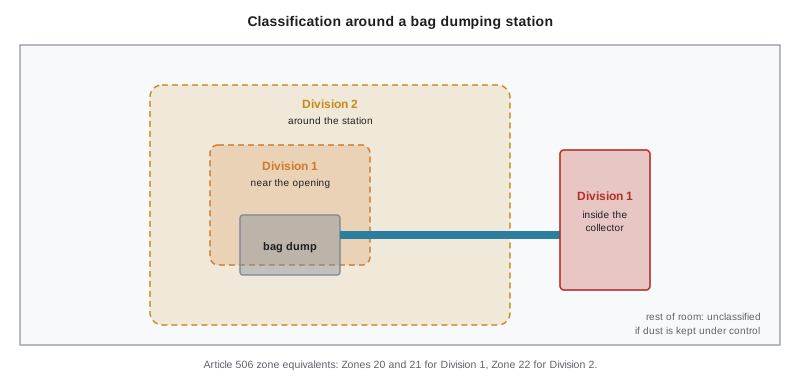
Under the division method, Class II locations are further divided into groups by the type of dust: Group E for combustible metal dusts, Group F for carbonaceous dusts such as coal and carbon black, and Group G for other combustible dusts such as flour, grain, wood, plastics and chemicals. Electrically conductive metal dusts are treated more strictly, and in the division method a location with Group E dust in hazardous quantities is generally Division 1. Under the zone method, dusts are grouped as IIIA for combustible flyings, IIIB for non-conductive dust and IIIC for conductive dust. Equipment marked for IIIC can be used for IIIB and IIIA, and equipment marked for IIIB can be used for IIIA, but not the other way round.
Deciding the extent of classified areas
The extent of each zone or division is decided by a qualified person using the DHA, test data and recognized guidance, such as NFPA 499 in the United States and IEC 60079-10-2 internationally. Important factors include where dust is released, how often and how much, how well the dust collection system controls the release, and how well housekeeping prevents accumulations. Accumulated dust layers can themselves create a classified location, because they can be raised into a cloud and can insulate equipment and cause overheating. If housekeeping fails, a location classified as Zone 22 or Division 2, or even an unclassified location, may need to be reclassified to a higher level. That is why classification drawings should be reviewed whenever processes, equipment or housekeeping practices change.
Equipment protection methods
Equipment for combustible dust locations is designed to prevent dust from entering in amounts that could ignite inside, and to keep its outer surface below temperatures that could ignite a cloud or a layer. The main protection methods are listed below. Equipment must be certified for the location and marked accordingly by a recognized certification body.
| Method | Marking (examples) | Principle |
|---|---|---|
| Dust-ignition-proof | Class II, Div 1, Groups E, F, G | A tight enclosure that excludes dust and keeps surfaces below ignition temperature (division method) |
| Dust-tight | Class II, Div 2 | An enclosure that excludes dust, used where clouds are not normally present (division method) |
| Protection by enclosure | Ex t (ta, tb, tc) | Enclosure that excludes dust and limits surface temperature (zone method) |
| Intrinsic safety | Ex i (ia, ib, ic) | Limits electrical energy so sparks and hot surfaces cannot ignite dust |
| Pressurization | Ex p | Keeps the enclosure at positive pressure with clean air so dust cannot enter |
| Encapsulation | Ex m | Encloses parts that could ignite dust in a compound |
Under the zone system, equipment is also given an equipment protection level (EPL). For dust, EPL Da is suitable for Zone 20 and also for Zones 21 and 22; EPL Db is suitable for Zones 21 and 22; and EPL Dc is suitable for Zone 22 only. Higher protection can always be used in a lower-hazard zone, never the reverse.
Temperature markings
Every piece of equipment for hazardous locations has a maximum surface temperature, shown either as an actual temperature or as a temperature class code. For dust, the actual maximum surface temperature, such as T135°C, is often marked directly. Temperature class codes from T1 to T6 are also used, with T1 allowing the highest surface temperature and T6 the lowest. The table below lists the common codes. The equipment's marked temperature must be below the safe surface temperature determined from the dust's cloud and layer ignition temperatures, as described in Lesson 3. Where dust layers are thicker than the test assumes, a lower limit is needed.
| Temperature class | Maximum surface temperature |
|---|---|
| T1 | 450 °C |
| T2 | 300 °C |
| T3 | 200 °C |
| T4 | 135 °C |
| T5 | 100 °C |
| T6 | 85 °C |
Worked problem
Matching a temperature class to the dust
Lesson 3 calculated a maximum allowable surface temperature of about 215 °C for a dust with a cloud ignition temperature of 430 °C and a 5 mm layer ignition temperature of 290 °C. A contractor proposes a light fitting marked T2 (300 °C) for the area. Is it suitable, and what class would be?
Show solution
- The allowable surface temperature is about 215 °C.
- T2 allows surfaces up to 300 °C, which is above 215 °C, so it is not suitable.
- T3 allows up to 200 °C, which is below 215 °C, so T3 or a lower-temperature class (T4, T5, T6) would be suitable on temperature grounds.
- The fitting must also be certified for the zone or division and dust group.
Answer: Reject the T2 fitting. T3 or better, certified for the location and dust group, would be acceptable on temperature.
classes = [("T1", 450), ("T2", 300), ("T3", 200), ("T4", 135), ("T5", 100), ("T6", 85)]

def safe_surface(cloud_mit, layer_5mm):
    """Simplified common rule: min(2/3 of cloud MIT, 5 mm layer temperature - 75 C)."""
    return min(cloud_mit * 2 / 3, layer_5mm - 75)

dusts = [("Dust A", 430, 290), ("Dust B", 500, 360), ("Dust C", 380, 220)]
for name, cloud, layer in dusts:
    limit = safe_surface(cloud, layer)
    ok = [c for c, t in classes if t <= limit]
print(f"{name}: limit {limit:.0f} C -> acceptable classes: {', '.join(ok)}")Dust A: limit 215 C -> acceptable classes: T3, T4, T5, T6 Dust B: limit 285 C -> acceptable classes: T3, T4, T5, T6 Dust C: limit 145 C -> acceptable classes: T4, T5, T6
A map between the two codes
| Topic | Canada (CEC, CSA C22.1) | United States (NEC, NFPA 70) |
|---|---|---|
| Main section | Section 18, Hazardous locations | Articles 500, 502 and 506 |
| Preferred method for new dust installations | Zone system: Zones 20, 21, 22 | Class and division (Class II, Div 1 and 2) most common; zones permitted under Article 506 |
| Class and division method | Kept in an annex for existing installations | Articles 500 and 502 |
| Fibers and flyings | Zones with group IIIA | Class III, or zones with group IIIA |
| Dust groups | IIIA, IIIB, IIIC | Groups E, F, G (divisions) or IIIA, IIIB, IIIC (zones) |
| Classification guidance | IEC 60079-10-2 and CSA adoptions | NFPA 499 and IEC 60079-10-2 |
| Workplace rule | Provincial OHS and electrical safety regulations | 29 CFR 1910.307 |
Maintaining equipment in classified areas
Certified equipment only stays safe if it is installed, maintained and repaired correctly. Common problems include missing or loose cover bolts, damaged gaskets, unsealed cable entries, conduit seals left open, dust layers on top of motors and lights, ordinary portable equipment such as extension cords and fans brought into classified areas, and replacement parts that are not equivalent to the originals. Inspection programs should cover these items, and only people trained in hazardous location equipment should work on it. Changes such as moving a machine or adding a lamp should go through management of change so that classification and equipment suitability are checked.
Common mistakes
MistakeBringing an ordinary fan or extension cord into a classified dust area.
InsteadUse only equipment certified for the zone or division and dust group.
MistakeChoosing equipment only by zone or division and ignoring the temperature marking.
InsteadCheck that the marked surface temperature is below the safe limit for the dust.
MistakeAssuming a Division 2 area stays Division 2 regardless of housekeeping.
InsteadRecognize that accumulations can raise the classification and keep housekeeping under control.
MistakeUsing a zone drawing from a Canadian plant to buy equipment for a US plant without review.
InsteadHave a qualified person confirm classification and equipment against the code adopted locally.
MistakeLeaving cover bolts loose or gaskets damaged after maintenance.
InsteadRestore all enclosure features after work and inspect them regularly.
Summary and key terms
- Electrical equipment can ignite dust by arcs, sparks and hot surfaces.
- The CEC Section 18 uses Zones 20, 21 and 22 for new dust installations, keeping Class II divisions in an annex for existing installations.
- The NEC uses Class II, Divisions 1 and 2 in Articles 500 and 502, and Zones 20, 21 and 22 in Article 506.
- Zone 20 is continuous or frequent; Zone 21 is occasional in normal operation; Zone 22 is unlikely and short.
- Equipment must be certified for the location, dust group and temperature, and higher protection may be used in lower zones.
- Marked surface temperatures must be below the safe limit derived from cloud and layer ignition temperatures.
- Housekeeping affects classification, and maintenance keeps equipment protection intact.
- Hazardous location
- A location where an explosible atmosphere may be present and electrical equipment must be specially protected.
- Zone 20
- A location where an explosible dust cloud is present continuously, for long periods or frequently.
- Zone 21
- A location where an explosible dust cloud is likely to occur occasionally in normal operation.
- Zone 22
- A location where an explosible dust cloud is not likely in normal operation and is short-lived if it occurs.
- Class II
- The division-method class for locations with combustible dust.
- Division 1
- A division-method location where hazardous dust concentrations are present in normal operation.
- Division 2
- A division-method location where hazardous concentrations are not normally present.
- Dust-ignition-proof
- Equipment enclosed to exclude dust and keep surfaces below ignition temperature.
- Equipment protection level
- A rating (Da, Db, Dc) showing the level of protection equipment provides.
- Temperature class
- A code, T1 to T6, indicating the maximum surface temperature of equipment.
Practice problems
Work each problem on paper first, then reveal the answer to check.
What are the two ways electrical equipment ignites dust?
Show answer
Arcs and sparks, and hot surfaces.
Which CEC section covers hazardous locations?
Show answer
Section 18.
Which NEC articles cover combustible dust locations?
Show answer
Articles 500 and 502 (class and division) and Article 506 (zones).
What is a typical Zone 20 location?
Show answer
The inside of a dust collector, silo or mill.
Which zones are roughly equivalent to Class II, Division 1?
Show answer
Zones 20 and 21.
Can EPL Db equipment be used in Zone 20?
Show answer
No; Zone 20 needs EPL Da.
A dust has a safe surface limit of 150 °C. Which temperature classes are acceptable?
Show answer
T4 (135 °C), T5 and T6.
Which dust group under the division method covers metal dusts?
Show answer
Group E.
Why does housekeeping affect classification?
Show answer
Accumulations can be raised into clouds and insulate equipment, so poor housekeeping can raise the classification.
Name three common maintenance problems in classified areas.
Show answer
Loose cover bolts, damaged gaskets, unsealed cable entries, dust on equipment, ordinary portable equipment.
Lesson quiz · 5 questions
Score 60% or more to complete this lesson.
Create a free account to save your progress, take quizzes and earn a certificate.