
HSE-313 · Lesson 6 of 12 · 27 min
The dust hazard analysis
A dust hazard analysis (DHA) is a systematic review of a facility or process to identify where combustible dust fire, flash fire and explosion hazards exist, what could go wrong, what safeguards are already in place and what more is needed. It is the backbone of a combustible dust program. Lesson 5 explained that NFPA 652 made the DHA a requirement, with a deadline of 7 September 2020 for existing facilities, and that NFPA 660 carries the requirement forward. This lesson explains what a DHA covers, who should do it, how to carry it out step by step and how to keep it current.
HSE-311 covered process hazard analysis methods such as what-if analysis, checklists, HAZOP and layer of protection analysis. A DHA can use any of these methods. What makes it a DHA is its focus: it looks specifically at combustible particulate solids, it considers both the inside of process equipment and the building spaces around it, and it uses explosibility data to decide whether a hazard is credible.
What a DHA must cover
NFPA 660 describes the minimum content of a DHA. In plain terms, the analysis must identify and evaluate the fire, flash fire and explosion hazards of the materials, and it must look at each part of the process and each building compartment where combustible dust is present. For each hazard it must identify the safeguards in place and recommend additional safeguards where needed. The results must be documented. The standard does not require a particular method, which leaves room to scale the analysis to the size and complexity of the facility, but the analysis must be done or led by a qualified person.
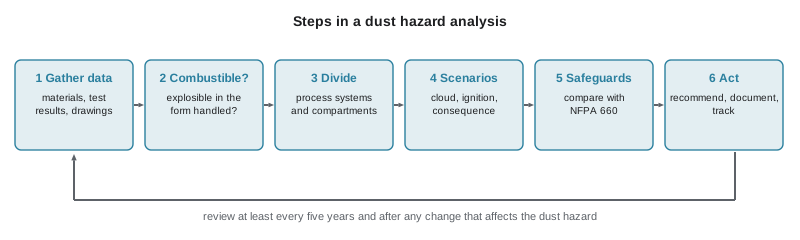
Step 1: Gather material data
Start by listing every combustible solid material handled, generated or stored, including raw materials, intermediates, products, wastes and dust generated by cutting, sanding or grinding. For each one, collect explosibility data from testing of representative samples, as described in Lesson 3. Where test data are not available and the material is not well characterized, NFPA 660 requires the material to be either tested or assumed to be combustible. Record the particle size, moisture content and the source of the data. Also gather drawings, equipment lists, process flow diagrams, previous incident reports, inspection findings, insurance surveys and any earlier hazard studies.
Step 2: Decide whether the dust is combustible or explosible
If testing shows that a material is not combustible or not explosible in the form handled, the analysis can document that and focus elsewhere. Remember that a material can change. A material that is coarse and moist when it arrives may become fine and dry after milling or drying. The analysis must consider the material in the condition in which it actually exists at each point in the process.
Step 3: Divide the facility into systems and compartments
Break the facility into manageable parts. Process systems are groups of connected equipment, such as a receiving and storage system, a milling system, a drying system, a conveying system, a packaging line and a dust collection system. Building compartments are rooms or enclosed spaces separated from each other, such as a mill room, a packing room, a warehouse and a basement conveyor gallery. Each process system is analyzed for hazards inside the equipment, and each building compartment is analyzed for hazards from dust that escapes into it.
Step 4: Identify hazard scenarios
For each system and compartment, ask where a dust cloud could form, what could ignite it, and what would happen if it did. Inside equipment, clouds usually exist during normal operation, so the questions focus on ignition sources and on what happens when an explosion occurs: could it rupture the equipment, injure people nearby, or travel through ducts and conveyors to other equipment or into the building? In building compartments, the questions focus on how much dust escapes, how much accumulates, and whether a primary event could lift enough dust to cause a flash fire or secondary explosion. Fire hazards such as smoldering in collectors, dryers and silos must also be considered.
| Area | Typical questions |
|---|---|
| Inside equipment | Is an explosible cloud present? What ignition sources could enter or occur? What pressure could develop? Is the equipment vented, suppressed or strong enough? Is it isolated from connected equipment? |
| Connections | Can flame or pressure travel through ducts, chutes, conveyors or return air lines? Are isolation devices present and maintained? |
| Building compartments | Where does dust escape? How fast does it accumulate? Are layers kept below the accepted criteria? Are hidden surfaces inspected? |
| Ignition control | Are hot work, electrical equipment, hot surfaces, static and mechanical sparks controlled? |
| Management systems | Are there procedures for housekeeping, inspection, maintenance, training, management of change and emergency response? |
Step 5: Evaluate existing safeguards
For each scenario, list the safeguards already in place and judge whether they are adequate. Safeguards may prevent the event, such as spark detection and extinguishing in a duct, magnetic separators to remove tramp metal, bonding and grounding, and housekeeping. Others mitigate the consequences, such as explosion vents, suppression systems, isolation valves, chemical isolation barriers, and building separation. Compare what is in place with the requirements of NFPA 660 and related standards such as NFPA 68 and NFPA 69. Where a safeguard exists but is not inspected, tested or maintained, it should not be given full credit.
Step 6: Recommend, document and track
Where safeguards are inadequate, recommend specific actions. Good recommendations are clear, practical and assigned to an owner with a target date. Document the analysis, including the data used, the method, the team members and their qualifications, the systems and compartments reviewed, the scenarios, the safeguards and the recommendations. Track recommendations through to completion. A DHA with a long list of open recommendations provides little protection, and it may become evidence against the employer if an incident occurs.
Worked problem
A DHA entry for a flour mill
In an invented flour mill, a pneumatic conveying line carries flour from the mill to a receiving bin. The bin has a vent filter on top and sits in the packing room. Test data for the flour show Kst of 110 bar·m/s and MIE of 50 mJ. The bin has no explosion vent. Write a DHA entry for the bin.
Show solution
- Hazard: an explosible flour cloud exists inside the bin during filling.
- Credible ignition sources: tramp metal sparks from the mill, smoldering material carried by the conveying air, and static from ungrounded parts.
- Consequence: an explosion could rupture the bin in an occupied packing room and lift settled dust, causing a secondary explosion.
- Existing safeguards: magnet upstream of the mill and grounded piping; no explosion protection on the bin and no isolation on the inlet line.
- Recommendations: have a qualified engineer design explosion protection for the bin (for example a vent ducted to a safe outdoor location or suppression), add isolation on the inlet, and confirm that dust in the packing room is kept below accumulation criteria.
Answer: The bin is unprotected in an occupied room. Recommend engineered explosion protection, inlet isolation and housekeeping verification, each assigned to an owner with a date.
Who should do the DHA
NFPA 660 requires the DHA to be performed or led by a qualified person. Such a person has the knowledge, training and experience to understand combustible dust hazards, the process and the relevant standards. In practice, a good DHA team includes the qualified leader, people who operate and maintain the equipment, an engineer who understands the process, and someone who knows the facility's history. Operators and maintenance staff often know where dust escapes, which machines run hot, and which safeguards are bypassed, which is information no drawing can provide.
Ranking risks
Many DHAs use a simple risk matrix to set priorities, combining an estimate of likelihood with an estimate of severity. HSE-223 covers risk matrices in detail. For combustible dust, severity is often high because explosions can kill, so the main differences between scenarios lie in the likelihood and in how many people are exposed. A quick ranking helps a facility decide what to fix first, but it is not a substitute for meeting the requirements of the applicable standards.
# Simple DHA risk ranking (illustrative 1-5 scales)
scenarios = [
    ("Bin explosion, no vent, packing room occupied", 3, 5),
    ("Collector fire spreading to building via duct", 3, 4),
    ("Secondary explosion from beam accumulations", 2, 5),
    ("Flash fire during manual bag dumping", 3, 3),
    ("Hot residue in dryer after shutdown", 2, 3),
]
ranked = sorted(scenarios, key=lambda s: s[1] * s[2], reverse=True)
for name, likelihood, severity in ranked:
    score = likelihood * severity
    level = "high" if score >= 12 else "medium" if score >= 6 else "low"
print(f"{score:2d} {level:6s} {name}")15 high Bin explosion, no vent, packing room occupied 12 high Collector fire spreading to building via duct 10 medium Secondary explosion from beam accumulations 9 medium Flash fire during manual bag dumping 6 medium Hot residue in dryer after shutdown
Keeping the DHA current
A DHA is a living document. NFPA 660 expects it to be reviewed and updated at least every five years. It must also be updated whenever a change could affect the dust hazard, such as a new raw material, a new piece of equipment, a change in production rate, a change in particle size, a modification to the dust collection system, or a change in building layout. This is where management of change, covered in HSE-311, links to dust safety. The 2012 BC sawmill explosions showed what can happen when the raw material changes but the hazard assessment does not.
Worked problem
Deciding whether a change triggers a DHA update
A woodworking plant plans three changes: replacing a worn sander with an identical model, adding a new CNC router connected to the existing dust collector, and switching from kiln-dried hardwood to medium-density fiberboard for some products. Which changes should trigger a DHA review?
Show solution
- Like-for-like replacement of the sander does not change the hazard, though it should go through normal maintenance checks.
- Adding a router to the collector changes airflow, dust load and the connected volume, so the collection system part of the DHA must be reviewed.
- Switching to fiberboard changes the material and produces very fine dust, so the material data and the hazard scenarios must be reviewed and new samples tested.
Answer: The router and the material change both trigger a DHA review; the like-for-like sander replacement does not.
Common weaknesses found in DHAs
Regulators and insurers often find the same weaknesses. Some DHAs analyze the equipment but ignore the building compartments. Others rely on generic data rather than testing the facility's own dust. Some are written by a consultant who never spoke to operators, so the analysis does not reflect how the plant actually runs. Recommendations may be vague, such as improve housekeeping, without saying what, where or how often. Many DHAs are completed once and never updated. The best protection against these weaknesses is to treat the DHA as a working tool that the facility owns, reviews and acts on.
Common mistakes
MistakeAnalyzing only the process equipment and ignoring the rooms around it.
InsteadAnalyze both process systems and building compartments, including hidden spaces.
MistakeWriting vague recommendations such as improve housekeeping.
InsteadWrite specific recommendations with an owner, a date and a measurable outcome.
MistakeGiving full credit to a safeguard that is never inspected or tested.
InsteadCredit only safeguards that are maintained, inspected and tested.
MistakeCompleting the DHA once and filing it.
InsteadReview it at least every five years and whenever a change affects the dust hazard.
MistakeLeaving operators and maintenance staff out of the analysis.
InsteadInclude people who know how the equipment actually runs and where dust escapes.
Summary and key terms
- A DHA systematically identifies dust fire, flash fire and explosion hazards, evaluates safeguards and recommends improvements.
- NFPA 652 set a 7 September 2020 deadline for existing facilities; NFPA 660 carries the requirement forward.
- The analysis covers both process systems and building compartments.
- Material data should come from testing representative samples, or the material should be assumed combustible.
- The DHA must be performed or led by a qualified person, ideally with operators and maintenance staff on the team.
- Recommendations should be specific, assigned and tracked to completion.
- Review the DHA at least every five years and whenever a change affects the hazard.
- Dust hazard analysis
- A systematic review of combustible dust fire, flash fire and explosion hazards and their safeguards.
- Qualified person
- A person with the knowledge, training and experience to lead a DHA.
- Process system
- A group of connected equipment that handles material, analyzed for hazards inside it.
- Building compartment
- A room or enclosed space analyzed for hazards from dust that escapes into it.
- Safeguard
- A measure that prevents a hazardous event or reduces its consequences.
- Prevention safeguard
- A safeguard that stops a cloud or ignition from occurring.
- Mitigation safeguard
- A safeguard that limits the consequences if an event occurs.
- Management of change
- A procedure for reviewing the hazards of a change before it is made.
- Risk matrix
- A tool that combines likelihood and severity to rank hazards.
- Recommendation tracking
- Following each DHA action to completion and recording when it is closed.
Practice problems
Work each problem on paper first, then reveal the answer to check.
What is the purpose of a dust hazard analysis?
Show answer
To identify dust fire, flash fire and explosion hazards, evaluate safeguards and recommend improvements.
Who must perform or lead a DHA?
Show answer
A qualified person.
What two kinds of areas must a DHA analyze?
Show answer
Process systems (inside equipment) and building compartments.
What should be done if a material has not been tested?
Show answer
Test it or assume it is combustible.
How often must a DHA be reviewed?
Show answer
At least every five years and whenever a change affects the dust hazard.
Give two examples of prevention safeguards.
Show answer
Magnetic separators, spark detection, bonding and grounding, housekeeping.
Give two examples of mitigation safeguards.
Show answer
Explosion vents, suppression systems, isolation devices, building separation.
Why include operators on the DHA team?
Show answer
They know where dust escapes, which machines run hot and which safeguards are bypassed.
What makes a good DHA recommendation?
Show answer
It is specific, practical, assigned to an owner and has a target date.
A plant switches from hardwood to fiberboard. Does the DHA need review?
Show answer
Yes; the material and dust characteristics change, so data and scenarios must be reviewed.
Lesson quiz · 5 questions
Score 60% or more to complete this lesson.
Create a free account to save your progress, take quizzes and earn a certificate.