
HSE-313 · Lesson 2 of 12 · 28 min
The dust explosion pentagon and secondary explosions
Most workers learn the fire triangle early in their training: fuel, oxygen and heat. Remove any one side and a fire cannot start or continue. A dust explosion needs those three elements and two more. The dust must be dispersed as a cloud, and the cloud must be confined. Together these five elements make up the dust explosion pentagon. Understanding the pentagon is the key to understanding every control in this course, because each control works by removing or limiting one or more of its sides.
From the fire triangle to the pentagon
The fire triangle explains a fire in a pile of sawdust or a smoldering layer in a dryer. The fuel is the dust, the oxygen comes from the air and the heat comes from an ignition source. That fire can be serious, but it burns at the surface of the pile and spreads relatively slowly. Adding dispersion turns the fire triangle into a fire tetrahedron of a different kind: when the same dust is suspended as a cloud, every particle is surrounded by air and the whole cloud can burn in a fraction of a second. In the open, this produces a flash fire, which can still kill or badly burn anyone caught in it. Adding confinement completes the pentagon. When a burning cloud is inside a duct, a vessel, a room or a building, the hot combustion gases expand faster than they can escape and the pressure rises. That pressure rise is what we call an explosion.
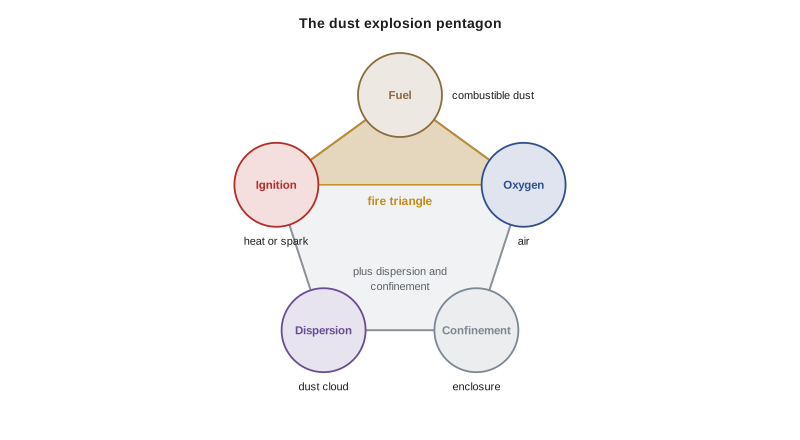
| Element | What it means | Typical ways to control it |
|---|---|---|
| Fuel | Combustible dust fine enough to burn rapidly | Keep dust inside equipment, clean up fugitive dust, substitute or wet the material where practical |
| Oxygen | Usually the oxygen in air | Inert the process with nitrogen or carbon dioxide where it is practical and safe |
| Ignition | Any source of enough energy or heat | Control hot work, sparks, hot surfaces, static and electrical equipment |
| Dispersion | Dust suspended as a cloud | Avoid blowing down with compressed air, keep layers thin so they cannot form a cloud |
| Confinement | An enclosure that lets pressure build | Vent, suppress, contain or isolate so an explosion cannot damage people or spread |
Fuel: the dust itself
Not every dust is combustible, and not every combustible dust is equally dangerous. Sand, cement and most mineral dusts do not burn. Organic dusts such as flour, sugar, wood and plastics do, and so do many metal dusts. Particle size matters greatly. In general, the finer the dust, the easier it is to ignite and the more violently it burns. A useful way to see why is to compare surface area with volume. When you halve the diameter of a particle, its volume falls by a factor of eight but its surface area falls only by a factor of four, so the surface area per unit mass doubles. Combustion happens at the surface, so finer particles release heat faster.
Older codes and guidance often used a particle size cut-off, such as particles passing through a fine sieve, to decide whether dust was a concern. Current NFPA guidance treats any particle that can present a flash fire or explosion hazard as combustible dust regardless of size, because larger particles can break down during handling, and because a small fraction of fines mixed into coarse material can still make a cloud explosible. Flat or fibrous particles such as wood fibers and flock can also be hazardous even when they would not pass a sieve. When in doubt, test.
Worked problem
Surface area and particle size
For spherical particles of a given material, specific surface area (surface area per unit mass) is proportional to 1/d, where d is the particle diameter. A dust has a median particle size of 400 micrometers. After grinding, the median size is 50 micrometers. By what factor has the specific surface area increased, and what does that mean for the hazard?
Show solution
- Specific surface area is proportional to 1/d, so the ratio is d_before / d_after.
- The ratio is 400 / 50 = 8.
- The ground dust has about eight times the surface area per kilogram.
- More surface area means faster heat release, easier ignition and a more violent explosion if a cloud forms.
Answer: About eight times more surface area per unit mass. Grinding has made the dust much more hazardous, so the dust hazard analysis should be reviewed.
import math

# Specific surface area of spheres: S/m = 6 / (rho * d)
rho = 1500.0  # kg/m3, an illustrative density for an organic powder
for d_um in [500, 200, 100, 50, 20, 10]:
    d = d_um * 1e-6
    ssa = 6.0 / (rho * d)  # m2 per kg
    print(f"d = {d_um:4d} um  ->  {ssa:8.0f} m2 per kg")
print()
print("Halving the diameter doubles the surface area per kilogram.")d = 500 um -> 8 m2 per kg d = 200 um -> 20 m2 per kg d = 100 um -> 40 m2 per kg d = 50 um -> 80 m2 per kg d = 20 um -> 200 m2 per kg d = 10 um -> 400 m2 per kg Halving the diameter doubles the surface area per kilogram.
Oxygen
The oxygen in ordinary air is the oxidant in almost every dust explosion. Most combustible dusts cannot sustain a flame below a certain oxygen concentration, called the limiting oxygen concentration (LOC). Some processes, such as certain mills, dryers and pneumatic conveying systems, are inerted with nitrogen or carbon dioxide to keep oxygen below the LOC with a safety margin. Inerting can be very effective, but it creates its own hazard: an oxygen-deficient atmosphere that can kill a worker who enters or opens the equipment. Inerting must therefore be combined with oxygen monitoring, interlocks and confined space controls. Confined space entry is covered in HSE-211. For most facilities, oxygen cannot be removed from the workroom, so the other sides of the pentagon must carry the load.
Ignition
Dust clouds can be ignited by open flames, welding and cutting sparks, hot surfaces, friction and impact sparks from tramp metal, overheated bearings, electrical arcs, static discharges and smoldering material carried into a cloud. Settled layers can also ignite on hot surfaces at temperatures lower than those needed to ignite a cloud, and the smoldering layer can then become an ignition source for a cloud. Lesson 9 covers ignition sources in detail, and Lesson 10 covers electrical equipment for dusty locations.
Dispersion
A layer of dust on a floor cannot explode. It must first be lifted into the air. Inside equipment such as mills, dryers, cyclones, dust collectors, bucket elevators, mixers, silos and pneumatic conveying lines, the dust is dispersed as part of normal operation. Outside the equipment, dispersion usually needs a disturbance: blowing down with compressed air, a falling bag, a burst bag, a vibrating machine, a door slamming in a draft, or, most dangerously, the pressure wave from a primary explosion. Controls that limit dispersion include cleaning by vacuum rather than compressed air and keeping settled layers too thin to form an explosible cloud when disturbed.
Confinement
Confinement turns a flash fire into an explosion. Equipment such as dust collectors, silos and ducts is highly confining. Rooms and buildings are also confining, and the walls and roofs of most industrial buildings are much weaker than process vessels, so a modest overpressure can collapse them. Removing confinement is rarely possible, but its effects can be managed. Explosion venting lets hot gases escape through weak panels to a safe area. Suppression detects the start of an explosion and floods the vessel with an extinguishing agent before pressure builds. Containment uses equipment strong enough to withstand the explosion. Isolation stops the explosion from traveling through connected ducts and conveyors. Lesson 11 covers these protection methods conceptually.
Primary and secondary explosions
Most fatal dust explosions follow a two-stage pattern. A primary explosion occurs inside a piece of equipment or in a small area where a cloud and an ignition source coincide. That explosion may be small. Its pressure wave and the rush of air it creates shake dust loose from beams, ledges, ducts, light fixtures and the tops of equipment throughout the area. A moment later the flame front reaches this new cloud, which may fill a large part of the building. The secondary explosion that follows is often far larger and more destructive than the first. It can propagate from room to room as long as there is dust to feed it.
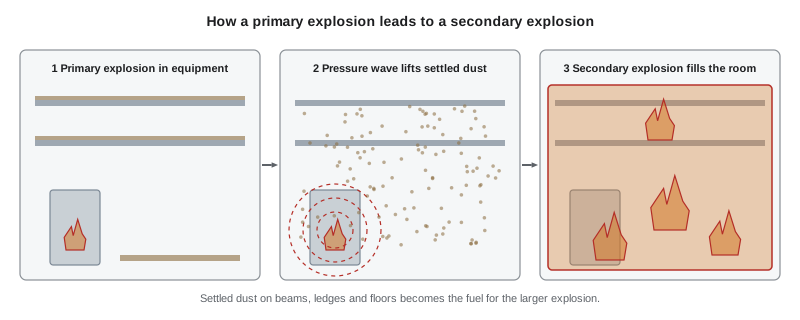
This pattern explains why housekeeping is not a cosmetic issue. The dust on the beams is the fuel for the secondary explosion. A building where accumulations are kept very thin may still suffer a primary explosion inside a collector, but the damage can stay limited to that equipment if it is properly protected. A building with heavy accumulations can be destroyed by the same primary event. In the Imperial Sugar refinery, investigators found that the initial explosion in an enclosed conveyor was followed by secondary explosions that spread through multiple floors and buildings.
Worked problem
Tracing an explosion through the pentagon
In a feed mill, a bucket elevator lifts ground grain. A bearing on the elevator head overheats. Dust inside the elevator casing ignites, and the explosion bursts the casing. Dust layers on the gallery floor and on the roof beams are thrown into the air and a second, larger explosion damages the gallery. Identify each side of the pentagon for both explosions.
Show solution
- Primary fuel: grain dust inside the elevator. Oxygen: air in the casing. Ignition: the overheated bearing.
- Primary dispersion: the elevator buckets keep dust suspended. Confinement: the elevator casing.
- Secondary fuel: dust settled on the gallery floor and beams. Oxygen: room air.
- Secondary dispersion: the pressure wave from the burst casing. Ignition: the flame from the primary explosion.
- Secondary confinement: the gallery walls and roof.
Answer: Both explosions have all five sides. Bearing monitoring would address ignition for the primary; housekeeping would remove the fuel for the secondary.
Hybrid mixtures
A hybrid mixture is a dust cloud that also contains a flammable gas or vapor. Examples include a dryer removing solvent from a powder, coal dust with methane in a mine, or a pharmaceutical granulation using ethanol. Even when the gas concentration is below its own lower flammable limit and the dust concentration is below its minimum explosible concentration, the mixture can still explode. Hybrid mixtures are typically easier to ignite and more violent than the dust alone. Facilities that handle solvents with powders need a specialist assessment. Flammable liquids and vapors are covered in HSE-311 and HSE-312.
Flash fires
Not every dust cloud that ignites is confined enough to cause a damaging overpressure. A cloud that ignites in an open area produces a flash fire. Flash fires last only seconds but can cause severe burns to anyone engulfed. That is why NFPA standards also address flash fire hazards and why flame-resistant clothing is required in some dusty areas. Flame-resistant clothing reduces burn injury but does not protect against overpressure, so it is a last line of defense and not a substitute for preventing clouds and ignition.
Common mistakes
MistakeThinking a dust layer on the floor cannot hurt anyone because it cannot explode as it lies.
InsteadRecognize that a layer becomes a cloud when disturbed, and that a primary event can lift it in an instant.
MistakeUsing only the fire triangle to assess dust hazards.
InsteadUse the pentagon, which adds dispersion and confinement, to understand explosion risk.
MistakeAssuming coarse material is safe because the average particle size is large.
InsteadAccount for fines, attrition during handling and fibrous particles, and test when unsure.
MistakeInerting a vessel and then allowing entry without atmospheric testing.
InsteadTreat inerted equipment as an oxygen-deficient confined space with monitoring and entry controls.
MistakeTreating the primary explosion as the main concern and ignoring the building.
InsteadControl settled dust throughout the building to prevent a larger secondary explosion.
Summary and key terms
- The dust explosion pentagon is fuel, oxygen, ignition, dispersion and confinement.
- Without confinement, a burning dust cloud produces a flash fire rather than a damaging explosion.
- Finer particles have more surface area per unit mass and burn faster; specific surface area is proportional to 1/d.
- Inerting can remove oxygen but creates an asphyxiation hazard that must be managed.
- Primary explosions inside equipment lift settled dust that fuels larger secondary explosions.
- Hybrid mixtures of dust and flammable vapor can explode even when each component is below its own limit.
- Every control in this course works by removing or limiting one or more sides of the pentagon.
- Fire triangle
- The three elements needed for fire: fuel, oxygen and heat.
- Dust explosion pentagon
- Fuel, oxygen, ignition, dispersion and confinement: the five elements needed for a dust explosion.
- Dispersion
- The suspension of dust in air as a cloud.
- Confinement
- An enclosure that allows pressure to build when a cloud burns.
- Specific surface area
- The surface area of particles per unit mass.
- Limiting oxygen concentration
- The oxygen level below which a dust cloud cannot propagate a flame.
- Inerting
- Replacing air with an inert gas to keep oxygen below the limiting oxygen concentration.
- Hybrid mixture
- A mixture of combustible dust and flammable gas or vapor in air.
- Fines
- The smallest particles in a bulk material, which often drive the explosion hazard.
- Overpressure
- Pressure above atmospheric produced by an explosion.
Practice problems
Work each problem on paper first, then reveal the answer to check.
Name the five elements of the dust explosion pentagon.
Show answer
Fuel, oxygen, ignition, dispersion and confinement.
What happens if a dust cloud ignites without confinement?
Show answer
A flash fire, which can cause severe burns but does not produce a damaging overpressure.
A dust is milled from 300 to 30 micrometers. By what factor does specific surface area change?
Show answer
It increases about ten times, since surface area per unit mass is proportional to 1/d.
Why can inerting be hazardous to workers?
Show answer
It creates an oxygen-deficient atmosphere that can asphyxiate anyone who enters or opens the equipment.
Give three ways settled dust can be dispersed outside equipment.
Show answer
Compressed air blowdown, a dropped or burst bag, vibration, drafts or a primary explosion pressure wave.
Why are secondary explosions usually worse than primary ones?
Show answer
They involve far more dust spread over a larger area, often a whole building.
What is a hybrid mixture?
Show answer
A combustible dust cloud that also contains a flammable gas or vapor.
Why can a hybrid mixture be dangerous even below each limit?
Show answer
The combination can propagate a flame when neither component could alone.
Which side of the pentagon does explosion venting address?
Show answer
Confinement, by letting hot gases escape to a safe area before pressure damages the enclosure.
Why does current guidance not rely solely on a particle size cut-off?
Show answer
Coarse material can break down, fines can be present and fibrous particles can be hazardous.
Lesson quiz · 5 questions
Score 60% or more to complete this lesson.
Create a free account to save your progress, take quizzes and earn a certificate.